

When engineers and fabricators first engage with the hot-dip galvanizing process, surface preparation is often the area that generates the most uncertainty. Specifiers familiar with paint systems naturally expect to apply the same surface preparation logic to galvanizing: blast the steel, verify the profile, then coat. But galvanizing behaves differently from organic coatings, and the preparation requirements reflect that difference in a fundamental way.
The misunderstanding runs in both directions. Some fabricators assume no preparation is needed at all and deliver steel to the galvanizer with weld slag, heavy mill coatings, or oil-based markings still on the surface. Others go in the opposite direction, specifying full abrasive blast cleaning across the board when it is rarely warranted. Both approaches can create problems, whether that means rejected work, ungalvanized spots, or unnecessary cost and schedule delays.
The American Galvanizers Association addresses this directly in their article on surface preparation prior to galvanizing. At V&S Galvanizing, we expand on that foundation to explain what is actually happening at the material level, how surface condition influences coating performance and appearance, and why this topic is often misunderstood in the field.
How the Galvanizing Plant Cleans Steel Before Coating
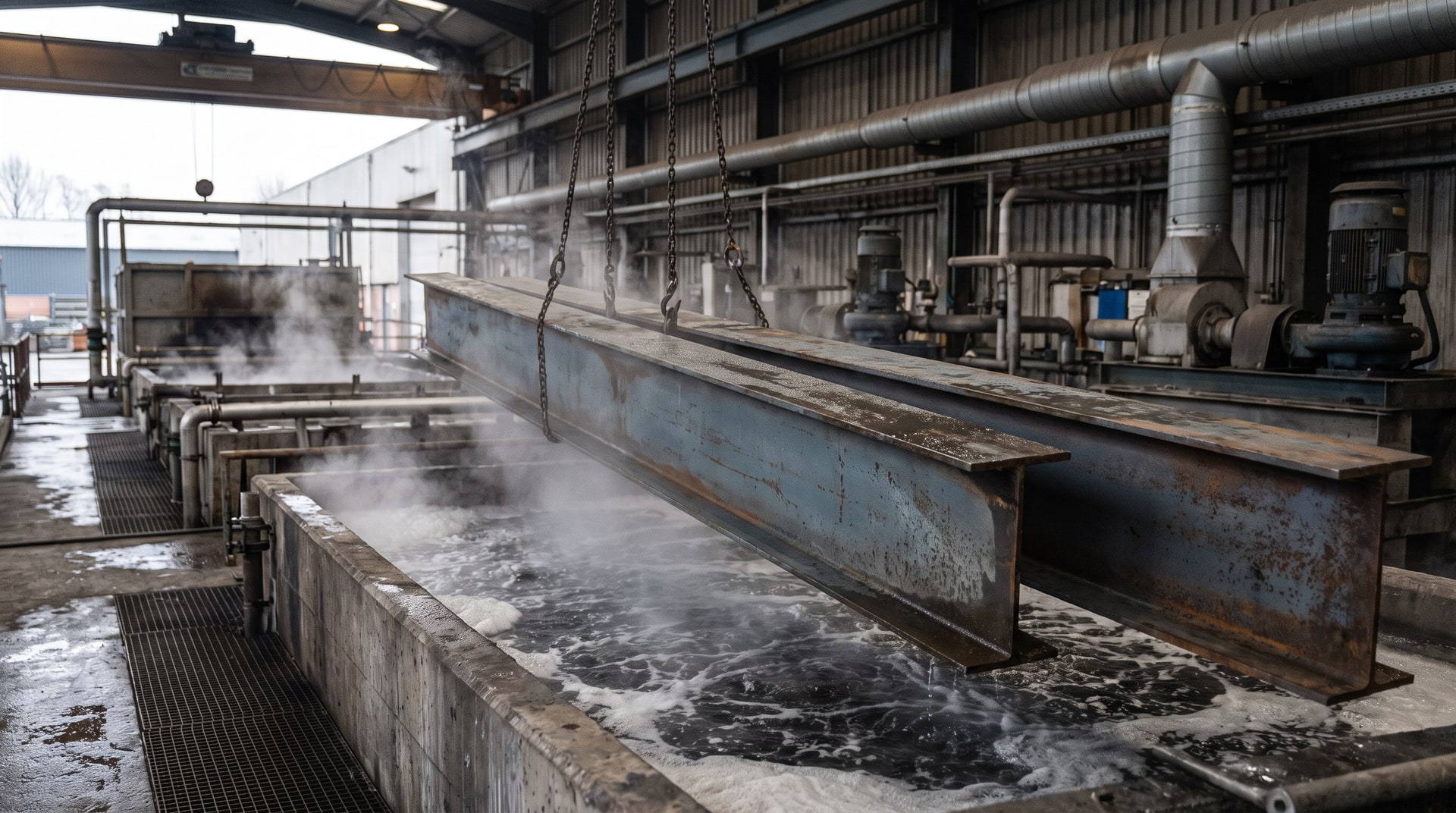
Before any steel enters the galvanizing kettle, it passes through a sequential chemical cleaning process designed to remove the specific categories of contamination that would prevent a metallurgical bond from forming. The process moves in a defined order because each step addresses a different class of surface contaminant.
The first stage is a degreasing bath that removes organic contamination: dirt, grease, oil, and similar residues. Once organics are cleared, the steel moves into an acid pickling bath. This step dissolves mill scale and rust, both of which are iron oxides. Removing oxides is non-negotiable. The galvanizing reaction depends on direct contact between molten zinc and clean iron, and any oxide layer present will block that reaction entirely, leaving bare spots in the finished coating.
The final pre-immersion step is a flux bath. Flux serves two purposes: it prevents the freshly cleaned steel from re-oxidizing during the interval between pickling and galvanizing, and it chemically promotes the zinc-iron diffusion reaction that forms the galvanized coating. Without fluxing, even clean steel would begin developing a new oxide layer from atmospheric exposure, and that thin oxide would compromise coating formation.
This three-stage sequence is why routine surface preparation beyond what the fabricator already performs is not required in the vast majority of projects. The galvanizer's cleaning line handles the work.
Why ASTM Specifications Are Silent on Pre-Galvanizing Surface Prep
Engineers accustomed to paint specifications like SSPC-SP standards are sometimes surprised to find that the primary galvanizing specifications do not contain mandatory surface preparation requirements for the steel before it arrives at the plant. ASTM A123/A123M and ASTM A153/A153M, the two most widely referenced batch hot-dip galvanizing specifications in North America, focus on the inspection requirements and quality thresholds of the finished galvanized product. They do not govern what happens to the steel upstream of the galvanizing plant.
This is intentional, not an oversight. Because the galvanizer controls the cleaning chemistry, the cleaning process itself serves as the preparation stage. The specifications that do address pre-galvanizing fabrication practices are ASTM A143/A143M, A384/A384M, and A385/A385M. These cover design and fabrication considerations, including some surface preparation guidance, but their focus is broader than cleaning chemistry alone. They address things like vent and drain hole placement, which affects how steel can be safely and completely immersed and drained in the cleaning baths as well as in the zinc kettle itself.
The practical implication for engineers specifying galvanized work is that surface preparation requirements should be framed around removing the contaminants that the galvanizer's cleaning line cannot address, not duplicating what the cleaning line already does effectively.
The Contaminants That Actually Require Attention Before Delivery
While the galvanizer's chemical cleaning sequence is effective against oxides, rust, oil, and common grease, certain materials are resistant to or incompatible with the cleaning baths. These are the contaminants that can cause real problems if the steel arrives at the plant still carrying them.
Weld slag and welding flux residues are among the most common culprits. Flux residue left from welding is chemically similar to the scale and deposits that resist acid pickling, and it can adhere tenaciously to weld zones. Weld spatter and anti-spatter compounds create irregular surface conditions that the acid bath may not fully address, and anti-spatter products in particular can contain materials that simply do not dissolve in the cleaning chemistry. Heavy or extremely adherent mill scale presents a similar challenge because the standard acid cleaning bath has limits on how much material it can work through in a reasonable immersion time.
Mill coatings applied to certain types of pipe, including varnishes, lacquers, and protective oils, also fall into this category. So do epoxies, vinyl coatings, and asphalt-based materials. Paint applied with oil-based products, including markers and crayons used during fabrication for identification, will resist the degreasing bath and must be removed beforehand. Very heavy wax or grease deposits, beyond what normal degreasing can handle, are also a concern.
On cast iron and steel castings specifically, sand and other impurities embedded from the casting process cannot be removed chemically. Abrasive blasting is the standard and often necessary solution for castings, and it should be specified as part of the fabrication scope rather than assumed to happen at the galvanizing plant.
How Surface Contamination Shows Up in Coating Appearance
This is where the appearance focus becomes directly relevant. When a galvanized coating develops over a surface that was not fully cleaned, the result is typically visible and often inspectable. Ungalvanized spots, sometimes called bare spots or black spots, are the most obvious outcome. These occur where a contaminant prevented the zinc from contacting and reacting with the base steel. Depending on the size and location, they may require touch-up with approved repair materials, or in severe cases, they can affect acceptance under ASTM A123 or A153 criteria.
Surface roughness also carries over into the coating. If steel arrives with heavy pitting, deep surface damage from advanced corrosion, or rough flame-cut edges that were not dressed, the finished galvanized surface will reflect that roughness. This is not a defect caused by the galvanizing process; it is the galvanized coating faithfully reproducing the underlying surface profile. Excessively pitted or rough steel will develop a coating that looks and measures rough, and in applications where surface smoothness matters for clearance fit or aesthetic requirements, that condition should be addressed during fabrication.
More subtle contamination, such as residual mill coatings or partial weld slag coverage, can produce matte patches, uneven sheen, or discolored zones in the finished coating. These visual variations are not always structurally significant, but they affect the appearance of the product and can raise questions during inspection. Understanding that they originate from surface preparation, not from the galvanizing process itself, helps fabricators trace the cause and address it at the right stage.
Smart Material and Product Selection Can Eliminate the Problem Upstream
Some of the most common surface contamination issues can be avoided entirely through material selection decisions made before fabrication even begins. Using uncoated welding electrodes removes the risk of depositing flux residue that will resist pickling. Specifying pipe that meets standards designating it free of mill coatings, varnishes, lacquers, or protective oils eliminates a category of contaminant that would otherwise require mechanical removal before galvanizing.
Marking materials deserve specific attention. Standard paint markers, wax crayons, and many stamping compounds leave residues that do not dissolve in the cleaning baths. Galvanizing-safe markers are commercially available and are formulated to dissolve in the degreasing and pickling steps. Specifying or requiring their use on fabrication drawings and shop procedures is a straightforward way to prevent a common source of bare spots and surface defects.
These decisions cost little or nothing at the fabrication stage but can prevent rework, schedule delays, and quality disputes at the galvanizing plant. For fabricators who send work to galvanizing regularly, establishing a standard list of approved marking products and electrode specifications is worth the one-time effort.
When Abrasive Blasting Is and Is Not Warranted
A recurring question from engineers and specifiers is whether abrasive blast cleaning should be required as a standard step before galvanizing. The short answer is that blanket blast requirements are generally unnecessary and add cost without proportional benefit when the steel is free of the resistant contaminants described above.
For typical structural steel, plate, bar, and standard rolled sections, the galvanizer's chemical cleaning line is sufficient. Requiring abrasive blasting across all material on a project imposes a cost on the fabricator, can change the surface profile in ways that affect the zinc-iron reaction, and does not improve the chemical bond that forms between zinc and steel during galvanizing. That bond is metallurgical, not mechanical, and it does not depend on blast profile the way a paint bond does.
Where abrasive blasting becomes necessary is when the steel carries contaminants that chemical cleaning cannot remove. Castings are the clearest case: sand inclusions and foundry surface residues require blast cleaning as a matter of course. Steel with very heavy or abnormally adherent mill scale, or with residues from epoxy, asphalt, or similar coatings, may also require mechanical surface preparation before chemical cleaning can be effective. SSPC and NACE provide a range of applicable standards for abrasive blast cleaning, hand tool cleaning, and power tool cleaning that can be specified for these specific conditions.
The practical guidance is to evaluate the actual condition of the steel and the nature of any coatings or residues present, then specify mechanical surface preparation only where the chemical cleaning process would be genuinely insufficient. That approach reduces cost, avoids unnecessary specification complexity, and directs attention to where preparation actually matters.
Structural Condition and Its Relationship to Coating Quality
Surface preparation is not only about cleanliness. The physical condition of the steel also affects both the coating and the integrity of the finished product. Heavily pitted or corroded steel raises two separate concerns that should be addressed before the material arrives at the galvanizing plant.
The first concern is structural. When corrosion has progressed to the point of significant section loss or deep pitting, the engineer of record needs to evaluate whether the remaining cross-section is adequate for the intended application. Galvanizing will protect the remaining steel going forward, but it cannot restore lost section. This evaluation belongs at the design and procurement stage, not at the galvanizing plant.
The second concern is coating quality and appearance. Even structurally acceptable pitted steel will produce a rough galvanized coating that mirrors the surface condition. In most industrial applications this is a performance non-issue, the coating provides the same corrosion protection regardless of surface texture. But for architectural applications, visible structural elements, or any situation where surface smoothness is specified or expected, rough source material is a problem that has to be solved before the steel is galvanized, not after.
Discussing the condition of heavily corroded or pitted material with the galvanizer in advance, rather than discovering the issue after the work is processed, is always the better path. Our team at V&S Galvanizing can help assess whether a given condition is likely to affect coating quality, and we can advise on preparation steps before work arrives at the plant. More information about what our process involves is available on our hot-dip galvanizing services page.
The Built-In Quality Control Logic of the Galvanizing Process
One of the less-discussed aspects of hot-dip galvanizing is that the process itself contains an inherent quality control mechanism. A galvanized coating can only develop if the underlying steel surface is genuinely free of organic contamination, mill scale, and oxides. If any of those are present, the zinc will not wet and react with the steel in that area, and the result is a visible bare spot rather than a coated surface.
This is fundamentally different from paint, where a coating can appear to be applied over a contaminated surface but fail adhesion weeks or months later. With galvanizing, if the coating formed, the surface was clean at the time of coating. This built-in indicator does not eliminate the need for preparation of the specific resistant materials discussed above, but it does mean that the process has a self-revealing character. Coating defects from inadequate surface preparation are visible at inspection, not hidden under an apparently intact coating.
For specifiers and inspectors, this is practically useful. ASTM A123 and A153 include provisions for evaluating the finish of galvanized work, and bare spots or inadequately coated areas are identifiable during visual inspection. The question of what caused the bare spot, whether inadequate cleaning, a resistant contaminant, or another factor, is separate from the inspection finding itself, but tracing the cause back to the pre-galvanizing surface condition is usually straightforward when the right records are kept.
Work With a Team That Understands Preparation From the Start
Surface preparation for hot-dip galvanizing is not complicated, but it does require understanding which steps belong to the fabricator, which belong to the galvanizer, and where the two responsibilities intersect. The galvanizer's chemical cleaning process handles the bulk of what steel needs before entering the zinc bath. The fabricator's responsibility is to ensure that the resistant contaminants, the ones the cleaning line cannot address, are removed before delivery. When both sides of that division of responsibility are understood and followed, the result is a high-quality galvanized coating with the appearance and performance the project requires.
If you are uncertain about the condition of steel you are preparing to send for galvanizing, or if you have questions about whether specific contaminants, coatings, or surface conditions require pre-treatment, we encourage you to reach out before delivery rather than after. Our team can work through those questions with you and advise on the most practical path forward. Use our contact page to get in touch with V&S Galvanizing directly.
Frequently Asked Questions About Surface Preparation Prior to Galvanizing
Does steel need to be abrasive blasted before hot-dip galvanizing?
In most cases, no. The galvanizer's chemical cleaning sequence, which includes degreasing, acid pickling, and fluxing, adequately prepares steel for galvanizing without requiring abrasive blasting. Blasting is typically necessary only when the steel carries contaminants that chemical cleaning cannot remove, such as sand on castings, epoxy coatings, or very heavy adherent mill scale.
What contaminants must be removed from steel before it arrives at the galvanizing plant?
Contaminants that resist the galvanizer's chemical cleaning baths must be removed prior to delivery. These include weld slag and welding flux residues, weld anti-spatter compounds, mill coatings such as varnishes and lacquers on pipe, epoxy and asphalt-based coatings, oil-based paint and markers, wax crayon markings, heavy wax or grease deposits, and sand or foundry residues on castings.
Why do ASTM A123 and A153 not specify surface preparation requirements for steel before galvanizing?
ASTM A123/A123M and A153/A153M govern the inspection and quality requirements of the finished galvanized product. They do not address pre-galvanizing surface preparation because the galvanizer controls the cleaning process. Fabrication-related surface preparation guidance appears in ASTM A143/A143M, A384/A384M, and A385/A385M, which cover design and fabrication practices for steel to be galvanized.
How does surface contamination affect the appearance of the finished galvanized coating?
Resistant contaminants that prevent the zinc from reacting with the base steel produce bare or ungalvanized spots in the finished coating. Partial contamination, such as residual mill coatings or weld flux, can create matte patches, uneven sheen, or discolored areas. Rough or heavily pitted steel will produce a galvanized coating that mirrors that roughness, since the coating follows the surface profile of the underlying metal.
Can galvanizing be applied over rusted or pitted steel?
Routine rust and surface oxidation are removed during the acid pickling step in the galvanizing process, so moderately rusted steel is acceptable. However, steel with heavy pitting or significant section loss from corrosion raises two concerns: the engineer should evaluate whether remaining structural cross-section is adequate, and heavily pitted steel will produce a correspondingly rough galvanized coating. Both issues should be assessed before galvanizing, not after.
What welding practices help avoid surface preparation problems before galvanizing?
Using uncoated welding electrodes eliminates the risk of depositing flux residue that resists acid pickling. Avoiding or minimizing anti-spatter compounds, or using galvanizing-compatible formulations, prevents another common source of resistant surface deposits. Removing weld slag by mechanical means, grinding or chipping, before delivery to the galvanizing plant ensures that weld zones are ready for the cleaning line.
Are there marking products that are safe to use on steel destined for galvanizing?
Yes. Galvanizing-safe markers are commercially available and are specifically formulated to dissolve in the degreasing and acid cleaning baths used in the galvanizing process. Standard paint markers, wax crayons, and many stamping inks are not compatible and must be removed before galvanizing. Specifying galvanizing-safe marking products in fabrication procedures is a straightforward way to prevent bare spots caused by marking residues.
How does the galvanizing process serve as its own quality control for surface cleanliness?
Hot-dip galvanizing can only form a coating where the steel surface is genuinely free of organic contamination, mill scale, and oxides. If any of these are present in a given area, the zinc will not wet or react with the steel there, producing a visible bare spot. This means that wherever a galvanized coating has successfully developed, the underlying metal was adequately clean at the time of coating. Unlike paint, which can appear intact over a contaminated surface and fail later, galvanizing makes surface preparation failures immediately visible at inspection.
