

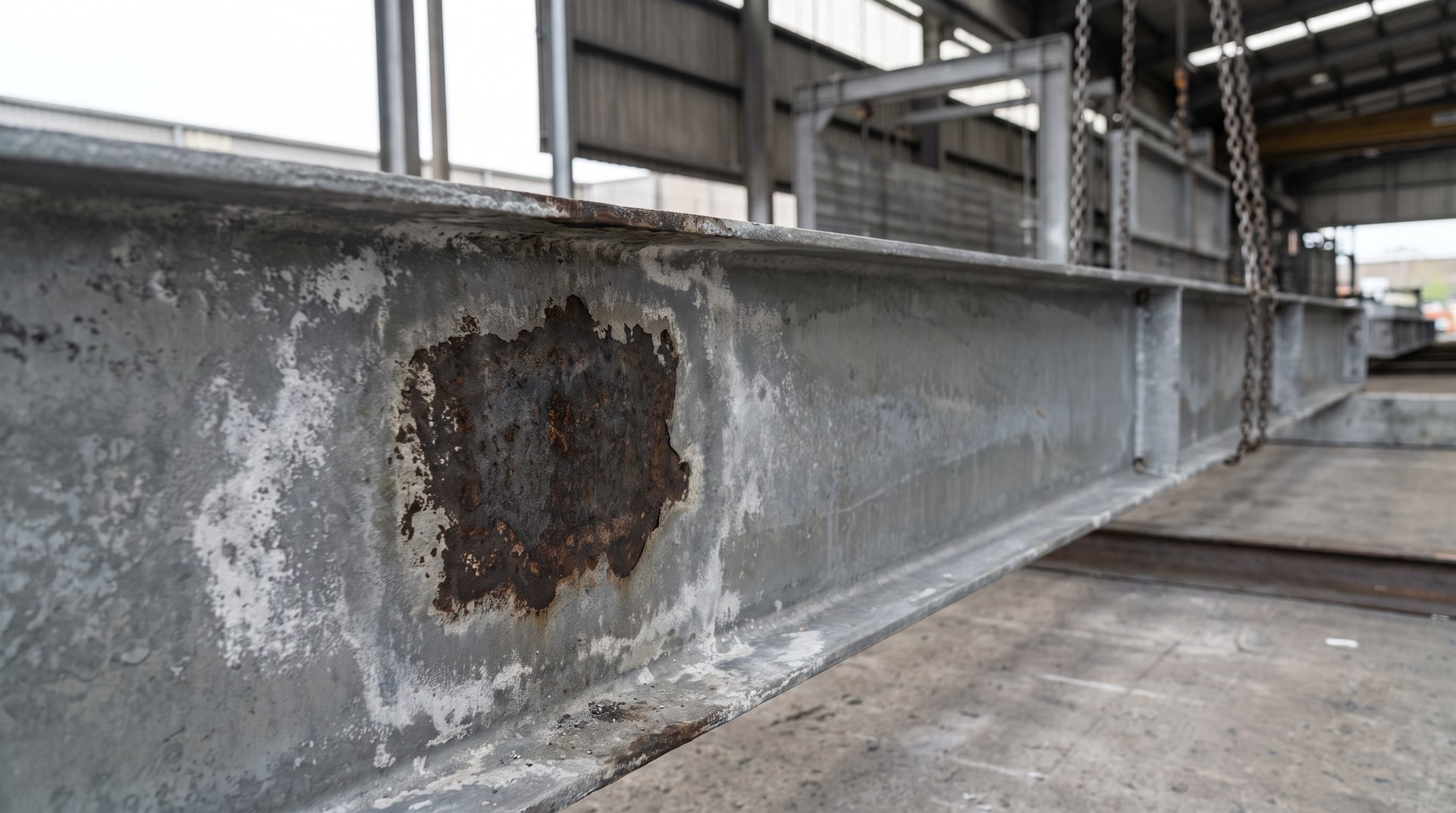
When steel comes out of a galvanizing kettle and there are small uncoated patches on the surface, it is not a random event. Bare spots, by definition, are localized areas where the zinc coating simply did not form. They are a visible signal that something interfered with the metallurgical bonding process, and identifying that interference is the only way to prevent recurrence. For engineers and fabricators who inspect finished parts, understanding what actually causes these spots helps distinguish a cosmetic nuisance from a structural concern, and determines whether repair or regalvanizing is the correct path forward.
The American Galvanizers Association addresses this directly in their article on bare spots. At V&S Galvanizing, we expand on that foundation to explain what is actually happening at the material level, how surface condition and bath chemistry influence coating formation, and why bare spots are often misunderstood in the field.
What a Bare Spot Actually Represents
A bare spot is not simply a thin coating, an area of uneven zinc distribution, or a region where the coating was mechanically damaged after galvanizing. It is an area where the zinc-iron intermetallic layers never formed at all. This distinction matters because the mechanism of hot-dip galvanizing depends on a direct metallurgical reaction between molten zinc and the steel substrate. When that reaction is blocked, the result is bare steel, not a thin coating.
The intermetallic bond that makes galvanized coatings so durable requires clean, reactive steel surface chemistry and unobstructed contact with molten zinc. Any contamination or physical barrier that interrupts that contact at the moment of immersion prevents the reaction from initiating. Once the part is withdrawn from the kettle and the zinc solidifies, there is no second chance for that reaction to occur in the affected area. What remains is bare steel exposed to the atmosphere.
Surface Preparation Failures That Lead to Bare Spots
The most common root cause of bare spots is inadequate surface preparation. The galvanizing pretreatment sequence, which typically includes degreasing, pickling in hydrochloric acid, rinsing, and fluxing, is designed to remove all contaminants and leave a chemically active steel surface ready to react with zinc. If any stage of that sequence fails to fully clean a portion of the surface, zinc will not adhere in that area.
Welding slag is a particularly common culprit. Unlike mill scale or rust, which acid pickling can remove, welding slag is chemically resistant to standard pickling solutions. If a fabricator leaves slag attached to a weld bead and the part enters the galvanizing process without proper slag removal, that area will emerge from the kettle bare. This is one of the primary reasons galvanizers and fabricators are trained to remove all welding slag mechanically before the part arrives at the plant.
Sand embedded in castings presents a similar challenge. Castings often retain sand from the molding process in surface porosity or recessed areas. That embedded sand is not removed by acid pickling and physically prevents zinc from reaching the steel. The result is bare spots that mirror the distribution of the sand contamination, often appearing as scattered small patches rather than a single defined area.
How Lifting Devices Create Localized Bare Zones
Another cause that is sometimes overlooked is the contact point of lifting devices. When parts are suspended for galvanizing using wire, hooks, fixtures, or racks, those attachment points are in direct contact with the steel during immersion. Zinc cannot flow between two surfaces in contact, so a small area at each attachment point may not receive coating. These bare spots are typically very small, circular or linear depending on the fixture geometry, and appear at predictable locations on the part.
In most cases, these contact-point bare spots are minor and fall within acceptable limits under the relevant specification. However, fixture design matters. A fabricator or galvanizer who understands this phenomenon can position fixtures at locations on the part that are less structurally or cosmetically critical, or use the minimum contact area necessary to support the part safely. This is a practical detail that reflects the broader principle that galvanizing quality is influenced at every stage, including how a part is handled.
Excess Aluminum in the Kettle and Bath Chemistry Effects
The chemistry of the zinc bath itself can also produce bare spots. Modern galvanizing kettles often contain small additions of aluminum, typically to improve surface appearance and reduce dross formation. However, when aluminum concentration in the bath exceeds a certain threshold, it interferes with the zinc-iron reaction at the steel surface. Aluminum preferentially reacts with the steel surface and forms an aluminum-iron intermetallic layer that blocks zinc from bonding. The result is an inhibition reaction that produces bare or poorly coated areas.
This is a process control issue that falls within the galvanizer's domain. Maintaining bath chemistry within the correct parameters requires regular sampling and adjustment. When excess aluminum is identified as the cause of bare spots, the corrective action is at the kettle level, not at the fabrication level. Understanding this distinction is important for root cause analysis when bare spots appear on otherwise well-prepared steel.
Identifying and Evaluating Bare Spots After Galvanizing
When bare spots are discovered during inspection, the first task is to characterize them accurately. Not all bare spots trigger automatic rejection. The applicable specification, typically ASTM A123 for structural steel or ASTM A153 for hardware, defines acceptance criteria based on the size of individual bare spots and the total area of bare spots relative to the surface area of the part. Small, isolated bare spots that fall within specification limits may be repaired in the field without rejecting the part.
The evaluation process requires measuring the bare area and comparing it against the specification thresholds. Visual inspection identifies the location and approximate size, but the critical determination is whether the bare spot exposes steel that is genuinely uncoated or whether it is an area of thin but present coating. A bare spot is defined by the absence of coating, which can be confirmed visually by the appearance of bare steel. If there is doubt, a magnetic thickness gauge can help determine whether any zinc layer is present.
The distinction between a bare spot and a thin coating area also has implications for corrosion performance. An area with thin zinc still has some cathodic protection benefit. A genuinely bare spot relies entirely on the zinc immediately surrounding it to provide sacrificial protection through galvanic action. The zinc in the adjacent coating will preferentially corrode to protect the exposed steel, but this protective effect diminishes as the bare area grows larger. Smaller bare spots are therefore less concerning from a service life standpoint than larger ones, which explains why specification limits are tied to size.
Repair Options Under ASTM A780
ASTM A780 is the governing standard for repair of damaged or uncoated areas on hot-dip galvanized steel. When bare spots fall within the size range that permits repair rather than regalvanizing, ASTM A780 identifies several acceptable repair methods. These include the use of zinc-based paint, zinc-rich paint systems, zinc alloy soldering, and thermal spray zinc.
Each method has practical limitations. Zinc-rich paints are the most commonly used repair material in the field because they are easy to apply and require no specialized equipment. However, the corrosion protection they provide is generally considered somewhat lower than that of a continuous hot-dip galvanized coating, because the zinc particles in paint are not in perfect metallic contact with each other or with the substrate in the way that a galvanized coating is. Proper surface preparation of the bare area before applying any repair material is essential: the steel must be clean and free of rust, mill scale, and other contaminants to allow the repair material to bond effectively.
Thermal spray zinc provides a higher-quality repair that more closely approximates the performance of the original galvanized coating. It requires specialized equipment and trained operators, which makes it less common as a field repair method but more appropriate for critical applications or large bare areas approaching the upper limit of what is permitted without regalvanizing.
When the size or total number of bare spots causes rejection under the applicable specification, the part must be stripped of its existing coating, regalvanized, and then re-inspected for compliance. This strips-and-regalvanize process resets the part to a fully coated condition but also adds time and cost to the project. Preventing bare spots through proper surface preparation and bath management is always preferable to addressing them after the fact.
Preventing Bare Spots: What Fabricators Can Do
Several of the root causes of bare spots are controllable at the fabrication stage, before the part reaches the galvanizing plant. Removing welding slag completely is the most important fabrication-side prevention measure. Wire brushing or grinding weld seams is standard practice, but it needs to be thorough. Any residual slag, even small fragments, can produce bare spots.
Castings require particular attention. If sand contamination is known to be present in a casting, the fabricator should communicate that to the galvanizer so that additional pretreatment steps can be considered. In some cases, blasting or mechanical cleaning before acid pickling helps expose embedded contamination and allows pickling to reach clean steel underneath.
Fixture placement is another area where fabricator input matters. Discussing attachment point locations with the galvanizer in advance, especially for parts with appearance requirements or complex geometry, allows both parties to plan fixture positions that minimize the visual or functional impact of any contact-point bare spots. Our team at V&S Galvanizing works with fabricators on this kind of coordination routinely, and it consistently produces better outcomes than addressing bare spots after the fact.
Work With a Team That Understands Coating Integrity
Bare spots are one of the most straightforward galvanizing defects to understand once you know what to look for, but they are also one of the easiest to prevent when fabrication and galvanizing are coordinated properly. The causes are well-defined: surface contamination that resists pretreatment, physical barriers at lifting contact points, and bath chemistry imbalances. The solutions follow directly from the causes. Clean steel, properly managed bath chemistry, and thoughtful fixture placement produce consistent, complete coatings.
When bare spots do occur, the repair path is governed by ASTM A780, and the decision between field repair and regalvanizing depends on the size and distribution of the uncoated areas relative to specification limits. Neither outcome is ideal compared to a fully compliant first-pass coating, which is why prevention remains the priority.
If you are specifying galvanized steel, managing a fabrication project, or working through an inspection question, our team is available to help you work through the details. Reach out to us through our contact page and we will connect you with someone who can address your specific situation.
Frequently Asked Questions About Bare Spots on Galvanized Steel
Can welding slag always be removed by acid pickling before galvanizing?
No. Welding slag is chemically resistant to the hydrochloric acid used in standard galvanizing pretreatment. It must be removed mechanically, by grinding or wire brushing, before the part enters the pickling tank. Leaving slag in place virtually guarantees bare spots at those locations.
How large can a bare spot be before it requires repair or rejection under ASTM A123?
ASTM A123 sets limits on both individual bare spot size and total bare area relative to part surface area. The exact thresholds depend on the part category and the applicable revision of the standard. The key principle is that small, isolated bare spots within the specified limits may be repaired per ASTM A780, while bare spots that exceed those limits require stripping and regalvanizing.
Does a bare spot mean the entire part lacks adequate corrosion protection?
Not necessarily. The zinc surrounding a small bare spot provides cathodic (sacrificial) protection to the exposed steel through galvanic action. The zinc preferentially corrodes to protect the bare area. However, this protection diminishes as bare spot size increases, which is why specification limits tie acceptance criteria to the size of uncoated areas.
What is the difference between a bare spot and a thin-coated area?
A bare spot has no zinc coating whatsoever, meaning the steel surface is directly exposed. A thin-coated area has some zinc present, even if below the minimum thickness requirement. The distinction matters because a thin coating still provides some galvanic protection and may only require a thickness deficiency assessment, while a true bare spot has no coating to contribute to corrosion resistance and requires repair or rejection per the applicable specification.
Why does excess aluminum in the galvanizing bath cause bare spots?
Aluminum at elevated concentrations in the zinc bath preferentially reacts with the steel surface, forming an aluminum-iron intermetallic layer before zinc can bond. This layer inhibits the zinc-iron reaction that forms the galvanized coating. The result is bare or poorly coated areas even on steel that was properly cleaned during pretreatment. Correcting this requires adjusting bath chemistry at the kettle level.
Is zinc-rich paint an acceptable permanent repair for bare spots?
ASTM A780 permits zinc-rich paint as a repair method for bare spots within allowable size limits. It is the most field-accessible option and is widely used. However, the long-term corrosion protection provided by zinc-rich paint is generally lower than that of a continuous hot-dip galvanized coating because the zinc particles in paint do not form the same continuous metallic structure as a galvanized layer. Proper surface preparation of the bare area before applying the paint is essential for the repair to perform as intended.
What should a fabricator do if a casting is suspected to contain embedded sand before galvanizing?
The fabricator should communicate the concern to the galvanizer before the part enters pretreatment. Additional mechanical cleaning, such as blasting, may help remove embedded sand and expose clean steel underneath. If embedded contamination is not addressed before galvanizing, acid pickling will not remove it and bare spots are likely to result. Early coordination avoids costly rework.
When is regalvanizing required instead of a field repair?
Regalvanizing is required when the size of an individual bare spot or the total number and combined area of bare spots on a part causes the part to fail acceptance criteria under the applicable specification, such as ASTM A123. In those cases, the part must be stripped of its existing coating, galvanized again, and re-inspected for full compliance. Field repair using ASTM A780 methods is only permitted when bare spots fall within the specification's allowable limits.
