

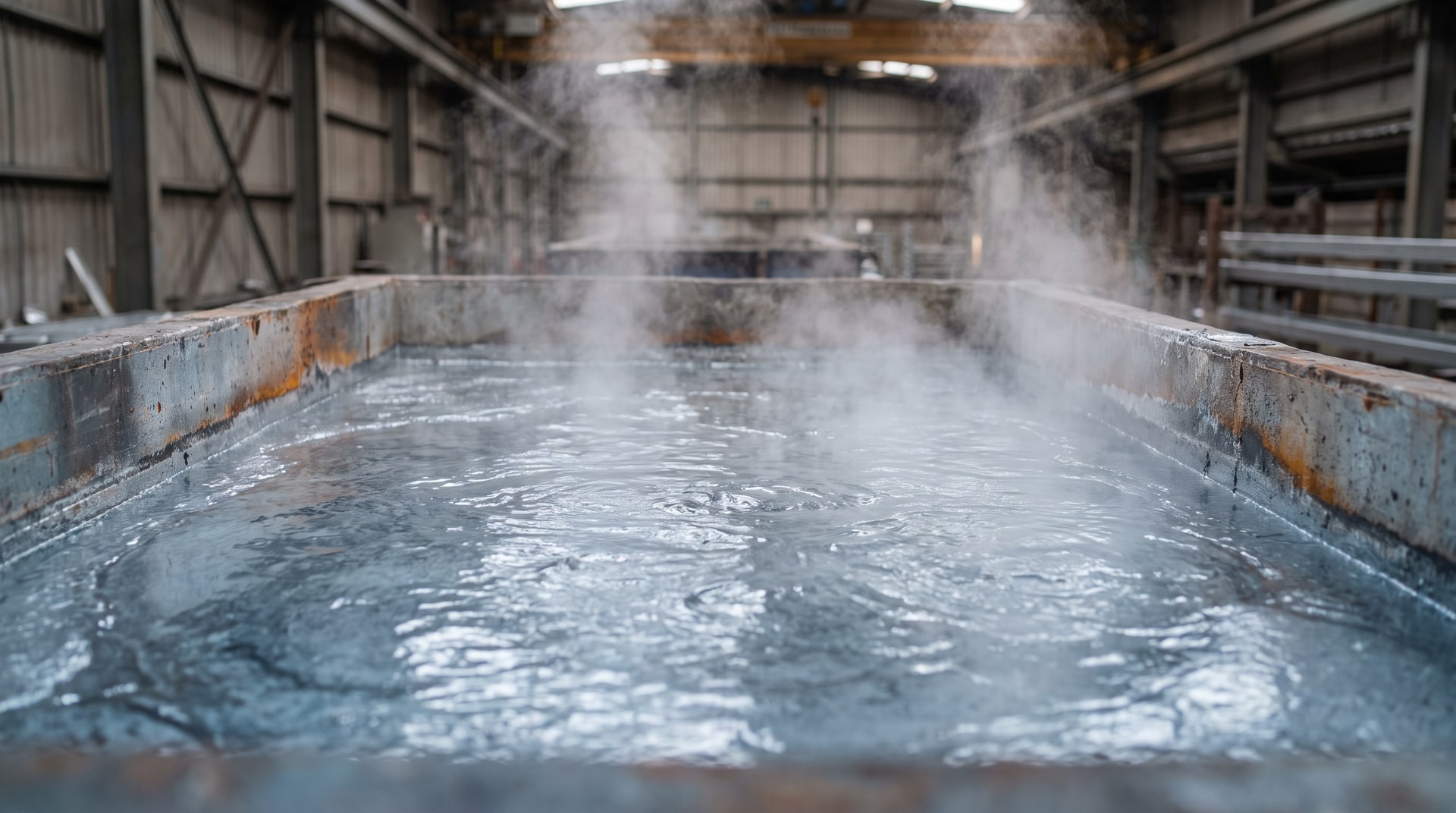
The galvanizing kettle looks simple from the outside: a steel vessel filled with molten zinc held at roughly 840 degrees Fahrenheit. But what is actually in that bath matters a great deal. The zinc itself is specified under ASTM B6 and must be at least 98% pure, but that remaining fraction, along with deliberate alloy additions, plays a significant role in how coatings form, how they look, and how they perform over time. Galvanizers do not simply dump steel into pure zinc and call it done. The bath chemistry is carefully managed, and when something in that chemistry is off, the results show up immediately on the product surface or in the dross accumulation at the bottom of the kettle.
The American Galvanizers Association addresses this directly in their article on alloy additions to the galvanizing kettle and their purposes. At V&S Galvanizing, we expand on that foundation to explain what is actually happening at the material level, how bath chemistry influences coating performance, and why this is often misunderstood in the field.
Why the Zinc Bath Is Never Just Zinc
Pure zinc, by itself, would technically coat steel. But the galvanizing process is not happening under laboratory conditions. Real fabricated steel arrives at the kettle with variation in surface chemistry, weld heat-affected zones, mill scale residue, and a wide range of silicon and phosphorus content in the base metal. The flux applied before immersion introduces its own chemistry. The speed of withdrawal, the geometry of the part, and the operating temperature all interact with the bath.
Alloying elements give galvanizers the ability to tune the bath to real-world conditions. Some additions modify the physical behavior of the molten zinc, making it more fluid so it drains cleanly. Others interact directly with the steel surface to control how intermetallic layers grow. Still others affect the final appearance of the coating. Each addition has a specific mechanism, a useful concentration range, and practical limits beyond which it becomes a liability rather than an asset.
Aluminum: Surface Control and Coating Brightness
Aluminum is lighter than zinc and has a higher melting point, which creates an interesting challenge when it comes to bath management. When added to the galvanizing kettle, aluminum rises toward the surface and forms a thin oxide film on the bath. That film is part of what makes aluminum useful: it creates a cleaner, brighter surface on the finished coating and slightly increases the fluidity of the zinc melt.
The fluidity improvement matters because it helps excess zinc drain off the product and return to the kettle rather than building up as thick drips or runs. For fabricators receiving galvanized parts, this means cleaner geometry on threaded fasteners and a more uniform coating profile across complex shapes.
The challenge is keeping aluminum at the right concentration. A maximum of 0.007% must be maintained in the bath. Above that threshold, aluminum begins to react with the zinc ammonium chloride flux that coats the steel before immersion. That reaction can inhibit wetting and produce bare spots where the zinc simply did not bond to the steel. Because aluminum naturally floats rather than dispersing evenly through the bath, it is typically added as brightener bar and physically plunged beneath the zinc surface to encourage mixing. This is not a set-it-and-forget-it addition. It requires active management throughout operation.
Bismuth: The Fluidity Additive That Stays Put
Bismuth is denser than zinc and has a lower melting point, which means it sinks into the bath and stays there rather than floating or segregating. This stability is one of its primary advantages over aluminum when fluidity is the main goal.
Adding bismuth to the zinc bath increases fluidity in a way that helps prevent some of the most common cosmetic and functional problems seen on complex galvanized parts. Bridged holes, where zinc spans across a small opening and seals it, become less frequent. Clogged threads, a persistent concern on bolts and connection hardware, are reduced. Heavy runs and sags on vertical surfaces are less likely to form when the zinc drains more freely before it freezes during cooling.
Because bismuth is chemically stable in the zinc bath, additions are straightforward. Replenishment is tied to the amount of zinc consumed rather than to a separate monitoring routine, which makes bath management more predictable. For galvanizers processing high volumes of hardware, structural connections, or fabrications with many penetrations, bismuth is a reliable tool for improving drainage and reducing rework.
Lead: Fluidity, Drainage, and the Drossing Advantage
Lead has been part of galvanizing chemistry for a long time. It is denser than zinc, has a lower melting point, and increases the fluidity of the zinc bath in much the same way bismuth does. One grade of zinc specified under ASTM B6, known as prime western zinc, already contains lead as a pre-alloyed constituent, so some galvanizing operations may have lead present without adding it separately.
Beyond fluidity, lead offers a practical benefit during the drossing process. Dross is the mixture of zinc-iron intermetallics that accumulates at the bottom of the kettle over time and must be periodically removed. When lead is present in sufficient quantity, it forms a dense layer at the very bottom of the kettle. Because dross is less dense than lead but more dense than zinc, it tends to float on top of the lead layer rather than distributing throughout the bath. This stratification makes dross easier to collect and remove, which reduces the labor involved in kettle maintenance and helps keep the bath cleaner between drossing cycles.
Lead is stable in the zinc bath and, when already present through prime western zinc, requires no special addition routine. For galvanizers managing kettle maintenance schedules carefully, the lead layer's effect on dross behavior is a meaningful operational advantage.
Nickel: Managing Reactive Steels
Nickel is where bath chemistry becomes most directly tied to steel metallurgy. It is denser than zinc and has a higher melting point. Its primary role in the galvanizing kettle is to control the behavior of reactive steels, specifically those with silicon content that causes accelerated and sometimes uncontrolled intermetallic layer growth.
When certain steels with elevated silicon are galvanized without bath modification, the iron-zinc intermetallic layers grow rapidly and without the normal self-limiting behavior seen in lower-silicon steels. The result is a coating that is thicker than specified, dull gray in appearance, and in some cases more brittle than a standard coating. This is often called the Sandelin effect, and it has frustrated engineers and galvanizers alike for decades.
Nickel additions to the bath help suppress this excessive intermetallic growth. The mechanism involves nickel incorporating into the intermetallic phases in a way that slows the diffusion-driven growth that makes reactive steels problematic. This is effective for steels with silicon levels below 0.20%. However, there is an important caveat on the lower end: steels with silicon below 0.03% may actually produce coatings that fall under the minimum thickness specified by the applicable standard. This is a range where neither pure zinc nor nickel-modified baths guarantee ideal results, and steel selection becomes a real factor in achieving consistent coating performance.
Nickel bath management comes with two significant constraints. First, it must be continuously replenished because it is consumed into the intermetallic layers during the galvanizing reaction. Second, nickel powder, the typical addition form, requires special handling equipment, adding operational complexity. Most critically, a maximum of 0.05% nickel must be maintained in a kettle operating at 440 degrees Celsius (824 degrees Fahrenheit). Exceeding this limit increases dross formation significantly, which creates its own set of problems for coating quality and kettle maintenance. Operating the bath outside this window undermines the very benefits nickel is supposed to provide.
Tin: Appearance Modification and Spangle Development
Tin is denser than zinc but has a lower melting point, and its primary role in the galvanizing kettle is aesthetic rather than structural. Tin is typically used in combination with lead to modify the appearance of the finished coating, specifically by increasing what is called spangle size and contrast.
Spangle refers to the crystalline pattern visible on the surface of a galvanized coating as the zinc solidifies. In a standard coating, this pattern may be subtle or nearly invisible. With tin present at sufficient concentrations, the zinc crystals grow larger and the boundaries between them become more visually pronounced, producing a bright, patterned surface with strong contrast between crystal faces. For some architectural applications or decorative uses, this appearance is specifically desired.
To have a measurable effect on appearance, tin must be present at a minimum of 0.05% in the bath. Below that threshold, the contribution is negligible. Like bismuth and lead, tin is stable when combined with zinc, and additions are calculated based on the amount of zinc in use. Replenishment is predictable and does not require the intensive monitoring that aluminum or nickel demand.
How These Additions Interact With Steel Chemistry and Design
No alloy addition to the kettle operates in isolation. The silicon content of the steel, the geometry of the fabrication, the flux system, and the operating temperature all interact with bath chemistry. A nickel addition that works well for one steel specification may do little for another. An aluminum addition that produces beautiful bright coatings on plate fabrications may create bare spot risks on complex assemblies with deep recesses where flux residue accumulates.
This is why the galvanizing process is not purely mechanical. Understanding bath chemistry means understanding the steel coming into the plant. When fabricators and engineers share material certifications and discuss silicon ranges with their galvanizer early in a project, the result is a better coating with fewer surprises. Our team regularly encounters situations where a steel specification change mid-project, without communication, produces a noticeably different coating appearance or thickness on otherwise identical parts. The bath has not changed, but the steel has, and the interaction between the two is what determines the outcome.
For engineers and detailers working on projects that require specific coating thicknesses or appearance criteria, connecting with the galvanizer during the design phase allows bath chemistry to be taken into account. If the structural steel specified falls in the reactive silicon range, a nickel-modified bath is one tool available, but steel selection is another. Both are worth discussing before fabrication begins. You can learn more about how our process handles these variables on our hot-dip galvanizing services page.
Work With a Team That Understands Bath Chemistry From the Ground Up
Galvanizing quality does not start at the moment steel enters the kettle. It starts with the zinc bath itself, how it is formulated, how additions are managed, and how the chemistry is matched to the steel and fabrication being processed. Aluminum, bismuth, lead, nickel, and tin each contribute something specific to the process, and managing them correctly is part of what separates consistent, high-quality galvanizing from unpredictable results.
At V&S Galvanizing, we maintain our bath chemistry carefully and stay current with the technical guidance established by the American Galvanizers Association and industry standards like ASTM B6. When your project has specific requirements around coating thickness, appearance, or involves steels with unusual silicon content, we want to know about it before fabrication is complete. The earlier those conversations happen, the more tools we have available to get the result right the first time. If you have a project in development or questions about how bath chemistry might affect your specification, reach out through our contact page and we will connect you with someone on our technical team.
Frequently Asked Questions About Alloy Additions to the Galvanizing Kettle
What is the maximum allowable aluminum level in a galvanizing kettle, and why does it matter?
The maximum aluminum level in a galvanizing bath is 0.007%. Above this concentration, aluminum reacts with the zinc ammonium chloride flux used to prepare steel surfaces before immersion. That reaction inhibits the flux from doing its job, which can result in bare spots where zinc fails to bond to the steel. Staying below this threshold is critical for coating continuity.
Why is nickel added to the galvanizing kettle for reactive steels, and what are its limits?
Nickel is added to the zinc bath to control excessive intermetallic layer growth on steels with elevated silicon content. It works by incorporating into the intermetallic phases in a way that slows diffusion-driven growth. It is effective for steels with silicon below 0.20%, but the nickel concentration must not exceed 0.05% at 440 degrees Celsius (824 degrees Fahrenheit) or it will cause excessive dross formation. Below 0.03% silicon, coatings may actually fall under minimum specified thickness even with nickel present.
What does bismuth do that aluminum does not in terms of improving zinc fluidity?
Both aluminum and bismuth increase zinc bath fluidity, but they behave very differently in the bath. Aluminum is less dense than zinc and floats, requiring active management to keep it distributed. Bismuth is denser than zinc, sinks into the bath, and remains stable without segregating. Bismuth also does not risk reacting with the flux system the way aluminum does at elevated concentrations, making it a more straightforward fluidity additive for preventing bridged holes, clogged threads, and zinc runs on complex parts.
How does lead help with kettle maintenance during drossing?
Lead is denser than both zinc and dross. When present in the bath, it settles to the very bottom of the kettle and forms a distinct layer. Dross, which is denser than zinc but less dense than lead, floats on top of this lead layer rather than dispersing throughout the bath. This stratification makes dross collection easier and more complete during maintenance cycles, reducing the amount of dross carried back into the bath during processing.
What tin concentration is required to actually affect coating appearance?
Tin must be present at a minimum of 0.05% in the zinc bath to have a measurable effect on coating appearance. Below that level, tin contributes little to spangle development. At or above 0.05%, tin works together with lead to increase the size and visual contrast of the zinc crystal pattern on the coating surface, producing larger, more pronounced spangles that some architectural and decorative applications specifically require.
Does adding nickel to the bath eliminate reactive steel coating problems entirely?
No. Nickel additions reduce the severity of excessive intermetallic growth on reactive steels, but they do not eliminate all concerns. The effect is reliable for steels with silicon content between approximately 0.03% and 0.20%. Steels below 0.03% silicon may still produce coatings thinner than the specified minimum, and steels with silicon above 0.20% may not respond adequately to nickel additions alone. Steel selection remains an important factor, and communicating material specifications to the galvanizer before fabrication is the most reliable way to anticipate coating behavior.
Why is aluminum difficult to maintain in a zinc bath compared to lead or bismuth?
Aluminum is less dense than zinc, so it naturally rises to the surface of the bath rather than distributing evenly through the melt. This means it must be physically plunged beneath the surface after each addition to encourage mixing, and concentrations must be monitored carefully because the effective amount in the bulk bath may differ from surface measurements. Lead and bismuth are both denser than zinc, so they integrate into the bath without the same tendency to segregate, making their concentrations more stable and predictable over time.
Can multiple alloy additions be used in the same galvanizing bath simultaneously?
Yes. Galvanizing baths can contain combinations of these elements. For example, tin is commonly used alongside lead to modify coating appearance, and bismuth and aluminum are sometimes both present. Each addition serves its own purpose and the concentrations of each must be managed within their respective limits. The interaction between additions and the steel being processed means that bath formulation decisions are made based on the product mix and coating requirements for a given operation, not a single universal formula.
