
When steel is bent after galvanizing, or when it arrives at the galvanizing plant already bent, the zinc coating is put under mechanical stress. That stress is not the same as what happens during tensile loading or simple surface abrasion. Bending introduces localized compression on one face of the steel and tension on the other, and if the coating cannot accommodate that deformation, it will crack, flake, or peel away from the substrate. That failure mode is not cosmetic. A coating that has delaminated at a bend can allow moisture and chlorides direct access to the steel beneath, defeating the purpose of galvanizing entirely.
The American Galvanizers Association addresses this directly in their article on the bending test for hot-dip galvanized coatings. At V&S Galvanizing, we expand on that foundation to explain what is actually happening at the material level, how bend diameter influences coating performance, and why this topic is often misunderstood in the field, particularly when rebar and other fabricated steel components enter the picture.
What the Bending Test Actually Evaluates
The bending test is a mechanical adhesion test. Its purpose is not to measure coating thickness or surface hardness. Instead, it asks a single, practical question: can this coating survive deformation without separating from the steel?
In the context of hot-dip galvanizing, the coating is a metallurgically bonded zinc-iron alloy system. It is not paint sitting on top of the steel surface. The galvanizing process produces a series of intermetallic layers that form between the zinc bath and the steel substrate, and the coating bonds through diffusion rather than mechanical adhesion alone. This distinction matters when you think about bending, because a truly metallurgically bonded coating behaves differently under deformation than an organic coating would.
That said, even a well-formed galvanized coating has limits. The intermetallic alloy layers, particularly the harder inner layers, are relatively brittle compared to the pure zinc outer layer. When a sharp or excessive bend is applied, those layers can fracture. The bending test is designed to catch galvanizing that has not formed correctly, or that was applied to a steel configuration that is incompatible with post-process bending.
The Standard Governing the Test: ASTM A143/A143M
The procedure for conducting the bending test is specified in ASTM A143/A143M, which covers the safeguarding of hot-dip galvanized structural steel against embrittlement. The bending test described within that standard gives inspectors and quality assurance teams a defined, repeatable method for evaluating coating integrity after bending is performed.
Under A143/A143M, the galvanized coating must withstand bending without flaking or peeling. Those two failure modes are the specific criteria being evaluated. Flaking refers to pieces of the coating separating from the steel surface. Peeling is a related but distinct mode where the coating lifts away in larger, continuous sections. Both indicate a breakdown in the bond between the zinc coating and the steel substrate.
It is worth noting that minor cracking visible in the harder intermetallic layers does not automatically constitute a failure under this test. The evaluation centers on whether the coating remains adhered to the base steel, not on whether superficial surface marks appear. This nuance can lead to misunderstandings in the field when inspectors unfamiliar with the standard call out visible surface cracking as a coating failure when no actual delamination has occurred.
Why Bending Sequence Matters: Before or After Galvanizing
The order in which bending and galvanizing occur has significant consequences for how the finished product performs. These are not interchangeable operations, and treating them as such is one of the more common sources of field problems.
When steel is bent after galvanizing, the coating must stretch or compress to follow the deformation. The outer zinc layer has some ductility, but the underlying intermetallic layers do not. This means that post-galvanizing bending, especially to tight radii, is a genuine risk to coating integrity. The bending test exists precisely to validate whether the coating has survived such operations.
Bending before galvanizing is a different scenario. In this case, the steel goes into the zinc bath already in its final shape. The galvanizing process then forms a new coating over the bent geometry, including on the inner and outer faces of the bend. This approach avoids putting the coating under bending stress entirely. However, it introduces its own risk: hydrogen embrittlement and strain-age embrittlement. Cold working steel, which is what bending at ambient temperatures accomplishes, can raise the susceptibility of higher-strength steels to embrittlement when they subsequently pass through a galvanizing bath at temperatures around 840 degrees Fahrenheit. ASTM A143/A143M also provides guidance on managing that risk, which is why it serves as the governing document for both the bending test and broader embrittlement safeguarding.
Rebar: A Case Where the Bend Comes First
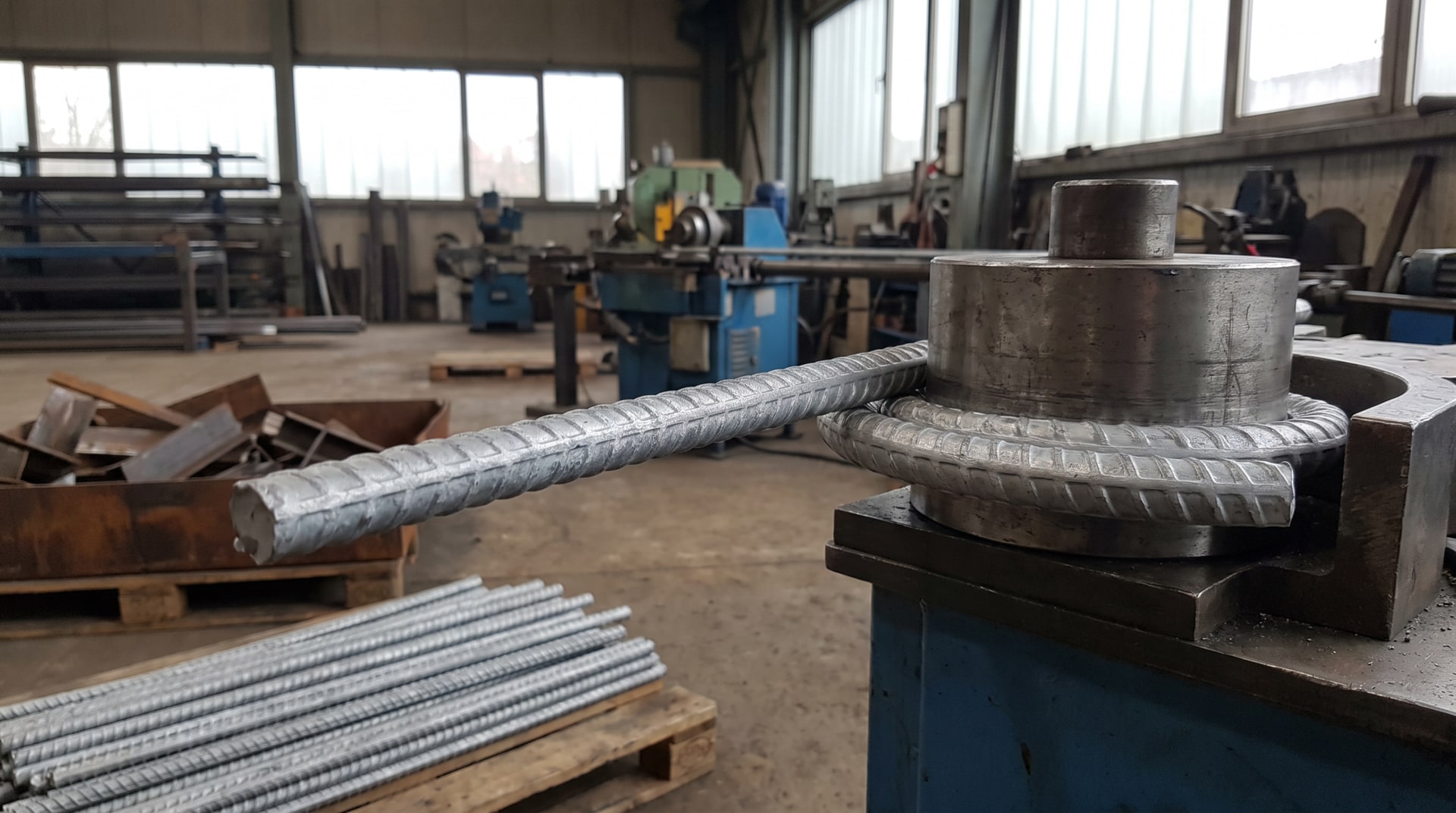
Reinforcing steel bars, commonly called rebar, represent one of the most common applications where bending occurs before galvanizing rather than after. Fabricators routinely bend rebar into hooks, stirrups, and other shapes to meet structural requirements, and those bent bars are then sent to the galvanizing plant for coating.
This sequence, bending cold prior to galvanizing, is standard practice for rebar. But the minimum bend diameter used during fabrication is not arbitrary. ASTM A767/A767M, the specification that governs galvanized steel bars for concrete reinforcement, specifies minimum bend diameters that cold-bent rebar must meet before it is galvanized. The rebar must be fabricated to a bend diameter equal to or greater than the value specified in A767/A767M.
The reason for that minimum diameter requirement comes back to the embrittlement concern mentioned above. Tighter bends concentrate more cold-work strain at the bend location. When the steel then passes through a galvanizing bath, the combination of residual stress from cold working and the thermal exposure of the galvanizing process can lead to cracking or embrittlement at the bend. By requiring a minimum bend diameter, A767/A767M reduces the strain concentration to a level that is compatible with the galvanizing process. Fabricators who ignore this requirement and use tighter bends are not just risking a coating defect. They are potentially compromising the structural integrity of the rebar itself.
What Happens to the Coating at the Bend Location
Understanding the metallurgy of the galvanized coating helps clarify why bends are a stress concentration for the coating and not just for the steel beneath.
A typical hot-dip galvanized coating consists of multiple layers. Moving from the steel outward, you encounter a gamma layer, then a delta layer, then a zeta layer, and finally the eta (pure zinc) outer surface. The inner layers are progressively harder and more brittle than the outer eta layer. The hardness of the zeta layer, for instance, actually exceeds that of the base steel in many cases.
When the coated assembly is bent, those hard inner layers are forced to follow a curved path. They respond by cracking in tension on the outer face of the bend, or by micro-buckling in compression on the inner face. If the coating was formed correctly and the bend radius is not too severe, the outer eta layer can bridge over those micro-cracks and the coating remains continuous and protective. If the bend is too tight, or if the coating has an unusually thick intermetallic layer due to reactive steel chemistry, those cracks can propagate through the full coating thickness and result in the flaking or peeling that the bending test is designed to detect.
This is also why silicon content and phosphorus content in the base steel matter. Steels that fall into certain reactive chemistry ranges produce thicker, more brittle intermetallic layers during galvanizing. Those same coatings are more vulnerable to cracking during bending. Matching the steel specification to the intended fabrication sequence, including any bending, is part of good project planning.
Common Misconceptions About Bending Test Results
In our experience, a few recurring misunderstandings show up when customers or inspectors evaluate bending test results or interpret coating behavior at bend locations.
The first is conflating surface cracking with coating failure. As noted above, superficial cracking in the harder intermetallic layers can be visible under certain lighting conditions without any actual delamination having occurred. The test criterion is flaking or peeling, not the presence of any surface irregularity. Calling a pass as a failure based on visual cracking alone wastes time and generates unnecessary rework conversations.
The second misconception is assuming that a thicker coating is always more durable under bending. In reality, a very thick coating, especially one driven by reactive steel chemistry rather than the bath parameters, may be more brittle and more prone to cracking under bend than a properly formed coating of standard thickness. Thicker is not unconditionally better when bending is involved.
Third, some fabricators assume that pre-bending rebar to any radius is acceptable as long as the coating looks intact afterward. The A767/A767M minimum bend diameter requirement exists precisely because visible coating integrity is not the only concern. The structural behavior of the bar at the bend, especially under load in a concrete structure, depends on the steel not having been overworked during cold bending.
How the Bending Test Fits Into a Broader Quality Program
The bending test is one tool in a broader quality assurance framework for hot-dip galvanized steel. It is not the primary method used on every piece of galvanized steel that leaves a plant. Most routine quality control focuses on coating thickness measurement, which is conducted using magnetic gauges on flat or mildly curved surfaces. The bending test is more specifically applied when bending is part of the fabrication sequence, when there is a question about coating adhesion, or when the applicable specification requires it.
For projects governed by ASTM A123/A123M, the standard covering hot-dip galvanized coatings on iron and steel products, coating thickness and adherence are the primary acceptance criteria. The bending test under A143/A143M becomes relevant when the product has been bent, or when there is reason to evaluate adhesion beyond what visual inspection can confirm.
Fabricators working on galvanized rebar projects should be coordinating with their galvanizing partner early in the design phase. Confirming that rebar bend diameters meet A767/A767M requirements before fabrication begins avoids the costly scenario of discovering non-compliant bends after the steel has already been formed and scheduled for processing. Our team regularly works with fabricators and structural engineers at the planning stage to catch these issues before they become field problems.
Work With a Team That Understands the Full Fabrication Sequence
The bending test might seem like a narrow quality check, but it touches on some of the most important intersections in galvanizing: coating metallurgy, base steel chemistry, fabrication sequence, and structural performance. Getting any one of those elements wrong can compromise the others, and the consequences are not always visible until the structure is in service.
At V&S Galvanizing, we approach every project with an understanding of how the coating will be stressed throughout its service life, including during fabrication. Whether you are working with pre-bent rebar headed into a concrete structure, structural members that need to be adjusted after galvanizing, or fabricated assemblies with complex geometry, the right coordination between design, fabrication, and galvanizing makes a measurable difference in coating performance.
If you have questions about bending requirements, applicable ASTM standards for your specific application, or how to plan a fabrication sequence that protects both the coating and the base steel, reach out through our contact page. We are glad to work through the details with your team before the steel hits the floor.
Frequently Asked Questions About the Bending Test for Galvanized Steel
What does the bending test for galvanized steel actually measure?
The bending test evaluates coating adhesion by determining whether the hot-dip galvanized coating flakes or peels from the steel surface after bending. It does not measure coating thickness. It is conducted according to the procedure in ASTM A143/A143M and is used to confirm that the zinc coating remains bonded to the substrate after the steel has been bent.
What ASTM standard governs the bending test for hot-dip galvanized coatings?
The bending test is performed in accordance with ASTM A143/A143M, which covers safeguarding against embrittlement of hot-dip galvanized structural steel. This standard defines the test procedure and the acceptance criteria, which require the coating to withstand bending without flaking or peeling.
Does rebar need to meet a minimum bend diameter before galvanizing?
Yes. ASTM A767/A767M, the specification for galvanized steel bars for concrete reinforcement, requires that rebar bent cold prior to hot-dip galvanizing be fabricated to a bend diameter equal to or greater than the values specified in that standard. This requirement exists to limit the amount of cold-work strain at the bend and reduce the risk of embrittlement during the galvanizing process.
Is it better to bend steel before or after galvanizing?
Bending before galvanizing avoids putting the coating under bending stress, but it introduces the risk of embrittlement from cold working prior to thermal exposure in the galvanizing bath. Bending after galvanizing preserves the steel but stresses the coating. The appropriate sequence depends on the material, the application, and the applicable specifications. For rebar, bending before galvanizing is standard practice provided the bend diameters comply with A767/A767M.
Can visible surface cracking at a bend be a sign of coating failure?
Not necessarily. The harder intermetallic layers within the galvanized coating can develop surface cracks under bending without the coating actually delaminating from the steel. The bending test criteria under A143/A143M are specifically flaking and peeling, which involve actual separation of the coating from the substrate. Superficial surface cracks that do not result in delamination do not automatically constitute a failure.
Why does steel chemistry affect how the coating performs during bending?
Certain steel chemistries, particularly those with elevated silicon or phosphorus content, react more aggressively with the zinc bath and produce thicker, more brittle intermetallic alloy layers. Those thicker layers are more prone to cracking under bending stress. Steels with reactive chemistries may require closer coordination between the design team and the galvanizer to manage coating brittleness when bending is part of the fabrication sequence.
Does a thicker galvanized coating provide better resistance to bending damage?
Not necessarily. A thicker coating driven by reactive steel chemistry tends to be more brittle, not more ductile, and may actually perform worse under bending than a standard-thickness coating formed on a less reactive steel. Coating thickness alone is not a reliable predictor of bending performance. The composition and structure of the coating layers matter as much as total thickness.
When is the bending test required versus optional?
The bending test is specifically required when the applicable specification calls for it, or when bending is part of the fabrication sequence and coating adhesion needs to be confirmed. It is not a routine check applied to every galvanized product. Most routine quality control relies on magnetic gauge thickness measurements conducted under ASTM A123/A123M. The bending test becomes the relevant evaluation tool when deformation of the coated steel is involved or when adhesion is in question.
