

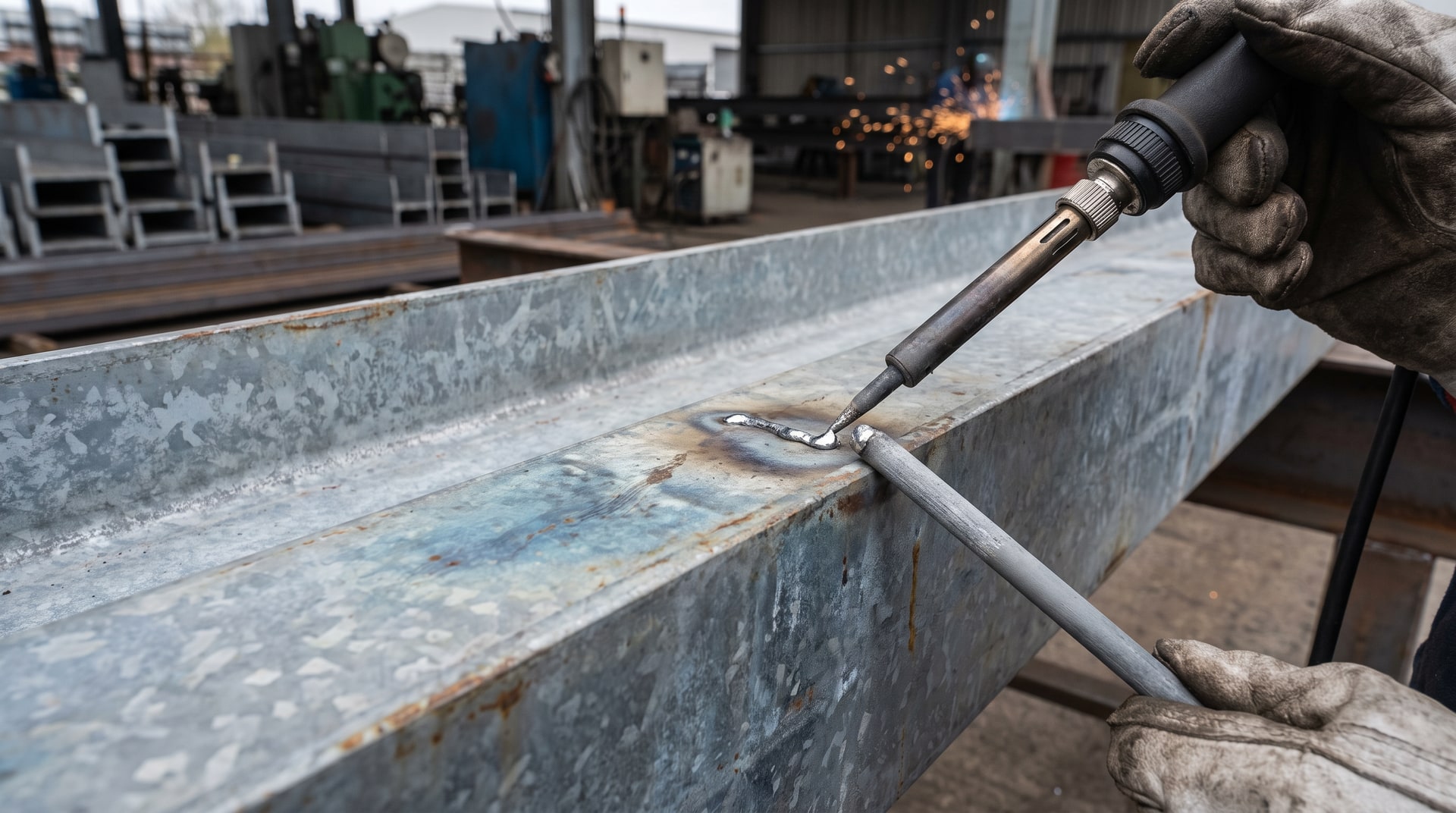
Touch-up and repair are routine parts of life for any fabricated steel assembly that goes through hot-dip galvanizing. Welds get ground after galvanizing, handling damage exposes bare steel, and cut edges need attention before the steel enters service. When those situations arise, the field team needs a fast, reliable solution, and zinc solder rods are often the first tool they reach for. The problem is that not everyone understands what those rods are actually made of, how ASTM governs their use, or why the composition matters to long-term corrosion protection.
The American Galvanizers Association addresses this directly in their article on zinc solder touch-up rods. At V&S Galvanizing, we expand on that foundation to explain what is actually happening at the material level, how alloy composition influences repair performance, and why this topic is often misunderstood in the field.
What the Standard Actually Requires for Touch-Up Materials
ASTM A780 is the governing specification for repair of damaged and uncoated areas of hot-dip galvanized coatings. It covers three accepted repair methods: zinc-based paint, zinc-filled epoxy systems, and zinc alloy soldering rods. What surprises many engineers and fabricators is how much latitude the standard gives when it comes to rod composition.
Unlike zinc-rich paints, which carry a requirement for a minimum zinc dust loading by weight, ASTM A780 sets no equivalent compositional floor for solder rods. The standard does not mandate a specific zinc percentage or a fixed alloy ratio. The only requirement is that the rod material qualifies as a zinc alloy. That is a meaningful distinction. The assumption that a touch-up rod must be primarily zinc, in the same way a zinc-rich paint must carry a certain zinc concentration, is technically incorrect.
This does not mean rod composition is irrelevant. It means the specification intentionally allows for a range of zinc alloy formulations, recognizing that manufacturers may balance other performance factors alongside zinc content. Understanding what that actually looks like in practice requires looking at what the rods contain.
What Modern Lead-Free Rods Contain
Earlier touch-up rods used in the galvanizing industry contained lead as part of their alloy matrix. Lead improved workability and lowered the melting point of the rod, making it easier to apply in the field. As environmental and health standards tightened, the industry moved toward lead-free formulations, and the question naturally arose: do these newer rods still meet ASTM A780?
The answer, confirmed by the AGA, is yes. The lead-free rods do meet ASTM specifications. The composition of these newer rods is notably different from what many people expect. They contain either 39% or 49% zinc, 1% copper, with tin making up the remainder. That means tin is the majority constituent, accounting for roughly 50% to 60% of the rod by weight depending on the formulation.
This surprises a lot of people. If you hand a galvanizing inspector a touch-up rod and ask them to guess the primary metal, most will say zinc. The reality is that these are zinc-tin-copper alloys with tin as the base, not pure zinc or even majority-zinc materials. That does not disqualify them under ASTM A780, but it does have real implications for how they perform and how closely their properties match the surrounding hot-dip galvanized coating.
Why Tin Is the Dominant Component
The practical reason tin dominates in these formulations comes down to processing temperature and workability. Pure zinc melts at approximately 419 degrees Celsius. Hot-dip galvanized coatings on steel are already bonded metallurgically to the substrate, and attempting to apply pure molten zinc to a repair area in the field would require temperatures that risk damaging the surrounding coating, overheating the steel locally, and creating a poor bond at the repair boundary.
Tin dramatically lowers the melting point of the alloy through eutectic behavior. A tin-zinc system with these proportions melts and flows at temperatures well below what pure zinc requires, making field application with a propane or butane torch practical and controllable. The 1% copper addition serves a stabilizing role in the alloy, improving adhesion and helping the material flow into the repair area before it solidifies.
The trade-off is that the electrochemical behavior of the repair material shifts as zinc content decreases. Zinc's protective mechanism for steel is galvanic sacrifice: zinc is anodic to steel, so when both are exposed to an electrolyte, the zinc corrodes preferentially and the steel is protected. A repair material with 39% to 49% zinc still provides meaningful galvanic activity, but the sacrificial capacity is proportionally reduced compared to a material that is 95%+ zinc. This is worth understanding when evaluating how well a touch-up repair will perform over the full service life of the component.
Galvanic Performance of the Repair Versus the Parent Coating
Hot-dip galvanized coatings produced through our process at V&S contain a zinc coating that, at the surface, is essentially pure zinc (the eta layer), underlaid by a series of zinc-iron intermetallic alloy layers that bond metallurgically to the steel. The zinc content throughout the coating system is extremely high, and the galvanic protection it offers is correspondingly robust.
A touch-up rod repair creates a zone of zinc-tin-copper alloy over bare steel. The zinc in that alloy is still anodic to steel, so galvanic protection is present. However, the alloy's electrode potential is slightly different from pure zinc, and the quantity of zinc available per unit volume to sacrifice over time is lower. For small repairs in low-to-moderate corrosivity environments, this is generally acceptable. For large exposed areas or aggressive environments, the performance gap between a solder rod repair and the original galvanized coating becomes more significant.
This is one reason ASTM A780 places practical limits on how much of a galvanized surface can be repaired rather than re-galvanized. The standard and the broader industry guidance treat touch-up as exactly that: a targeted intervention for small, discrete damaged areas. It is not a substitute for proper galvanizing where a structural component has substantial coating loss.
Application Technique and Bond Quality
The effectiveness of a zinc solder rod repair depends heavily on application technique. Composition alone does not determine outcome. The steel surface in the repair area needs to be clean and free of mill scale, rust, paint, or contamination before the rod is applied. Applying the rod to a dirty or oxidized surface will result in a weak bond and a repair that separates prematurely, defeating the purpose entirely.
The torch must bring the substrate to the right temperature range for the rod to flow properly. Too cold and the alloy will not bond or wet the surface adequately; it will ball up and lack adhesion. Too hot and the alloy runs excessively, produces an uneven surface, and may damage the galvanized coating on the surrounding steel. Field technicians need practical experience with these materials to develop reliable judgment about torch distance, dwell time, and rod application angle.
Copper in the alloy at 1% plays a useful role here. It improves wetting behavior and helps the alloy flow more evenly into the repair area before it sets. This is a small but meaningful contribution to repair quality, particularly on vertical surfaces where gravity works against achieving a uniform fill.
Lead-Free Formulations and Regulatory Context
The shift from lead-containing to lead-free touch-up rod formulations reflects broader regulatory pressure and environmental responsibility across the metal finishing industry. Lead was historically used in galvanizing bath chemistry as well, and its gradual removal from both the bath and repair materials has been an ongoing transition over several decades.
From a health and safety standpoint, eliminating lead from repair rods reduces occupational exposure risk for the technicians applying them. Zinc fumes from torch application still require appropriate ventilation and respiratory protection, but removing lead from the alloy eliminates one category of hazard from what is already a controlled-environment operation.
The confirmation that the new lead-free rods meet ASTM A780 is important because it removes any ambiguity about specification compliance. Projects that reference ASTM A780 for repair methods can use these lead-free formulations without any waiver or alternate specification language. The standard's composition-neutral approach to rod qualification made this transition straightforward from a compliance standpoint.
Choosing Between a 39% and 49% Zinc Rod
The two formulations available, one with 39% zinc and one with 49% zinc, offer somewhat different performance characteristics. The higher zinc rod at 49% provides more sacrificial zinc per unit of repair material, which translates to marginally better galvanic protection over time. The difference is not dramatic, but in environments with higher corrosivity, the 49% formulation is the more conservative choice.
The lower zinc formulation at 39% may have slightly different flow and working characteristics given that the tin-to-zinc ratio is higher. Tin-rich alloys tend to be somewhat more fluid when molten, which can be advantageous on complex or irregular surfaces where getting complete coverage in a single pass is difficult.
In practice, the selection between these two formulations often comes down to what the rod supplier provides and what the project or inspector requires. Neither is disqualified under ASTM A780. Where a project specification or engineer of record has stated a preference or requirement, that takes precedence over general field judgment.
When Touch-Up Rods Are the Right Tool and When They Are Not
Zinc solder rods work well for small, localized repairs: weld splatter removal marks, minor handling scrapes, small cut edges, and drilled holes made after galvanizing. They apply quickly, require minimal equipment, and leave a repair that is reasonably durable under normal service conditions.
They are not the right tool for large areas of coating damage, for surfaces that will see continuous immersion in aggressive solutions, or for projects where the engineer has specified a minimum zinc thickness for the repair that the solder rod cannot reliably achieve due to its alloy composition. In those cases, zinc-rich paint or, better, re-galvanizing, are the appropriate paths.
Understanding this boundary is part of using the standard correctly. ASTM A780 provides three options because different repair situations have different requirements. Defaulting to touch-up rods for every repair regardless of area or environment is as problematic as refusing to use them at all. Good engineering judgment, combined with familiarity with what the rod material actually contains and how it performs, leads to repair decisions that hold up in service.
Work With a Team That Understands Coating Repair at the Material Level
Touch-up repair is often treated as an afterthought in the galvanizing process, something handled at the end of the line with minimal attention. In reality, the repair materials used, how they are applied, and whether they are appropriate for the application all affect how well the finished assembly performs over its service life. The composition of zinc solder rods, the flexibility built into ASTM A780, and the shift to lead-free formulations are all details that matter when decisions about repair method are being made under real project conditions.
At V&S Galvanizing, our team is familiar with the nuances of coating repair standards and can help project teams make informed decisions about when touch-up rods are appropriate, which formulation fits the situation, and when a different approach is warranted. If you have questions about galvanizing repair requirements for your next project, reach out through our contact page and we will work through the specifics with you.
Frequently Asked Questions About Zinc Solder Touch-Up Rods
Do zinc solder touch-up rods meet ASTM A780?
Yes. ASTM A780 permits zinc alloy solder rods as an approved repair method and does not specify a minimum zinc percentage for rods, unlike the requirements for zinc-rich paint. Both 39% and 49% zinc lead-free formulations comply with this standard.
What are zinc solder touch-up rods made of?
Modern lead-free touch-up rods contain either 39% or 49% zinc, 1% copper, with tin comprising the remainder. This makes tin the majority constituent in both formulations, which lowers the working temperature and improves field applicability.
Why does ASTM A780 not require a minimum zinc level for touch-up rods?
The standard takes a composition-neutral approach for rods, requiring only that the material qualifies as a zinc alloy. This is intentionally different from the paint requirement because the galvanic and application characteristics of alloy systems vary, and the standard accounts for that flexibility.
How does the galvanic protection of a solder rod repair compare to the original galvanized coating?
A solder rod repair contains less zinc per unit volume than a hot-dip galvanized coating, so its sacrificial capacity is somewhat lower. Zinc in the rod is still anodic to steel and provides real galvanic protection, but the repair is best suited to small, discrete areas rather than large zones of coating loss.
Why is tin the primary metal in lead-free touch-up rods rather than zinc?
Tin reduces the melting point of the alloy, making it possible to apply the material with a standard hand torch without reaching temperatures that would damage the surrounding galvanized coating. Pure zinc's melting point is too high for practical field torch application in most repair scenarios.
Is there a practical difference between the 39% zinc and 49% zinc rod formulations?
The 49% zinc rod provides slightly more sacrificial zinc per unit of repair material, making it the more conservative choice for higher corrosivity environments. The 39% zinc rod has a higher tin ratio and may flow more readily on irregular surfaces. Neither is excluded by ASTM A780.
When should a zinc solder rod not be used for galvanizing repair?
Solder rods are not appropriate for large areas of coating damage, continuous immersion service in aggressive environments, or where a specified minimum repair coating thickness cannot be achieved with the alloy. In those cases, zinc-rich paint systems or re-galvanizing are more suitable.
Are lead-free touch-up rods safer to use than older lead-containing rods?
Yes. Removing lead from the alloy eliminates lead fume exposure as a hazard during torch application. Zinc fumes from the repair process still require appropriate ventilation and respiratory protection, but the overall occupational hazard profile is reduced compared to lead-containing formulations.
