
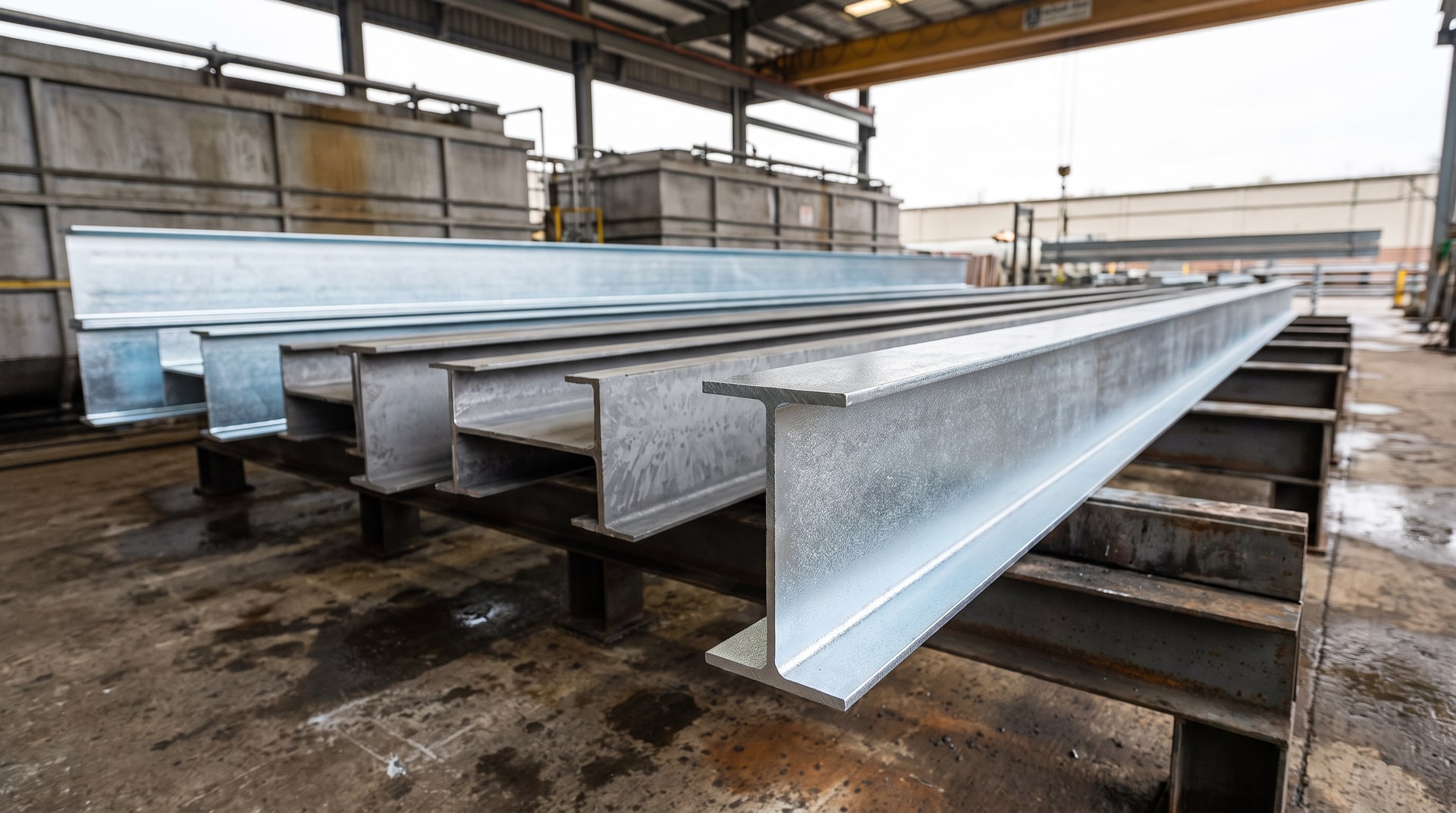
Few topics generate more confusion on a job site than the appearance of freshly galvanized steel. An engineer signs off on a specification, the steel comes back from the galvanizer, and suddenly someone is flagging pieces because one section looks bright and another looks dull, or because there is a mottled pattern across the surface, or a dark gray finish that nobody expected. The instinct is to treat visual difference as a defect. In practice, it rarely is.
Understanding why requires looking at what the specifications actually say, and more importantly, what they deliberately leave out. The American Galvanizers Association addresses this directly in their article on appearance requirements for batch galvanized steel. At V&S Galvanizing, we expand on that foundation to explain what is actually happening at the material level, how steel chemistry and processing influence the final look of a coating, and why color variation is one of the most consistently misunderstood topics in galvanizing specification and inspection.
What the ASTM Specifications Actually Require
Four ASTM standards govern batch hot-dip galvanizing and each contains language about appearance: ASTM A123/A123M, A153/A153M, A767, and A385. The first three share a closely aligned set of requirements, while A385 takes a somewhat different approach.
For A123, A153, and A767, the acceptance criteria for appearance are grounded in function and safety, not aesthetics. A galvanized coating must be free of bare areas, blisters, flux deposits, and gross dross inclusions. Zinc globules or excess zinc that would interfere with the intended use of the product are not permitted. Edge tears or spikes that create handling hazards are not acceptable. Beyond those specific conditions, the specification is intentionally permissive. Projections or minor surface roughness that do not interfere with the intended use of the product are explicitly listed as non-rejectable.
Notice what is absent from that list: there is no mention of color, sheen, mottling, or uniformity of appearance. That omission is not an oversight. It is a deliberate reflection of how galvanizing performance actually works.
Why Color and Appearance Are Not Part of the Acceptance Standard
The practical reason the specifications exclude color variation from rejection criteria is straightforward: color differences do not affect corrosion protection. A matte gray coating and a bright, spangled coating on the same structural member will deliver equivalent service life under equivalent exposure conditions, provided both meet the coating thickness requirements of the applicable specification.
ASTM A385 is the only batch galvanizing specification that directly addresses appearance variation, and it does so to clarify, not restrict. The standard states that hot-dip galvanized coatings are specified for corrosion protection rather than appearance, and that coatings with varied appearances provide equal corrosion protection for all practical purposes. That language exists because fabricators and specifiers occasionally push back on non-uniform finishes, and the standard needed to be explicit about what the coating is actually designed to do.
When we review a coating during inspection, the questions we are answering are: Is there adequate zinc coverage? Are there bare areas? Is there physical damage to the surface that compromises the coating's integrity? Visual color variation answers none of those questions and is therefore not a useful rejection criterion.
The Metallurgical Reason Appearance Varies
To understand why galvanized steel so often displays non-uniform appearance, it helps to understand what the coating actually consists of. Batch hot-dip galvanizing produces a layered structure of zinc-iron intermetallic compounds that form between the steel substrate and the outer zinc layer. The composition, thickness, and growth rate of those intermetallic layers depend heavily on the silicon and phosphorus content of the steel being galvanized.
Steel chemistry drives the visual result more than almost any other single factor. When reactive silicon or phosphorus levels in the steel promote rapid intermetallic growth, the coating may develop a thicker, more uniform intermetallic structure that appears matte gray or dark. When those elements are present at lower concentrations, the intermetallic layers grow more slowly and a free zinc outer layer forms on top, producing the brighter, more reflective finish many people associate with new galvanizing.
When a fabricated assembly uses steel from different heats or different product forms, such as structural shapes welded to flat plate, or tube sections joined to angle, the chemistry of each piece can vary enough to produce dramatically different appearances side by side on the same part. The coating on the angle might look bright and silvery while the adjacent plate appears dull or mottled. Both coatings are performing exactly as intended. The visual difference is a record of the material's chemistry, not an indicator of coating quality.
How Cooling Rate Creates the Shiny-versus-Dull Contrast
Steel chemistry is not the only variable that shapes final appearance. The rate at which a part cools after being withdrawn from the zinc bath also plays a meaningful role. When a part cools quickly, the outer free zinc layer solidifies rapidly before it has time to fully alloy with the underlying intermetallic layers. That rapid solidification preserves a relatively pure zinc outer surface, which reflects light and reads as a bright, shiny finish.
Parts that cool more slowly allow continued diffusion of iron into the outer zinc layer, building up the intermetallic phases closer to the surface and producing a duller, more uniform gray appearance. On a large fabricated assembly, different sections of the same part can cool at different rates. The outer edges of a frame or the thinner sections of a weldment might cool faster than the interior or heavier sections, resulting in one section that is visually bright and another that is visually matte, even though both left the same bath at the same time.
This is not a processing defect. It is a natural consequence of geometry and thermal mass. As the coating weathers over time, these cooling-rate differences in appearance become progressively less noticeable. The zinc surface oxidizes and develops a zinc carbonate patina that gradually equalizes the color across the part toward a uniform, stable gray.
When Fabrication and Mill Processing Leave a Pattern
Occasionally a galvanized part will display a patterned or striped appearance, particularly in tubular products. A tube section may show winding bands of dull gray alternating with brighter areas, following the spiral or linear direction of the tube-making process. This happens because the mechanical stresses introduced during mill processing affect how the steel surface responds to the zinc bath.
Residual stresses in the steel alter the kinetics of intermetallic layer formation. Where stress concentrations are higher, the iron-zinc reaction can be slightly more or less aggressive, producing a locally thicker or thinner intermetallic layer. The result is a visual pattern that mirrors the fabrication process used to form the material. The corrosion resistance of those pieces is unaffected, and they fully meet specification. The pattern is essentially a surface record of how the steel was made.
Touch-Up Materials and What They Mean for Appearance
Touch-up and repair materials applied after galvanizing introduce another layer of visual variability. When a small bare area, handling damage, or a minor surface defect requires touch-up, the materials used, typically zinc-rich paints or zinc-based repair compounds, are not an exact color match for the surrounding galvanized surface. They may appear lighter, darker, or have a different sheen than the adjacent coating.
The specifications are clear on this point: variations in appearance due to touch-up materials are not cause for rejection. The functional purpose of touch-up is to restore corrosion protection to an area where bare steel would otherwise be exposed. It is not intended to replicate the visual characteristics of the original galvanized surface, and specifiers should not expect it to do so.
Over time, as the overall coating weathers, the visual distinction between touched-up areas and the surrounding galvanized surface tends to diminish. The zinc oxide and zinc carbonate patina that forms during weathering creates a more uniform appearance across the whole surface, making earlier variations far less visible.
When a Specifier Can Legitimately Require a Specific Appearance
There is one clear exception to the general principle that color variation is not rejectable: when a galvanizer explicitly agrees to provide a coating with a specific appearance as part of the purchase agreement. This most commonly arises with architecturally exposed structural steel (AESS), where the galvanized surface will be visible in a finished building or structure and aesthetic uniformity has design value.
In those cases, the requirements need to be established before galvanizing begins, written into the purchase order, and agreed upon by all parties. Achieving a consistent appearance often requires careful attention to steel selection, because the chemistry of the base metal is the dominant driver of final appearance. It may also require the galvanizer to process some pieces more than once to reach the desired result. That additional effort carries a cost premium, and both the specifier and the galvanizer need to understand that going in.
Outside of those specifically negotiated situations, the standard specifications do not permit rejection based on appearance variation. A specifier who attempts to reject galvanized steel solely on the basis of color, sheen, or mottling, without any pre-existing agreement about appearance, is operating outside the boundaries of the applicable standard.
Work With a Team That Understands What Quality Actually Looks Like
The appearance requirements built into ASTM A123, A153, A767, and A385 reflect a deliberate, technically grounded philosophy: galvanizing is specified for corrosion protection, and the criteria for evaluating a coating should focus on the factors that actually affect that protection. Bare areas, blisters, flux deposits, gross dross inclusions, and physical hazards like edge spikes are legitimate rejection criteria because they compromise either the coating's integrity or worker safety. Color variation, mottling, and surface sheen are not rejection criteria because they do not compromise either.
What looks like inconsistency on the surface of a galvanized part is almost always a record of the material's chemistry, its thermal history, and its fabrication process. Understanding that relationship helps engineers and specifiers evaluate galvanized steel accurately and avoid disputes that stem from expecting a coating to look a certain way when the specification never required it to.
At V&S Galvanizing, our team works with engineers, fabricators, and contractors throughout the project lifecycle to make sure appearance expectations are aligned with what the specifications actually require before steel arrives at the plant. If you have questions about a specific project's requirements or want to talk through how steel selection might affect your finished coating's appearance, reach out through our contact page and we will connect you with someone who can help.
Frequently Asked Questions About Galvanizing Appearance Requirements
Can a specifier reject hot-dip galvanized steel based on color variation or mottled appearance?
No. ASTM A123, A153, and A767 do not include color, sheen, or mottling as rejection criteria. Rejection based solely on appearance variation is not supported by the applicable specifications unless the galvanizer has specifically agreed in writing to provide a particular appearance, such as for architecturally exposed structural steel.
What does ASTM A123 actually identify as rejectable appearance defects?
ASTM A123 requires that the coating be free of bare areas, blisters, flux deposits, and gross dross inclusions. Zinc globules or excess zinc that interfere with the intended use of the product are not permitted, nor are edge tears or spikes that create handling hazards. Minor surface roughness that does not interfere with the intended use is explicitly non-rejectable.
Why does galvanized steel sometimes look bright on one section and matte gray on an adjacent section of the same part?
This is primarily a result of differences in steel chemistry between the two sections. Silicon and phosphorus content in the steel significantly influence how the zinc-iron intermetallic layers grow during galvanizing. Higher reactive element concentrations tend to produce thicker intermetallic layers and a more matte appearance, while lower concentrations allow a free zinc outer layer to form, which looks brighter. Different steel heats or product forms welded together commonly produce this side-by-side contrast.
Does a dull or dark galvanized finish indicate a thinner or lower-quality coating?
Not necessarily. A matte or darker finish often indicates a thicker intermetallic layer structure driven by steel chemistry, which can actually exceed the minimum coating thickness requirements. ASTM A385 explicitly states that galvanized coatings with varied appearances provide equal corrosion protection for all practical purposes. Appearance alone is not a reliable indicator of coating quality or thickness.
Do touch-up repairs have to match the appearance of the surrounding galvanized surface?
No. Touch-up materials, including zinc-rich paints and zinc-based repair compounds, are not typically an exact color match for the surrounding galvanized coating. The specifications are clear that appearance variations resulting from touch-up are not cause for rejection. The purpose of touch-up is to restore corrosion protection, not to replicate the visual characteristics of the original galvanized surface.
What is the process for specifying a consistent appearance for architecturally exposed galvanized steel?
When a uniform or specific appearance is needed, such as for AESS applications, the requirement must be agreed upon by the galvanizer and written into the purchase order before work begins. Steel selection becomes critical because the base metal chemistry is the dominant driver of final appearance. A price premium typically applies because achieving consistent appearance may require multiple galvanizing cycles or careful material sourcing.
Will the appearance variation in a freshly galvanized coating become less noticeable over time?
Yes. As the galvanized coating weathers, zinc oxide and zinc carbonate compounds form on the surface and develop into a stable patina. This weathering process gradually equalizes the color across the part toward a uniform, dull gray. Variations due to cooling rate differences, steel chemistry, and touch-up materials all tend to become less visually distinct as the coating matures.
Which ASTM galvanizing specification is the only one that directly addresses appearance variation?
ASTM A385 is the only batch hot-dip galvanizing specification that directly addresses variation in appearance or color. It states that hot-dip galvanized coatings are specified for corrosion protection rather than appearance, and that coatings with varied appearances provide equal corrosion protection for all practical purposes.
