

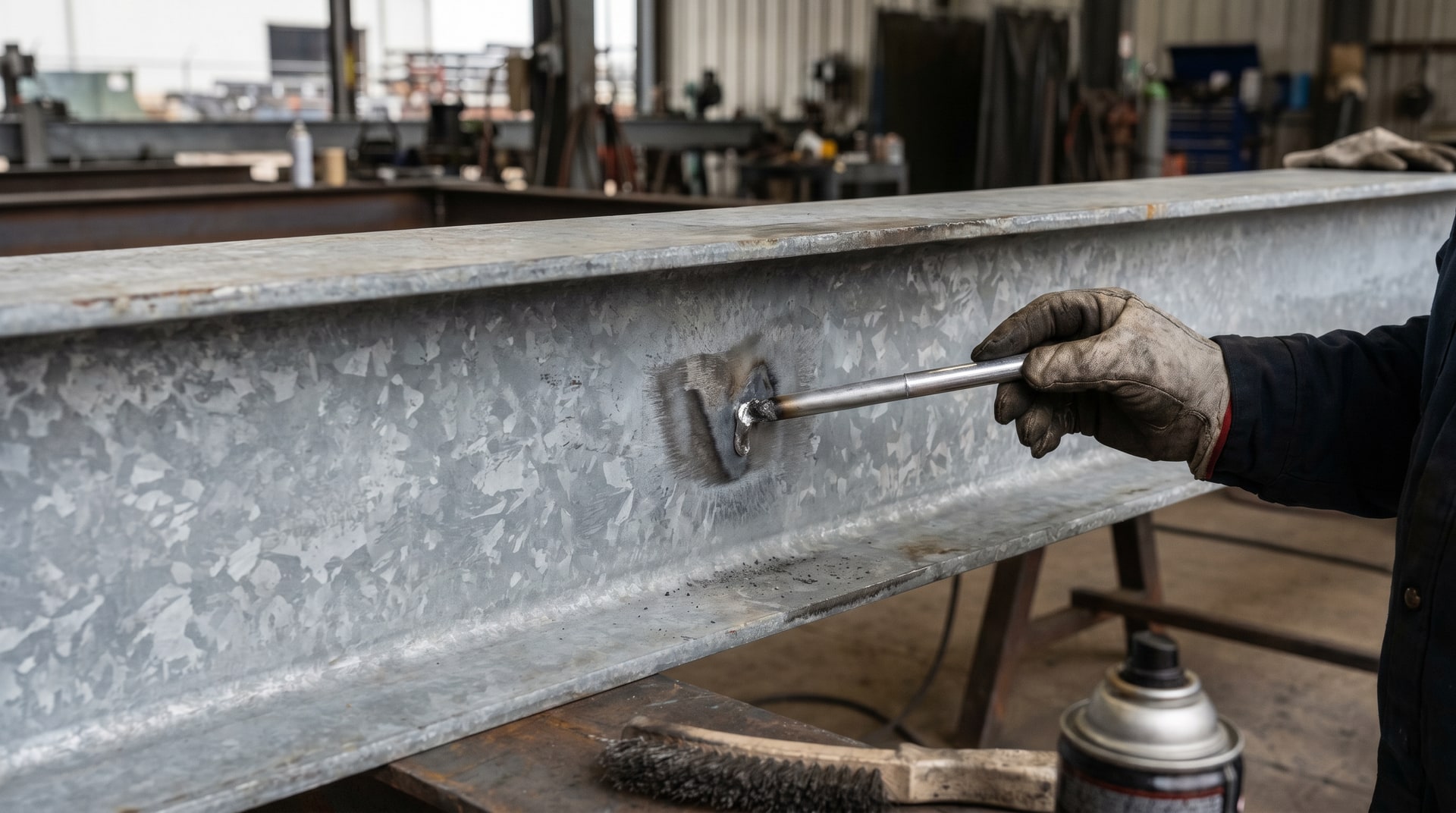
When hot-dip galvanized steel leaves the plant, it carries a continuous, metallurgically bonded zinc coating that is built to last for decades in most environments. But steel does not always stay in its as-galvanized condition all the way to final installation. Fabrication cuts, welding, mechanical damage, and handling can all break or burn through that coating, leaving areas of bare or thinned steel that need to be addressed before the structure goes into service. The method used to address those areas matters, because not every repair product restores the coating to the same level of performance.
Zinc-based solders represent one of the recognized methods for repairing damaged hot-dip galvanized coatings. They work differently from zinc-rich paints and cold-galvanizing compounds, and they carry specific application requirements that affect whether the repair actually meets specification. Understanding why the preheat is necessary, how the alloy form affects handling, and what the thickness rules require will help fabricators and inspectors make better decisions in the field.
The American Galvanizers Association addresses this directly in their article on zinc-based solders. At V&S Galvanizing, we expand on that foundation to explain what is actually happening at the material level, how preheat temperature influences performance, and why this repair method is often misunderstood in the field.
Why Repair Methods Are Not All Equivalent
Before getting into the mechanics of zinc-based soldering, it helps to understand why repair method selection is a specification-level decision rather than a field convenience choice. ASTM A123/A123M, the governing specification for hot-dip galvanized coatings on fabricated steel, permits a defined set of repair methods. Each method has its own application constraints and performance characteristics, and not all of them produce a coating that behaves identically to the original galvanized layer.
Hot-dip galvanizing produces a coating that is not simply zinc sitting on top of steel. It is a series of zinc-iron intermetallic alloy layers bonded to the steel substrate, capped by a relatively pure outer zinc layer. That metallurgical bond is what gives the coating its exceptional adhesion and abrasion resistance. Repair methods that apply zinc at ambient or low temperatures cannot replicate that intermetallic structure, but they can still provide meaningful cathodic protection and meet the required coating thickness if applied correctly.
Zinc-based solders occupy a specific position in that repair landscape. They require elevated substrate temperature to flow and adhere properly, which means they are a more process-intensive option than brushing on a cold compound, but they also produce a repair that bonds more effectively to the surrounding galvanized surface and more closely replicates the visual appearance of the original coating.
The Role of Preheat: What 600 F (315 C) Actually Does
The preheat requirement for zinc-based solder application is approximately 600 F (315 C) at the repair area. That number is not arbitrary, and skipping or under-achieving it is one of the most common sources of repair failure in the field.
Zinc alloys used in solder form have melting points that fall within a range where they can flow and wet a metal surface, but only if that surface is also at or near the working temperature of the alloy. If the base steel is cold or only mildly warm, the solder will solidify almost immediately upon contact rather than flowing into surface irregularities and bonding to the surrounding zinc coating. The result looks like a repair but has minimal adhesion and will likely delaminate under mechanical stress or thermal cycling.
Preheating to approximately 600 F serves two functions. First, it brings the local steel temperature high enough that the solder remains fluid long enough to wet and flow across the repair area. Second, it drives off any moisture that may have condensed on the surface, which would otherwise create steam pockets or interfere with bonding. This is the same logic that governs brazing and soldering in other metal-joining applications: the substrate temperature needs to support the working temperature of the filler material.
In practice, this means using a torch to heat the steel before applying the solder, and monitoring that temperature rather than relying on visual estimation alone. Pyrometer sticks or contact thermometers are useful here. The surrounding galvanized coating will start to show heat discoloration as temperature increases, which is expected. The key is achieving adequate preheat at the repair zone without overheating to the point of burning away the surrounding zinc, which would only expand the area needing repair.
Stick vs. Powder: How Alloy Form Affects Application
Zinc-based solder products are available in two primary forms: stick and powder. Each form has practical trade-offs that affect which is appropriate for a given repair scenario.
Stick form is the more common choice for field repairs. It handles similarly to a brazing rod, allowing the applicator to feed material into the heated repair area with reasonable control. The operator can modulate the amount of material deposited, work around irregular geometries, and see the solder flow as the substrate reaches working temperature. For repairs on structural members, connection points, or fabricated assemblies with complex geometry, stick form generally offers better practical control.
Powder form is better suited to situations where broad, thin coverage is needed, or where the repair area geometry makes feeding a stick rod difficult. The powder is typically applied to the preheated surface and then spread or worked with a brush or spatula as it melts. Achieving uniform thickness across a powder application takes more care, and there is a greater risk of inconsistent coverage if the substrate temperature is uneven across the repair area.
Both forms can produce specification-compliant repairs when applied correctly. The choice comes down to the repair geometry, the skill of the applicator, and the practical constraints of the job site. Neither form should be applied without the required preheat, regardless of what shortcut a time-pressured application might suggest.
Alloy Composition and Specification Compliance
Not every zinc-containing product marketed as a solder or repair compound qualifies under the specification. ASTM A123/A123M defines the acceptable material compositions for zinc-based solders used in repair of hot-dip galvanized coatings. Using a product outside those defined compositions, even if it contains zinc and applies similarly, does not produce a specification-compliant repair.
This matters in contexts where the galvanized assembly is subject to third-party inspection, where project specifications reference ASTM A123 explicitly, or where the end-use environment is corrosive enough that coating quality will have direct long-term consequences. Specifying engineers and inspectors are within their rights to ask for documentation confirming that a repair product meets the composition requirements of the specification, and fabricators should be prepared to provide it.
From a practical standpoint, purchasing repair products from suppliers who specifically market them as A123-compliant solder materials is the most straightforward way to stay within specification. The compositional requirements are not unusually restrictive, but they do exist, and assuming compliance without verification is a risk in formal inspection contexts.
Measuring Repair Thickness: Meeting the Coating Category Requirement
After a zinc-based solder repair is complete, the coating thickness at the repair area must meet the same specification requirement that applies to the steel part as a whole. ASTM A123/A123M organizes steel into material categories based on thickness, and each category carries a minimum average coating thickness requirement. The repaired area is not held to a different or reduced standard simply because it is a repair.
Thickness measurement at a repair zone must be performed using non-destructive methods specified in ASTM A123/A123M. Magnetic thickness gauges are the most common tool used in the field. They work on the principle of measuring the distance between a magnetic probe tip and a ferromagnetic substrate, which corresponds directly to the thickness of any non-magnetic coating above the steel. Zinc and zinc alloy coatings are non-magnetic, so this method is well-suited to measuring galvanized coating thickness including solder repairs.
One practical complication with measuring repair thickness is surface profile. A freshly applied solder repair may have slight surface irregularities, built-up edges, or slight crowning above the surrounding coating level. Thickness gauges should be zeroed and calibrated on an uncoated reference surface from the same or similar steel, and measurements should be taken at multiple points across the repair area to confirm that the minimum average thickness requirement is being met rather than just a high point. If the solder has been feathered or blended at the edges, the transition zone is often the thinnest part and warrants specific attention during measurement.
Visual Match and Coating Appearance
One of the practical advantages of zinc-based solder repairs compared to paint-based touch-up methods is visual compatibility. Zinc-based solder products, when applied at proper temperature and allowed to cool, closely match the appearance of the surrounding hot-dip galvanized coating. The color and surface texture tend to blend in naturally, which matters on architecturally visible applications or projects where coating appearance is a formal requirement.
This is not purely cosmetic. The visual similarity reflects that the solder repair is also zinc-based in composition, which means it will weather and develop patina at a rate roughly consistent with the surrounding coating. Paint-based repair compounds, by contrast, age differently from the galvanized surface around them, and the repair area often becomes more visually distinct over time rather than less.
That said, a solder repair will not be invisible. An experienced inspector will typically be able to identify a repaired area even when it blends reasonably well, particularly under raking light conditions. The goal of appearance matching is not concealment but consistency, ensuring that the repair does not stand out in a way that suggests the coating has been compromised or that a lower-quality patch material was used.
When Zinc-Based Solder Is the Right Choice vs. Alternatives
ASTM A123/A123M recognizes multiple acceptable repair methods for damaged hot-dip galvanized coatings, each suited to different circumstances. Zinc-based solder is not the only option, but it has characteristics that make it preferable in certain situations.
For repairs on steel that will be exposed to moderate-to-aggressive corrosive environments, the better adhesion and visual compatibility of zinc-based solder makes it a stronger long-term choice than zinc-rich paint alone. For repairs on architecturally exposed work where appearance continuity is important, solder's visual match is an advantage. For shop repairs performed prior to shipping, where a torch and controlled working conditions are available, solder is practical and efficient.
Zinc-rich paint touch-up compounds, by contrast, are often preferred for field repairs on installed assemblies where heating the steel is not practical or safe, or for very small nicks and scratches where the repair area is too small to work with a solder stick effectively. Cold-spray zinc compounds fall into a similar use case. Neither of those alternatives requires preheat, which reduces the skill barrier and equipment requirements, but the trade-off is a repair that relies on mechanical adhesion rather than the thermal bonding that preheat enables with solder.
The decision ultimately depends on the size and severity of the damage, the environment the steel will see in service, the accessibility of the repair area, and whether heat application is practical given the installation context. Our team at V&S Galvanizing works with fabricators and contractors to identify the right repair approach for their specific project conditions, within the constraints of what ASTM A123/A123M permits.
Work With a Team That Understands the Full Coating System
Repair methods like zinc-based soldering are not afterthoughts in a hot-dip galvanizing program. They are a defined, specification-governed part of how the industry ensures that finished assemblies meet coating requirements even after the unavoidable handling and fabrication damage that occurs between the galvanizing plant and final installation. Getting the repair right, including proper preheat, correct alloy selection, appropriate application technique, and post-repair thickness verification, is what separates a compliant finished product from one that has a weak point built into it from day one.
At V&S Galvanizing, we understand zinc coatings from the metallurgical layer structure up through inspection and delivery. When repair questions arise on projects we process, we provide guidance grounded in the actual specification requirements rather than general advice. If you are working through a repair situation, facing inspection questions about a galvanized assembly, or planning a project and want to understand what repair methods are available and appropriate, we are ready to help. Reach out through our contact page and a member of our technical team will follow up with you directly.
Frequently Asked Questions About Zinc-Based Solders for Galvanizing Repair
What preheat temperature is required before applying zinc-based solder to a galvanized surface?
The repair area must be preheated to approximately 600 F (315 C) before zinc-based solder is applied. This temperature ensures the solder remains fluid long enough to wet and bond to the substrate, rather than solidifying on contact with cold steel.
Does the repaired area need to meet the same coating thickness as the rest of the galvanized part?
Yes. The final coating thickness at the repair zone must meet the same minimum requirement as the rest of the steel part, based on its material category under ASTM A123/A123M. The specification does not allow a reduced standard for repaired areas.
How is coating thickness measured after a zinc-based solder repair?
Thickness must be measured using non-destructive methods specified in ASTM A123/A123M. Magnetic thickness gauges are the standard tool. Multiple readings should be taken across the repair area, paying particular attention to feathered edges where the coating may be thinnest.
Is zinc-based solder better than zinc-rich paint for galvanizing repair?
It depends on the situation. Zinc-based solder produces better adhesion and closer visual match to the surrounding galvanized coating, making it preferable for environments with higher corrosion exposure and for architecturally visible work. Zinc-rich paint is more practical when heat application is not feasible, such as on installed structures in the field.
Can any zinc alloy product be used as a solder repair under ASTM A123?
No. ASTM A123/A123M specifies acceptable material compositions for zinc-based solders used in repair. Only products that meet those defined composition requirements qualify as compliant repair materials. Fabricators should obtain documentation from suppliers confirming that a product meets the specification before using it on a compliant project.
Why do zinc-based solder repairs blend in better than paint-based repairs?
Zinc-based solders are zinc-dominant alloys, so their color, surface texture, and long-term weathering behavior closely match the surrounding hot-dip galvanized coating. Paint-based compounds have a different surface chemistry and tend to age at a different rate, making the repair area more visually distinct over time.
What forms do zinc-based solder repair products come in, and when is each used?
Zinc-based solders are available in stick and powder form. Stick form offers better control for most field and shop repairs, particularly on irregular or three-dimensional surfaces. Powder form is better suited for broad, relatively flat repair areas where spreading a melted material across a wider surface is more practical than feeding a rod.
What happens if the preheat temperature is not reached before applying zinc-based solder?
The solder will solidify on contact with the cold or insufficiently heated steel rather than flowing and bonding. The repair will appear complete but will have poor adhesion and is likely to delaminate under mechanical stress, thermal cycling, or corrosive exposure. Achieving and verifying the required preheat is essential for a durable repair.
