
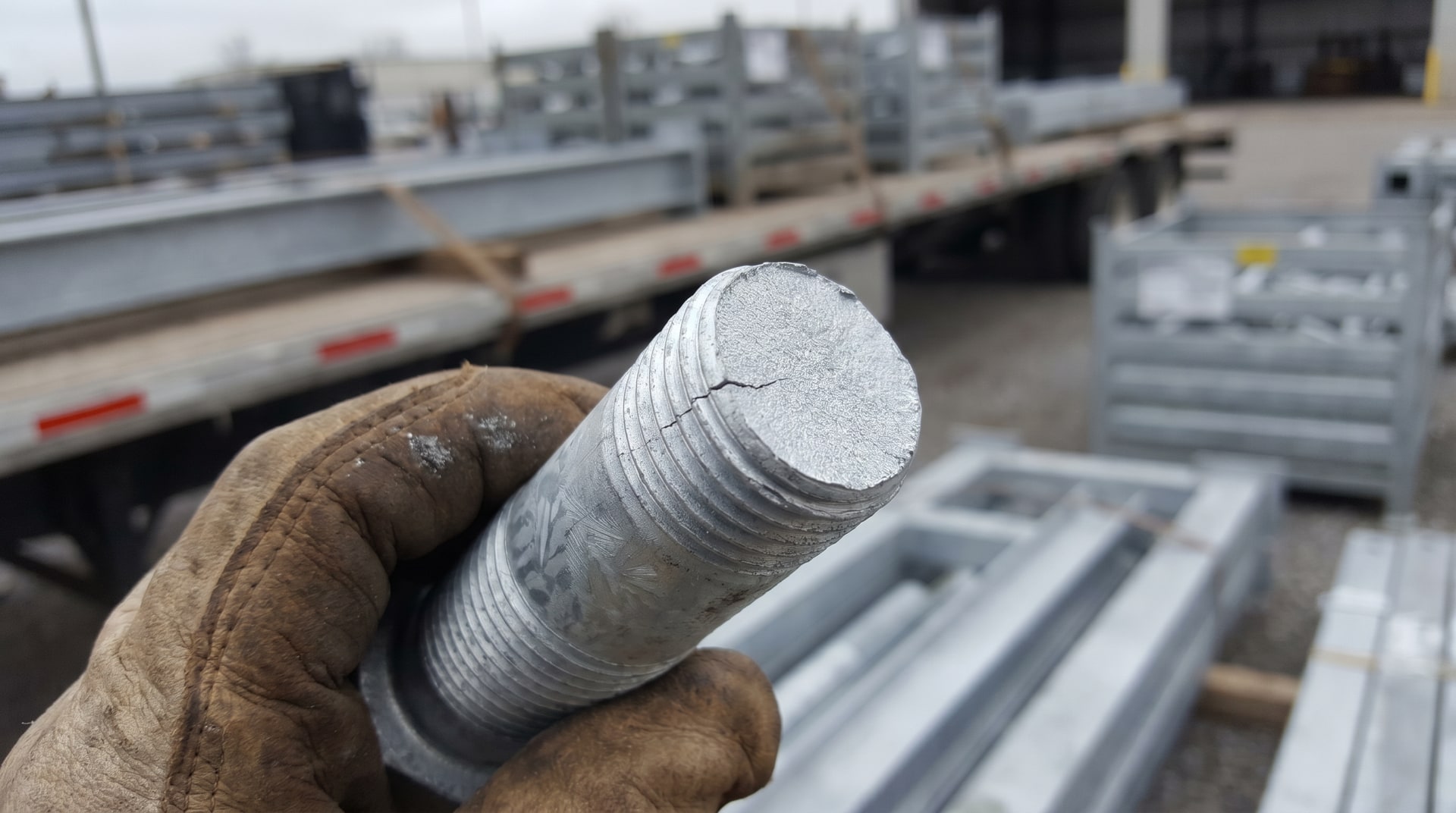
Embrittlement is one of the most misunderstood topics in hot dip galvanizing. It is often assumed that the galvanizing process itself weakens steel, but in reality, embrittlement is a material behavior that only occurs under specific combinations of steel chemistry, prior processing, and stress conditions.
The American Galvanizers Association provides a technical foundation on this topic here.
At V&S Galvanizing, we help engineers and fabricators understand when embrittlement is a legitimate concern and when it is not. The distinction matters, because avoiding unnecessary restrictions on galvanizing can preserve both performance and cost efficiency, while still addressing real risks where they exist.
What Embrittlement Actually Is in Structural Terms
Embrittlement is a reduction in ductility. Instead of bending or deforming under load, the steel becomes more prone to cracking, often with little visible warning. This is not a surface defect and cannot be identified by appearance alone. It is a change in how the steel behaves under stress.
In galvanized applications, this matters most in components that are either highly stressed, highly hardened, or have undergone significant cold working prior to galvanizing. The galvanizing process does not create these conditions, but it can interact with them.
Hydrogen Embrittlement and Why It Gets Overstated
Hydrogen embrittlement is the most commonly cited concern, but it is also the most frequently misunderstood.
Hydrogen can be introduced into steel during acid pickling, which is part of the galvanizing preparation process. However, for hydrogen embrittlement to occur, three conditions must exist at the same time:
- The steel must be high strength, typically above 150 ksi
- Hydrogen must enter and remain trapped in the steel
- The steel must be under sustained tensile stress
If any one of these conditions is not present, hydrogen embrittlement is not a risk.
Most structural steels used in galvanizing applications fall well below the strength threshold where hydrogen embrittlement becomes a concern. In addition, the heat of the galvanizing bath itself promotes hydrogen diffusion out of the steel, reducing the likelihood of retention.
This is why hydrogen embrittlement is rarely an issue in typical structural galvanizing work, but it becomes highly relevant in specialized applications such as high-strength fasteners or hardened components.
Strain-Age Embrittlement and Fabrication Effects
A more relevant mechanism in galvanizing is strain-age embrittlement, which is tied to how the steel was fabricated before galvanizing.
When steel is cold worked through bending, punching, or forming, it introduces internal strain. If that strain is combined with certain steel chemistries, particularly those containing nitrogen, the material can become more susceptible to brittle behavior when exposed to elevated temperatures.
The galvanizing process involves immersion in molten zinc at approximately 840 to 850 degrees Fahrenheit. This thermal exposure can accelerate strain-aging effects in susceptible materials.
What this means in practice is that the risk is not created at the galvanizer. It is introduced during fabrication and then revealed during galvanizing.
Where Embrittlement Risk Actually Exists
The risk of embrittlement is not uniform across all galvanized steel. It is concentrated in specific types of materials and applications.
High-strength steels, particularly those that have been quenched and tempered, are more susceptible. Components that have undergone aggressive cold forming without stress relief are also candidates. Sharp bends, punched holes, and heavy deformation increase localized stress, which can contribute to brittle behavior.
In contrast, typical structural shapes such as beams, plates, and standard fabrications rarely experience embrittlement issues when processed correctly.
Understanding this distinction is critical. It prevents overgeneralizing the risk and allows engineers to focus on the areas where attention is actually needed.
The Role of Design in Preventing Problems
Embrittlement is far more effectively managed in the design and fabrication phase than at the galvanizing stage.
Material selection is the first control point. Choosing steels that are appropriate for galvanizing and avoiding unnecessarily high strength grades reduces risk immediately.
Fabrication practices also matter. Avoiding sharp bend radii, minimizing cold work where possible, and considering stress-relief treatments for heavily formed components all contribute to better outcomes.
What is often overlooked is that galvanizing itself does not introduce embrittlement into properly designed components. It simply exposes conditions that were already present.
Why Galvanizing Is Still Widely Used in Critical Applications
Despite the discussion around embrittlement, hot dip galvanizing continues to be used in infrastructure, transportation, and industrial applications where reliability is critical.
This is because the vast majority of galvanized components are not susceptible to embrittlement when proper material selection and fabrication practices are followed.
The durability benefits of galvanizing, including long-term corrosion protection and minimal maintenance, outweigh the risks when those risks are properly understood and managed.
Work With a Team That Understands the Difference Between Risk and Reality
Embrittlement is a real phenomenon, but it is not a blanket limitation on galvanizing. The key is knowing when it applies and how to address it before it becomes an issue in the field.
At V&S Galvanizing, we work with engineers and fabricators to review material selection, fabrication details, and application conditions so that galvanizing performs exactly as expected.
Embrittlement in hot dip galvanized steel is not caused by the coating itself, but by the interaction between steel chemistry, prior fabrication, and stress conditions. When those factors are understood and managed correctly, galvanizing remains a reliable and widely used solution for corrosion protection across critical applications. If you are working with high-strength materials or complex fabrications and want to ensure your design is aligned with galvanizing best practices, reach out to our team through our contact page.
Frequently Asked Questions About Embrittlement in Galvanized Steel
Does galvanizing cause embrittlement in steel?
No. Galvanizing does not inherently cause embrittlement. It can interact with pre-existing material conditions that make embrittlement possible.
What types of steel are most at risk?
High-strength steels and heavily cold-worked materials are the most susceptible.
Is hydrogen embrittlement common in galvanizing?
No. It is rare in standard structural steel but can be a concern for high-strength components.
What is strain-age embrittlement?
It is a condition caused by prior cold work and steel chemistry that can lead to reduced ductility when exposed to elevated temperatures.
Can embrittlement be prevented?
Yes. Proper material selection, fabrication practices, and coordination with the galvanizer significantly reduce risk.
Should high-strength fasteners be galvanized?
They can be, but they require careful consideration of material properties and processing methods.
Does galvanizing weaken steel?
No. The process does not reduce the inherent strength of properly selected and fabricated steel.
When should embrittlement be evaluated in a project?
It should be reviewed when using high-strength steels or when fabrication involves significant cold work.