

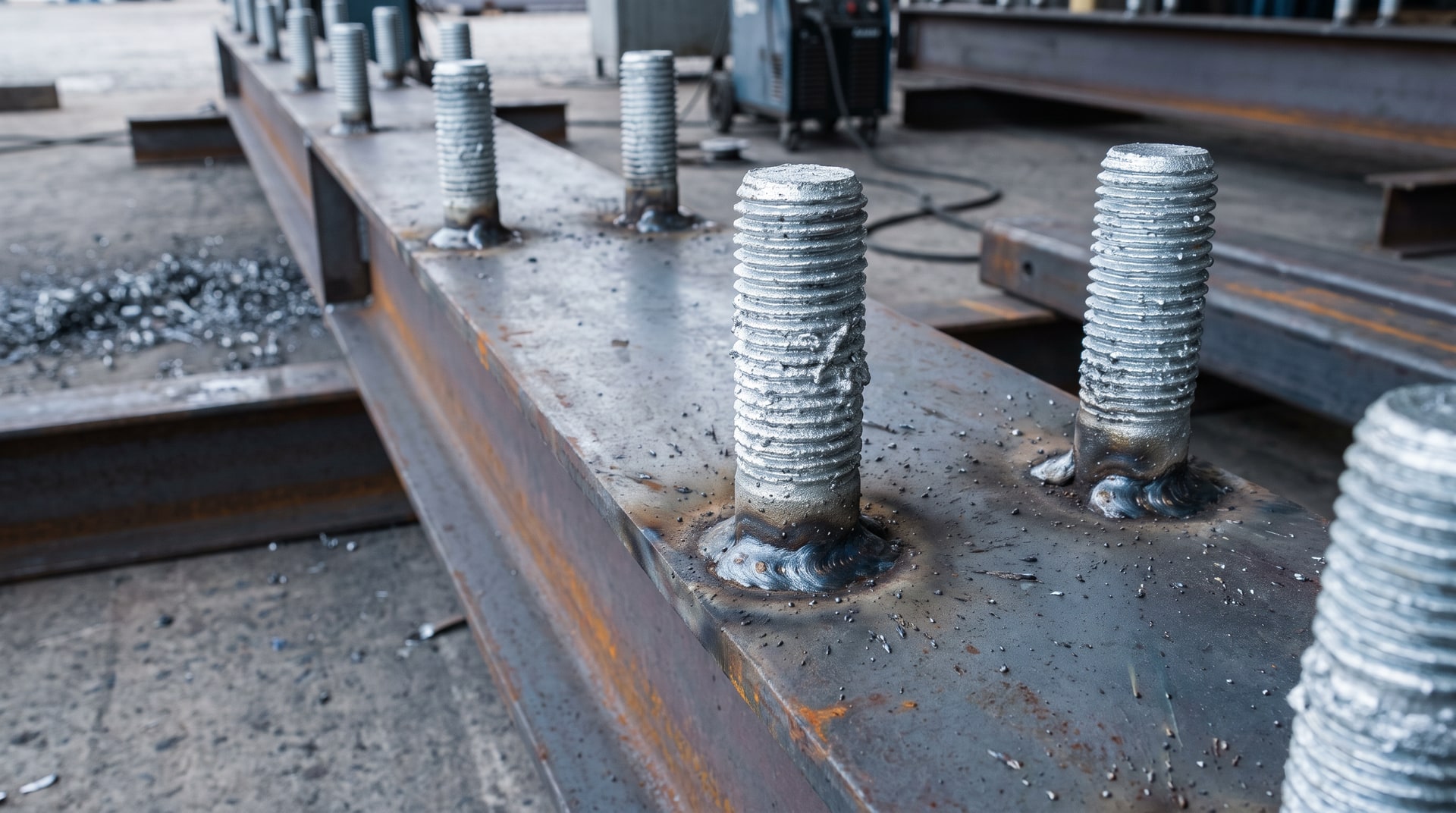
When a fabricator welds threaded studs to a structural steel member and then sends the assembly through the galvanizing line, a reasonable question comes up almost immediately: does the coating on those studs have to meet the same standard as the structural steel itself? It seems like it should be straightforward, but the answer involves two separate ASTM standards, a cross-reference buried in specification language, and some practical post-galvanizing cleanup that trips up even experienced shops.
The American Galvanizers Association addresses this directly in their article on ASTM A123 for Threaded Studs. At V&S Galvanizing, we expand on that foundation to explain what is actually happening at the material level, how thread geometry influences zinc buildup, and why the dual-standard requirement is often misunderstood in the field.
Why Two Standards Apply to the Same Assembly
ASTM A123 is the governing specification for hot-dip galvanized coatings on iron and steel products. When a structural member with welded threaded studs is submitted for galvanizing, the entire assembly falls under A123 in a general sense. But A123 is not designed to handle every geometry or component category uniformly. Threads introduce a complication: the specification language in Section 5.2.1, which covers threaded components in assemblies, explicitly states that coatings on those threaded elements shall conform to the requirements of ASTM A153.
ASTM A153 is the standard specifically written for zinc coatings on hardware, including bolts, nuts, and threaded fasteners. The two specifications reflect different coating thickness requirements and acceptance criteria suited to their respective applications. So while the structural steel portion of your assembly is evaluated against A123, the threaded studs welded onto it are evaluated against A153. One assembly, two applicable standards, each governing a different element of it.
This is not a loophole or an ambiguity. It is an intentional design of the specification system that recognizes geometry-specific behavior during galvanizing and in service.
What ASTM A153 Actually Governs on Threaded Components
ASTM A153 divides hardware into classes based on material type and thickness, and it assigns coating thickness requirements accordingly. Threaded fasteners typically fall into Class C or Class D depending on the material. The coating thickness minimums under A153 are generally lower than those required by A123 for structural shapes, and that difference is intentional. A thread form has recesses and crests that concentrate and retain zinc differently than a flat plate or structural section. Holding a thread to the same average coating thickness as a wide-flange beam would be impractical and, in many cases, would render the thread unusable without remediation.
The A153 framework accounts for this geometry by setting realistic minimums that still provide meaningful corrosion protection while preserving thread function. When our team reviews an assembly that includes welded studs, understanding which class of A153 applies to those studs is part of what we check before a job goes through our process.
How Zinc Behaves on Thread Geometry
To understand why thread management matters after galvanizing, it helps to think about how the zinc metallurgically bonds to steel. In hot-dip galvanizing, the steel is immersed in a bath of molten zinc at approximately 840 degrees Fahrenheit. A series of zinc-iron alloy layers forms at the steel surface through a diffusion reaction, and a layer of relatively pure zinc caps those alloy layers on the outside. The total coating is essentially metallurgical, not merely adhesive.
On a flat surface, the zinc drains cleanly as the part is withdrawn from the bath. On a threaded profile, the zinc has to navigate the thread valleys, flanks, and crests. Surface tension and drainage dynamics mean that zinc can accumulate unevenly. The thread roots and valleys tend to collect more zinc than the crests because molten zinc pools slightly in those recesses before it solidifies. By the time the zinc has frozen, thread profiles that were within tolerance before galvanizing can be partially filled or tightened to the point where a nut will not run cleanly.
This is not a defect in the galvanizing process. It is a predictable outcome of applying a metallic coating to a complex profile. Managing it is a routine part of working with galvanized assemblies that include threaded features.
Pre-Fabrication Thread Allowances and Why They Matter
One of the most effective ways to handle thread zinc buildup is to address it before the steel even goes through the galvanizing line. ASTM A123 and related industry guidance both recognize that threads intended for galvanizing can be cut or tapped to slightly oversized dimensions prior to processing. The extra clearance accommodates the zinc coating so that after galvanizing, the effective thread form is closer to the nominal dimension.
For external threads, this typically means cutting the threads slightly undersized in major diameter so that once the zinc layer is added, the result falls within the acceptable tolerance range. For internal threads, the approach is reversed: the threads are tapped slightly oversized before galvanizing. How much clearance to add depends on the thread pitch and the expected coating thickness, which is determined by the steel material category under A153.
When fabricators skip this step because the assembly was never explicitly designed for galvanizing, the resulting threads may be too tight for a nut to engage without forcing. That is when post-galvanizing remediation becomes necessary.
Clearing Clogged Threads After Galvanizing: The Correct Approach
The AGA guidance on this point is specific and worth following carefully. To clean clogged threads or remove excess zinc, the recommended approach is to warm the threaded portion of the stud with a torch and then work the threads with a wire brush. Applying controlled heat softens or remobilizes the zinc enough to allow a wire brush to clear the thread valleys without requiring aggressive mechanical action that could damage the thread form itself.
The critical caution here involves temperature control. The source material explicitly notes that care must be taken to avoid overheating the material beyond its tempering temperature. This matters because threaded studs, depending on their material and manufacturing process, may have mechanical properties that were established through heat treatment. If you heat the stud beyond its tempering temperature during thread cleanup, you can reduce the hardness or tensile strength of the stud, compromising its structural function in the assembly.
In practice, this means applying heat judiciously, working in short intervals, and not concentrating a torch flame directly on one spot for an extended period. The goal is to warm the zinc, not to overheat the steel beneath it. For studs made from standard low-carbon steel this concern is relatively modest, but for higher-strength grades it is a real consideration that should not be treated casually.
Common Misconceptions in the Field
One thing our team encounters fairly often is the assumption that because the structural member meets A123, the threaded studs on it are automatically covered under A123 as well. That reading misses the cross-reference in Section 5.2.1. The studs are part of the assembly, but their coating requirements are specifically handed off to A153 within the specification itself. Inspectors evaluating a galvanized assembly need to know which standard governs which element before they measure or assess anything.
Another common misunderstanding involves what to do when threads do not accept a nut after galvanizing. Some contractors assume any difficulty engaging a thread means the galvanizing was done incorrectly and that re-galvanizing or full replacement is necessary. In most cases, the issue is simply zinc accumulation in the thread form, which is a predictable outcome and is addressed through the warming-and-brushing procedure described above. Re-galvanizing the assembly is not the solution and would only repeat the same outcome.
There is also occasional confusion about whether running a die or tap over galvanized threads is acceptable. Mechanically chasing threads with a die removes zinc coating from the thread form, which reduces corrosion protection on those surfaces. The preferred approach is the controlled heat method because it removes excess zinc without stripping the metallurgically bonded coating from the thread flanks and crests.
Inspection Responsibilities When Both Standards Apply
From an inspection standpoint, a galvanized assembly with welded threaded studs requires two different sets of eyes. The structural steel portions are measured and evaluated against A123 thickness requirements, which vary by steel category and thickness. The threaded studs are evaluated against A153, which organizes its requirements by hardware class.
Coating thickness on threaded components is typically measured on the shank of the stud rather than directly on the thread form, because the geometry of threads makes reliable gauge readings on crests and roots impractical. The shank measurement serves as the representative value for the zinc present on that component. This is consistent with how A153 is applied in practice for fasteners and hardware generally.
Any inspector signing off on an assembly that includes welded studs should document which standard governs each portion of the assembly and record measurements accordingly. Conflating the two standards in inspection records, or applying only A123 measurements to the entire assembly, can create compliance gaps that are not apparent until a question arises later in the project.
Design and Specification Implications for Structural Assemblies
For engineers specifying hot-dip galvanizing on assemblies that include welded threaded studs, there are a few things worth building into the specification and drawing notes from the beginning. First, note explicitly that the threaded studs are to be evaluated per ASTM A153 and that the structural steel is to be evaluated per ASTM A123. This removes ambiguity for the galvanizer, the inspector, and the contractor.
Second, indicate whether threads are being pre-cut with clearance allowances for the zinc coating. If the fabricator is not accounting for zinc buildup in thread dimensions before fabrication, that decision shifts the thread management responsibility entirely to post-galvanizing remediation, and the specification should acknowledge that explicitly so that all parties understand the plan.
Third, if the threaded studs are made from materials with specific heat treatment or strength requirements, those properties should be documented so that anyone performing thread cleanup using the torch-and-brush method understands the temperature constraints they are working within. An assembly specification that is silent on stud material and heat treatment leaves too much to assumptions in the field.
Work With a Team That Understands the Details Behind the Standards
The interaction between ASTM A123 and ASTM A153 on a single galvanized assembly is exactly the kind of specification detail that causes problems when it is not understood before the work begins. Getting coating thickness right on structural steel is one task. Understanding that the threaded studs on that same piece are held to a different standard, with different thickness requirements and different inspection methods, is a separate task that requires deliberate attention.
At V&S Galvanizing, our team works through these details at the intake stage, not after a problem surfaces. We understand how zinc behaves on threaded profiles, what the specification cross-references require, and how to guide fabricators and inspectors through assemblies that involve more than one applicable standard. If you are working on a project that includes structural members with welded threaded studs or other mixed-component assemblies, we are glad to talk through the specifics with you before the work goes through the line. Reach out through our contact page and we will make sure the right standards are being applied to every element of your assembly.
Frequently Asked Questions About ASTM A123 and Galvanizing Threaded Studs
Does ASTM A123 apply to threaded studs welded to a structural member?
Yes, with an important qualification. ASTM A123 governs the overall assembly, but Section 5.2.1 specifically states that threaded components in assemblies must have coatings that conform to ASTM A153, not A123. So the structural steel is evaluated under A123 while the threaded studs are evaluated under A153.
Why do threaded studs follow ASTM A153 instead of ASTM A123?
ASTM A153 is specifically designed for zinc coatings on hardware and threaded fasteners. Thread geometry creates different coating behavior than flat structural surfaces, and A153 sets coating thickness requirements that are appropriate for threaded profiles while still providing adequate corrosion protection. A123 requirements are calibrated for structural steel categories, not threaded hardware.
How should clogged threads on galvanized studs be cleaned?
The recommended method is to warm the threaded portion of the stud with a torch and then work the threads with a wire brush. The heat softens the excess zinc enough for the brush to clear thread valleys without damaging the thread form. Mechanical chasing with a die is not preferred because it strips zinc from thread flanks, reducing corrosion protection.
What temperature risk exists when using a torch to clean galvanized threads?
Overheating the stud beyond its tempering temperature can reduce the hardness or tensile strength of the material, particularly for higher-strength grades. The torch should be used to warm the zinc, not to heat the underlying steel aggressively. Working in short intervals and avoiding concentrated heat on a single spot helps control this risk.
Should threads be cut to a different size before galvanizing to account for zinc buildup?
Yes, this is standard practice when threads will be galvanized. External threads are cut slightly undersized in major diameter, and internal threads are tapped slightly oversized, to leave clearance for the zinc coating. After galvanizing, the effective thread form falls within an acceptable tolerance. Skipping this step increases the likelihood of needing post-galvanizing remediation.
Where is coating thickness measured on galvanized threaded studs?
Coating thickness is typically measured on the shank of the stud rather than directly on the thread crests or roots. Thread geometry makes reliable gauge readings on the thread form impractical, so the shank measurement serves as the representative value for the zinc present on that component, consistent with how ASTM A153 is applied in practice.
Can a galvanized assembly with welded threaded studs be re-galvanized if threads are clogged?
Re-galvanizing is not the appropriate response to clogged threads. The zinc accumulation is a predictable result of the thread geometry, and re-galvanizing would produce the same outcome. The correct remedy is the controlled heat-and-brush method to remove excess zinc from the thread form without stripping the coating from the thread surfaces.
How should an engineer specify galvanizing for an assembly with welded threaded studs?
The specification should explicitly note that threaded studs are to be evaluated per ASTM A153 and structural steel per ASTM A123. It should also address whether threads are being pre-cut with clearance allowances for zinc, and if studs have specific strength requirements, document material properties so anyone performing post-galvanizing thread cleanup understands the applicable temperature constraints.
