

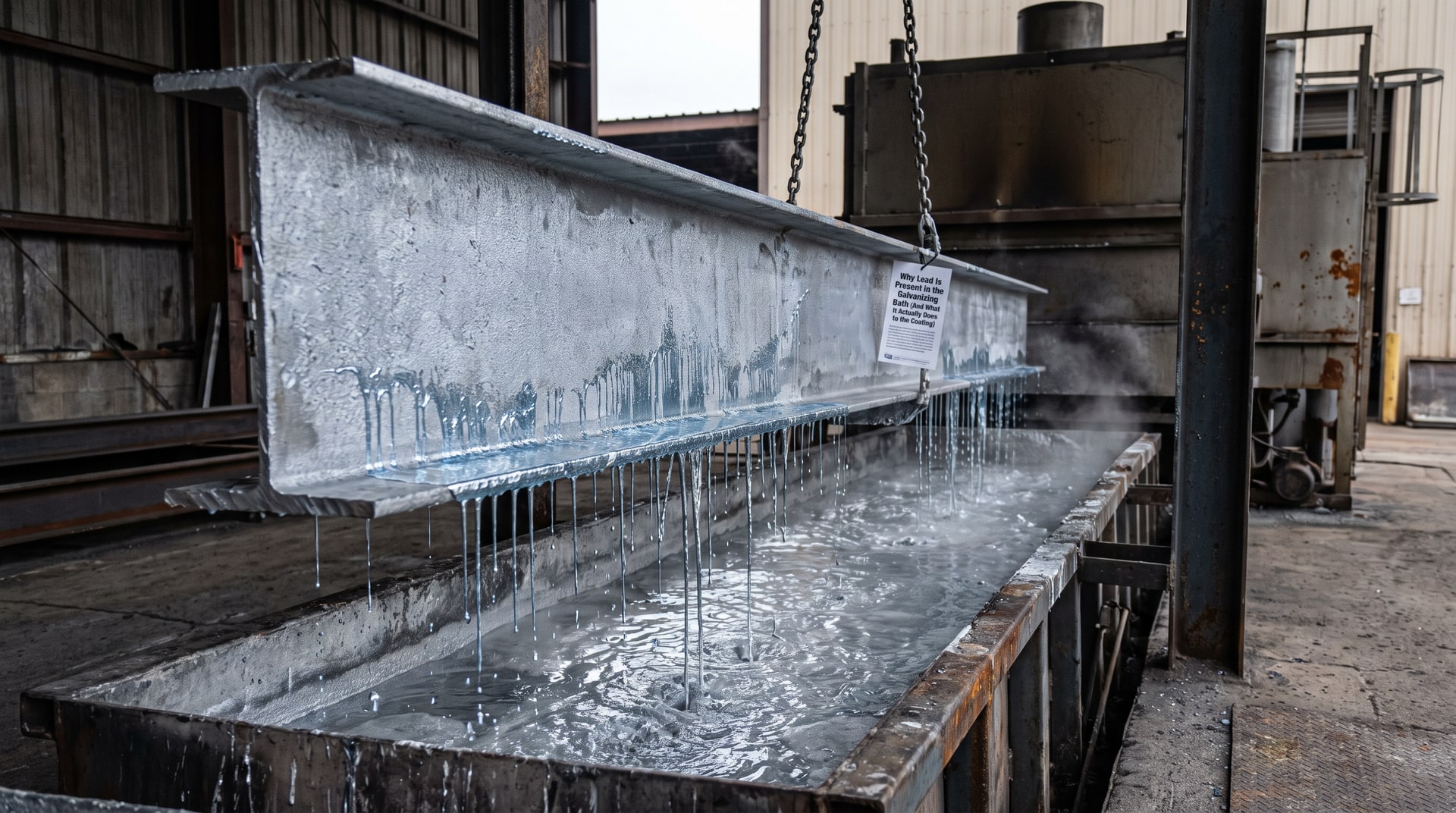
When fabricators and engineers see a galvanized coating with a slightly uneven surface, small drips, or irregular flow patterns, questions about the bath chemistry often follow. One of the more persistent misconceptions in the field is that galvanizers deliberately add lead to the zinc kettle as a processing aid. The reality is more nuanced, and understanding what lead actually does in the bath helps clarify why surface appearance varies between galvanizers and even between individual parts coming out of the same kettle.
The American Galvanizers Association addresses this directly in their article on why lead is added to the galvanizing bath. At V&S Galvanizing, we expand on that foundation to explain what is actually happening at the material level, how lead content influences coating performance and appearance, and why this is often misunderstood in the field.
Lead as an Impurity, Not an Additive
The framing matters here. Lead is not something galvanizers choose to add to a zinc kettle the way a chef adds seasoning. It arrives as a naturally occurring impurity within zinc ore itself. Because zinc and lead deposits frequently co-exist geologically, nearly every grade of commercial zinc contains at least some measurable concentration of lead, even after refining.
This distinction between an intentional additive and an inherent impurity shapes how the industry manages lead content. Rather than asking "how much should we add," galvanizers ask "which grade of zinc keeps lead within acceptable bounds for the job at hand?" That framing shifts the conversation toward zinc specification and procurement rather than kettle management.
ASTM B6, the standard governing slab zinc used in industrial processes including hot-dip galvanizing, defines maximum lead concentrations for each zinc grade. Those specified maximums vary meaningfully depending on the grade selected, and the choice of zinc grade has direct consequences for how the finished coating looks and behaves.
The Surface Tension Mechanism Behind the Benefit
Despite being an impurity rather than a deliberate addition, lead does confer a measurable processing benefit. It reduces the surface tension of molten zinc. That might sound like an abstract materials science point, but its practical effect is straightforward: lower surface tension allows liquid zinc to flow off a steel workpiece more readily as the part is withdrawn from the kettle.
When a steel beam, channel, or fabricated assembly is lifted out of a 830-850°F zinc bath, any excess zinc that clings to the surface rather than draining away becomes a problem. High surface tension keeps molten zinc attached longer, increasing the likelihood of runs, drips, and heavy buildup at low points, edges, and re-entrant corners. The result is a coating that is thicker in some areas than the geometry actually requires, with visible drip formations that are purely cosmetic in mild cases but can be functionally problematic in others.
Lead, by lowering that surface tension, encourages clean drainage. The zinc sheets off the part more completely before it solidifies, producing a thinner, more uniform coating profile with fewer visible runs. For galvanizers, this is not a trivial benefit. Coating consistency directly affects how parts meet thickness specifications, how they fit together in assemblies with tight tolerances, and how predictably the finished surface weathers over time.
How This Shows Up in Coating Appearance
The connection between lead content, surface tension, and appearance is where this chemistry becomes practically relevant for designers and inspectors. When zinc has higher lead content, the molten metal drains more cleanly, and the solidified coating tends to be smoother, more uniform in thickness, and less prone to the heavy drip formations that accumulate at corners and holes.
Coatings produced with very low-lead zinc can appear different. Without the surface tension reduction that lead provides, the molten zinc may cling slightly longer during withdrawal, creating a marginally heavier or less even initial distribution. This does not necessarily mean a defective coating. Thickness specifications under ASTM A123 focus on minimum coating weight by steel category, not surface smoothness. A coating with slightly more texture is not a failed coating. But understanding why the surface looks the way it does helps everyone involved interpret what they are seeing without jumping to incorrect conclusions.
Drips, runs, and uneven build at lower edges are among the most common appearance concerns raised during inspection. In many cases, the explanation traces back not to poor technique but to the lead content of the zinc in use and whether the galvanizer has compensated through other means.
Bismuth as a Functional Replacement
As low-lead zinc grades have become more common due to environmental regulations and customer specifications, the galvanizing industry has developed a practical workaround: bismuth additions to the kettle. Bismuth achieves the same surface tension reduction that lead provides naturally in higher-lead zinc grades.
When galvanizers use high grade or special high grade zinc ingots (which carry lead maximums of less than 0.03% and less than 0.003%, respectively), the surface tension benefit that trace lead normally provides is largely absent. Adding bismuth restores that processing advantage, allowing zinc to drain cleanly from the part during withdrawal and producing a coating appearance comparable to what higher-lead zinc would yield.
From a surface appearance standpoint, bismuth additions in low-lead baths can produce coatings that look nearly identical to those produced with conventional zinc. This is worth knowing for any project where low-lead zinc has been specified but the coating appearance is also being evaluated, since the presence of bismuth explains why the coating behaves as though it had higher lead content during processing.
Understanding Low-Lead Zinc Grades and ASTM B6
Not all commercial zinc is the same, and the grade used in a galvanizing kettle affects more than just processing behavior. ASTM B6 classifies slab zinc into several grades, each with defined maximum limits for lead and other trace elements.
Two grades that come up frequently in low-lead discussions are high grade zinc, with a lead maximum of less than 0.03%, and special high grade (SHG) zinc, with a lead maximum of less than 0.003%. These grades are produced through more intensive refining and are substantially purer than standard prime western zinc, which can contain significantly more lead.
Galvanizers who serve industries or customers with low-lead requirements (certain food processing environments, applications near potable water, or projects subject to specific environmental standards) often stock high grade or special high grade zinc specifically for those jobs. The tradeoff, as already described, is the potential need for bismuth additions to maintain the surface tension benefits that lead would otherwise provide.
It is also worth noting that the phrase "lead-free zinc" circulates in some procurement contexts. In practice, no commercially available zinc grade is completely free of lead. Even special high grade zinc contains trace amounts, because lead is present in natural zinc deposits at a fundamental level. The accurate framing is "low-lead" rather than "lead-free," and understanding that distinction prevents specification errors downstream.
Practical Implications for Fabricators and Designers
For most structural steel applications, the lead content of the zinc bath is an internal galvanizer process variable that does not require action from the design team. The coating will meet ASTM A123 thickness requirements regardless of which compliant zinc grade is in use, provided the galvanizer is managing the bath chemistry correctly.
Where this becomes relevant for designers and fabricators is in two specific situations. First, if the project has an explicit low-lead requirement (specified in the contract documents or driven by end-use environment), that needs to be communicated to the galvanizer before fabrication is complete, because it affects which zinc inventory will be used and may affect lead times or cost. Second, if there is a surface appearance specification beyond standard ASTM A123 compliance, understanding the role of zinc chemistry in appearance outcomes helps set realistic expectations and interpret what the inspector sees on the finished parts.
Designs that trap zinc in pockets or create geometry where drainage is difficult will amplify any surface tension effects. Proper venting and drainage hole placement, as outlined in good design-for-galvanizing practice, reduces the degree to which zinc bath chemistry influences the final surface appearance. The two factors work together: bath chemistry determines how well zinc drains under ideal conditions, and part geometry determines how close to ideal conditions the actual drainage path comes.
What This Means for Coating Performance Beyond Appearance
Surface appearance is one measure of a galvanized coating, but it is not the primary performance criterion. The zinc coating's corrosion protection comes from its thickness, its metallurgical bond to the steel, and the electrochemical relationship between zinc and iron. Lead content in the bath affects none of these mechanisms directly.
A coating produced with special high grade zinc and bismuth performs identically to one produced with higher-lead zinc in terms of corrosion protection, bond strength, and long-term durability, assuming equivalent coating thickness. The zinc-iron intermetallic layers that form during the galvanizing reaction are determined by steel chemistry, bath temperature, immersion time, and withdrawal speed, not by whether the bath contains 0.003% or 0.03% lead.
This is an important clarification for any project team evaluating whether to specify low-lead zinc. The performance case for galvanized steel in corrosive environments is unaffected by this chemistry choice. The considerations that actually change are surface uniformity during processing, the need for bismuth additions, and any regulatory or contractual lead content thresholds that apply to the specific application.
Work With a Team That Understands Bath Chemistry and Its Effects
Bath chemistry in hot-dip galvanizing is not something most project teams need to manage directly, but knowing how variables like lead content and surface tension interact with coating appearance helps everyone interpret results accurately and specify work correctly. The difference between a coating that looks slightly textured due to low-lead zinc processing and a coating with an actual defect is not always obvious without that context. At V&S Galvanizing, our team works with this chemistry every day, and we are equipped to discuss zinc grade selection, bismuth use, and appearance expectations before your parts enter the kettle.
If you have a project with low-lead requirements, surface appearance criteria, or questions about how your steel's geometry will interact with the galvanizing process, reach out through our contact page and we will walk through the specifics with you.
Frequently Asked Questions About Lead in the Galvanizing Bath
Is lead intentionally added to the galvanizing bath?
No. Lead is not deliberately added by galvanizers. It is a naturally occurring impurity in zinc ore, and its concentration in the galvanizing bath depends entirely on which grade of zinc is being used. ASTM B6 specifies maximum lead levels for each commercial zinc grade.
What does lead actually do in the molten zinc bath?
Lead reduces the surface tension of molten zinc. Lower surface tension allows zinc to drain more freely off a steel workpiece during withdrawal from the kettle, which results in thinner, more uniform coatings with fewer runs and drip formations.
What is bismuth doing in a galvanizing bath, and when is it used?
Bismuth is added to low-lead zinc baths to replicate the surface tension reduction that lead provides naturally in higher-lead zinc grades. When galvanizers use high grade or special high grade zinc (with lead below 0.03% or 0.003%), bismuth additions help maintain clean zinc drainage and consistent coating appearance.
What lead levels are specified for high grade and special high grade zinc under ASTM B6?
Under ASTM B6, high grade zinc has a maximum lead content of less than 0.03%, and special high grade (SHG) zinc has a maximum of less than 0.003%. Both are considered acceptable for low-lead applications.
Does the lead content of the zinc bath affect the corrosion protection of the galvanized coating?
No. Corrosion protection depends on coating thickness, the metallurgical bond between zinc and steel, and the electrochemical relationship between zinc and iron. These are not influenced by whether the bath uses high-lead or low-lead zinc, assuming all other process variables are properly controlled.
Is there such a thing as truly lead-free zinc for galvanizing?
Not in commercial practice. All zinc grades contain at least trace amounts of lead because lead is found in most natural zinc ore deposits. Even special high grade zinc contains measurable lead below 0.003%. The accurate term for what the industry offers is low-lead zinc, not lead-free zinc.
If a project specifies low-lead zinc, does that affect coating appearance?
It can, depending on whether the galvanizer compensates with bismuth. Without bismuth, low-lead zinc baths have higher surface tension, which can produce slightly more texture, heavier drip formations, or less uniform drainage on complex geometry. Galvanizers using bismuth additions in low-lead baths generally produce an appearance comparable to conventional zinc processing.
When should a designer or fabricator communicate a low-lead zinc requirement to the galvanizer?
As early as possible, ideally before fabrication is finalized. Low-lead zinc requirements affect which zinc inventory the galvanizer will draw from, may require bismuth additions, and can affect scheduling and cost. Communicating this requirement after parts arrive at the plant limits the galvanizer's ability to plan accordingly.
