
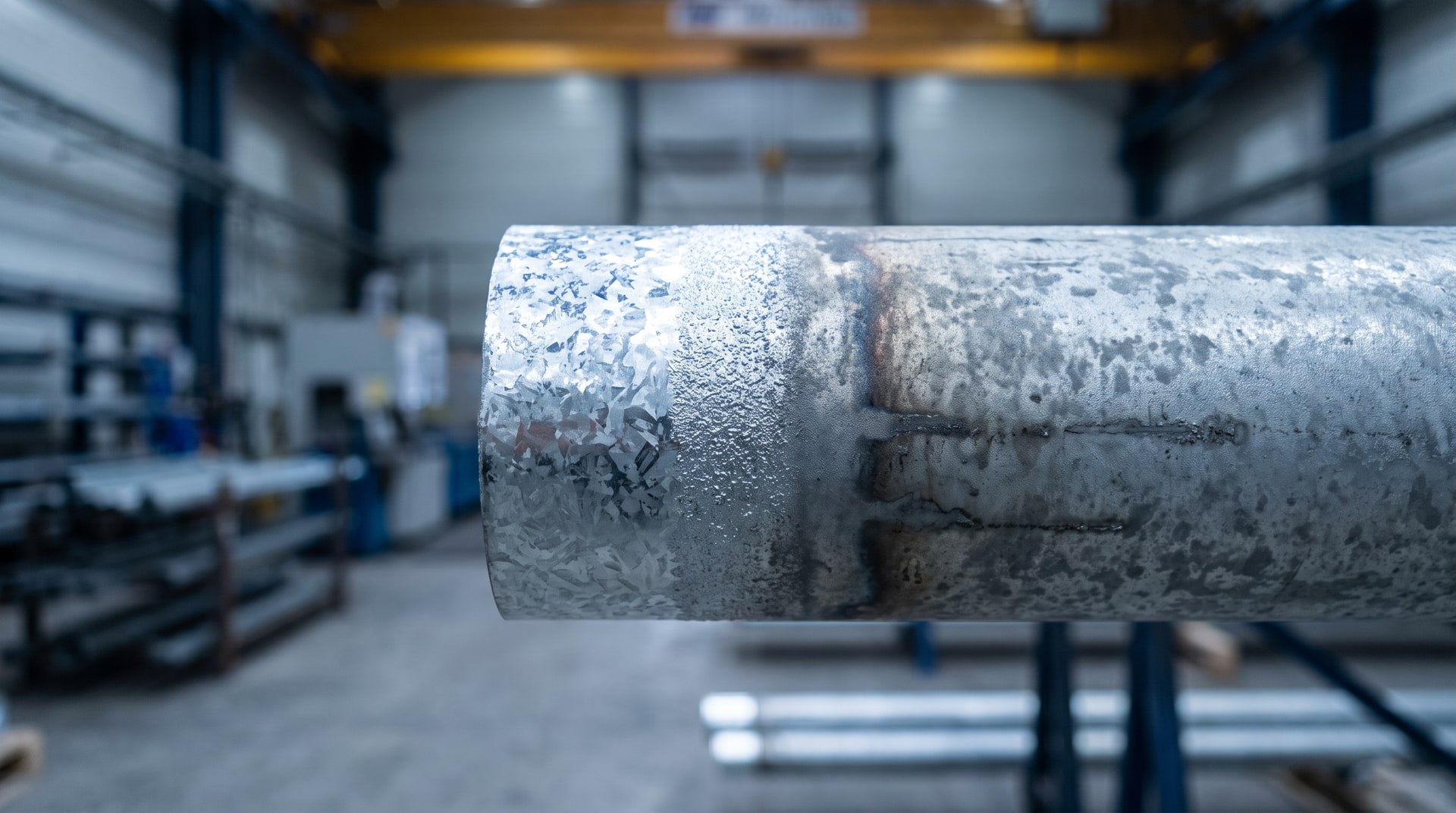
When galvanized steel comes out of the kettle, it rarely looks uniform. One section may be mirror-bright while the section bolted right next to it is a flat, matte gray. A tube might show spiral streaks of dull gray running along its length. A single beam could be half glossy, half chalky before it even leaves the facility. For engineers, fabricators, and inspectors who are not steeped in galvanizing metallurgy, this visual inconsistency can trigger immediate concern, and sometimes project delays, over what is actually a non-issue.
The underlying question is almost always the same: does the appearance tell us something meaningful about coating quality, or is it simply a surface-level artifact of chemistry and process? The answer matters enormously, because rejecting compliant material based on appearance alone wastes time and money, while missing a genuine defect creates real liability.
The American Galvanizers Association addresses this directly in their article on visual observations for finish and appearance. At V&S Galvanizing, we expand on that foundation to explain what is actually happening at the material level, how steel chemistry and processing history influence the final look of the coating, and why appearance-based judgments are so often misapplied in the field.
What ASTM A123 Actually Says About Appearance
ASTM A123 is the governing specification for hot-dip galvanized coatings on iron and steel products. Its primary acceptance criteria center on coating thickness, measured by magnetic gauge or weight, and on the absence of specific defects. What the specification does not do is mandate a particular surface color or gloss level.
This is a point that surprises many people encountering galvanized steel for the first time in a spec-checking role. The standard defines what the coating must accomplish, not what it must look like at the moment of delivery. A coating can be bright silver, flat gray, or show distinct zoning between those extremes, and still be fully compliant, provided it meets the thickness requirements and is free from uncoated areas, blistering, or other listed discontinuities.
That framing sets the context for everything else. Appearance is not irrelevant, but its relevance is narrow. It becomes a concern only when it signals an underlying structural problem with the coating, not when it simply reflects variation in steel chemistry or process conditions that have no bearing on performance.
The Metallurgical Reason Two Adjacent Pieces Look Different
Hot-dip galvanizing is not a paint or a simple surface deposit. When steel is immersed in molten zinc at approximately 830 degrees Fahrenheit, a series of intermetallic alloy layers forms at the steel-zinc interface through solid-state diffusion. These layers, composed of iron-zinc compounds of varying composition, build up from the steel surface outward. Atop those intermetallic layers, a free zinc layer may or may not form depending on how the steel responds to the process.
Steel chemistry plays a decisive role in which of those layers dominates the surface and how thick each becomes. Silicon and phosphorus content are the most influential variables. Steels with silicon content in certain ranges, commonly called Sandelin steels, tend to produce thicker intermetallic layers that grow rapidly and sometimes consume the free zinc layer entirely. The result is a coating that appears matte gray, sometimes with a rough texture, because the outermost surface is an iron-zinc intermetallic compound rather than pure zinc.
When fabricated assemblies include components made from different heats of steel, each with its own mill chemistry, the differences in appearance can be striking even though every piece was processed together in the same kettle under the same conditions. The AGA source article illustrates this clearly: products with connected galvanized pieces that look dramatically different from one another due to the steel chemistry of their respective sections, all while providing equal corrosion resistance and meeting the specification.
How Cooling Rate Produces Shiny and Dull Zones on the Same Part
Beyond steel chemistry, the rate at which a part cools after withdrawal from the zinc bath has a direct effect on the final surface appearance. When steel is pulled from the molten zinc and cooled relatively slowly, the zinc at the surface has time to solidify in a way that encourages the formation of large zinc crystals, sometimes called spangle. These produce the bright, spangled appearance familiar from galvanized sheet products.
When certain areas of a part cool more rapidly, perhaps because of geometry, mass distribution, or quenching practices, the free zinc layer can be preserved in a different crystalline state, or the intermetallic compounds near the surface behave differently. The net result is that on a single part, the outer edges or thinner sections may cool faster than the core or thicker sections, producing visible differences in gloss and color across a single piece of steel.
As the AGA article notes, the outer edges of a product cooled rapidly can allow a free zinc layer to form on top of the intermetallic layers. This gives those areas a brighter, more reflective appearance. The interior sections, cooling more slowly, may develop a more matte surface. Neither zone is defective. Both are protecting the underlying steel through the same fundamental electrochemical mechanism: zinc sacrificially corroding in preference to iron.
The practical takeaway is this: if you are inspecting galvanized steel and see a bright ring around the perimeter of a plate or a glossier surface on a thinner member, that is almost certainly a cooling rate artifact, not a coating failure. Coating thickness measurement will confirm it.
Why Processing History Leaves Visible Marks on the Coating
Steel does not arrive at a galvanizing facility in a chemically uniform, stress-free state. It carries the history of its manufacture. Cold drawing, rolling, welding, bending, punching, and other fabrication processes all introduce residual stresses and localized microstructural changes into the steel. These are invisible to the naked eye before galvanizing, but they become visible afterward.
The AGA source article describes this effect directly in the context of tubular steel. A top rail made from tube can show a winding pattern of dull gray areas corresponding to the process used during the tube's manufacture. The stresses introduced during tube forming affect how the intermetallic layers nucleate and grow in those regions. Where residual stress is higher, the iron-zinc reaction may proceed differently, producing zones with a different surface microstructure and therefore a different visual appearance.
The result can look like a spiral or helical stripe running along the length of the tube, following the geometry of the forming process. To someone unfamiliar with the mechanism, this looks like a processing error or an inconsistent coating. In practice, it is neither. The corrosion protection is intact throughout, and the part meets the specification. We see this pattern regularly in structural tubing, and it is one of the most commonly misidentified visual features during inspection.
The Role of Weathering in Normalizing Appearance
One of the more reassuring facts about galvanized steel is that the visual variation that concerns people at delivery largely disappears over time. Fresh galvanizing, regardless of whether it is bright or matte, begins to oxidize immediately upon exposure to the atmosphere. Zinc reacts with oxygen and moisture to form zinc oxide, and over weeks to months, zinc carbonate and other stable zinc compounds build up on the surface.
This patina, often called the zinc carbonate layer or the passive layer, is what gives long-weathered galvanized steel its characteristic uniform, dull gray color. It forms more quickly on areas that were matte gray to begin with, since the intermetallic surface has greater surface energy. On brighter areas, the process takes a bit longer, but the endpoint is the same: a consistent, stable gray surface that is one of the most corrosion-resistant films that zinc can form.
The AGA article confirms this directly: as the product weathers, the differences in appearance will become less noticeable and the overall color will turn a uniform, dull gray. For project owners or architects who are concerned about aesthetic inconsistency at delivery, this is an important point to communicate. The variation is transient. What they are seeing on the day of inspection is not what the structure will look like six months into service.
Distinguishing Cosmetic Variation from Actual Coating Defects
None of the above means that all visual anomalies are acceptable. ASTM A123 does identify specific conditions that constitute defects, and visual inspection is a legitimate and necessary part of the acceptance process. The key is understanding which visual conditions fall into which category.
Uncoated areas, bare spots where the zinc did not adhere due to surface contamination or inadequate preparation, are genuine defects that must be addressed. Blistering or peeling can indicate adhesion failure. Gross surface roughness that would interfere with the assembly or function of a part may also be cause for rejection under the specification, depending on the requirements specified in the contract documents.
By contrast, color variation between sections, matte versus bright surfaces, visible crystal structure, and processing-related stripe patterns are cosmetic. They do not indicate a failure of the galvanizing process. Experienced inspectors know to verify thickness with a magnetic gauge rather than making decisions based on gloss level. The appearance of a galvanized coating is informative context, but it is not a substitute for measurement.
For projects subject to formal inspection under ASTM A123, our team at V&S Galvanizing can walk fabricators and project teams through the acceptance criteria before material ships, which eliminates most disputes before they start. You can learn more about how we approach the galvanizing process at our hot-dip galvanizing services page.
Communicating Appearance Expectations Early in the Project
One of the most effective things a project team can do is establish appearance expectations before fabrication begins, not during inspection. This sounds straightforward, but it is frequently skipped. The result is that architects or owners who expect mirror-bright galvanizing are disappointed by a matte gray surface, even when that surface is technically superior in terms of coating thickness and corrosion performance.
If a specific aesthetic outcome matters, steel selection is the right lever to pull, not rejection of compliant material after the fact. Working with a galvanizer early in the design phase allows for conversations about steel chemistry, fabrication practices that might affect appearance, and what to realistically expect at delivery for a given application. We have had many of those conversations, and they consistently save time and prevent friction downstream.
Similarly, engineers specifying galvanizing on assemblies made from multiple steel sections or multiple heats should include a note in the specification acknowledging that appearance variation between sections is expected and does not constitute a basis for rejection, provided coating thickness requirements are met. This protects everyone involved and keeps the inspection focused on what actually matters.
Work With a Team That Understands What the Coating Is Doing
Visual variation in hot-dip galvanized steel is one of the most persistent sources of unnecessary project friction in structural and architectural work. It stems from a genuine and understandable gap: the coating looks inconsistent, and without metallurgical context, inconsistency reads as defect. But the physical chemistry of galvanizing is clear on this point. Steel chemistry, cooling rate, and fabrication history all influence surface appearance without affecting the corrosion protection that makes galvanizing one of the most reliable long-term coating systems available. What ASTM A123 requires is measurable coating thickness and freedom from specific structural defects, not visual uniformity.
At V&S Galvanizing, our team works with engineers, fabricators, architects, and inspectors every day to make sure galvanized steel is evaluated on the right criteria. If you have questions about a specific project, a particular surface appearance, or how to frame acceptance criteria in a specification, we are glad to help. Reach out through our contact page and we will get you the technical support you need.
Frequently Asked Questions About Galvanized Steel Appearance and ASTM A123
Does ASTM A123 require hot-dip galvanized steel to have a uniform color or gloss level?
No. ASTM A123 does not specify a required color or surface gloss. Its primary acceptance criteria are coating thickness and freedom from specific defects such as bare spots and blistering. Color variation between shiny and matte zones on the same part or across connected pieces is explicitly not a basis for rejection under the standard.
Why does one section of a galvanized assembly look bright silver while another looks flat gray?
The most common cause is a difference in steel chemistry between the two sections, particularly silicon and phosphorus content. These elements influence how the iron-zinc intermetallic layers form during galvanizing. Sections with certain silicon levels may develop thicker intermetallic layers that produce a matte gray surface, while lower-silicon steel tends to retain a bright free zinc outer layer. Both surfaces provide equivalent corrosion protection.
What causes spiral or stripe-shaped dull gray patterns on galvanized tubing?
This pattern reflects the residual stresses introduced during tube forming. The mechanical working of the steel during manufacture alters the local microstructure in a helical pattern that follows the forming geometry. When that steel is galvanized, the stress concentrations affect intermetallic layer formation in those zones, producing a visually distinct stripe. This is a cosmetic artifact of fabrication history, not a coating defect, and the parts meet the specification.
Will the visual differences between shiny and dull galvanized sections go away over time?
Yes. As galvanized steel weathers, zinc oxidizes and forms a stable zinc carbonate patina. This patina builds up uniformly across both shiny and matte surfaces over a period of weeks to months, resulting in the characteristic dull, uniform gray color of weathered galvanizing. The initial appearance differences visible at delivery are transient and do not persist in service.
Can cooling rate after galvanizing cause appearance differences on a single part?
Yes. Areas that cool more rapidly after withdrawal from the zinc bath, typically the outer edges or thinner sections of a part, may develop a brighter surface because the free zinc layer forms and solidifies differently under faster cooling. Slower-cooling interior sections may appear more matte. Neither condition indicates a problem with the coating; both protect the steel equally well.
How should an inspector distinguish a cosmetic appearance variation from an actual defect?
The most reliable method is coating thickness measurement using a calibrated magnetic gauge, evaluated against the ASTM A123 thickness requirements for the applicable material category. Genuine defects include bare uncoated areas, visible adhesion failure, and blistering. Color variation, gloss differences, and processing-related patterns are cosmetic and should not trigger rejection if thickness requirements are met.
Should fabricators with mixed-chemistry assemblies flag this to their galvanizer before processing?
Yes, and it is worth doing early. Informing the galvanizer that an assembly includes components from different steel heats or with known high silicon content allows the galvanizer to anticipate appearance variation and communicate it to the project team in advance. It also allows for more informed decisions about steel selection if aesthetic uniformity is a project requirement.
Does a matte gray galvanized coating perform worse than a shiny one?
No. A matte gray surface is typically the result of a thicker intermetallic layer, which in many cases means more total zinc coverage and equivalent or greater corrosion protection. The appearance does not correlate to performance. Both bright and matte galvanized coatings rely on the same electrochemical mechanism: zinc corrodes sacrificially to protect the underlying steel, regardless of the surface's visual character.
