

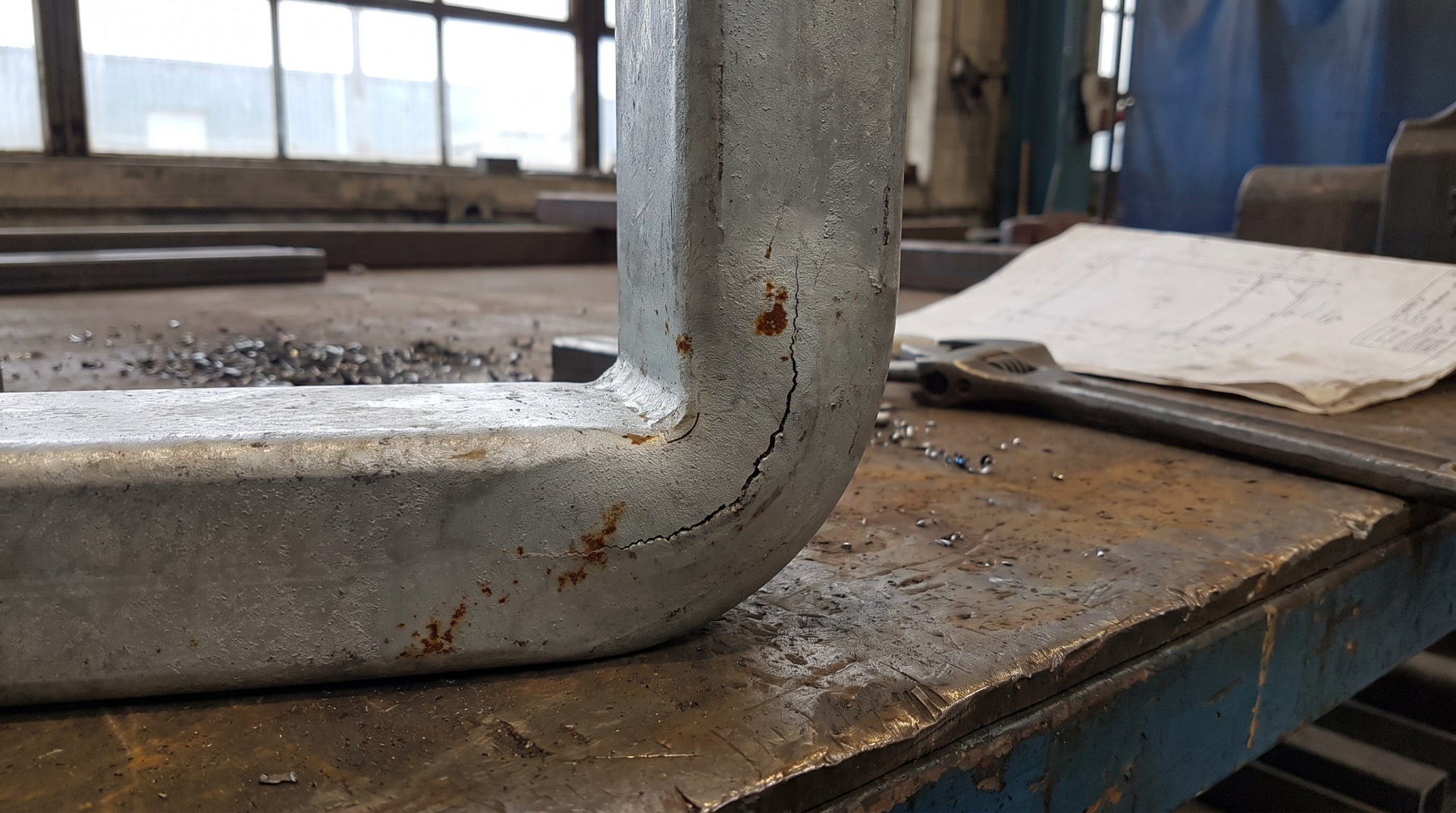
Cracking in galvanized steel parts is one of those problems that tends to generate more heat than light. When a fabricator or engineer discovers a crack in a hot-dip galvanized component, the instinctive response is often to point at the galvanizing process itself. From there, the label 'hydrogen embrittlement' gets applied, almost reflexively, regardless of whether the evidence actually supports it. That misidentification is a problem, because each type of embrittlement has a distinct cause, a distinct mechanism, and a distinct set of corrective measures. Treating them as interchangeable leads to fixes that address the wrong problem entirely.
Embrittlement in steel is not a single phenomenon. It is a family of related but mechanistically different failure modes, each governed by its own set of material properties, thermal conditions, and fabrication histories. Understanding those distinctions is what allows engineers and fabricators to trace a crack back to its actual origin and make targeted design or process changes that prevent recurrence.
The American Galvanizers Association addresses this directly in their article on the different forms of embrittlement in hot-dip galvanized steel. At V&S Galvanizing, we expand on that foundation to explain what is actually happening at the material level, how tensile strength and cold-working history influence susceptibility, and why the most commonly cited cause of embrittlement is frequently the wrong diagnosis in practice.
Why the Term 'Hydrogen Embrittlement' Gets Overused
Hydrogen embrittlement is well-known enough in the engineering world that it has become the default explanation for cracking in steel that has been through any kind of chemical processing. Hot-dip galvanizing involves acid pickling during surface preparation, and pickling does introduce hydrogen into the steel. So the logical leap to hydrogen embrittlement feels natural. The problem is that logical leap skips over a critical condition: not all steel is susceptible to hydrogen embrittlement, and the vast majority of steel that gets galvanized falls well outside the susceptibility range.
The determining factor is tensile strength. Steels with tensile strengths above 150,000 psi (1,100 MPa) are susceptible to hydrogen embrittlement. More recent industry research has indicated that threshold is closer to 170 ksi (1,170 MPa), though the formal publication of that revised figure was still pending at the time the AGA's source article was written. The mechanism behind that threshold comes down to grain structure: higher tensile strength steels have finer grain structures, and those tighter grain boundaries create spaces where absorbed hydrogen can become trapped even after the steel is heated. In lower-strength steels, the grain boundaries are coarser, and heating to galvanizing temperatures is sufficient to allow the hydrogen to diffuse out before it can do damage.
In practical terms, the steels susceptible to hydrogen embrittlement are specialty grades used for fasteners, anchor rods, and components engineered to carry extreme tensile loads. Structural steel sections, tube steel, angle iron, plate, and most fabricated assemblies operate at tensile strengths far below those thresholds. For those materials, hydrogen embrittlement is not a realistic concern. That does not mean cracking cannot occur, only that hydrogen is almost certainly not the cause.
The Mechanism Behind Hydrogen Trapping in High-Strength Steel
It is worth understanding the physical mechanism here, because it clarifies why tensile strength is the line of demarcation rather than some other metallurgical property. When steel is pickled in acid during surface preparation, a byproduct of the acid reaction is nascent hydrogen. Some of that hydrogen is absorbed into the steel matrix. In most structural steels, when the material enters the galvanizing kettle at temperatures around 840°F (449°C), the thermal energy is enough to mobilize the trapped hydrogen and allow it to escape through the grain boundaries before the zinc coating seals the surface.
In high-strength steels, the grain structure is refined to such a degree that the intergranular spaces are essentially too small to allow rapid hydrogen diffusion, even at elevated temperatures. The hydrogen becomes mechanically trapped. Once the galvanized part is placed into service and subjected to tensile loading, the trapped hydrogen migrates toward regions of high triaxial stress at the tips of any existing microdefects. There, it reduces the cohesive strength of the metal lattice, allowing a crack to initiate and propagate at stresses well below what the unaffected steel could tolerate. The failure can be delayed, sometimes by hours or days after the load is applied, which makes diagnosis more difficult.
This delayed-fracture characteristic is one of the reasons hydrogen embrittlement is worth understanding thoroughly even if it applies to a narrow range of steel. When it does occur, the failure mode is often unexpected in timing, and the connection to the galvanizing process may not be immediately obvious.
Strain-Age Embrittlement: The Most Common Culprit
Once hydrogen embrittlement is properly set aside for the cases where it genuinely does not apply, a different mechanism moves to the front of the line as the most frequent explanation for cracking in galvanized assemblies: strain-age embrittlement. This is the type most likely responsible for the tube cracking described in the AGA's source article, and it is the form that our team sees arise most often in real fabrication situations.
Strain-age embrittlement is the result of residual stresses locked into steel during cold working. When steel is bent, punched, rolled, or otherwise deformed at ambient temperatures, the material at stress concentration points, corners of bends, edges of punched holes, weld heat-affected zones, and similar locations develops locally elevated internal stresses. Those stresses do not resolve on their own at room temperature; they remain locked in the microstructure.
When that stressed steel enters the galvanizing kettle, the heat provides enough energy to partially relieve those residual stresses. Partial relief sounds beneficial, but it is actually the problem: stress relief that is incomplete and rapid can allow the built-up strain energy to drive crack initiation and propagation at the stress concentrations before the steel has a chance to redistribute that load safely. The result is cracking that appears during or immediately after galvanizing, in the exact locations where cold-working operations introduced the highest stresses.
For tube steel specifically, the fabrication process typically involves rolling or bending flat plate into a tubular form at ambient temperature. The corners and seam weld areas are where stress concentrations naturally accumulate, and those are precisely the locations where strain-age cracking tends to initiate. The tensile strength of that steel is well below the hydrogen embrittlement threshold, which makes strain-age embrittlement the correct diagnosis in cases like these.
How Fabricators Can Prevent Strain-Age Embrittlement
The good news is that strain-age embrittlement is preventable through deliberate choices at the fabrication stage. There are two primary paths, and which one makes sense depends on the production context.
The first is thermal stress relief before galvanizing. If steel has been cold-worked, heating it to 1,100°F (593°C) for a duration of one hour per inch of cross-sectional thickness will fully relieve the residual stresses introduced by the cold-working operation. Completing that heat treatment before the steel arrives at the galvanizing plant removes the conditions that drive strain-age cracking. The steel enters the kettle without the locked-in stress energy that would otherwise seek release during galvanizing.
The second path is to avoid cold working in the first place by using hot-working or hot-forming operations instead. When steel is formed at elevated temperatures, the metal is in a plastic state that allows deformation to occur without creating the concentrated residual stresses characteristic of cold forming. Stress concentrations do not develop at bend corners or hole edges to the same degree, and the resulting fabrication does not carry the elevated internal stress field that creates vulnerability to strain-age cracking.
In practice, deciding between these two approaches involves a straightforward tradeoff of cost, lead time, and production capabilities. Hot working requires different equipment and planning. Stress-relief heat treatment adds a processing step and must be sequenced correctly relative to other fabrication operations. Neither option is universally superior; the right choice depends on the specific part geometry, the alloy, and the production environment. What matters is that the choice be made deliberately and with awareness of the consequence if it is skipped.
Liquid-Metal Embrittlement and Why It Is Not a Galvanizing Concern
Liquid-metal embrittlement is a real phenomenon, but it is one that operates under conditions quite different from those in a standard galvanizing operation. The mechanism involves molten metal penetrating the grain boundaries of a solid metal substrate, reducing cohesive strength and initiating cracking. In general materials engineering, certain metal-liquid combinations at elevated temperatures can produce this effect.
Within the context of hot-dip galvanizing, liquid-metal embrittlement is not a concern for steel. The evidence for this is essentially empirical and historical: steel has been galvanized in molten zinc for close to 150 years, and the process does not produce liquid-metal embrittlement of the steel substrate. Zinc and steel simply do not constitute a metal-liquid system that generates this failure mode under galvanizing conditions. Other metal combinations may be susceptible, and those combinations often involve temperature ranges significantly above what a galvanizing kettle operates at, but that is a separate discussion.
For engineers and fabricators working with hot-dip galvanized steel, liquid-metal embrittlement can be acknowledged and then set aside. It is worth knowing what it is so the terminology is not confused with other forms, but it does not require preventive design or process measures for galvanizing applications.
The Catch-All Term: 'Galvanizing Embrittlement'
The term 'galvanizing embrittlement' appears in technical discussions and failure reports with some frequency, but it is not a mechanistically distinct form of embrittlement. It is a catch-all classification that simply means embrittlement observed in a part that has been galvanized. By itself, that label tells you nothing about cause, mechanism, or corrective action.
The problem with relying on this general term is that it stops the diagnostic process before it reaches anything useful. If a part cracks and the report says 'galvanizing embrittlement,' the next question still has to be: which kind? Was it strain-age cracking driven by residual stress from cold forming? Was it hydrogen embrittlement in a high-strength fastener? Until the specific mechanism is identified, no meaningful corrective measure can be designed. Calling something 'galvanizing embrittlement' without further classification is, in effect, an incomplete diagnosis.
Our team's approach when we encounter cracking in galvanized parts is to work through the diagnostic sequence systematically: What is the tensile strength of the material? Was it cold-worked prior to galvanizing? Was stress relief performed? Where on the part is the cracking located, and does that location correspond to a stress concentration point from fabrication? Answering those questions in order usually points clearly to the actual mechanism, which then points clearly to the fix.
Material Selection and Its Role in Embrittlement Risk
Steel selection is the upstream decision that has the greatest influence on embrittlement risk. For most structural and architectural applications, the steel specified operates at tensile strengths well below any embrittlement threshold, and the primary risk to manage is the fabrication process rather than the material itself. Cold-working operations on standard structural steel need to be followed by appropriate stress relief if the severity of the deformation is high enough to create concern.
For high-strength applications, particularly fasteners, anchor rods, and post-tensioning hardware, the material selection decision carries more consequence. If the application requires steel above the 150 ksi to 170 ksi tensile strength range and that steel must be galvanized, the combination requires explicit attention to pickling time, hydrogen bake-out procedures, and possibly alternative surface preparation methods that reduce hydrogen uptake. These are engineering decisions that should be made before fabrication and galvanizing begin, not investigated after a failure.
Working closely with the galvanizing team during design and specification development is the most reliable way to catch these situations early. When we know the tensile strength of the material and the cold-working history of a fabrication before it arrives, we can flag potential concerns and coordinate on mitigation measures rather than discovering the problem on the plant floor.
Work With a Team That Understands Embrittlement at the Source
Embrittlement is one of those topics where surface-level familiarity creates more problems than it solves. Knowing that 'hydrogen embrittlement exists' without understanding the tensile strength threshold leads to misdiagnosis. Knowing that 'galvanizing can cause cracking' without understanding the role of cold-working history and stress relief leads to unfounded blame on the galvanizing process. Getting to the right answer requires working through the actual mechanism, material by material and fabrication method by fabrication method.
At V&S Galvanizing, we bring that level of technical engagement to every project that raises embrittlement concerns. We understand that cracking discovered after galvanizing almost always has a root cause that predates the galvanizing step, and we can work with engineers and fabricators to identify it correctly and implement targeted corrective measures for future production runs. If you are dealing with cracking in galvanized steel, or if you want to evaluate a design before fabrication begins, reach out through our contact page and let us work through it with you.
Frequently Asked Questions About Embrittlement in Hot-Dip Galvanized Steel
What tensile strength threshold makes steel susceptible to hydrogen embrittlement during galvanizing?
Steels with tensile strengths above 150,000 psi (1,100 MPa) are susceptible to hydrogen embrittlement. More recent industry research has moved that threshold upward to approximately 170 ksi (1,170 MPa). Below those values, the grain structure is coarse enough that hydrogen absorbed during acid pickling can diffuse out when the steel is heated to galvanizing temperature, making hydrogen embrittlement highly improbable.
Why does strain-age embrittlement occur specifically during or after galvanizing?
Steel that has been cold-worked carries residual stresses locked into the microstructure at stress concentration points such as bend corners and punched holes. When that steel enters the galvanizing kettle, the heat provides enough energy to partially relieve those stresses. That partial, rapid stress relief can drive crack initiation at the stress concentrations before the steel redistributes the load safely. The cracking appears to be caused by galvanizing, but the actual root cause is the unrelieved residual stress from cold working.
How do you perform stress relief to prevent strain-age embrittlement before galvanizing?
Heat the cold-worked steel to 1,100°F (593°C) and hold it at that temperature for one hour per inch of cross-sectional thickness. This thermal treatment fully resolves the residual stresses introduced by cold working and effectively eliminates the risk of strain-age cracking during subsequent galvanizing. The treatment must be completed before the steel goes to the galvanizing plant to be effective.
Can hot working instead of cold working eliminate strain-age embrittlement risk?
Yes. When steel is formed at elevated temperatures rather than at ambient temperature, the metal deforms in a plastic state without creating the localized residual stress concentrations that cold working produces. Bend corners and punched or formed edges do not accumulate the same level of internal stress, so the driving force for strain-age cracking is largely absent. Hot working is an alternative to thermal stress relief, not a complement to it; the two approaches address the same underlying problem through different means.
Does molten zinc cause liquid-metal embrittlement in steel during hot-dip galvanizing?
No. Zinc and steel do not form a combination that produces liquid-metal embrittlement under standard galvanizing conditions. This has been confirmed by nearly 150 years of industrial galvanizing practice without this failure mode occurring in steel substrates. Liquid-metal embrittlement is a real phenomenon in some metal combinations, but it is not a concern for steel immersed in molten zinc at galvanizing temperatures.
What does the term 'galvanizing embrittlement' actually mean, and is it a useful diagnosis?
'Galvanizing embrittlement' is a general term for any embrittlement observed in a part that has been galvanized. It is not a mechanistically distinct failure mode. Without further classification into hydrogen embrittlement, strain-age embrittlement, or another specific type, the term carries no diagnostic value and cannot guide corrective action. Treating it as a final diagnosis stalls the investigation before reaching anything actionable.
How can an engineer determine which type of embrittlement caused cracking in a galvanized part?
Start by identifying the tensile strength of the material. If it is below 150 ksi to 170 ksi, hydrogen embrittlement is highly improbable. Then assess the fabrication history: was the part cold-worked? Were stress relief procedures performed? Examine where the cracks are located; strain-age cracking typically initiates at cold-formed corners, punched holes, or other stress concentration points. That sequence of questions, answered in order, almost always points to the correct mechanism.
Are fasteners treated differently than structural steel when it comes to embrittlement risk during galvanizing?
Yes. High-strength fasteners and anchor rods are the category of steel most likely to fall above the tensile strength threshold for hydrogen embrittlement. When those components must be galvanized, the galvanizing process needs to account for hydrogen uptake during pickling, and post-galvanizing bake-out or other mitigation measures may be required. Standard structural steel sections used in most fabricated assemblies operate well below those thresholds and do not require the same level of concern for hydrogen embrittlement specifically.
