

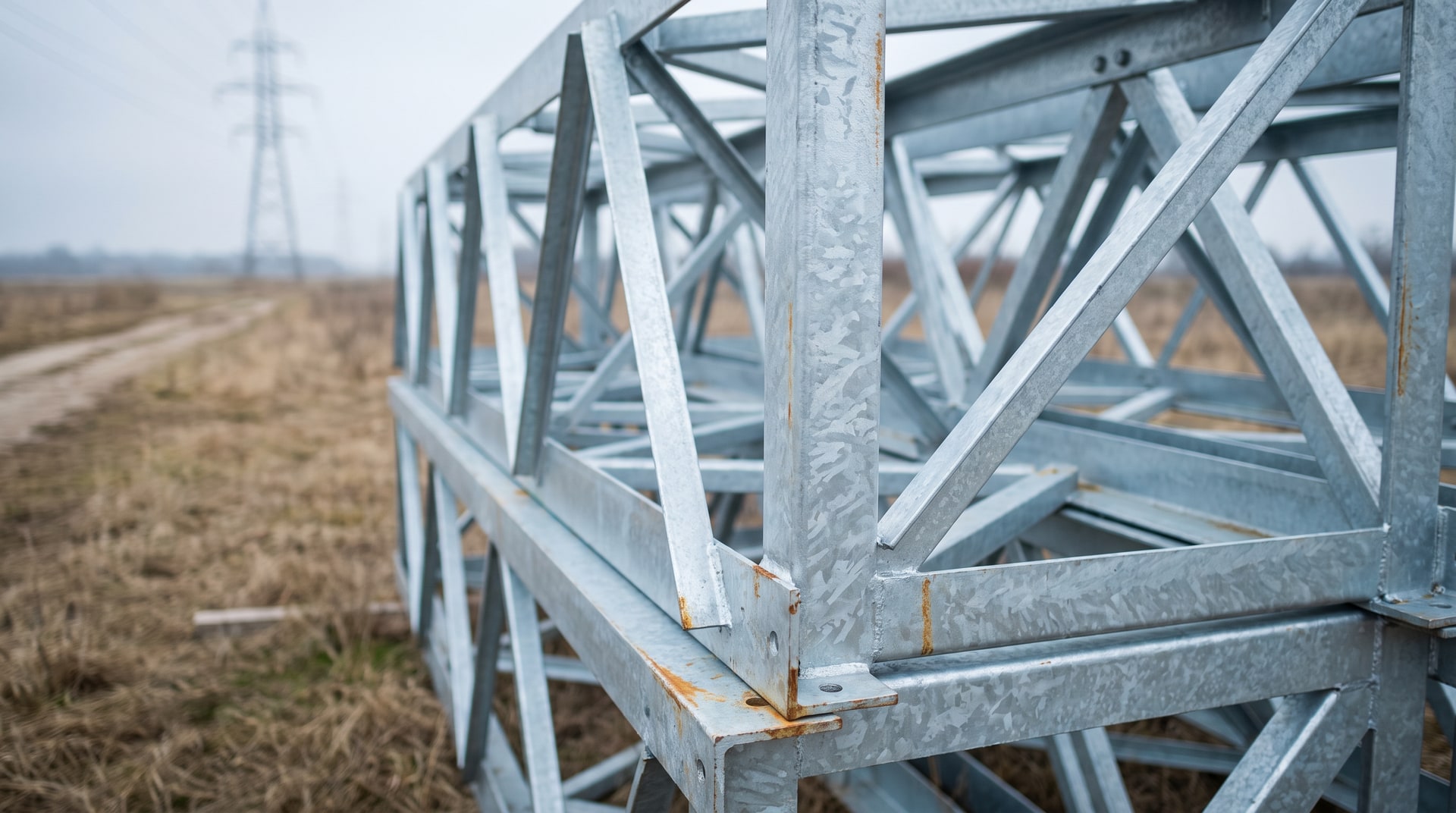
Most of the conversation around hot-dip galvanizing focuses on maximizing coating quality: achieving full coverage, appropriate thickness, and a clean, adherent surface. So it might seem counterintuitive to ask how to make a galvanized part look less impressive. But that is exactly the question that came to the forefront in the electrical transmission line industry decades ago, when engineers and environmental agencies began raising concerns about the intense reflectivity of newly galvanized steel structures installed in open rural and wilderness settings.
A freshly galvanized part with a pure zinc outer layer reflects more than 70% of visible light. That is a significant optical signature, and in the wrong context, it creates real problems: distracted or flash-blinded drivers near roadways, and ecological disruption in sensitive landscapes where bright metallic towers were considered visually intrusive. The target reflectivity specified by some agencies dropped to just 12% to 18%, which required active intervention rather than waiting for natural weathering to do the job.
The American Galvanizers Association addresses this directly in their article on dulling galvanized steel. At V&S Galvanizing, we expand on that foundation to explain what is actually happening at the material level, how the zinc coating structure influences reflectivity, and why this topic is often misunderstood in the field.
Why Newly Galvanized Steel Is So Reflective
To understand dulling, you first need to understand what you are looking at on the surface of a freshly galvanized part. When steel is withdrawn from a molten zinc bath and cooled under standard conditions, the outermost layer of the coating is composed of relatively pure zinc. This layer is metallurgically distinct from the intermetallic alloy layers that form beneath it at the steel-zinc interface during the galvanizing reaction.
Pure zinc, like many metals, has a crystalline structure that produces a smooth, specular surface at the microscopic level. That smooth metallic surface is what creates the mirror-like reflectivity, measured at over 70% in the visible spectrum. For comparison, the natural reflectivity of aluminum runs between 80% and 85%, so freshly galvanized steel occupies a similar optical range to polished aluminum sheeting.
When the outer zinc layer oxidizes over time, zinc oxides and zinc carbonate films develop on the surface. These corrosion products are matte and non-specular, which is why galvanized steel gradually loses its shine in outdoor exposure and transitions to the familiar dull gray patina. That natural weathering process is exactly what dulling treatments attempt to accelerate or replicate in a controlled way before the part leaves the shop.
The Industrial Context That Drove This Requirement
The historical context here is worth understanding, because it explains both why this issue became formalized and why the reflectivity thresholds are what they are. As early as the 1970s, at least four separate power companies and governmental agencies were requiring that galvanized products be dulled to between 12% and 18% reflectivity before field installation. That is a dramatic reduction from the baseline of over 70%.
The Bonneville Power Administration, a Department of Interior agency operating in the Pacific Northwest, was among the organizations that sent formal correspondence to galvanizers and the AGA documenting these requirements. Two distinct concerns drove the policy. The first was driver safety: electrical transmission towers situated near highways could reflect sunlight in ways that momentarily blinded motorists, a genuine road hazard. The second concern was environmental and aesthetic, rooted in the argument that highly reflective towers were disruptive to wilderness areas and the wildlife within them.
These requirements forced the industry to develop and document practical dulling methods that could be applied reliably, at scale, without compromising the protective function of the zinc coating. That pressure produced the range of approaches we still reference today.
Chemical Treatments Applied After Galvanizing
Several post-galvanizing chemical treatments have been developed to reduce surface reflectivity, each working through a different mechanism at the zinc surface.
One of the earliest documented methods uses a solution of copper sulfate and hydrochloric acid. The formulation calls for dissolving three pounds of copper sulfate crystals in one gallon of water, then adding a half pint of concentrated hydrochloric acid. This mixture is sprayed directly onto the freshly galvanized surface and immediately rinsed off. The reaction is rapid, which is why the immediate rinse is critical. The treatment deposits a darkened surface layer, effectively producing a black coating that substantially reduces reflectivity.
A simpler chemical approach involves immersing parts in a 1% nitric acid solution for 90 seconds. This mild acid treatment etches the zinc surface lightly, breaking up the smooth crystalline structure responsible for specular reflection and producing a more diffuse, matte finish. The 90-second contact time is specific and should not be extended arbitrarily, as over-treatment risks attacking more of the coating than intended.
A third chemical option is zinc phosphate treatment, sometimes called phosphatizing. This process converts part of the outer zinc surface into a zinc phosphate crystalline layer, which is inherently non-reflective. Phosphate coatings are also frequently used as a primer adhesion promoter before painting, so in some application scenarios this method serves double duty. All three of these chemical methods share one important constraint: they are not effective on quenched parts that have received a chromate conversion coating. The chromate layer chemically alters the zinc surface in a way that interferes with subsequent dulling treatments, so the sequence of operations matters.
Primer Coats as a Practical Field Solution
For situations where chemical post-treatment is impractical, particularly for large structural assemblies already in the field or for projects where the chemical handling infrastructure is not available, applying a primer coat is a straightforward alternative. There are commercially available primer formulations that will darken the galvanized surface adequately to meet reflectivity reduction targets.
These primers can be spray-applied in the field without specialized equipment beyond a standard spray setup, which makes them accessible on construction sites. From a technical standpoint, this approach has the additional benefit of initiating a duplex coating system, where the primer serves as both a dulling agent and the first layer of a paint system over galvanized steel. If a full topcoat follows, the result is a hot-dip galvanized substrate protected by both the zinc corrosion barrier and an organic coating, which typically extends service life significantly beyond either system alone.
The practical caution with primers is surface preparation compatibility. Most primers applied over galvanizing perform best when the zinc surface has some profile or chemical conversion to promote adhesion. A freshly galvanized, smooth pure zinc layer can present adhesion challenges depending on the primer type, so it is worth confirming that the selected primer is formulated specifically for galvanized steel or that appropriate surface preparation has been performed.
Process Controls During Galvanizing That Reduce Reflectivity
Not all dulling has to happen after the part leaves the kettle. Several adjustments to the galvanizing process itself can reduce surface reflectivity, though with some important caveats about the degree of control achievable.
Cooling rate is one of the most significant variables. When a galvanized part is cooled slowly, without quenching, the intermetallic alloy layers that form at the steel-zinc interface continue to grow even after the part is withdrawn from the bath. The intermetallic phases (iron-zinc compounds including the eta, zeta, delta, and gamma layers in the coating cross-section) have a very different surface character than pure zinc. They are harder, more granular, and substantially less reflective. Allowing these phases to grow toward the surface by slowing the cooling process naturally dulls the coating without any post-treatment.
The composition of the zinc bath also plays a role. Brightener bars, typically zinc alloy additions, are used to promote a smooth, spangle-free, high-purity zinc outer layer. Reducing or eliminating brightener additions shifts the surface character in the direction of a duller finish.
Steel chemistry is arguably the most powerful natural influence on coating appearance and reflectivity. Steel with elevated silicon content, particularly steel in the range commonly associated with reactive galvanizing behavior, tends to produce coatings that are almost entirely intermetallic in cross-section with very little or no free zinc outer layer. These coatings are characteristically dull gray and rough, which aligns well with low-reflectivity requirements. The trade-off is that silicon-reactive coatings can be thicker and less predictable to control, and the dulling effect is a byproduct of the steel chemistry rather than a parameter the galvanizer can independently dial in.
Over-chemical cleaning, meaning more aggressive or extended exposure to the pretreatment acids, also tends to produce a rougher, more matte surface on the finished coating. However, this is not a precision technique and should not be applied indiscriminately, as excessive pretreatment can affect steel surface integrity.
Critically, none of these in-process techniques reliably achieve the 12% to 18% reflectivity targets specified by agencies like the Bonneville Power Administration across all situations. They should only be relied upon after explicit agreement with the customer about what is achievable, and they should be verified by measurement before parts ship.
The Tannic Acid Observation and What It Suggests
One of the more unexpected observations in the history of galvanizing surface behavior involves the interaction between freshly galvanized steel and green wood. When newly galvanized parts are stacked directly on green lumber, the tannic acid present in the wood migrates to the zinc surface and stains it brown. This is generally considered a storage and handling problem to be avoided, but it pointed researchers and galvanizers toward an interesting possibility.
The underlying chemistry is straightforward: tannic acid, a naturally occurring polyphenol found in many plant materials including tea, reacts with zinc to form zinc tannate compounds on the surface. These compounds are dark, matte, and essentially non-reflective. The observation led to the theoretical suggestion that tea could serve as a quenching medium for galvanized parts, producing a low-reflectivity coating through a natural organic reaction. As of the time of writing, there is no established industrial practice using tannic acid in this way, but the concept illustrates how the zinc surface chemistry can be altered through relatively benign organic compounds.
For the practicing engineer or galvanizer, the wood staining observation carries a more immediate practical lesson: contact between freshly galvanized parts and tannic acid sources during storage will alter the surface appearance, even if the zinc coating itself remains intact and protective. Specifying appropriate storage practices in contract documentation helps prevent appearance complaints that have nothing to do with the galvanizing quality itself.
Reflectivity Measurement and Verification
When a project specification requires a defined reflectivity range such as 12% to 18%, that target needs to be verified through measurement rather than assumed based on appearance. Reflectivity is measured with a reflectometer, an instrument that quantifies the percentage of incident light returned from a surface at a defined angle.
The measurement protocol matters because surface reflectivity is angle-dependent. A surface that appears matte under diffuse lighting may still have localized specular reflection at certain angles. Specifications should define both the target reflectivity percentage and the measurement geometry to avoid ambiguity. When submitting treated samples for approval, it is worth confirming with the specifying agency whether measurements should be taken at a single angle or averaged across multiple angles.
For the galvanizer accepting a project with dulling requirements, establishing measurement expectations before production begins avoids disputes at delivery. If the treatment method selected is a chemical post-treatment like copper sulfate or nitric acid dip, running sample panels and confirming reflectivity values against the specification before processing production parts is standard practice. In-process controls alone, as noted above, cannot reliably hit the narrower reflectivity bands without supplementary chemical treatment or priming.
Work With a Team That Understands Coating Appearance Specifications
Dulling is a relatively specialized requirement, but it is not an unusual one. Transmission infrastructure, highway structures, bridge components, and other installations in visually sensitive or safety-critical environments have all carried reflectivity specifications at various points. Understanding which treatment methods are appropriate, how the zinc coating structure influences baseline reflectivity, and where process controls reach their limits is knowledge that belongs in the conversation early, not after parts are already galvanized and on a truck.
At V&S Galvanizing, we work through these kinds of project-specific coating requirements with engineers and fabricators before production begins. Whether the concern is meeting a defined reflectivity target, coordinating dulling with downstream primer or paint application, or simply understanding what a specification is asking for, our team can provide the technical clarity and production coordination needed to get it right. Reach out through our contact page to discuss your project requirements.
Frequently Asked Questions About Dulling Galvanized Steel
What is the natural reflectivity of freshly galvanized steel, and why is it so high?
Freshly galvanized steel with a pure zinc outer layer reflects more than 70% of visible light. This is because the outer pure zinc layer has a smooth, specular metallic surface at the microscopic level, similar in optical character to polished aluminum, which reflects 80% to 85% of visible light. The reflectivity decreases naturally over time as zinc oxide and zinc carbonate films form during outdoor weathering.
What reflectivity target is typically required for galvanized transmission towers near roadways?
Agencies including the Bonneville Power Administration have specified a reflectivity range of 12% to 18% for galvanized structures installed in rural and wilderness settings. This is a substantial reduction from the baseline of over 70% and cannot be achieved through process controls alone in most cases. Active post-treatment or priming is generally required to reliably hit this target.
Does quenching after galvanizing affect dulling treatment effectiveness?
Yes, significantly. When parts are quenched and receive a chromate conversion coating as part of that quench process, the altered zinc surface chemistry makes subsequent chemical dulling treatments ineffective. If a project requires post-galvanizing dulling treatment, the galvanizer should avoid chromate quenching, and this coordination needs to happen before production begins.
How does steel silicon content influence galvanized coating reflectivity?
Steel with elevated silicon content tends to produce galvanized coatings that are nearly all intermetallic in cross-section, with little or no free zinc outer layer. Intermetallic iron-zinc phases are harder, rougher, and much less reflective than pure zinc. This produces a characteristically dull gray coating. However, silicon-reactive coatings come with trade-offs including variable thickness and less precise control, so relying on steel chemistry to meet a specific reflectivity specification requires careful discussion with the galvanizer.
Can in-process controls alone meet a 12% to 18% reflectivity specification?
Not reliably. In-process adjustments such as slow cooling, reduced brightener additions, and steel chemistry selection can shift the coating toward a duller appearance, but these methods do not consistently achieve the 12% to 18% reflectivity range across all part geometries and steel types. Chemical post-treatments or primer application are generally needed when a specific low-reflectivity target must be verified and documented.
What causes galvanized steel stacked on green wood to stain brown?
Green lumber contains tannic acid, a naturally occurring polyphenol that reacts with the zinc surface to form zinc tannate compounds. These compounds are dark and matte, producing brown staining on the freshly galvanized surface. While this is typically treated as a storage defect to avoid, it demonstrates that tannic acid can alter zinc surface reflectivity and has prompted theoretical interest in controlled tannic acid application as a dulling method, though no established industrial practice currently exists for this approach.
If I prime over galvanized steel to dull it, does that create a duplex system?
Yes. Applying a primer over galvanized steel initiates a duplex coating system, where the zinc layer provides cathodic and barrier corrosion protection while the organic primer (and any subsequent topcoat) provides additional barrier protection. This combination typically extends service life beyond either system used alone. It is important to select a primer formulated for compatibility with galvanized steel surfaces and to confirm that the galvanized surface has appropriate adhesion characteristics before application.
How should reflectivity be measured to verify compliance with a dulling specification?
Reflectivity is measured using a reflectometer, which quantifies the percentage of incident light returned from a surface. Because reflectivity is angle-dependent, the specification should define both the target percentage range and the measurement geometry. Galvanizers accepting dulling specifications should confirm measurement protocols with the specifying agency before production, and should run verification samples before processing full production quantities.
