
When a fabricator or contractor contacts a galvanizer convinced that the zinc coating has destroyed their steel, the conversation can deteriorate quickly. This kind of dispute is more common than most people in the industry expect, and it rarely starts with a clear-cut answer. Steel that arrives at a job site with cracks, dimensional problems, or surface irregularities gets scrutinized, and the galvanizing step is often the first thing to get blamed. That reaction is understandable. Galvanizing involves submerging steel in a bath of molten zinc at roughly 840°F (449°C), and to someone unfamiliar with the process, it is easy to assume that kind of thermal exposure is responsible for anything that went wrong afterward.
What actually happens in most of these cases is more nuanced. The hot-dip galvanizing process can reveal pre-existing conditions in the steel that were invisible beforehand, and it can accelerate certain behaviors in steel that was already compromised before it ever reached the kettle. Understanding the difference between a galvanizing defect and a steel or fabrication problem is not just about protecting the galvanizer. It is about getting to an accurate answer that everyone on a project team can act on.
The American Galvanizers Association addresses this directly in their article on troubleshooting possible coating failures. At V&S Galvanizing, we expand on that foundation to explain what is actually happening at the material level, how fabrication history influences how steel behaves during and after galvanizing, and why disputes like these are often misunderstood or mishandled in the field.
Why Galvanizing Gets Blamed First
Fabricators and specifiers who are not deeply familiar with the hot-dip galvanizing process tend to fill in gaps in their knowledge with stories they have heard secondhand. Someone on another project had a problem. A colleague mentioned a galvanizing failure. Those anecdotes create a mental model where galvanizing is a risky, unpredictable step that can ruin steel. That framing makes it very easy to attribute any post-galvanizing problem to the zinc bath without investigating further.
The reality is that the galvanizing process follows tight metallurgical principles. The zinc coating forms through a series of iron-zinc alloy layers that develop at the surface during immersion. The process is well understood and well documented. Problems that appear after galvanizing are far more likely to trace back to the steel's composition, its fabrication history, or how it was designed than to anything that happened inside the kettle. That does not make the galvanizer automatically blameless in every case, but it does mean that accusations should be tested rather than accepted.
Starting With Documentation and Communication
The single most important thing a galvanizer can do when a customer raises a complaint is to establish a clear, documented record of the situation from the beginning. That means reaching out to every party involved: the customer, the structural engineer, the steel fabricator, the steel manufacturer if necessary, and any inspection or testing party that needs to be brought in. Every communication matters. Emails, photographs, inspection reports, delivery records, and any memorandums should be retained and organized from the moment a complaint surfaces.
This is not just defensive record-keeping. Documentation creates the foundation for an objective investigation. When everyone agrees on what the steel looked like at each stage, what testing was performed, and what the results showed, it becomes much easier to isolate where the problem actually originated. Without that shared record, the conversation tends to stay in the realm of competing opinions, and those situations rarely resolve well for anyone.
The goal at this stage is straightforward: find out what the complaint actually is, determine whether it can be corrected, and then work to understand the root cause so it does not happen again. That sequence matters. Trying to assign blame before understanding the mechanism rarely produces useful answers.
A Real Case: I-Beams With Severe Cracking
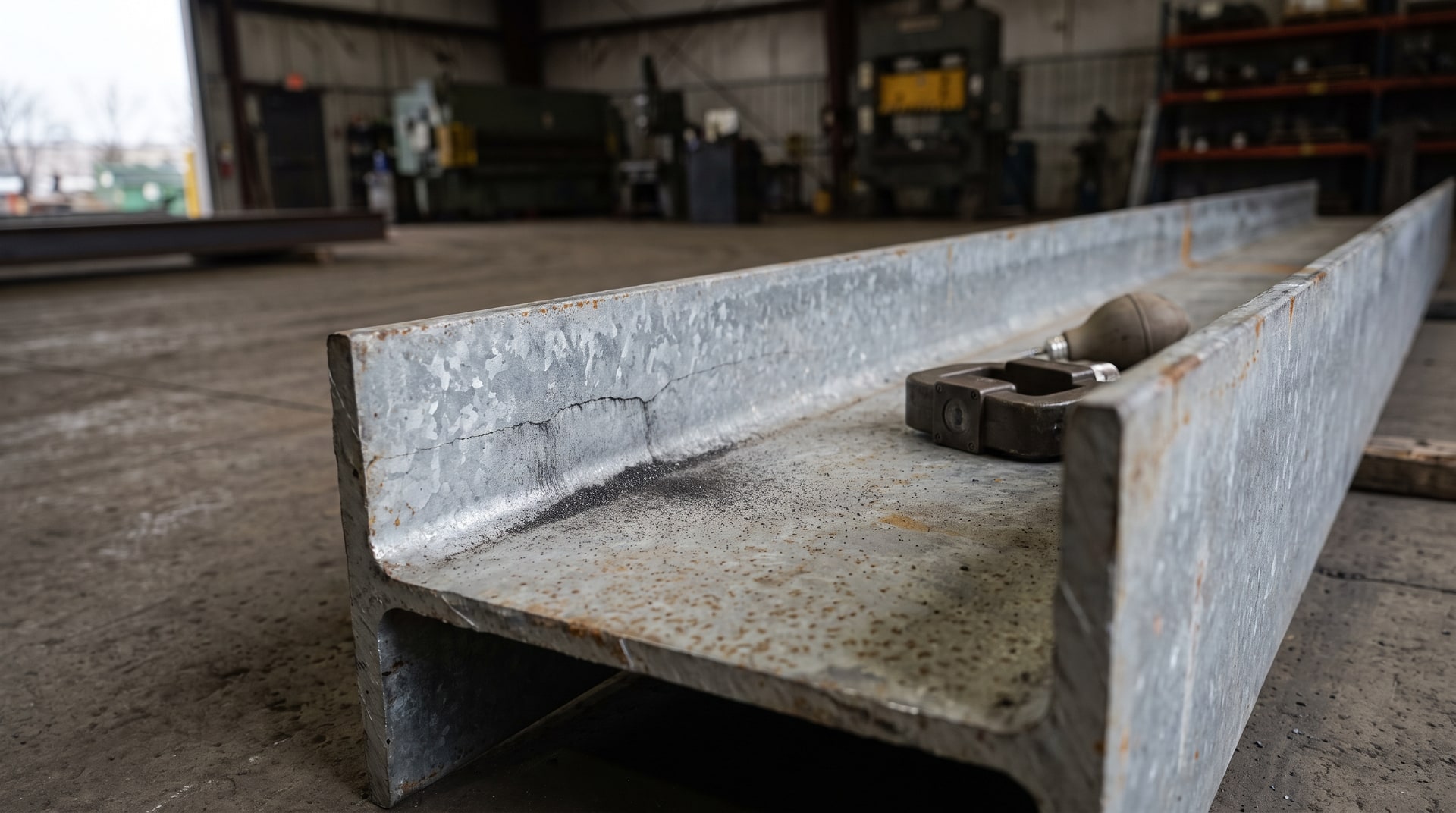
The case that the AGA documents in their source article is worth examining in detail because it illustrates how a seemingly catastrophic galvanizing problem turned out to have nothing to do with galvanizing at all. A galvanizer called the AGA after a batch of I-beams came out of the kettle showing significant cracking in the web. The photographs from that incident show how extreme the cracking became. One beam had nearly cracked through into two separate pieces.
The galvanizer's first move was correct: he identified the problem immediately and contacted the customer. From there, all relevant parties were assembled, and the investigation began. Of the 20 beams that had been galvanized, seven showed evidence of cracking. That number was large enough to suggest a systematic issue rather than an isolated defect in a single piece of steel.
The investigation then moved to the un-galvanized beams still on the galvanizer's lot. Four of those black beams were spot-checked using magnetic particle testing, and all four showed evidence of cracks in the flange area. One beam had a crack that was already visible to the naked eye before it ever went into the zinc bath. This was a critical finding. If cracks existed in the steel before galvanizing, then the galvanizing process could not have caused them.
What Magnetic Particle Testing Revealed
Magnetic particle testing is the right tool for this kind of investigation. It detects surface and near-surface discontinuities in ferromagnetic materials that would not be visible during a standard visual inspection. When the beams were tested, the results were striking. The number of micro-cracks found across the tested beams was in the hundreds, and they followed a clear, repeating pattern: the cracks appeared every ten feet along the flange.
That regularity is significant. Random cracking caused by a thermal or mechanical process does not distribute itself at precise ten-foot intervals. A pattern like that points to something systematic in the fabrication or production history of the steel. The ten-foot spacing was the clue that pointed investigators toward the steel manufacturer.
When the steel manufacturer's metallurgist was brought into the discussion, the pattern was explained. The manufacturer hot-stamped their logo into the flange every ten feet during production. After that, the beams were cold bent to produce a curve for the project's structural requirements. Cold bending places significant strain on the steel, and the areas around the hot-stamped logos were stress concentration points. The combination of the logo's localized material disturbance and the cold bending strain had generated micro-cracks at each of those locations.
Understanding Strain-Age Embrittlement in This Context
The mechanism at work here is strain-age embrittlement, and it is worth explaining clearly because it comes up in galvanizing contexts more often than people expect. When steel is cold worked, meaning bent, punched, notched, or otherwise deformed at ambient temperature, it develops residual stresses and localized zones of increased dislocation density. In certain steels, particularly those with higher nitrogen content or carbon content at the upper end of acceptable ranges, this cold-worked condition makes the material susceptible to further embrittlement when exposed to heat.
Hot-dip galvanizing provides that heat exposure. The zinc bath temperature, while well below the range that would normalize or anneal steel, is high enough to accelerate strain aging in susceptible material. The elevated temperature effectively locks in the dislocations introduced by cold working and reduces the steel's toughness and ductility in those zones. If micro-cracks already exist at those stress concentration points, the galvanizing heat can drive their propagation. If cracks have not yet initiated, galvanizing can trigger them in steel that was already on the edge.
In the I-beam case, the micro-cracks had already formed during cold bending. The galvanizing process did not create those cracks. What it did do was make them visible and, in the worst cases, extend them further. The AGA's metallurgist was direct about this: the hot-dip galvanizing process was not the cause of the cracking. In fact, it had performed a service by revealing the defects before those beams were installed in a structure.
The Proposed Solution and What It Tells Us About Design
The corrective action identified for this case was to grind out the cold-formed logos prior to galvanizing. By removing the material at those stress concentration points before the beams were bent and processed, the zones most susceptible to micro-cracking would be eliminated. This would remove the potential for strain-age embrittlement at those locations after galvanizing.
That solution carries a broader lesson about design and fabrication decisions upstream of galvanizing. Any process that introduces cold work into steel, including punching, shearing, notching, and bending, creates zones that deserve scrutiny when galvanizing is in the project plan. This is not a reason to avoid cold working, but it is a reason to communicate clearly between the fabricator, the engineer, and the galvanizer so that appropriate precautions are taken. In some cases, stress relief by thermal treatment may be warranted before galvanizing. In others, grinding or other mechanical preparation is the right answer. The specific approach depends on the steel chemistry, the degree of cold work, and the geometry of the part.
Our team at V&S Galvanizing works with fabricators and engineers during the planning phase specifically because decisions made at the design and fabrication stage have direct consequences for how steel behaves in the galvanizing kettle. Addressing those considerations early costs far less than investigating a failure after the fact. For projects where cold working is part of the fabrication sequence, early consultation through our hot-dip galvanizing services process helps surface these concerns before they become field problems.
Handling the Customer Relationship During an Investigation
From a practical standpoint, the investigation process is only part of the challenge. Managing the customer relationship during that process is equally important. A customer who believes their steel is unusable is under pressure. They may be facing project delays, cost overruns, or contractual penalties. That pressure can make them resistant to information that suggests the galvanizing was not at fault, because accepting that conclusion may mean looking inward at their own fabrication process or at their steel supplier.
The approach that works best is to stay objective, stay documented, and let the testing results do the talking. When magnetic particle testing finds cracks in un-galvanized beams that never entered the zinc bath, that is hard to dispute. When a steel manufacturer's metallurgist confirms that cold bending around hot-stamped logos generates micro-cracks, that is a factual finding, not an opinion. Presenting those results clearly and professionally, without accusatory framing, gives the customer something concrete to engage with rather than a competing argument to push back against.
Keeping copies of all communications, test results, and photographic evidence also protects the galvanizer if the dispute escalates to a formal claim. An organized record of how the investigation was conducted and what it found demonstrates professionalism and good faith, both of which matter if the situation moves beyond a technical disagreement.
When Galvanizing Actually Does Reveal Problems It Did Not Cause
One of the underappreciated aspects of the I-beam case is the point that the AGA's metallurgist raised directly: galvanizing revealed defects that would otherwise have remained hidden. Those beams, if they had gone into service without galvanizing, would have carried concealed micro-cracks into a structural application. Under load and environmental exposure over time, those cracks could have propagated in ways that would be far more difficult to detect and far more dangerous to address.
This is not an argument that galvanizing functions as a non-destructive evaluation method, but it does illustrate that the process interacts with the full history of the steel it receives. The thermal cycle and the associated stresses of immersion and cooling act on whatever condition the steel is already in. If that condition includes residual stresses, pre-existing discontinuities, or susceptibility to embrittlement, the galvanizing process may make those conditions more apparent. That is valuable information, even if the timing and circumstances of its discovery are inconvenient.
For engineering teams and fabricators who work with galvanized steel, the practical takeaway is that pre-galvanizing inspection has value, particularly for steel that has undergone significant cold working. Magnetic particle testing is not a standard step in most fabrication workflows, but in applications where tight bends, punched holes, or notched sections are combined with a galvanizing specification, a targeted inspection before processing can prevent exactly the kind of situation described in this case.
Work With a Team That Knows the Difference
Distinguishing between a galvanizing defect and a pre-existing steel or fabrication problem requires technical knowledge, a structured investigation process, and the willingness to engage all parties honestly. Most galvanizing failures that land on a galvanizer's desk are not failures of the galvanizing process at all. They are downstream manifestations of decisions made earlier in the fabrication chain, and finding the actual cause requires looking at the full picture rather than stopping at the most recent step.
At V&S Galvanizing, we take that investigative approach seriously. When questions arise about coating performance or steel condition after galvanizing, we document thoroughly, communicate transparently, and bring in the right technical resources to get to an accurate answer. We also work proactively with fabricators and engineers before steel reaches our facility, so that design and fabrication decisions that could create problems downstream are identified and addressed early. If you have a project with complex fabrication details or materials that have undergone significant cold working, reach out to us through our contact page before the steel ships. A short conversation at the front end of a project can save a much longer one after something goes wrong.
Frequently Asked Questions About Troubleshooting Galvanizing Coating Failures
How do you determine whether cracking in galvanized steel was caused by the galvanizing process or by prior fabrication?
The most direct method is to test un-galvanized steel from the same batch using magnetic particle testing. If cracks appear in steel that never entered the zinc bath, the galvanizing process cannot be responsible. In the I-beam case documented by the AGA, four black beams tested before galvanizing all showed evidence of cracks, which confirmed the problem originated during cold bending, not in the kettle.
What is strain-age embrittlement and why does it matter for hot-dip galvanized steel?
Strain-age embrittlement occurs when steel that has been cold worked is subsequently exposed to elevated temperature. Cold working introduces residual stresses and dislocations into the steel's microstructure. When heat is applied, such as during hot-dip galvanizing, those dislocations become locked in place, reducing ductility and toughness in the affected zones. Steel with pre-existing micro-cracks at cold-worked areas is particularly vulnerable to crack propagation during galvanizing.
What role does magnetic particle testing play in a galvanizing failure investigation?
Magnetic particle testing detects surface and near-surface discontinuities in ferromagnetic steel that are not visible to the naked eye. In a failure investigation, it can reveal micro-cracks in both galvanized and un-galvanized steel, helping to establish when and where the cracks originated. It is one of the most effective tools for determining whether a problem predates the galvanizing step.
Can hot-dip galvanizing reveal pre-existing defects in steel that were not visible before processing?
Yes. The thermal cycle of galvanizing, involving immersion in a zinc bath at approximately 840 degrees Fahrenheit followed by cooling, can cause pre-existing micro-cracks to propagate and become visible. This is not a galvanizing defect. It means the steel carried concealed discontinuities before it arrived at the galvanizing facility. In some cases, this kind of discovery prevents cracked steel from entering service undetected.
What fabrication practices are most likely to create problems when steel is subsequently hot-dip galvanized?
Cold bending, punching, notching, and any other cold-working operation that introduces residual stress into the steel creates zones that can be susceptible to strain-age embrittlement during galvanizing. Hot-stamped markings or logos are also stress concentration points. When these features are located in areas that will carry significant structural load, grinding out the affected zones before galvanizing can eliminate the cracking risk.
What documentation should a galvanizer collect when a customer claims the galvanizing caused a failure?
From the moment a complaint is raised, the galvanizer should retain all emails, photographs, delivery records, inspection reports, and any other written communication between parties. This includes photos of the steel before galvanizing if available, photos of the condition that prompted the complaint, and records of any testing performed during the investigation. A clear documented timeline allows all parties to evaluate the facts objectively rather than relying on competing recollections.
How should a galvanizer manage a customer who refuses to accept that the galvanizing was not responsible for a failure?
The most effective approach is to let objective test results drive the conversation. Magnetic particle testing, metallurgical analysis, and documented findings from the steel manufacturer are difficult to dispute. Presenting those results professionally, without framing the discussion as adversarial, gives the customer factual information to engage with. Retaining all communications and test records also protects the galvanizer if the dispute escalates beyond a technical discussion.
When should a fabricator consider pre-galvanizing inspection for cold-worked steel members?
Any time steel has undergone significant cold working, including tight-radius bending, punching of closely spaced holes, or notching, and is also specified to be hot-dip galvanized, a targeted pre-galvanizing inspection is worth considering. Magnetic particle testing of representative pieces before the batch is processed can identify micro-cracking early, when corrective action such as grinding or stress relief is still practical.
