

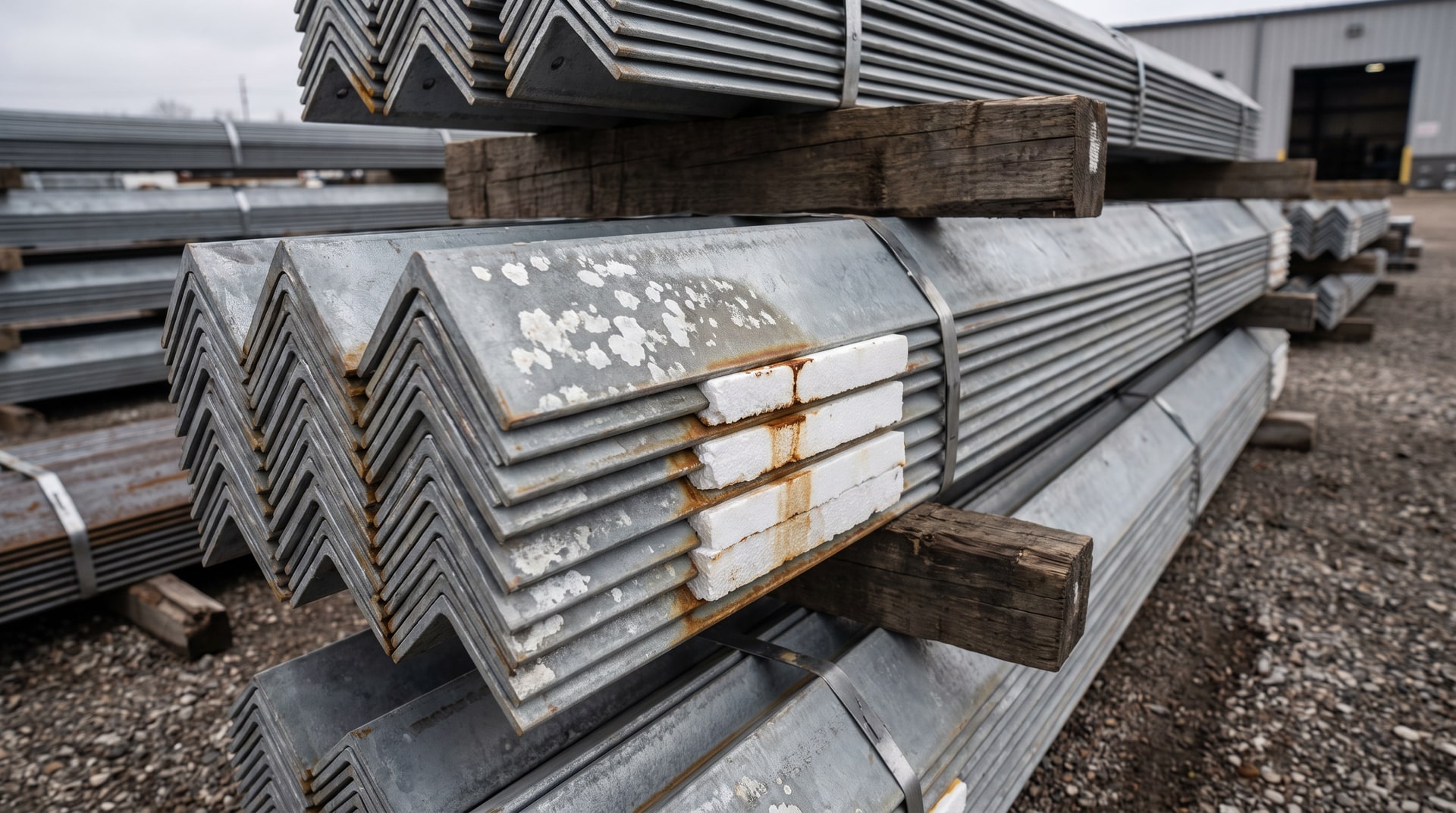
Storing freshly galvanized steel outdoors is a practical reality for many fabricators and galvanizers. Space constraints, just-in-time delivery schedules, and large order volumes all push material into open-air steelyards where it sits exposed to humidity, rain, and temperature swings. Under the right conditions, that exposure triggers a cosmetic problem that generates a surprising number of field questions: wet storage stain, sometimes called white rust or white storage stain.
The issue is not simply that steel got wet. It is that moisture became trapped between tightly nested or stacked pieces in a way that prevented normal evaporation, creating a confined, oxygen-depleted environment where zinc corrosion accelerates in a specific and recognizable pattern. Understanding what is actually happening at the coating surface explains why the standard preventive advice works, and why shortcuts tend to fail.
The American Galvanizers Association addresses this directly in their article on utilizing styrofoam spacers to prevent wet storage stain. At V&S Galvanizing, we expand on that foundation to explain what is actually happening at the material level, how air circulation influences coating performance during storage, and why this particular problem is often misunderstood in the field.
What Wet Storage Stain Actually Is
Zinc is electrochemically active and begins reacting with its environment immediately after a hot-dip galvanized coating solidifies. Under normal atmospheric exposure, zinc reacts with oxygen and moisture to form a tightly adherent patina of zinc oxide and zinc hydroxide. Over a period of weeks to months, carbon dioxide from the atmosphere converts this layer into zinc carbonate, which is slightly alkaline, very stable, and highly resistant to further corrosion. This mature patina is what gives hot-dip galvanized steel its well-known long-term performance.
The problem during storage is that this stabilization process requires access to carbon dioxide. When galvanized surfaces are pressed tightly together with no air gap between them, moisture can enter the interface but carbon dioxide cannot circulate freely. Zinc hydroxide forms but cannot convert to zinc carbonate. The result is a buildup of voluminous, white-to-gray zinc corrosion product that looks alarming but is, in most cases, cosmetically damaging rather than structurally significant.
It is worth being precise here: wet storage stain is not a failure of the galvanized coating in the structural sense. The underlying zinc layer is still intact and still protecting the steel. What has been lost is a portion of the coating's surface thickness and the clean, uniform appearance that specifiers and end users expect. Depending on severity, the stain can range from a light powdery film to heavier crusting, and in severe cases it can represent meaningful zinc consumption that reduces the remaining service life of the coating.
Why Tightly Nested Profiles Are Especially Vulnerable
Not all galvanized products are equally at risk. Flat plate stacked face-to-face, nested channel sections, or bundled angle iron create geometry that is particularly prone to wet storage stain because their shapes allow near-complete contact along extended surfaces. A pair of angles nested together forms a long, narrow, enclosed pocket that moisture can enter by capillary action but that air struggles to penetrate.
This geometry matters because the two conditions driving wet storage stain, moisture and restricted oxygen and carbon dioxide access, are directly produced by tight nesting. A single piece of angle iron sitting on an open rack in moving air will develop the normal zinc carbonate patina and show little or no staining. That same piece, pressed tightly against an identical piece in a bundle of several hundred, sees none of that protective circulation. The problem is not exposure to weather per se; it is stagnation.
Larger bundles make this worse in proportion to their size. Each additional layer adds weight that compresses the layers below and reduces whatever small gaps might otherwise allow air movement. By the time a skid carries a full commercial bundle, the interior pieces are effectively sealed off from meaningful air exchange, regardless of what is happening on the exterior of the bundle.
The Role of Passivation, and What to Do Without It
The most reliable industrial solution to wet storage stain is passivation, a post-galvanizing chemical treatment that applies a thin chromate or similar conversion coating to the zinc surface immediately after galvanizing. This treatment accelerates the formation of a stable surface layer that resists the onset of white rust during storage. Many high-volume galvanizing operations routinely passivate products that will be bundled and shipped, precisely because it makes storage behavior predictable regardless of how the material is handled downstream.
The practical complication is that not every galvanizer has passivation capability, and not every situation allows for it. The scenario the AGA source article addresses is exactly this: a large, identical-product order requiring just-in-time delivery, multiple truckloads staged in an outdoor steelyard, no passivation available. What can be done with the tools actually on hand?
The answer involves combining several strategies, each targeting a different aspect of the problem. No single step is sufficient on its own, but together they can reduce wet storage stain risk substantially even in challenging outdoor storage conditions.
Physical Separation as the Core Preventive Strategy
If passivation is not available, the next best approach is to mechanically prevent the surface-to-surface contact that enables moisture entrapment. This is where styrofoam spacers become genuinely useful, and the reason they work is straightforward: they create a consistent air gap between nested pieces along the full length of the profile without requiring significant extra volume, weight, or cost.
The AGA recommendation for angle iron is specific and worth repeating carefully because the placement method is what makes it effective. The first angle is placed on the skid with the peak facing up. A styrofoam strip, approximately half an inch thick, two inches wide, and four inches long, is placed across the peak at two or three evenly spaced points along the length of the angle. The next piece is then nested on top in the normal orientation.
As the second angle seats itself on the styrofoam, the foam compresses slightly and is forced down along both interior faces of the angle below it. This compression is actually beneficial because it creates contact along the sloped surfaces of both angles, not just at the peak. The result is a consistent air channel running the full length of the nested pair, not just a point gap at the spacer locations. Every subsequent layer adds weight that slightly compresses the foam further, but because foam compresses rather than crushing to zero, the air gap is maintained throughout the bundle.
The practical advantages of styrofoam over wood strips are meaningful. Foam does not absorb moisture, which means it does not become a water reservoir sitting between galvanized surfaces. It is significantly lighter than wood, which matters when bundles are being weighed for freight cost. It can be sourced in custom forms that match the angle geometry, which speeds up the placement process considerably. And the cost per linear foot is typically lower than wood strip alternatives. For a very large order, all of these factors add up.
Complementary Measures: Drainage Slope and Weather Protection
Styrofoam spacers address air circulation between pieces, but they do not prevent moisture from entering the bundle from above. Two additional measures work together with physical separation to cover that gap.
The first is orienting each skid so that one end is elevated relative to the other. Even a modest slope is sufficient to allow rain and condensation to drain off the bundle rather than pooling between pieces. Water that drains away quickly does not have time to migrate deep into bundle interfaces, which means the styrofoam spacers are dealing with incidental moisture rather than sustained saturation. This is a low-effort step with real preventive value.
The second is tarping the bundles to intercept precipitation before it reaches the steel at all. A tarp does not create a sealed environment, and it should not. The goal is to block direct rainfall and snow accumulation while still allowing air to circulate around the bundle at ground level and through the ventilation gaps the spacers create. A tarp that is sealed tightly on all sides can actually trap humidity inside the bundle, which is counterproductive. Adequate coverage with some allowance for air exchange at the base strikes the right balance.
Used together, elevation for drainage, tarping for precipitation control, and styrofoam spacers for internal air circulation, these three measures address the three conditions wet storage stain requires: sustained moisture, restricted airflow, and extended contact between zinc surfaces.
Recognizing and Evaluating Stain Severity When It Does Occur
Even with good storage practices, some degree of surface staining may appear, particularly on material that sits through extended periods of high humidity or frequent rain. Knowing how to evaluate what you are looking at matters because the appropriate response depends on severity.
Light wet storage stain appears as a white or gray powdery deposit that wipes away relatively easily. At this level, the zinc carbonate formation process simply needs to resume, and natural weathering once the material is installed will typically remove any remaining trace within a few months. The underlying coating thickness is not meaningfully affected, and no remediation is usually necessary beyond normal inspection.
Heavier staining produces thicker, more adherent deposits that may include some superficial pitting of the zinc surface beneath. In these cases, cleaning with a stiff brush and a mild acidic solution can remove the stain and allow the surface to resume normal patina formation. The coating should be inspected after cleaning to confirm adequate remaining thickness, particularly on interior bundle surfaces where staining tends to be most concentrated.
Severe wet storage stain, with visible pitting or significant zinc layer reduction, is less common when basic storage precautions are followed, but it does occur when galvanized material is stored improperly for months in wet conditions without any of the preventive measures described here. In those cases, a formal thickness assessment is appropriate before the material is accepted for installation.
Application Beyond Angle Iron: Adapting the Approach to Other Profiles
The AGA article specifically addresses angle iron because it is a common profile and one whose nesting geometry makes wet storage stain particularly predictable. The same logic applies to other profiles, though the spacer geometry and placement approach will vary.
Channel sections nest in a similar way and present similar risks. Flat bar stacked face-to-face creates a simpler geometry but still benefits from spacers that interrupt full-surface contact. Hollow sections are generally less prone to wet storage stain on their exterior faces because the flat surfaces do not nest as tightly as angles, but if they are stacked in a way that traps moisture in surface-to-surface contact zones, the same principles apply.
The underlying engineering principle is consistent: prevent zinc surfaces from resting in sustained, moisture-laden contact with each other without access to circulating air. The specific implementation details, spacer thickness, width, placement interval, depend on the profile geometry and bundle weight. Custom-cut foam forms are available from most packaging suppliers and can be specified to match the profile dimensions of whatever product is being stored, which reduces placement time and ensures consistent spacing across an entire production run.
Work With a Team That Understands What Happens After the Steel Leaves the Kettle
Hot-dip galvanized steel does not stop requiring attention when it exits the zinc bath. How it is handled, cooled, bundled, and stored in the hours and days after galvanizing has a direct influence on the appearance and condition of the coating that arrives at the job site. Wet storage stain is one of the most preventable quality issues in the galvanizing supply chain, and it is preventable precisely because the mechanism is well understood and the countermeasures are straightforward.
At V&S Galvanizing, we think through storage logistics as part of the overall service we provide. For large orders with extended staging requirements, we work with customers to identify the right combination of protective measures given the available space, weather exposure, and delivery timeline. Getting these details right at the beginning of a project avoids field questions, inspection disputes, and re-work conversations later.
If you have an upcoming order with unusual storage requirements, or if you have questions about how to evaluate or address wet storage stain on material already in the field, reach out through our contact page and we will connect you with someone on our technical team who can help.
Frequently Asked Questions About Wet Storage Stain and Galvanized Steel Storage
What causes wet storage stain on hot-dip galvanized steel?
Wet storage stain forms when moisture becomes trapped between tightly stacked or nested galvanized surfaces without adequate air circulation. Zinc reacts with moisture to form zinc hydroxide, which would normally convert to a stable zinc carbonate patina if carbon dioxide were present. Without airflow, that conversion cannot occur, and the result is a buildup of white or gray zinc corrosion product on the coating surface.
Does wet storage stain mean the galvanized coating has failed?
Not in most cases. Wet storage stain is primarily a cosmetic issue. The underlying zinc layer typically remains intact and continues to protect the steel. However, severe staining involving visible pitting or significant white rust accumulation can represent real zinc consumption, which warrants a coating thickness inspection to confirm adequate remaining protection.
Why are styrofoam spacers recommended over wood strips for galvanized steel storage?
Styrofoam does not absorb moisture, so it does not become a water source sitting between galvanized surfaces the way wet wood can. It is also significantly lighter than wood, which reduces freight costs on large bundled orders. It can be sourced in custom profiles matched to the piece geometry, and it costs less per unit length than equivalent wood strips.
How should styrofoam spacers be placed between nested angle iron?
Place the first angle on the skid with the peak facing up. Position styrofoam strips approximately half an inch thick, two inches wide, and four inches long across the peak at two or three evenly spaced intervals along the length of the piece. When the next angle is nested on top, the foam compresses and is forced down along both interior faces, creating a continuous air channel along the full length of the nested pair.
Does tarping galvanized bundles prevent wet storage stain on its own?
No. Tarping reduces precipitation exposure but does not prevent moisture from condensation, and it does nothing to address the restricted airflow between nested surfaces that drives wet storage stain. Tarping works best as one part of a combined approach that also includes sloping the skid for drainage and using physical spacers to create air gaps between pieces.
At what point should wet storage stain be considered a structural concern rather than just cosmetic?
When staining produces heavy, adherent deposits with visible pitting of the zinc surface beneath, a thickness measurement is warranted. Light powdery staining that wipes away easily and leaves a smooth zinc surface below is generally cosmetic. Significant pitting or measurable zinc layer reduction, particularly on interior bundle surfaces, requires evaluation against the specified coating thickness to determine whether adequate protection remains.
Can wet storage stain develop on galvanized steel stored indoors?
Yes, though it is less common. Indoor storage reduces rain exposure but does not eliminate humidity or condensation, particularly in facilities without climate control. Tightly nested bundles stored indoors in humid conditions can still develop wet storage stain if moisture accumulates at surface interfaces. The same principle applies: air gaps between pieces reduce risk regardless of whether storage is indoors or outdoors.
Is there a way to reverse or remove wet storage stain after it has formed?
Light staining can often be removed with a stiff brush and a mild acidic cleaning solution, after which the zinc surface can resume normal patina formation through atmospheric exposure. Heavier staining may require more thorough cleaning. After any cleaning, the coating should be inspected for adequate remaining thickness. Natural weathering once the material is installed will gradually remove residual staining in mild cases without any intervention.
