

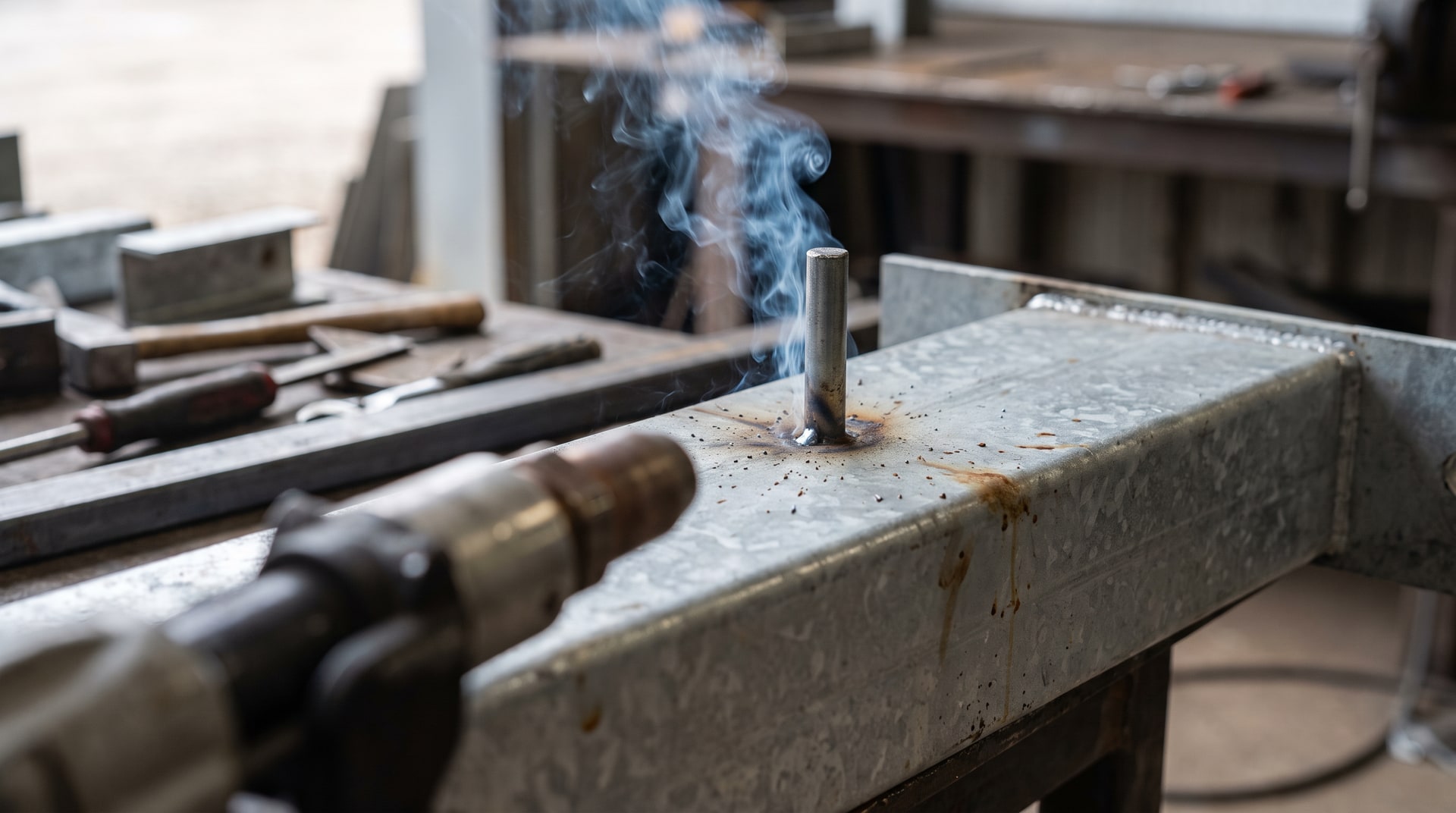
In composite construction, attaching shear studs to the top flange of a structural beam is one of the most routine tasks on a job site. When those beams arrive hot-dip galvanized, the conversation gets more complicated. Contractors are sometimes caught between the protective coating the spec requires and the clean steel substrate the welding process prefers. The result is a practical tension that plays out every day on bridge decks, parking structures, and commercial floor systems across the country.
The American Galvanizers Association addresses this directly in their article on galvanized steel and stud welding. At V&S Galvanizing, we expand on that foundation to explain what is actually happening at the material level, how zinc contamination influences weld performance, and why this is often misunderstood and mismanaged in the field.
How Electric Arc Stud Welding Works
Electric arc stud welding is a process with a surprisingly long history. It was developed before World War II specifically to solve a shipbuilding problem: attaching wood planking to the steel decks of naval aircraft carriers. Before stud welding existed, the process required drilling from one side, inserting a fastener, and working from both faces of the steel simultaneously. One worker, one gun, one side of the steel. That was the revolution.
The mechanics of the process are worth understanding before we get into how zinc complicates them. A stud welding gun is connected to a power source that controls both amperage and arc duration. The operator holds the gun against the steel surface, and when triggered, an arc fires between the tip of the stud and the base steel. This arc generates enough heat to melt both surfaces simultaneously, forming a molten pool. At a precisely controlled moment determined by the power settings, the current cuts off and a spring inside the gun drives the stud down into that molten pool. As the pool solidifies around the stud base, a full fusion weld is formed.
The key variables in this process are the stud diameter, the type of stud being used, and the condition of the base steel. These factors drive the amperage and duration settings on the control system. On clean bare steel, the arc behaves predictably, the melt pool is consistent, and the resulting weld meets structural requirements reliably. The moment you introduce a coating between the stud and the steel, that predictability changes.
What Zinc Does to the Weld
Zinc melts at roughly 420 degrees Celsius and vaporizes around 907 degrees Celsius. The arc in stud welding reaches temperatures far above those thresholds, so in theory zinc should be fully consumed before the stud contacts the melt pool. In practice, it does not work that cleanly.
The hot-dip galvanized coating on a structural beam is not a single uniform layer of pure zinc. It is a metallurgical bond that includes an outer layer of relatively pure zinc sitting on top of a series of zinc-iron alloy layers that grade into the base steel. The arc vaporizes the zinc it directly contacts, but the speed of the process and the geometry of the joint mean that zinc vapors and some liquid zinc can be drawn into the forming melt pool before it solidifies. Once trapped, that zinc becomes an inclusion in the weld.
Zinc inclusions weaken a weld in two distinct ways. First, zinc has a much lower melting point than steel, so pockets of it within the weld zone remain soft or semi-molten at temperatures where the surrounding steel has already solidified, creating stress concentration points. Second, zinc vapor trapped in the weld does not fully escape before solidification, leaving porosity. Both mechanisms reduce the load-carrying capacity of the stud weld compared to a weld made on bare steel. The AGA is direct about this: the presence of zinc and zinc vapors in the weld can weaken it to the point of failure.
The Two-Pass Method and Why It Is Used
Because removing zinc before every stud weld is often impractical on a production job site, the industry has settled on a procedural workaround. The first pass is essentially a sacrificial weld. The gun is set to its highest power setting and longest arc duration, with the goal of driving as much thermal energy into the weld zone as possible. The intent is to vaporize as much zinc as the arc can reach before the stud is driven into the pool.
That first weld is then deliberately knocked off. This is not a failed weld being discarded, it is the planned outcome. Removing the first stud accomplishes two things. It burns off and physically displaces a large portion of the zinc coating in that exact location, and it leaves behind a small zone of exposed steel mixed with solidified slag from the first arc cycle. The second stud is then welded directly onto that cleared area, where the zinc concentration is substantially lower.
The second weld is stronger than the first. There is less zinc available to contaminate the new melt pool, and the arc is forming in a zone that has already been thermally affected. But it is still not equivalent to a weld on clean black steel. The slag and debris left by the first weld can become inclusions in the second, and any zinc that migrated into the base steel heat-affected zone during the first pass may still be present. The AGA describes the result plainly: still inferior to one performed on a clean black steel substrate.
The reason this method is accepted rather than prohibited comes down to redundancy in modern composite deck design. The shear connection between a concrete deck and a steel beam is achieved through a pattern of many studs, and the design accounts for the statistical reality that weld quality will vary. Individual studs with somewhat reduced capacity are tolerated because the overall connection has enough reserve capacity built in. That is an important distinction. The two-pass method is not a best practice in the engineering sense, it is a pragmatic compromise that works within the margins of the design system.
The Actual Best Practices: Grinding and Masking
If the two-pass approach is a field compromise, the genuine engineering solutions are zinc removal before welding. The AGA identifies two methods: grinding the zinc away from the weld area, or preventing zinc from being deposited there in the first place through masking during the galvanizing process.
Grinding is straightforward in concept. An angle grinder removes the galvanized coating down to bare steel in the footprint of each stud location. This gives the arc a clean substrate and eliminates the zinc contamination problem entirely. The resulting weld is fully comparable to one made on ungalvanized steel. The practical limitation is time and labor. On a beam with dozens of stud locations, grinding each one individually adds meaningful cost to the job. On complex or congested framing, access can be an issue as well.
Masking is a method applied during the hot-dip galvanizing process itself. Areas of the steel that are not intended to receive a zinc coating are covered with a masking compound before the steel is processed through the galvanizing bath. When the masking is removed after galvanizing, those areas remain bare steel. This is the cleanest solution from a weld quality standpoint, but it requires coordination between the fabricator, the galvanizer, and the party responsible for welding the studs. It also means the uncoated areas need to be treated with a zinc-rich paint or other repair coating after the studs are welded to restore corrosion protection to those spots.
Both of these approaches represent real engineering intent rather than field improvisation. When the project allows for either, they should be the default choice over the two-pass method.
Why Zinc Contamination in Welds Is Underappreciated
One reason this issue is underestimated in the field is that failed stud welds from zinc contamination do not always look different from good ones. The exterior of a zinc-contaminated weld can appear visually complete. The porosity and inclusions are internal. Standard visual inspection of a stud weld checks for collar shape, weld flash around the base, and whether the stud is plumb. None of those checks reveal internal zinc inclusions.
The conventional field test for shear studs is the bend test, where a stud is struck with a hammer or a slug wrench to deflect it roughly 30 degrees from vertical. A properly fused weld survives this without fracturing at the base. A zinc-contaminated weld may also survive this test, because the bend test loads the weld in bending, which is not the same loading condition as shear under service loads. A weld that passes a bend test can still have reduced shear capacity due to internal porosity.
This is not an argument against field testing. It is an argument for understanding what field tests actually measure, and for recognizing that the best way to ensure weld integrity on galvanized steel is to control zinc contamination at the source rather than depend entirely on post-weld inspection to catch problems.
Galvanizing Sequence and Coordination on Structural Projects
On projects where composite steel beams will be hot-dip galvanized, the sequence of operations matters significantly. There are essentially two viable sequences. In the first, studs are welded to bare steel before galvanizing. The beam then goes through the galvanizing process with studs already attached. This is technically straightforward from a weld quality standpoint, but it creates complications in galvanizing. Studs welded to the top flange of a beam can trap flux, interfere with zinc drainage, and create uncoated shadow zones at the base of each stud. The geometry of the stud pattern affects how well zinc flows around and under the stud collar.
In the second sequence, the beam is galvanized first and studs are welded afterward through or onto the coating. This is the scenario the AGA article addresses directly. It is the more common sequence in practice because it keeps the galvanizing process simpler and allows coating to fully cover the beam, but it creates the weld quality challenge described throughout this article.
Coordination between the structural engineer of record, the fabricator, and the galvanizer early in the design phase can resolve which sequence is appropriate for a given project. When the project calls for galvanizing before stud welding, the masking approach to protect weld zones deserves serious consideration as part of the galvanizing scope of work rather than an afterthought.
Understanding the Limits of the Accepted Practice
The two-pass stud welding method is widely used and broadly accepted in composite construction on galvanized beams. That acceptance is grounded in the redundancy of composite deck systems and in the understanding that the reduced capacity of individual studs is accounted for within the design. It is not grounded in the idea that the welds are equivalent to those on clean steel, because they are not.
What matters practically is that the people performing the work understand why the two-pass method is done the way it is, and that they do not skip the first pass, rush the removal of the first stud, or assume that a single pass at high power is adequate on its own. Each step in the procedure exists for a specific reason tied to the behavior of zinc under arc heat, and shortcuts in any part of the sequence compound the contamination problem rather than reducing it.
For engineers specifying galvanized composite beams, the question worth asking during design is not simply whether stud welding on galvanized steel is permissible. It is whether the project conditions, schedule, and inspection requirements create a situation where grinding or masking is achievable. When those options are feasible, the resulting weld quality is categorically better, and the uncertainty introduced by zinc contamination is removed from the equation entirely.
Work With a Team That Understands the Full Picture
Stud welding on galvanized steel sits at the intersection of corrosion protection and structural performance, and the right outcome depends on decisions made well before a welder picks up a gun on the job site. Specifying the correct galvanizing approach, coordinating masking requirements, and understanding how the two-pass field method actually works are all part of getting composite galvanized construction right from start to finish.
At V&S Galvanizing, we work with engineers, fabricators, and contractors throughout the project planning process to identify the galvanizing sequence and surface preparation requirements that best support downstream welding and assembly work. If you are working on a project involving galvanized structural steel and have questions about weld zone preparation, masking, or how to specify the galvanizing scope to support stud welding, reach out through our contact page and we will walk through the specifics with you.
