

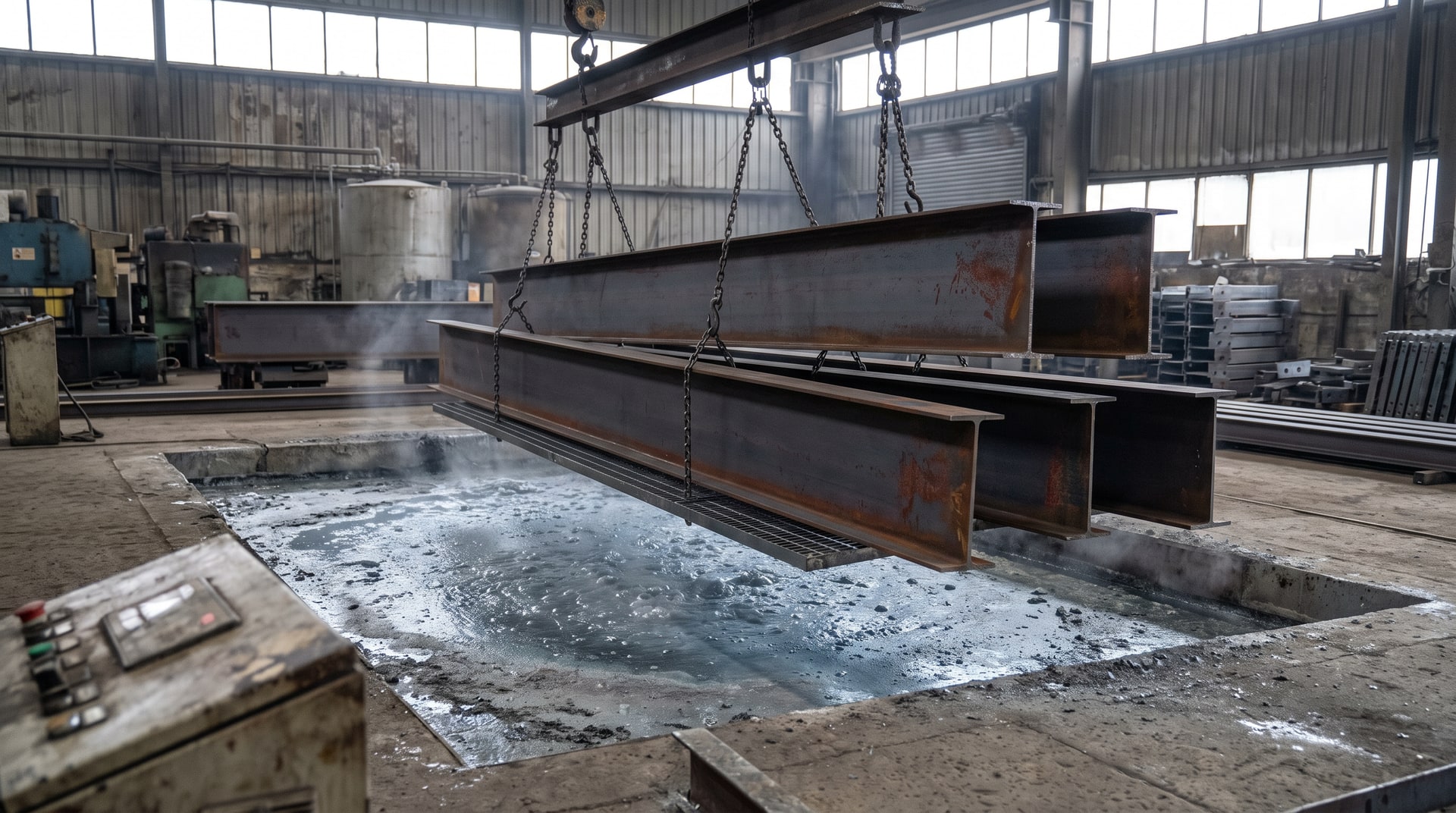
Even in a well-controlled galvanizing operation, not every piece that comes out of the kettle meets specification. Bare areas may exceed what ASTM A123/A123M allows under Section 6.2, or a structurally reactive steel chemistry may produce a coating so thick and brittle that it flakes before the part ever leaves the shop. In other cases, galvanized steel that has performed in service for years eventually reaches a point where the coating is nearly consumed and the structure needs to be brought back to full protection. In each of these situations, the path forward is the same: strip the existing zinc from the steel and galvanize it again.
This is not a niche scenario. It happens routinely in fabrication shops and in the field, and it raises legitimate engineering questions. What does the stripping process do to the steel itself? Will the new coating behave the same as the first? Are there risks to mechanical performance? The American Galvanizers Association addresses this directly in their article on stripping and regalvanizing. At V&S Galvanizing, we expand on that foundation to explain what is actually happening at the material level, how surface chemistry and steel composition influence the outcome of a second galvanizing cycle, and why several common assumptions about this process turn out to be wrong in practice.
Why Parts Get Stripped in the First Place
Understanding the stripping process starts with understanding why it becomes necessary. The three most common triggers are specification failures on fresh work, coating problems driven by steel chemistry, and end-of-life coating renewal.
On fresh fabrications, bare areas that exceed the limits in ASTM A123/A123M Section 6.2 or ASTM A153/A153M Section 4.5 cannot simply be ignored. While touch-up using zinc-rich paint or other repair materials is permitted within defined limits, a part that comes out of the kettle with bare spots beyond those thresholds may require full stripping and reprocessing rather than spot remediation. The decision depends on the extent and location of the defect, and your galvanizer should be the first call when this situation arises.
The second trigger is a steel chemistry problem, specifically silicon content. Certain steels with elevated or poorly distributed silicon react with the zinc bath in a way that accelerates intermetallic layer growth far beyond what is structurally useful. The coating can grow to thicknesses exceeding 10 mils, at which point it becomes brittle and prone to flaking. Parts that arrive in this condition are not defective in terms of steel quality, but the coating is functionally unreliable. Regalvanizing is both the corrective step and, as we will explain below, often an improvement over the first attempt.
The third scenario, end-of-life renewal, applies to guardrails, structural members, and other infrastructure that has been in service long enough for the zinc coating to approach full consumption. Rather than replacing the steel, stripping and regalvanizing returns the component to a like-new protective state, provided the underlying steel is in acceptable condition.
How Stripping Actually Works
The chemistry used to strip zinc from galvanized steel is the same acid-based cleaning chemistry used in normal pre-galvanizing preparation. Most galvanizers run the part through their standard pickling sequence, which dissolves the zinc coating. Some operations maintain a dedicated acid bath specifically for stripping work, keeping the regalvanizing line cleaner and more efficient.
What matters mechanically is that the stripping process does not simply lift the zinc off the surface like peeling tape. During the original galvanizing cycle, the outermost layer of steel reacted with zinc to form a series of iron-zinc intermetallic phases. Those phases are part of the steel surface, not just deposited on top of it. When the zinc is stripped, a small amount of that reacted steel comes away with it. The base metal loses a thin layer at the interface.
For most structural applications, this loss is negligible. The thickness involved is small enough that it falls within normal fabrication tolerances and has no bearing on structural capacity. The exception is when a part has been designed to extremely tight dimensional tolerances, where even minor surface removal could matter. Designers working with components in that category should consult directly with the galvanizer before proceeding with stripping and regalvanizing, and evaluate whether the dimensional change is within their acceptable range.
Surface Profile and Chemistry: What Changes the Second Time Around
Running a steel part through the chemical cleaning sequence a second time does more than remove zinc. It can alter both the surface profile and the localized surface chemistry of the steel, and those changes directly influence how the new coating forms and how thick it will be.
Consider the case of a silicon-reactive steel that produced an excessively thick, flaking coating on the first galvanizing attempt. Silicon in the steel acts as a catalyst for the galvanizing reaction, accelerating intermetallic layer growth. During that first coating cycle, some of the silicon at the steel surface is consumed by the reaction. When the part is stripped and returned to the kettle, the surface silicon concentration is lower than it was the first time. The accelerating effect is reduced, and the resulting coating is typically thinner and better-adhered. In other words, the failure of the first attempt partially corrects the chemistry problem that caused it.
The inverse also holds. Steels that produced a coating below minimum thickness requirements on the first attempt may respond differently to chemical cleaning and come out of a second galvanizing cycle with better coverage. The change in surface profile after acid exposure can create a more favorable substrate for zinc adhesion and intermetallic growth, helping the coating reach the required minimum average thickness.
Neither outcome is guaranteed, and neither replaces a proper analysis of the steel chemistry before fabrication. But it is useful to understand that regalvanizing is not simply running the same inputs through the same process twice. The surface presented to the zinc bath on the second pass is measurably different from what it was on the first.
Mechanical Properties: What the Research Actually Shows
One of the most persistent concerns about stripping and regalvanizing is whether the additional thermal and chemical exposure degrades the mechanical properties of the steel. The short answer, supported by multiple independent studies, is that it does not, with one important category of exception.
Research conducted by Mittal Steel Ostrava and Vysoka Skola Banska examined four steel types through the full galvanizing process, evaluating upper yield point, ultimate strength, ductility, impact strength, and microstructure. The differences in mechanical properties between galvanized and non-galvanized specimens were negligible. Galvanizing, including the thermal exposure involved, did not produce meaningful changes in any of the tested properties.
A separate study by BNF Metals Technology Centre and ILZRO, focused specifically on structural steels and their weldments, confirmed that hot-dip galvanizing does not affect tensile strength, proof strength, bend properties, or impact properties. There was a nuance: cold-worked steels did show small changes in some properties after galvanizing, and the study found that using larger bend radii during fabrication reduced those effects.
A third study, conducted by Industrial Galvanizers Corporation Pty Ltd., specifically addressed the question of whether stripping affects yield strength. They compared non-galvanized black steel against pre-galvanized sheet that had been stripped before testing. The variation in yield strength between the two conditions was less than 1%, which fell within the accuracy tolerance of the testing method itself. The conclusion was clear: galvanizing does not affect yield strength in either black steel or steel that has been stripped and regalvanized.
Taken together, these studies support a consistent position: for the vast majority of structural steels, the galvanizing process, including a second cycle following stripping, has no meaningful effect on mechanical performance.
The Hydrogen Embrittlement Question for High-Strength Steels
The one area where additional chemical cleaning carries real risk is with very high-strength steels. When steel with a tensile strength above 150 ksi is exposed to an acid pickling bath, it can absorb hydrogen. That absorbed hydrogen can migrate to grain boundaries and stress concentrations, creating the conditions for hydrogen embrittlement, a failure mode characterized by brittle fracture at stress levels well below the material's nominal strength.
For steels below 150 ksi in tensile strength, the AGA's position is that chemical cleaning does not meaningfully increase the risk of hydrogen embrittlement. The threshold matters. A standard structural steel like A36 or A572 Grade 50 is not in the risk category. But specialty high-strength steels, certain alloy grades, and spring steels can be, and they require a different approach.
When stripping must be performed on high-strength steel above that threshold, mechanical cleaning methods such as abrasive blasting offer a safer path than acid stripping. Blasting removes the zinc without introducing hydrogen to the steel matrix. The galvanizer should be informed of the steel's tensile strength before any stripping work begins so the correct method can be selected.
Coating Appearance After Regalvanizing: What to Expect
One question that comes up frequently in the context of hot-dip galvanizing remediation is whether a regalvanized part will look the same as a freshly galvanized component that has never been through the process before. The answer depends heavily on the condition of the steel and why the part was being regalvanized.
For steel that has been in service for an extended period, the surface below the consumed zinc coating may show pitting, mechanical damage, or texture changes that occurred during its service life. Stripping the coating reveals the steel as it actually is, not as it was when it left the original fabrication shop. Regalvanizing will coat that surface faithfully, following every contour, pit, and texture variation that exists in the steel. The zinc does not fill in surface defects or smooth out damage; it conforms to them.
This matters for appearance-sensitive applications. If the surface quality of the original steel has deteriorated, the regalvanized finish will reflect that. Specifying a cosmetically acceptable finish on regalvanized service-worn steel requires first addressing the steel surface condition, either through blasting or mechanical preparation, before the part goes back into the zinc bath. For new work being regalvanized due to a process defect rather than service wear, the surface quality issue is less significant because the steel itself has not been degraded.
On the other end of the spectrum, a silicon-reactive steel that produced a rough, heavily textured coating on its first pass often produces a smoother, more uniform finish on regalvanizing, precisely because the surface chemistry change described earlier results in thinner, more controlled intermetallic growth. The appearance improvement in this case is a direct consequence of the chemistry correction.
Fasteners and High-Strength Bolts: A Separate Issue
Bolts and threaded fasteners deserve specific attention in any discussion of regalvanizing because the rules governing their reuse are stricter than those for structural members, and the reasons are not always well understood.
Galvanized bolts that have been brought to specified tension and then removed from service cannot be reused. This is a requirement of the Research Council on Structural Connections specification for structural joints using high-strength bolts. It is worth emphasizing that this prohibition exists independently of whether the bolts are stripped and regalvanized. The limitation is not a consequence of the galvanizing process; it is a general fastener industry rule rooted in the fact that high-strength bolts under specified tension experience deformation that affects their clamp load behavior if they are reinstalled.
A separate research study by Bowman and Betancourt examined the reuse of A325 and A490 high-strength bolts specifically and confirmed that the restriction holds regardless of the coating condition. If you have previously tensioned bolts that need to go back into service, the answer is replacement, not regalvanizing.
Galvanizers should always be informed when previously tensioned bolts are included in a batch for stripping and regalvanizing. The zinc can be reapplied, but the bolts cannot be reinstalled in a structural connection where specified pretension is required.
Work With a Team That Understands What the Process Is Actually Doing
Stripping and regalvanizing is a well-established corrective and renewal process, but it is not a simple repeat of the original galvanizing cycle. The steel surface that goes back into the zinc bath has been changed by the acid exposure, and in many cases those changes work in the part's favor. For steels with reactive chemistry, the second galvanizing cycle often produces a more compliant coating than the first. For service-worn steel, regalvanizing restores full corrosion protection to infrastructure that would otherwise require replacement. Understanding what the process changes, and what it does not, allows engineers and fabricators to make confident decisions rather than treating regalvanizing as an unknown variable.
The mechanical property data is consistent and clear: galvanizing, whether performed once or twice, does not meaningfully affect the strength, ductility, or fracture properties of structural steels below 150 ksi. The material loss during stripping is real but typically negligible. The surface chemistry change is predictable and can be used to advantage. The risks are well-defined and manageable with the right process selection. If you are working through a regalvanizing situation and want to talk through the specifics of your steel type, application, or dimensional requirements, reach out to our team through our contact page and we will walk through it with you.
Frequently Asked Questions About Stripping and Regalvanizing
Does stripping and regalvanizing change the mechanical properties of structural steel?
No. Multiple independent research studies have confirmed that hot-dip galvanizing, including regalvanizing after stripping, does not meaningfully affect tensile strength, yield strength, ductility, impact strength, or microstructure in structural steels. The variation in yield strength between stripped and non-galvanized steel has been measured at less than 1%, which falls within normal testing accuracy tolerances.
How much steel is actually lost when a galvanized coating is stripped?
A small amount of steel is lost because the outermost layer reacted with zinc during the original galvanizing cycle to form intermetallic phases. When the zinc is removed, that reacted layer comes away with it. For most applications this loss is negligible, but designers working with very tight dimensional tolerances should consult their galvanizer to evaluate whether the material loss affects critical dimensions before proceeding.
Will a regalvanized part look the same as one that was galvanized for the first time?
Not necessarily. For service-worn steel, the surface below the stripped coating will reflect whatever pitting, texture changes, or mechanical damage occurred during service life. Regalvanizing follows the existing steel surface profile and will not fill in or conceal those defects. For appearance-sensitive applications, surface preparation such as abrasive blasting before regalvanizing may be needed. Conversely, silicon-reactive steels often produce a smoother finish on regalvanizing because the surface chemistry change leads to thinner, more controlled intermetallic growth.
Is acid stripping safe for all steel types, or are there limits?
Acid stripping is appropriate for steels with tensile strength below 150 ksi. For steels above that threshold, acid pickling can cause hydrogen absorption leading to hydrogen embrittlement. In those cases, mechanical cleaning methods such as abrasive blasting should be used to remove the zinc without exposing the steel to acid. Always inform your galvanizer of the steel's tensile strength before stripping begins.
Why does regalvanizing sometimes produce a thinner coating than the original?
When a silicon-reactive steel is galvanized, some of the silicon at the steel surface is consumed during the first coating reaction. Silicon accelerates intermetallic layer growth, so when less silicon is present on the surface for the second galvanizing cycle, the growth rate slows and the resulting coating is thinner. This is actually beneficial for steels whose first coating was excessively thick and prone to flaking, because the second coating is more adherent and within specification.
Can a bolt be regalvanized and put back into a structural connection?
Not if it was previously brought to specified tension. High-strength bolts that have been tensioned to their installation specification cannot be reused in structural connections, regardless of whether they are stripped and regalvanized. This rule comes from the Research Council on Structural Connections and reflects deformation behavior during tensioning, not the condition of the coating. The zinc can be reapplied to the fastener, but the bolt itself must not be reinstalled in a pretensioned structural joint.
What reasons justify stripping and regalvanizing rather than using a zinc-rich touch-up?
Touch-up using zinc-rich paint or other repair materials is permitted within defined limits under ASTM A123/A123M and ASTM A153/A153M. When bare areas exceed those limits, or when the coating failure is widespread rather than isolated, full stripping and regalvanizing becomes the appropriate corrective path. Similarly, when a coating has flaked due to excessive thickness from reactive steel chemistry, spot repair is not a viable solution and regalvanizing is required.
Does chemical cleaning a second time increase the chance of coating failure on the regalvanized surface?
Not inherently. The second chemical cleaning changes the surface profile and localized chemistry of the steel, which can influence coating thickness and adhesion, but those changes are often neutral or beneficial rather than harmful. The risk factors are the same as with any galvanizing job: steel chemistry, surface contamination, and process control. For steels that are known to be reactive or dimensionally critical, involving the galvanizer early in the decision to regalvanize is the best way to anticipate and manage any surface chemistry effects.
