
When a freshly galvanized part comes out of the zinc bath and cooled parts are inspected on the shop floor, the expectation is usually a uniform, smooth, metallic-gray surface. Most of the time, that is exactly what you get. But occasionally, a part emerges with a surface that tells a more complex story: raised parallel ridges running in one direction, or an irregular corrugated pattern spreading across the entire face of the piece. Neither of these appearances matches the mental model most people carry for what galvanized steel should look like, and both tend to raise immediate questions from engineers, fabricators, and project owners who are seeing them for the first time.
These surface conditions have names. The parallel ridges are called striations. The irregular, wave-like pattern across the full surface is called fish boning. Both are byproducts of the interaction between steel chemistry and molten zinc, and both are entirely acceptable from a corrosion protection standpoint. The key is understanding what drives them, so that when they show up on a project, the conversation is grounded in facts rather than alarm.
The American Galvanizers Association addresses this directly in their article on striations and fish boning in galvanized coatings. At V&S Galvanizing, we expand on that foundation to explain what is actually happening at the material level, how steel chemistry influences these surface patterns, and why this is one of the most commonly misunderstood visual outcomes in the field.
How the Galvanizing Reaction Produces a Layered Coating
To understand why striations and fish boning appear, it helps to understand what the hot-dip galvanizing process is actually doing to the steel surface. When steel is immersed in a bath of molten zinc at roughly 830 to 850 degrees Fahrenheit, a metallurgical reaction begins immediately. Zinc atoms diffuse into the iron at the surface, and iron atoms migrate outward into the zinc. This exchange produces a series of iron-zinc intermetallic alloy layers, each with a distinct crystal structure and zinc content, topped by an outer layer of relatively pure zinc.
The layers closest to the steel, called the gamma, delta, and zeta phases, form through solid-state diffusion. The outermost layer, the eta phase, is the free zinc that solidifies as the part is withdrawn from the bath. The thickness and morphology of these layers depend on immersion time, bath temperature, and, critically, the composition of the steel itself. When the steel chemistry is non-uniform or contains specific alloying elements, the reaction does not proceed at a perfectly uniform rate across the surface. That variation in reaction rate is the root cause of both striations and fish boning.
What Striations Are and Where They Come From
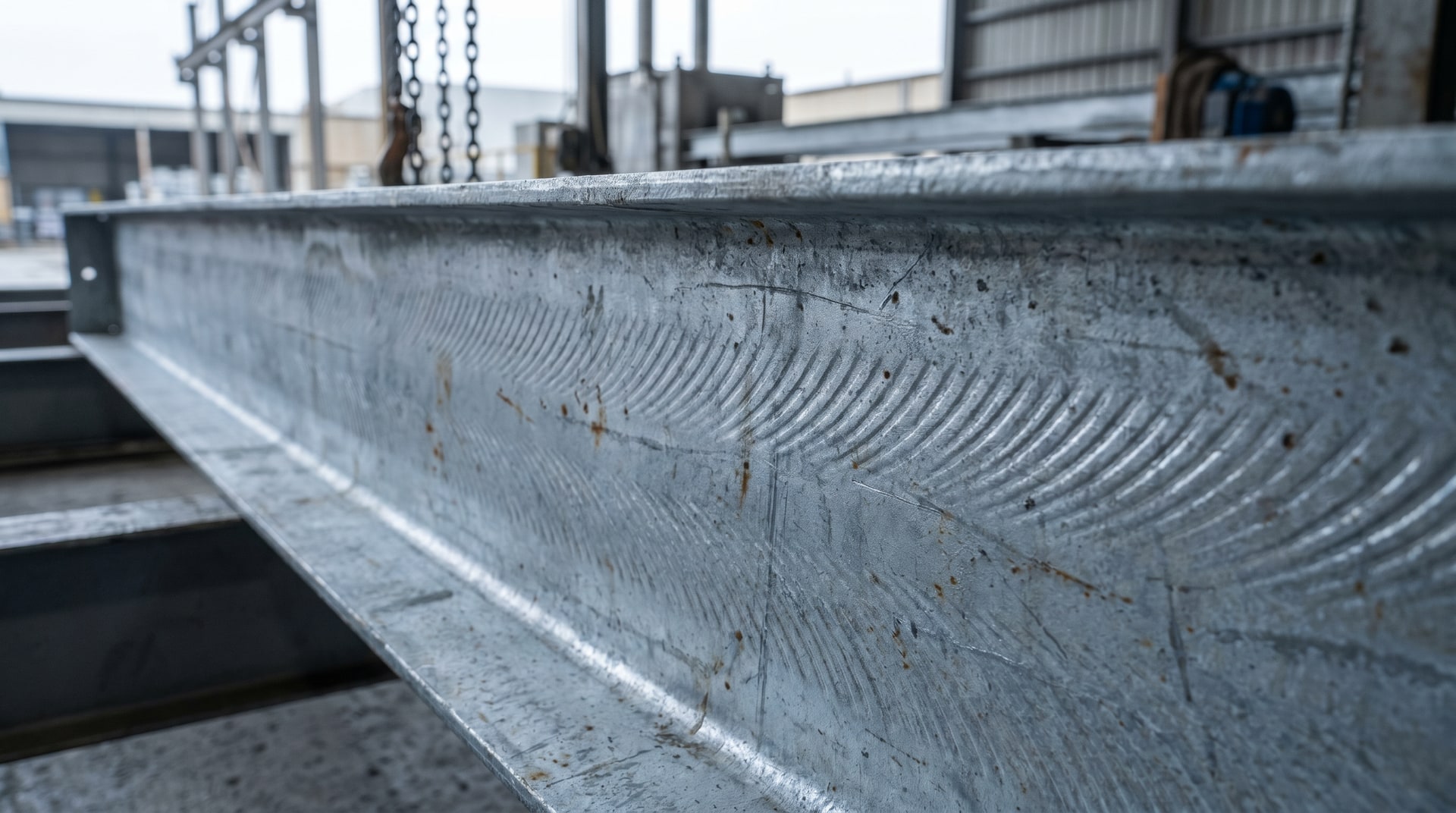
Striations appear as raised parallel ridges running across the galvanized surface. They are not cracks, delamination, or a sign of coating failure. Visually, they can look like subtle corrugations aligned in a consistent direction, and under certain lighting conditions they become quite pronounced.
The AGA identifies the chemical composition of the steel as the driving cause. The steel grain structure, rolling direction, and localized variations in carbon, silicon, or phosphorus content create regions where the iron-zinc reaction proceeds slightly faster or slower. When the reaction rate varies in a directional pattern, such as along the rolling direction of a plate or bar, the resulting alloy layer grows unevenly. That uneven growth produces the ridged topography we recognize as striations.
It is worth noting that the direction of the ridges often reflects something meaningful about the steel itself. Rolled steel products carry a grain orientation aligned with the rolling direction, and that directionality shows up in the surface chemistry. If you see striations on a flat bar or plate, the ridges are frequently parallel to the long axis of the piece, following the same grain flow introduced during the steel manufacturing process. The galvanizing did not create a flaw. It revealed a characteristic that was already present in the base metal.
Fish Boning: A Different Pattern with a Related Cause
Fish boning produces a visually different result, but the underlying mechanism is closely related. Rather than parallel ridges, fish boning creates an irregular, scale-like or herringbone pattern distributed across the entire surface of the steel part. The name comes from the visual resemblance to the arrangement of bones along a fish spine.
The AGA attributes fish boning specifically to two factors working together: differences in surface chemistry across large-diameter steel pieces, and variations in the reaction rate between the steel and molten zinc. Large-diameter sections, such as heavy round bar, thick-walled pipe, or large structural members, present a greater surface area and more opportunity for surface chemistry to vary from one zone to another. Those chemistry variations mean that some areas react more aggressively with the zinc while adjacent areas react more slowly. The resulting alloy layer has an irregular, patchy character rather than a uniform one, and when that irregular layer solidifies, the surface texture takes on the fish-bone or scale-like appearance.
The key distinction between striations and fish boning is geometric. Striations follow a directional pattern tied to rolling or grain orientation. Fish boning is non-directional and covers the full surface in a more random, organic arrangement. Both are visual manifestations of the same fundamental truth: the zinc-iron reaction responds to the chemistry it encounters, and not all steel surfaces present identical chemistry.
Why These Conditions Do Not Affect Corrosion Performance
This is the question that matters most from an engineering standpoint, and the answer from the AGA is unambiguous. Both striations and fish boning are acceptable surface conditions. The corrosion protection provided by the coating is not compromised.
The reason comes back to the nature of galvanizing as a metallurgical bond rather than a paint or applied coating. The zinc and iron-zinc alloy layers are not sitting on top of the steel in the way a film coating would. They are chemically bonded to it, with each layer continuously graded from one composition to the next. The ridges and irregularities that produce striations or fish boning represent variations in the topography of the outer zinc surface, not voids, disbonding, or thinning of the protective layers underneath.
In fact, areas where the iron-zinc reaction was more vigorous, which often correspond to the raised portions of striations, may actually have a slightly thicker alloy layer present. The corrosion protection mechanism, which relies on both the barrier effect of zinc and the sacrificial galvanic protection zinc provides, remains fully intact regardless of whether the surface looks textured or smooth. What you see on the surface does not correlate with what is happening at the metallurgical interface where protection actually originates.
The Role of Steel Selection in Managing Surface Appearance
If a project has strict aesthetic requirements, the likelihood of striations or fish boning depends in part on the steel specified. Not all steels react the same way in the zinc bath, and this is one of the reasons steel selection matters well before fabrication begins.
Silicon and phosphorus content are the two elements most strongly associated with reactive steel behavior. Steels with silicon levels in the Sandelin range (roughly 0.04 to 0.14 percent) or above approximately 0.22 percent tend to produce thicker, more irregular alloy layers. Phosphorus levels above about 0.02 percent can also intensify the reaction. When steel within these ranges is galvanized, the resulting coating may have more pronounced surface texture, including greater tendency toward striations on rolled products or fish boning on heavier sections.
This does not mean reactive steel should be avoided outright. For structural and industrial applications where performance is the priority and surface appearance is secondary, reactive steel galvanizes perfectly well and produces coatings with excellent corrosion resistance. But for architectural or highly visible applications where uniform appearance is part of the design intent, working with a galvanizer early to discuss steel selection, and reviewing mill certifications for silicon and phosphorus content, gives the project team better control over the likely outcome.
How These Surface Patterns Are Identified During Inspection
Striations and fish boning are visual, tactile conditions. An inspector looking at a freshly galvanized piece with striations will see and feel the parallel ridges. Fish boning presents as a patterned, irregular texture across the face of the piece. Neither condition involves coating separation, bare spots, flaking, or any of the physical failures that would constitute a genuine rejection criterion.
ASTM A123, the standard governing hot-dip galvanized coatings on fabricated iron and steel products, addresses coating thickness and continuity requirements but does not penalize striations or fish boning. The visual character of the coating, provided it meets thickness and adhesion requirements, is evaluated with the understanding that steel chemistry will influence surface appearance. Inspectors who understand the underlying metallurgy can quickly distinguish between cosmetic variation and actual coating defects, which makes communication with project owners considerably more efficient.
When our team at V&S Galvanizing encounters striations or fish boning on a returned or inspected part, the first step is confirming that the coating passes the relevant thickness and adhesion requirements. If it does, and it almost always does, the surface condition is documented and communicated to the customer as an acceptable cosmetic variation rather than a defect requiring rework.
What to Tell Project Owners and Architects When They Ask
One of the practical challenges with striations and fish boning is managing expectations downstream. An engineer or fabricator who understands the metallurgy will not be concerned. But a project owner or architect reviewing a galvanized railing system or structural frame for the first time may look at an uneven surface and assume something went wrong.
The most effective explanation is usually grounded in the concept of authenticity: galvanizing is a chemical reaction between two metals, not a paint applied by a machine. The surface of a galvanized part reflects the actual metallurgical history of that piece of steel. A visually varied surface is not evidence of poor workmanship. It is evidence of a genuine metallurgical process responding to real material characteristics. That framing tends to resonate with architects and owners who value material authenticity and understand that industrial processes produce materials with inherent character.
For applications where visual uniformity is a hard requirement, the conversation needs to happen before galvanizing, not after. Pre-galvanizing consultation between the specifier, fabricator, and galvanizer gives everyone the opportunity to select appropriate steel, review expected surface outcomes, and make informed decisions before metal goes into the bath. Retroactive concerns about surface appearance on an otherwise-conforming coating put everyone in an avoidable position.
Work With a Team That Understands the Full Picture
Striations and fish boning are not failures. They are surface expressions of a sophisticated metallurgical reaction that is doing exactly what it is supposed to do: forming a durable, bonded zinc coating that will protect steel for decades. The appearance may be unexpected, but the performance is not compromised. Understanding this distinction is part of what separates technically informed galvanizing work from guesswork, and it is part of what our team brings to every project we process.
At V&S Galvanizing, we work with engineers, fabricators, and project teams throughout the specification and production process, not just at the point of pickup. If you have questions about how your steel selection may affect coating appearance, want to discuss inspection outcomes on a current project, or need help communicating surface condition acceptability to a downstream stakeholder, we are ready to help. Reach out through our contact page and connect with our technical team directly.
Frequently Asked Questions About Striations and Fish Boning in Galvanized Coatings
Do striations in a galvanized coating indicate the zinc layer is thinner or weaker in those areas?
No. Striations are raised ridges caused by variations in the iron-zinc reaction rate driven by steel chemistry. They represent topographic variation in the outer zinc surface, not thinning or weakening of the coating. The corrosion protection remains fully intact, and striations are considered an acceptable surface condition under galvanizing standards.
Can fish boning be prevented by changing the galvanizing process?
Fish boning is primarily driven by differences in surface chemistry across large-diameter steel pieces and variations in the zinc-iron reaction rate. Process adjustments such as bath temperature or immersion time have limited ability to eliminate it entirely when the root cause is in the steel itself. Selecting steel with tighter compositional control, particularly lower silicon and phosphorus content, is generally more effective than process changes alone.
Will ASTM A123 inspectors reject a part that shows fish boning?
Not on the basis of fish boning alone. ASTM A123 governs coating thickness and continuity. Fish boning is a surface texture condition, not a coating deficiency. Provided the part meets minimum average coating thickness requirements and passes adhesion checks, fish boning does not constitute grounds for rejection.
Are striations more likely on certain steel products than others?
Yes. Striations tend to appear on rolled products such as flat bar, plate, and structural shapes where the rolling direction creates a consistent grain orientation in the steel. That directionality in the surface chemistry produces the parallel ridge pattern characteristic of striations. Products with less directional grain structure are less likely to exhibit pronounced striations.
Does fish boning affect how a duplex coating system, such as paint over galvanizing, performs?
An irregular surface texture from fish boning can influence paint adhesion if the texture is pronounced enough to create application difficulties. In practice, most duplex system applications involve surface preparation such as sweep blasting that normalizes the texture before painting. For critical duplex applications, discussing the expected surface condition with the coating applicator before galvanizing helps avoid surprises during paint application.
Is there a way to assess which steel lots are likely to produce striations before galvanizing begins?
Reviewing mill test reports for silicon and phosphorus content gives a reasonable indication. Steels in the reactive silicon range or with elevated phosphorus are more likely to produce surface texture variations including striations and fish boning. While this does not guarantee a specific outcome, it allows the project team to set appropriate expectations before fabrication is complete and parts arrive at the galvanizing plant.
Do striations affect the adhesion of the zinc coating to the steel substrate?
No. Striations are a surface feature of the outer zinc layer, not a sign of poor adhesion between the coating and the steel. The iron-zinc metallurgical bond that anchors the coating to the steel is not disrupted by surface ridge formation. Standard bend or impact adhesion tests on striated parts consistently demonstrate that the coating remains well-bonded.
If a project owner rejects a galvanized part based on striations or fish boning alone, what is the appropriate response?
The technically correct response is to reference the AGA guidance and applicable standards confirming that these are acceptable surface conditions that do not affect corrosion performance. Providing documentation from the galvanizing standard, along with a clear explanation of the metallurgical mechanism, typically resolves the concern. If aesthetic requirements were critical to the project, the better practice is to establish those requirements in pre-galvanizing discussions and select steel accordingly, rather than attempting to address appearance concerns after the fact.
