

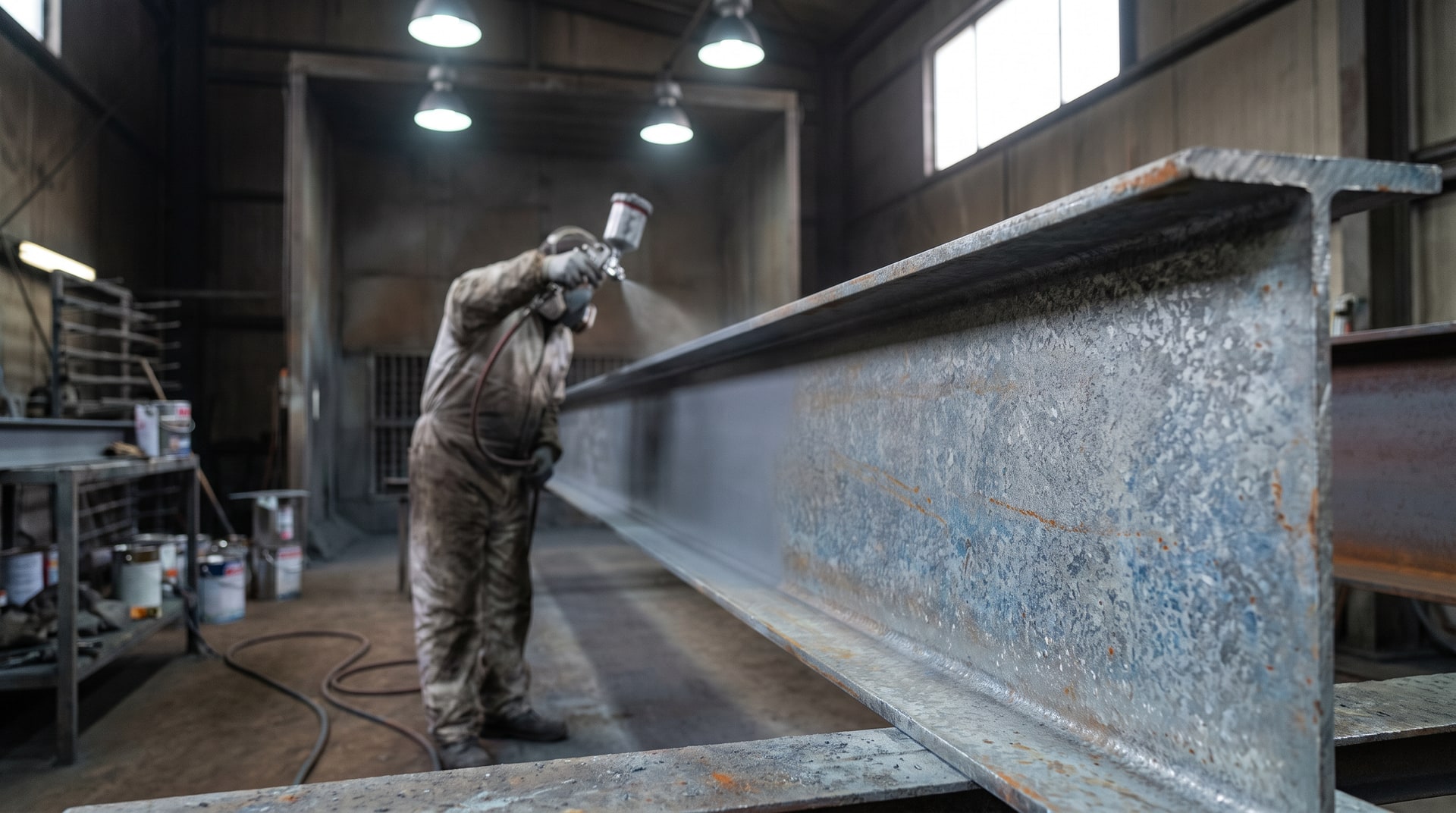
Specifying paint over hot-dip galvanized steel is not a new idea, but it has become considerably more common in recent years. Engineers and project owners are increasingly recognizing that combining galvanizing with a paint topcoat, what the industry calls a duplex system, delivers a level of corrosion protection that neither coating achieves on its own. Utility towers, bridge components, automotive parts, and architectural structures have been built this way for decades. Yet despite this long track record, adhesion failures still occur in the field, almost always because the surface preparation step was treated as an afterthought rather than a discipline in its own right.
The American Galvanizers Association addresses this directly in their article on painting over galvanized steel. At V&S Galvanizing, we expand on that foundation to explain what is actually happening at the material level, how the age and weathering condition of the zinc coating influences paint compatibility, and why the preparation requirements for galvanized steel are so frequently misunderstood or underestimated in the field.
Why Galvanizing and Paint Work Better Together
The appeal of a duplex system comes down to a concept that materials engineers call a synergistic effect. When galvanizing and paint are applied together correctly, the combined service life of the corrosion protection system exceeds the sum of what each coating would provide independently. The galvanized zinc layer sacrificially protects the steel from beneath, while the paint film above acts as a barrier that dramatically slows the rate at which the zinc is consumed. The result is a system where both coatings last longer precisely because they are working together.
Beyond raw performance, duplex systems solve a variety of practical problems. In environments where bare galvanized steel would still provide adequate corrosion protection, a paint topcoat can provide safety marking, color coding for facility management, or aesthetic matching with an architectural color palette. In situations where previously galvanized steel needs its service life extended without full re-galvanizing, paint over the existing zinc is often the most practical path. And in aggressive industrial or coastal environments where a single corrosion control layer carries too much risk, the duplex approach offers meaningful redundancy.
The Surface is Not as Simple as It Looks
One of the most persistent misconceptions about painting galvanized steel is that the surface is uniform. It is not. The characteristics of any given galvanized coating vary based on the chemistry of the steel itself, the composition of the galvanizing bath, and critically, how long the coating has been exposed to the environment since leaving the kettle. Two pieces galvanized in the same batch can present meaningfully different surfaces if one has been stored outdoors for six months and the other has not.
This variability does not affect corrosion resistance, but it matters enormously when paint adhesion is the goal. A paint system that bonds well to a freshly galvanized surface may perform very differently on a piece that has been weathering for a year. Understanding why requires understanding what is happening chemically at the zinc surface as it ages.
Three Stages of Weathering and What Each Means for Paint
The galvanizing industry categorizes galvanized steel into three weathering stages: newly galvanized, partially weathered, and fully weathered. Each stage presents a different surface chemistry, and each therefore requires a somewhat different preparation approach before painting.
Newly galvanized steel has a bright, relatively smooth surface that may contain zinc oxide and zinc hydroxide compounds formed during cooling and early exposure. These compounds are weakly bonded to the surface and can act as a release layer that prevents paint from adhering properly. This is why fresh galvanizing often requires more deliberate profiling work before painting, despite looking cleaner than older material.
Partially weathered galvanized steel has begun converting its surface chemistry toward zinc carbonate, a more stable and adherent compound that forms as the zinc reacts with carbon dioxide in the atmosphere. This intermediate stage is generally considered the most receptive surface for painting, because the conversion products are more stable than fresh oxides and hydroxides but the surface has not yet become too smooth or too contaminated from extended environmental exposure.
Fully weathered galvanized steel has a matte gray appearance and a relatively stable zinc carbonate surface. While this surface is chemically more predictable than fresh galvanizing, it may have accumulated years of dirt, grease, biological growth, or corrosion byproducts that must be thoroughly removed before any paint system will bond reliably. The preparation effort required at this stage is different in character, but no less important.
Cleaning: The Step Where Most Failures Begin
Cleaning a galvanized surface before painting has a deceptively straightforward goal: remove dirt, grease, and oils without removing meaningful amounts of the zinc coating itself. The difficulty is that many common cleaning agents are aggressive enough to attack zinc if used incorrectly.
Highly acidic or highly alkaline cleaning solutions both pose a risk. Zinc is amphoteric, meaning it reacts chemically with both acids and strong bases. Using an overly aggressive cleaner strips zinc from the surface, reducing the thickness of the coating and diminishing the very protection the galvanizing was applied to provide. This is a genuine engineering concern, not a minor procedural detail.
Alkaline cleaning, ammonia-based cleaning, and solvent cleaning are the accepted approaches for removing surface contamination from galvanized steel. Each has appropriate use cases depending on the nature of the contamination present. Because some cleaning agents can interact differently with specific paint systems, our team always recommends consulting directly with the paint manufacturer before finalizing the cleaning protocol. What works cleanly with one topcoat chemistry may create compatibility problems with another.
Profiling: Creating the Right Surface Texture for Bond Strength
Cleaning removes what should not be there. Profiling addresses what the surface needs to have: a texture fine enough that paint can mechanically key into it, but controlled enough that the zinc coating is not compromised in the process.
Paint systems bond to substrates through a combination of mechanical interlocking and chemical adhesion. On a perfectly smooth surface, mechanical interlocking is limited, and the bond strength depends almost entirely on chemical compatibility between the primer and the substrate. On a properly profiled surface, both mechanisms contribute, and the result is a more durable, more reliable bond.
For galvanized steel, the profiling methods most commonly used are sweep blasting, phosphating, and the application of wash primers or acrylic passivation treatments. Filing or grinding can address localized high spots, such as flux inclusions or rough drips at drainage points, before broader profiling work begins.
Sweep blasting is effective but requires careful control of blast pressure and media selection. Excessive blast energy strips zinc at an unacceptable rate. The goal is to roughen the surface without exposing the underlying iron-zinc alloy layers. Phosphating and wash primers offer a chemical route to improved adhesion rather than a mechanical one, and in some situations they are preferable precisely because they carry less risk of coating damage. The right choice depends on the condition of the galvanized surface, the environment the finished part will serve in, and the paint system being applied over it.
Selecting Compatible Paint Systems
Surface preparation is only half the equation. The paint system itself must be chemically compatible with a zinc substrate, and not all paint chemistries are. Some primers contain reactive ingredients that interact poorly with zinc and can cause adhesion failure or early delamination even when the surface has been correctly prepared.
ASTM has developed specifications covering the process and procedures for preparing hot-dip galvanized steel for painting, drawing on decades of failure analysis and performance data from galvanizers, paint manufacturers, researchers, and contractors. These standards exist precisely because the combination of galvanizing and paint is technically nuanced enough to require structured guidance rather than intuitive assumptions.
The most important practical lesson from that body of knowledge is that no single universal primer or paint system works on all galvanized surfaces in all conditions. Selection should be made based on the specific weathering stage of the galvanized coating, the service environment the finished assembly will be exposed to, and the documented compatibility of the paint system with zinc substrates. When in doubt, engaging both the galvanizer and the paint manufacturer together early in the specification process saves significant rework cost later.
Common Misconceptions That Lead to Field Failures
Several recurring assumptions cause duplex system failures that are entirely preventable with better information.
The first is that visible cleanliness equals surface readiness. A galvanized part can look perfectly clean and still have a surface chemistry that will cause paint to delaminate within months. Invisible contamination, oil films from handling, and unreacted flux residues are not always detectable by visual inspection alone. Proper cleaning protocols address this systematically rather than relying on appearance.
The second is that newer galvanizing is inherently easier to paint than older galvanizing. As described earlier, this is not reliably true. Fresh zinc oxide and hydroxide compounds on newly galvanized steel can act as release agents for paint, making a partially weathered surface in some respects a better starting point. The correct approach is not to assume based on age but to understand the surface chemistry at each stage and prepare accordingly.
The third misconception is that paint adhesion on galvanized steel is inherently unreliable. Historical performance data from applications including automobiles and utility infrastructure directly contradicts this. When preparation is executed correctly and a compatible paint system is selected, adhesion is excellent and the duplex system delivers service life well beyond what either coating alone would provide. The failures that generate skepticism about duplex systems are almost universally attributable to skipped or inadequate preparation steps, not to any fundamental incompatibility between galvanizing and paint.
Communication Between Trades Is Not Optional
One theme runs consistently through every successful duplex system project: early and ongoing communication between the galvanizer, the paint contractor, and the paint manufacturer. These are not independent trades that hand off work sequentially. The decisions made at the galvanizing stage, including bath chemistry, drainage design, and post-galvanizing handling, influence what the paint contractor will encounter. The paint system selected by the coating contractor determines which preparation methods are appropriate. And the galvanizer can provide critical information about the age and condition of the coating that the paint applicator needs to make good decisions on the job site.
Projects that treat this as a relay race, where each party completes their scope and passes the piece along without discussion, are the projects most likely to experience preventable adhesion failures. Projects where all three parties communicate from specification through application consistently produce better outcomes. This is not a soft recommendation. It is one of the core technical conclusions from decades of documented duplex system experience.
Work With a Team That Understands Both Sides of the Duplex System
A duplex system is only as reliable as the weakest link in its preparation chain. The galvanized coating quality, the cleaning method, the profiling approach, and the paint system selection all carry weight. Getting any one of them wrong is enough to undermine the performance of an otherwise well-designed assembly. Our team at V&S Galvanizing brings the galvanizing side of that equation with the depth of process knowledge and communication capability that duplex system projects require. We understand what paint contractors and paint manufacturers need to know about the zinc surface we produce, and we can work with your project team to make sure the right information reaches the right people before work begins rather than after a problem surfaces.
If you are specifying or planning a project that involves painting over hot-dip galvanized steel, we encourage you to bring us into the conversation early. Visit our contact page to reach our technical team and discuss your project requirements. The investment in that conversation at the front end pays dividends in coating performance for the life of the structure.
Frequently Asked Questions About Painting Over Hot-Dip Galvanized Steel
Why does paint sometimes peel off galvanized steel even when it looks like it was applied correctly?
Peeling usually traces back to inadequate surface preparation rather than an incompatible paint system. Zinc oxide and zinc hydroxide compounds on newly galvanized steel can act as a weak interface between the zinc surface and the primer, allowing the paint film to delaminate under stress or moisture exposure. Proper cleaning and profiling prior to paint application eliminates this weak layer and allows the primer to bond directly to a stable zinc surface.
Does the weathering stage of the galvanized coating actually change which preparation steps are needed?
Yes, meaningfully. Newly galvanized steel often requires more aggressive profiling to overcome the smooth, chemically reactive surface left by fresh zinc oxide formation. Partially weathered steel with a developing zinc carbonate layer is generally more receptive to paint with less intervention. Fully weathered steel requires thorough cleaning to remove accumulated contamination but may need less profiling work. Treating all three stages identically is a common source of inconsistent results.
What ASTM standards govern painting over hot-dip galvanized steel?
ASTM has developed specifications that detail the process and procedures for preparing hot-dip galvanized steel for painting. These standards were developed by drawing on documented adhesion failures and successes from galvanizers, paint companies, researchers, and paint contractors over many years. Consulting the current applicable ASTM specification is strongly recommended before finalizing a surface preparation protocol for any duplex system project.
Is sweep blasting always required before painting galvanized steel?
No. Sweep blasting is one of several methods for profiling the galvanized surface to improve paint adhesion, but it is not universally required and must be applied carefully to avoid stripping excessive zinc. Phosphating, wash primers, and acrylic passivation treatments offer alternative chemical routes to improved adhesion that carry less risk of coating damage. The appropriate method depends on the condition of the galvanized surface and the requirements of the paint system being applied.
Can you paint over galvanized steel that has started to rust at scratch or damage points?
Duplex systems are specifically recognized as a method for extending the life of previously galvanized steel, including steel that has seen some coating degradation. However, areas of active red rust or significant zinc depletion require repair of the galvanized coating before painting, not painting over. Paint applied over corroded zinc or bare steel will not arrest the corrosion beneath it and will fail prematurely. Proper touch-up of damaged areas followed by compatible primer application is the correct sequence.
Does painting over galvanized steel reduce the corrosion protection the zinc provides?
No, it extends it. The paint topcoat acts as a barrier that slows atmospheric attack on the zinc layer beneath, which means the zinc sacrificial protection is consumed far more slowly than it would be on bare galvanized steel. This is the core mechanism behind the synergistic effect of duplex systems: both coatings last longer in combination than either would independently.
Who should be consulted when selecting a paint system for galvanized steel?
Both the galvanizer and the paint manufacturer should be involved. The galvanizer can provide information about the bath chemistry, coating age, and surface condition that determines which preparation and priming approaches are appropriate. The paint manufacturer can confirm compatibility of their system with zinc substrates and advise on cleaning agents that will not create adhesion problems with their specific primer chemistry. Treating these as separate decisions made by separate parties is one of the most common sources of duplex system failures.
How do the reasons for specifying a duplex system affect the preparation requirements?
The end-use purpose influences the performance targets for the paint system, which in turn affects how stringently the preparation must be executed. A color-coding application in a low-corrosion interior environment may tolerate a less intensive preparation protocol than a duplex system specified for a coastal industrial structure where both coatings are being relied upon for long-term corrosion control. The more demanding the service environment, the more important it becomes to execute every preparation step precisely and to verify paint-to-zinc compatibility before proceeding.
