

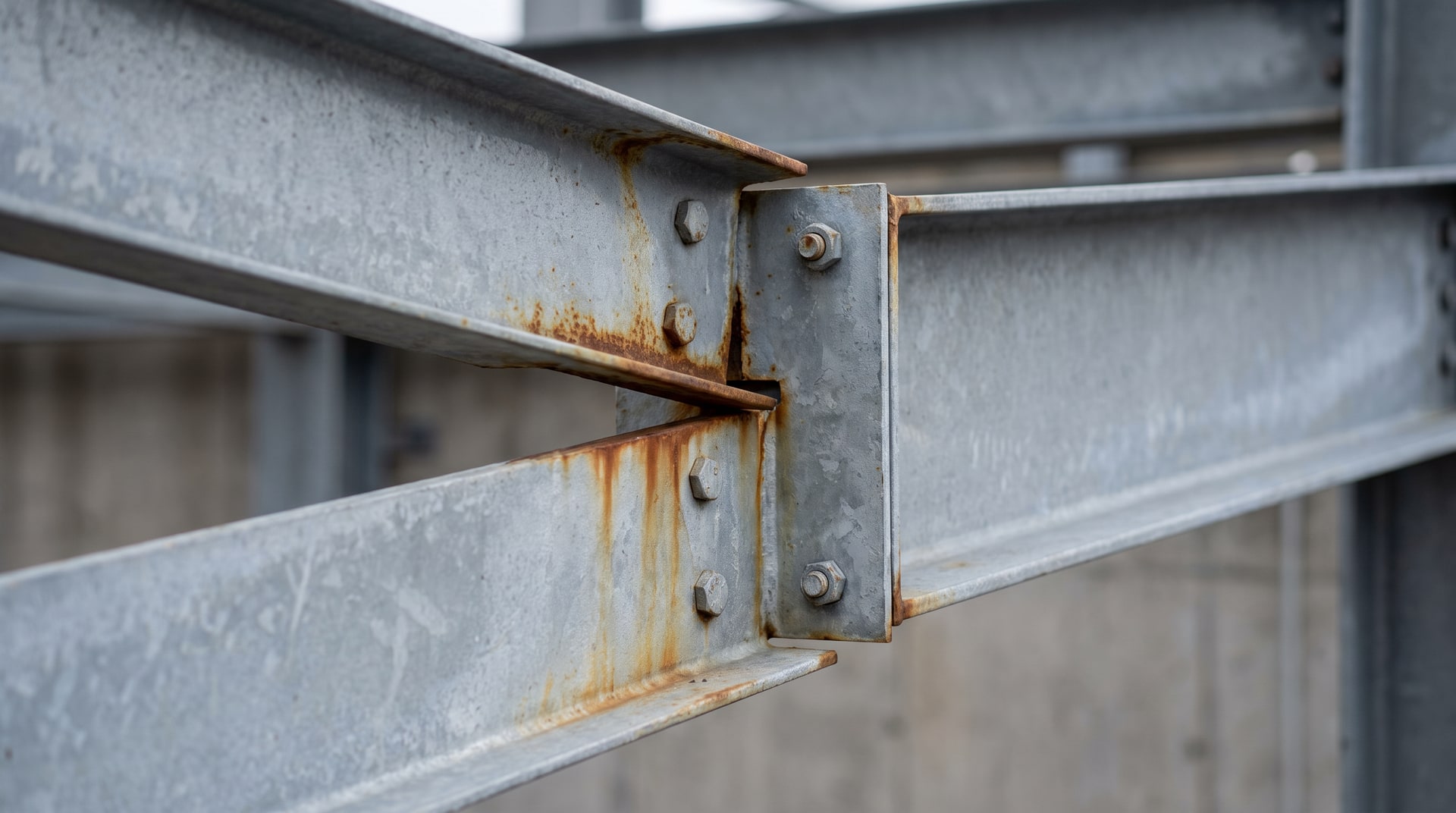
Few things create more confusion on a job site than receiving freshly galvanized steel and discovering what looks unmistakably like rust dripping down the side of a newly coated part. The immediate assumption is almost always the same: the galvanizer missed a spot. In reality, what you are looking at is a well-documented phenomenon called rust bleeding, and it has nothing to do with an incomplete galvanizing job. Understanding why it happens requires looking closely at the chemistry that occurs inside tight joints and overlapping surfaces before, during, and after the galvanizing process.
The American Galvanizers Association addresses this directly in their article on rust bleeding on overlapping surfaces. At V&S Galvanizing, we expand on that foundation to explain what is actually happening at the material level, how joint geometry influences performance, and why this condition is so often misunderstood in the field.
What Rust Bleeding Actually Is
Rust bleeding is the visible dripping or trailing of iron oxide (rust) from small gaps formed where steel surfaces overlap or contact each other before galvanizing. The staining can appear alarming because it runs down an otherwise bright, metallic zinc surface. But the rust itself is not coming from the galvanized exterior. It originates from inside the joint, from steel that never received a zinc coating at all.
The distinction matters. The outer galvanized surface is performing exactly as it should. The problem is localized to the interior of the gap, a geometry that the galvanizing process cannot physically reach. What you see bleeding out is the product of an ongoing corrosion reaction happening inside a confined space, then seeping outward through the same narrow opening it entered.
Why Zinc Cannot Enter Tight Gaps
The galvanizing process involves immersing steel in a bath of molten zinc at approximately 850 degrees Fahrenheit. Zinc in its molten state has a significantly higher viscosity than water. Cleaning solutions and flux solutions, which are applied to the steel earlier in the process, are thin enough to wick into gaps narrower than 3/32 of an inch. Molten zinc simply cannot follow them in. Its surface tension and viscosity prevent penetration into such confined geometry.
This is not a process failure or a quality control issue. It is a physical limitation governed by fluid dynamics. The result is that any gap tighter than 3/32 of an inch presents a surface that gets cleaned and fluxed but never coated with zinc. The interior of that joint is left as bare, unprotected steel.
The Chemistry That Drives the Problem
Cleaning and flux solutions penetrate the gap during the pre-treatment stages of galvanizing. As the steel heats up and approaches galvanizing temperature, those solutions vaporize. The vaporization itself is not the issue. What it leaves behind is.
When the liquid phase evaporates, anhydrous crystals from the cleaning and flux chemistry are deposited on the bare steel surfaces inside the joint. These crystals are chemically stable in a dry state, but they are highly reactive when moisture is reintroduced. After the steel leaves the galvanizing bath and is returned to service, atmospheric moisture gradually penetrates back into the gap. That moisture mixes with the anhydrous crystals to form an acidic, highly corrosive solution.
That corrosive solution attacks the bare steel surfaces inside the joint. As iron oxidizes, corrosion products accumulate. The gap provides no drainage and no circulation, so pressure builds and the rust eventually migrates outward, bleeding from the gap opening and staining the surrounding zinc surface. The stain you see is the end result of a sustained electrochemical process taking place out of sight, inside the joint.
Design Is the First Line of Defense
The most effective intervention happens before fabrication reaches the galvanizer. ASTM A385, the standard that covers design requirements for hot-dip galvanized structural assemblies, provides specific guidance on how to handle overlapping and contacting surfaces. The two primary approaches are seal welding and stitch welding, and the choice between them depends on the geometry and the minimum gap that can be maintained.
For gaps smaller than 3/32 of an inch, the standard recommends seal welding all overlapping or contacting surfaces. A complete, continuous seal weld closes the joint entirely, preventing cleaning and flux solutions from entering in the first place. When the solution never enters the gap, the anhydrous crystal residue never forms, and rust bleeding cannot occur.
Where the design allows for a gap of at least 3/32 of an inch to be maintained, stitch welding becomes an option. A 3/32-inch opening is wide enough to permit molten zinc to enter and coat the interior surfaces during immersion. This eliminates the ungalvanized zone altogether. Stitch welding supports that gap while still connecting the surfaces structurally, though whether stitch welding is suitable depends on the structural requirements of the design.
The distinction between these two approaches is worth internalizing. Seal welding works by exclusion: it keeps the problem chemistry out. Stitch welding with an adequate gap works by inclusion: it lets the zinc in. Both are valid strategies, but they require the designer and fabricator to engage with the problem proactively, before any steel reaches the galvanizing line.
The Safety Risk of Imperfect Seal Welds
Seal welding carries a responsibility that goes beyond surface preparation. A seal weld must be truly complete. Any imperfection, pinhole, or discontinuity in the weld allows moisture to enter the enclosed space. Inside a fully or nearly sealed area, moisture that enters during atmospheric exposure has nowhere to go. When the steel is subsequently heated, that trapped moisture vaporizes and expands rapidly.
This creates an explosive pressure hazard for galvanizing personnel. The consequences of a sealed chamber rupturing during immersion in the zinc bath are serious. This is why ASTM A385 recommends venting any enclosed area greater than 16 square inches. Venting allows vapor to escape safely during the heating process rather than building to dangerous pressure levels inside the sealed cavity.
The message for fabricators is clear: if you seal weld, do it completely and correctly, and follow the standard's venting requirements for larger enclosed areas. A partial or pinholed seal weld may actually create a worse hazard than no seal weld at all, because it traps moisture without providing a path for it to escape.
Responsibility in the Supply Chain
A question that comes up regularly in our conversations with fabricators and project teams is: who is responsible for this? The answer is defined clearly in ASTM A385. The designer and fabricator are responsible for notifying the galvanizer when overlapping or contacting surfaces are present in the assembly. The galvanizer is not responsible for ensuring gaps have been seal welded, and is not responsible for repairing cosmetic or structural damage that results from rust bleeding.
This is not a matter of the galvanizer avoiding accountability. It reflects the practical reality that by the time steel arrives at our facility, the joint geometry is fixed. We cannot retroactively seal weld a joint, and we cannot change the physics that prevent zinc from entering a tight gap. What we can do is flag potential issues when we see them and discuss options with the project team before the work begins. That kind of communication is most valuable early in the project lifecycle, not after fabrication is complete.
If you are working on an assembly with overlapping surfaces and are uncertain about how to detail the joints for hot-dip galvanizing, that conversation should happen during the design or pre-fabrication phase. We are available to review drawings and flag concerns before they become field problems.
Cleaning Rust Bleeding Stains from Galvanized Steel
If rust bleeding has already occurred, the cosmetic staining is reversible. The rust itself has not damaged the zinc coating. It has simply deposited iron oxide on the surface of the galvanized steel as it migrated out of the gap. Rinsing the affected area with water and scrubbing with a nylon brush is sufficient to remove the staining. Avoid wire brushing or abrasive tools that could damage the zinc surface.
Cleaning addresses the appearance but does not address the source. The bare steel inside the gap is still vulnerable to corrosion, and the anhydrous crystals may still be present. Without additional intervention, rust bleeding is likely to recur as moisture continues to enter the gap through atmospheric exposure.
Post-Galvanizing Remediation at the Source
Once a galvanized structure has been cleaned of rust staining, the underlying corrosion mechanism can be interrupted by sealing the gap opening from the outside. The goal is to prevent atmospheric moisture from re-entering the joint and reacting with any remaining anhydrous crystal residue. Without that moisture, the electrochemical reaction that produces rust cannot continue.
Silicone caulking and epoxy coatings are two materials commonly used for this purpose. Applied over the gap opening on the galvanized surface, they block both ingress of water and egress of any further rust. This is not a substitute for proper seal welding at the fabrication stage, but it is a practical and effective remediation step when the issue is discovered on an already-galvanized assembly. It stops the bleeding, protects the remaining steel inside the joint, and preserves the appearance of the galvanized surface going forward.
Work With a Team That Understands Joint Geometry and Galvanizing Design
Rust bleeding is one of those conditions where the visible symptom and the actual cause are separated by time, chemistry, and geometry. A rust stain on a zinc surface does not mean the galvanizing failed. It means the joint design created conditions that the galvanizing process cannot physically overcome. Closing the gap in the design, through proper seal welding or adequate clearance for zinc penetration per ASTM A385, is what eliminates the problem at its root. Remediation after the fact is available and effective, but prevention through design is always the cleaner outcome for the project and the end user.
At V&S Galvanizing, we work with engineers, fabricators, and contractors across a wide range of structural applications. If you have questions about how to detail your assemblies for galvanizing, need help identifying whether overlapping surfaces in your design require attention, or want to review a drawing before fabrication begins, reach out through our contact page and we will connect you with someone on our technical team.
Frequently Asked Questions About Rust Bleeding on Galvanized Steel
Why does rust appear on steel that was just galvanized?
The rust is not coming from the galvanized exterior. It originates from bare steel inside tight gaps at overlapping or contacting surfaces, where molten zinc cannot penetrate during the galvanizing process. Cleaning and flux residues left inside those gaps react with atmospheric moisture after galvanizing, producing an acidic solution that corrodes the ungalvanized steel and bleeds outward.
What gap size is the threshold for rust bleeding risk?
Gaps smaller than 3/32 of an inch are the problem. Cleaning and flux solutions can penetrate gaps below this threshold, but molten zinc cannot because of its higher viscosity. Interior surfaces inside gaps narrower than 3/32 of an inch are left uncoated, making them vulnerable to the corrosion mechanism that causes rust bleeding.
What does ASTM A385 require for overlapping surfaces before galvanizing?
ASTM A385 recommends seal welding all overlapping or contacting surfaces where the gap is less than 3/32 of an inch, or providing a stitch weld arrangement where a 3/32-inch gap can be maintained to allow zinc penetration. The standard also requires venting any enclosed areas greater than 16 square inches to prevent pressure hazards during galvanizing.
Is a galvanizer responsible for rust bleeding if it was not disclosed?
No. Per ASTM A385, the designer and fabricator are responsible for notifying the galvanizer when overlapping or contacting surfaces are present and for ensuring proper joint treatment before galvanizing. The galvanizer is not responsible for seal welding gaps or for repairing damage caused by rust bleeding that results from undisclosed joint conditions.
What is the safety hazard associated with imperfect seal welds on galvanized assemblies?
A seal weld with pinholes or discontinuities can trap moisture inside an enclosed cavity. When the steel heats to galvanizing temperature (approximately 850 degrees Fahrenheit), that trapped moisture vaporizes and expands rapidly, creating explosive pressure inside the sealed area. This is a direct safety hazard to galvanizing personnel. Seal welds must be complete and continuous, and enclosed areas over 16 square inches must be vented per ASTM A385.
Can rust bleeding stains be removed from galvanized steel?
Yes. The staining is cosmetic and does not damage the zinc coating. Rinsing with water and scrubbing with a nylon brush removes the iron oxide deposits from the galvanized surface. Avoid abrasive tools that could scratch or thin the zinc. Cleaning alone does not stop the corrosion at the source; sealing the gap opening afterward is also recommended.
How do you stop rust bleeding from recurring after cleaning?
After removing the staining, apply a sealant such as silicone caulking or an epoxy coating over the gap opening on the galvanized surface. This prevents atmospheric moisture from re-entering the joint and reacting with any anhydrous crystal residue inside. Without moisture, the corrosion reaction stops. The sealant also prevents additional rust from exiting the gap and staining the surface.
Can stitch welding be used instead of seal welding to prevent rust bleeding?
Stitch welding is a viable alternative when the joint can be designed to maintain a minimum gap of 3/32 of an inch between the overlapping surfaces. At that gap size, molten zinc can enter and coat the interior surfaces during galvanizing, eliminating the ungalvanized zone. Whether stitch welding is structurally appropriate depends on the design requirements of the specific assembly.
