

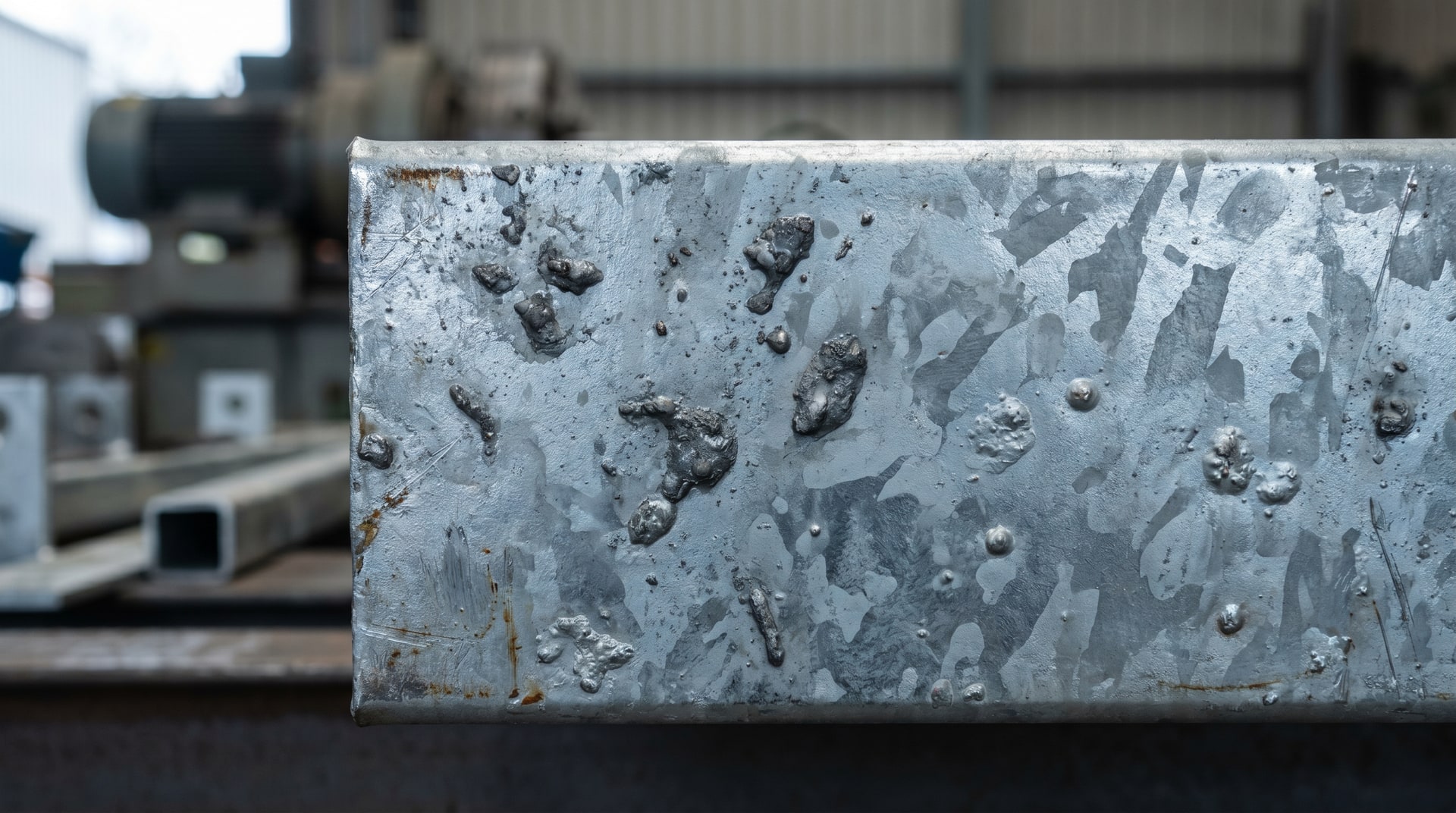
If you have ever pulled a part out of a zinc kettle and found it covered in bumps, ridges, or a texture that looks more like orange peel than a smooth metallic finish, you are not alone. Rough galvanized coatings show up regularly in production environments, and they tend to generate immediate concern, both from the galvanizer and from the customer receiving the steel. The question that follows is almost always the same: is this a problem?
The answer depends entirely on what caused the roughness and what the steel is being used for. Not all rough coatings are created equal, and understanding the mechanism behind a given surface condition is essential before deciding whether to accept, reject, or repair a part. The American Galvanizers Association addresses this directly in their article on rough galvanized coatings. At V&S Galvanizing, we expand on that foundation to explain what is actually happening at the material level, how steel chemistry and process conditions influence surface texture, and why this topic is often misunderstood in the field.
The Metallurgical Reason Galvanized Coatings Go Rough
Hot-dip galvanizing is a diffusion-driven reaction. When steel is immersed in molten zinc, a series of iron-zinc intermetallic layers form at the steel surface and grow outward. Under normal conditions with steel that falls within acceptable chemistry ranges, this growth is relatively uniform and controlled, producing a smooth, layered coating.
When the steel chemistry departs from those norms, particularly with elevated silicon or phosphorus content, the kinetics of that intermetallic growth change significantly. The reaction accelerates, and instead of building up in an orderly, planar manner, the zinc-iron layers grow faster and in less predictable directions. The coating thickens more rapidly than surrounding areas and can push outward in ways that create visible ridges, striations, or an all-over rough texture. This is not a processing error by the galvanizer. It is the material responding to its own chemistry.
Silicon and Phosphorus: The Reactive Steel Problem
Silicon and phosphorus both act as catalysts during the galvanizing reaction. ASTM A385 provides recommendations on acceptable silicon and phosphorus levels for steel intended to be galvanized. Steel that falls outside those recommendations is referred to as reactive steel, and it reliably produces coatings that are thicker and rougher than what you would see on clean, low-alloy carbon steel.
One of the more frustrating aspects of reactive steel is that a heat chemistry certificate does not always predict what will happen in the kettle. Heat chemistries represent a sample of the full melt, and individual pieces of steel within that heat can have silicon or phosphorus levels that are meaningfully higher or lower than the reported average. This variability matters because silicon and phosphorus are not always distributed evenly through the steel. A single structural member might have pockets of elevated silicon that cause certain zones to react aggressively while adjacent areas galvanize normally. The result is a coating with localized thick ridges surrounded by otherwise acceptable zinc, a pattern that is visually striking but not necessarily a rejection criterion.
Phosphorus deserves specific attention. Steel with phosphorus content over 0.04% tends to produce dull coating areas along with ridges where intermetallic growth has intensified. The end result is a rough surface with a distinctly ridged appearance that can look almost like weld spatter or surface scaling when you first encounter it in the field.
Does Coating Roughness from Reactive Steel Hurt Corrosion Performance?
This is where a lot of field confusion originates. When engineers or inspectors see a rough galvanized coating, the immediate assumption is often that something went wrong and the corrosion protection has been compromised. In most cases, the opposite is closer to the truth.
Reactive steel produces thicker coatings than non-reactive steel. More zinc mass on the surface means more material available to sacrificially protect the underlying steel. Rough galvanized coatings caused by steel chemistry do not reduce corrosion resistance and, in many service environments, can actually extend the service life of the product compared to a thinner, smoother coating on low-reactivity steel. The coating itself, even if visually uneven, remains metallurgically bonded and provides the same electrochemical protection mechanism as any other hot-dip galvanized surface.
The concern with rough coatings is primarily functional and application-specific, not a question of whether the zinc is doing its job at the material level.
Dross Inclusions: A Different Kind of Surface Defect
Steel chemistry is not the only route to a rough galvanized coating. Dross inclusions represent a process-side cause that operates through a completely different mechanism and requires its own set of controls to manage.
Dross forms when free iron particles suspended in the molten zinc bath react with the zinc to produce zinc-iron compounds with a higher density than the surrounding liquid metal. These particles can accumulate at the bottom of the kettle or, under certain temperature conditions, float near the surface. As steel is lowered into or withdrawn from the bath, dross particles can adhere to the coating, where they appear as hard, gritty pimple-like protrusions on the finished surface.
Unlike the roughness caused by reactive steel chemistry, dross inclusions are discrete particles sitting on or partially embedded in the zinc coating rather than a product of the coating growing irregularly. This distinction matters when evaluating whether a rough coating is acceptable.
When Dross Inclusions Cross Into Rejection Territory
Dross inclusions, like roughness from reactive steel, do not inherently reduce the corrosion resistance of the coating. The zinc around the inclusion is still intact, and the base steel is still protected. However, dross inclusions can become a rejection issue under two specific conditions.
The first is when the inclusions are large enough that they can be knocked loose from the coating during handling or installation. If a dross particle separates from the surface and leaves behind a bare spot on the steel, that area is unprotected. If those bare spots cannot be repaired in accordance with ASTM A780, the part is rejectable. ASTM A780 governs the repair of damaged and uncoated areas on hot-dip galvanized steel, and it sets the standard against which any repair work is measured.
The second rejection criterion is functional. When a part with dross inclusions is intended for an application where surface condition matters, such as handrails or steel that will receive a paint or powder coat system after galvanizing, the presence of protruding inclusions can make the coating unsuitable for its intended use regardless of whether bare spots exist.
Controlling Dross at the Process Level
Because dross originates from free iron in the zinc bath, the most effective controls target iron content directly. Thoroughly rinsing steel after chemical cleaning before it enters the preflux tank reduces the amount of dissolved iron compounds carried into the bath. Keeping the iron content of the preflux solution within controlled limits serves the same purpose.
Element additions to the zinc bath also play a role. Controlled weekly additions of nickel and aluminum can lower the solubility of iron in molten zinc, which causes iron to precipitate out of solution and settle to the bottom of the kettle as bottom dross rather than remaining suspended where it can adhere to parts. Temperature management is equally important. Maintaining proper zinc kettle temperatures, especially near the top of the kettle along the walls, significantly reduces the formation of floating dross that is most likely to attach to parts being withdrawn from the bath. Finally, regular drossing of the kettle, physically removing accumulated dross from the bottom and sides, keeps the overall iron particle load in the bath at a manageable level.
These are standard practices at any well-run galvanizing operation, but the degree to which they can be optimized has a direct bearing on how often dross inclusions appear in finished work.
Surface Preparation as a Contributing Factor
Beyond steel chemistry and bath conditions, the physical condition of the steel surface before it enters the kettle can independently cause a rough galvanized coating. If the steel surface is already rough because of mechanical preparation methods, particularly abrasive blasting, the galvanized coating will reflect that underlying texture. Zinc follows the surface profile it is applied to, and a deeply blasted or pitted surface will produce a coating that mirrors those irregularities.
Excessive blasting and overly aggressive chemical cleaning both fall into this category. Overblasting removes more base metal than necessary, creating a rougher profile than the galvanizing process requires. Aggressive chemical cleaning can also etch the steel surface in ways that leave behind a texture that carries through into the finished coating. In both cases, the issue originates in the preparation stage, not in the galvanizing reaction itself, and the roughness is a predictable consequence of how the surface was treated before the zinc ever touched it.
This is worth understanding because it means surface preparation decisions made earlier in the fabrication process can determine coating appearance well before the part reaches the galvanizer. When surface finish is a known requirement for a project, communicating that upstream in the production chain avoids problems that are much harder to resolve after the fact.
Acceptance and Rejection: What the Standards Actually Say
The practical question for anyone inspecting or receiving galvanized steel is straightforward: when is a rough coating actually rejectable? The answer under applicable standards is tied to the intended use of the product, not to visual appearance alone.
Rough galvanized coatings are only rejectable when the roughness affects the part's suitability for its intended application. Two applications commonly cited in this context are handrails, where surface texture is a safety and handling concern, and steel that will be painted or coated after galvanizing, where surface profile directly affects adhesion and finish quality of the subsequent coating system. Outside of these and similar functional requirements, a rough or visually uneven galvanized coating that is otherwise metallurgically sound and well-bonded is generally acceptable.
This framing is important for fabricators and engineers specifying galvanized steel. If a smooth finish is genuinely required for a particular application, that requirement should be communicated clearly in the project specification so that steel chemistry can be screened in advance and appropriate steel selected. Retrofitting a smoothness requirement after the fact creates conflict and cost that could easily be avoided with upfront coordination.
Work With a Team That Understands the Whole System
Rough galvanized coatings are a real-world condition that comes up across a wide range of projects and materials. The causes span steel chemistry, bath management, and surface preparation, and the implications vary depending on what the steel is being used for. A coating that looks alarming on first inspection may be performing exactly as it should, while a subtler condition in the wrong application context can create a legitimate problem. Getting that distinction right requires understanding how the galvanizing reaction works and what standards actually govern acceptance.
At V&S Galvanizing, our team works through these questions every day. We understand the material science behind reactive steel behavior, the process controls that minimize dross, and the ASTM standards that define what is and is not acceptable in a finished coating. If you are working through a coating appearance question, specifying galvanized steel for an application with specific surface requirements, or just trying to understand what you are looking at on a part that came back from the kettle, we are glad to help. Reach out to us through our contact page and we will get you a straight answer.
Frequently Asked Questions About Rough Galvanized Coatings
What causes a rough or bumpy texture on hot-dip galvanized steel?
Rough galvanized coatings are most commonly caused by reactive steel chemistry, specifically elevated silicon or phosphorus content that accelerates intermetallic growth during the galvanizing reaction. Dross inclusions from the zinc bath and rough steel surfaces prior to galvanizing, from excessive blasting or aggressive chemical cleaning, are also recognized causes.
Does a rough galvanized coating mean the steel has less corrosion protection?
Not in most cases. Roughness caused by reactive steel chemistry typically comes with a thicker coating, which can actually extend service life compared to smoother coatings on non-reactive steel. Dross inclusions also do not reduce corrosion resistance unless they detach and leave unrepaired bare spots on the steel surface.
What silicon and phosphorus levels make steel reactive for galvanizing purposes?
ASTM A385 provides the recommended silicon and phosphorus ranges for steel intended to be hot-dip galvanized. Steel with chemistry outside those recommendations is classified as reactive and is likely to produce thicker, rougher coatings. Phosphorus content above 0.04% is specifically associated with dull coating areas and visible ridging.
When is a rough galvanized coating actually rejectable?
A rough coating is only rejectable when the roughness affects the intended use of the product. Applications like handrails, where surface texture is a handling and safety concern, and steel that will be painted after galvanizing, where surface profile affects adhesion, are the primary cases. A rough but well-bonded coating on structural steel in a standard service environment is generally acceptable.
Can dross inclusions be repaired, and what standard governs that repair?
If dross inclusions are large enough to detach and leave bare spots on the steel, those areas require repair. ASTM A780 governs the repair of damaged and uncoated areas on hot-dip galvanized steel. Parts are rejectable only when bare areas created by detached dross cannot be repaired in accordance with that standard.
How does abrasive blasting contribute to rough galvanized coatings?
Abrasive blasting creates a surface profile on the steel that the zinc coating follows during galvanizing. Excessive blasting removes more base metal than necessary and produces a rougher underlying texture, which carries through to the finished coating surface. Overly aggressive chemical cleaning can produce a similar effect by etching the steel surface before it enters the zinc bath.
Why can heat chemistry certificates fail to predict reactive steel behavior?
Heat chemistry certificates represent a sample drawn from the overall melt and are not always fully representative of every piece of steel produced from that heat. Individual pieces can have silicon or phosphorus levels that are higher or lower than the reported values. Additionally, silicon and phosphorus are not always distributed evenly within a single piece of steel, meaning localized high-concentration zones can cause uneven coating growth even when the certified heat chemistry appears within acceptable limits.
What process controls reduce dross inclusions in galvanized coatings?
Effective dross control involves fully rinsing steel after chemical cleaning to limit iron carryover into the bath, controlling iron levels in the preflux solution, making regular additions of nickel and aluminum to reduce iron solubility in the molten zinc, maintaining proper kettle temperatures especially near the top along the walls, and drossing the kettle frequently to physically remove accumulated iron-zinc compounds.
