

Surface quality in hot-dip galvanizing is not just an aesthetic concern. When a coating is absent or disrupted in a localized area, that gap represents a point where the corrosion protection that galvanizing is specifically engineered to provide can be compromised. In most cases these defects are small, they have defined causes, and they are entirely preventable with proper planning and handling. But understanding exactly why they occur, what distinguishes one type from another, and how they are addressed once discovered is essential for anyone specifying, inspecting, or receiving galvanized steel.
The American Galvanizers Association addresses this directly in their article on products in contact and touch marks. At V&S Galvanizing, we expand on that foundation to explain what is actually happening at the material level, how product handling and fixture loading influence coating integrity, and why these defects are often conflated or misunderstood in the field.
Two Distinct Defect Types That Are Frequently Confused
The terms "contact mark" and "touch mark" are sometimes used interchangeably in the field, but they describe different phenomena with different causes, different timing, and different implications for the finished product.
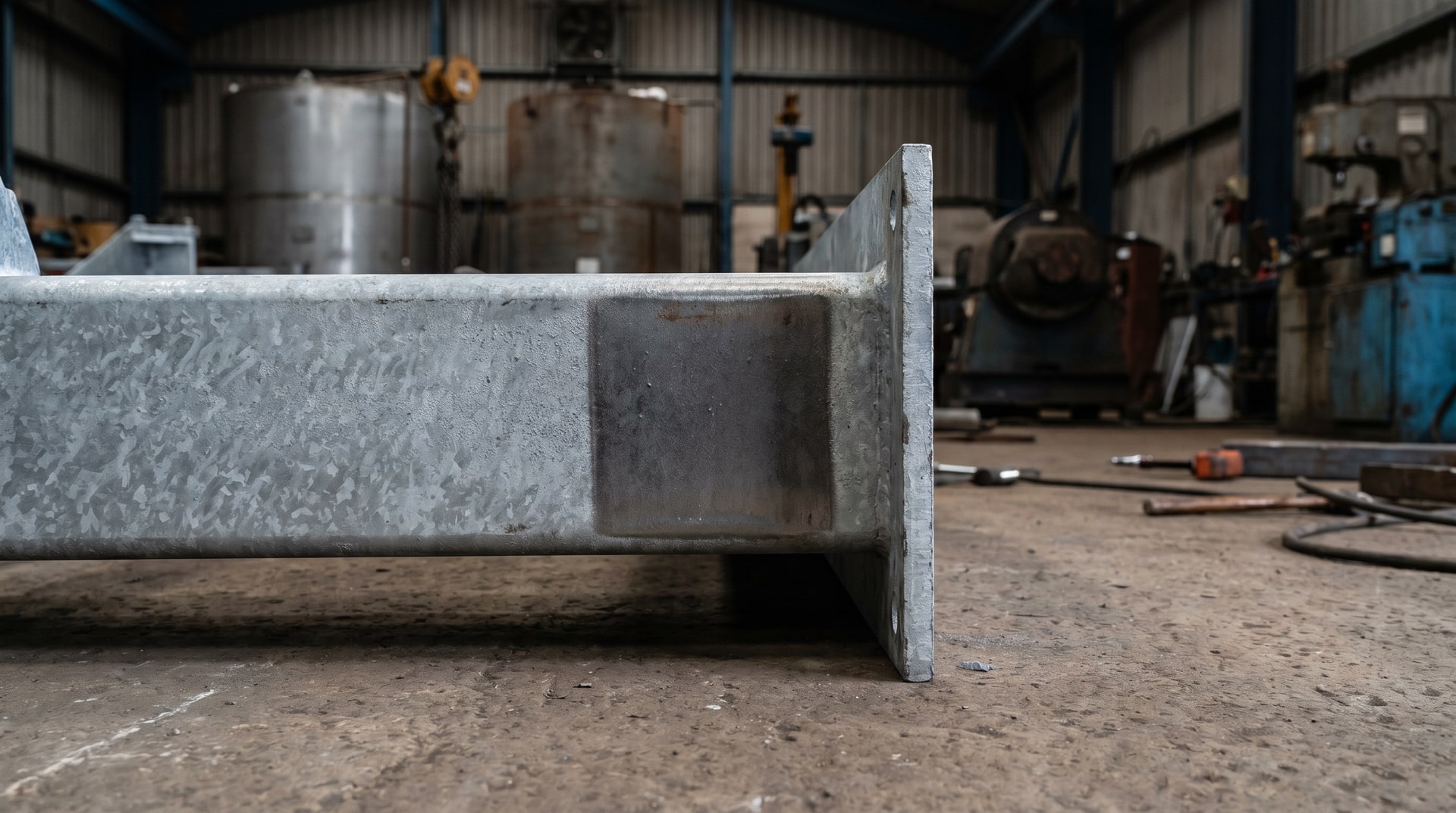
A contact mark occurs during the galvanizing process itself. When two or more steel pieces touch each other while submerged in the zinc bath, molten zinc cannot penetrate the interface between them. The result is an area on each surface that receives little to no zinc coverage, because the physical barrier of the adjacent part prevented the coating from forming. This is a process-side issue rooted in how parts are loaded and hung before they enter the kettle.
A touch mark, by contrast, occurs after the galvanized coating has already formed. It is the result of coated surfaces coming into contact with other galvanized pieces or with material handling equipment during processing, cooling, or transport. The coating exists but gets damaged, scraped, or compressed at the point of contact. Both result in a disrupted surface, but the mechanism is fundamentally different, and that distinction matters when determining responsibility and deciding on an appropriate response.
What Actually Happens When Parts Touch in the Zinc Bath
To understand why contact marks form, it helps to think through the chemistry and physics of the galvanizing reaction. When clean, fluxed steel enters the molten zinc bath, a metallurgical reaction begins immediately at the steel surface. Zinc and iron interdiffuse to form a series of zinc-iron alloy layers: the gamma, delta, and zeta phases, topped by a relatively pure eta (eta) layer of free zinc. This reaction requires direct contact between the molten zinc and the steel surface.
If two steel parts are touching at the moment they enter the bath, the area where they press against each other is effectively sealed off from the zinc. Molten zinc cannot flow into that interface unless the parts separate. Depending on how tightly the parts are held together by their own weight or by the geometry of the fixture, that sealed zone can remain uncoated for the entire dip cycle. When the pieces are extracted and separated, you are left with a bare or thinly coated spot on each surface corresponding precisely to where the contact occurred.
With small parts hung in bulk, this problem multiplies quickly. A single fixture loaded with dozens of small brackets, clips, or fasteners creates many potential contact points, and parts that shift or settle against one another during immersion create unpredictable bare areas across the batch.
The Galvanizer's Responsibility in Preventing Contact Marks
The AGA is clear on this point: the galvanizer is responsible for the proper handling of all steel parts to avoid contact-related defects. This responsibility is not passive. It requires active decisions about how parts are positioned on fixtures, what spacing is maintained between pieces, and whether the racking geometry allows molten zinc to reach all surfaces.
In practice, this means fixtures should be designed or selected to hold parts at angles or spacings that prevent overlap. For small parts in volume quantities, this can require individual hanging, spreading across multiple bars, or the use of purpose-built racks that maintain physical separation throughout the dip. The challenge is balancing throughput efficiency against coating integrity. Overloading a fixture to move more parts in a single run increases the probability of contact and increases the risk of coating failures that will require repair or rejection.
Fabricators and engineers working closely with their galvanizer can help by flagging product configurations that are likely to nest or stack. Parts with flat mating surfaces, closely spaced perforations, or geometries that naturally interlock require extra attention in the racking stage. Communicating these details before production begins is far more efficient than discovering contact marks during final inspection.
How Touch Marks Form After the Coating Has Set
Once steel emerges from the zinc bath and cools, the coating is mechanically sound but not indestructible. The zinc-iron alloy layers that form the bulk of a hot-dip galvanized coating are relatively hard and well-bonded to the steel, but the outer eta layer of free zinc is softer and susceptible to mechanical damage if parts are handled carelessly or stored in contact with one another.
Touch marks occur when a freshly galvanized part rests on another galvanized surface or makes contact with a hard edge of handling equipment before it has been adequately separated and cooled. The weight of the part pressing against the coating, combined with the relatively soft state of freshly solidified zinc, can compress or abrade the coating down to or through the alloy layers, leaving a visibly damaged spot. Hooks, chains, lifting slings, and even the steel frames used to rack parts can all create touch marks if the contact pressure is sufficient.
This is why post-bath handling practices matter as much as the bath loading itself. Parts need to be separated promptly after extraction, cooled without being stacked, and supported in ways that distribute load rather than concentrate it on isolated coating areas.
Why Touch Marks Are Cause for Rejection
The AGA source is explicit that touch marks are cause for rejection. This is not a quality formality. A touch mark represents an area where the coating has been physically damaged, meaning the zinc layer that would otherwise provide both barrier protection and cathodic protection to the underlying steel is reduced or absent.
Hot-dip galvanizing's corrosion resistance depends on the coating remaining continuous and at sufficient thickness across the entire surface. Where that continuity is broken, the surrounding zinc will still provide some cathodic protection to a small bare area through electrochemical action, but that protection has a practical range. Large or numerous touch marks, or touch marks at critical locations like edges or weld seams, can reduce the service life of the coated steel below the level the specification assumes.
The rejection standard exists to ensure that customers receive product that will actually perform to the expected service life. Accepting touch marks without evaluation or repair creates downstream risk that is difficult to quantify and even harder to address once the steel is in service.
When Touch Marks Can Be Repaired Rather Than Rejected Outright
Rejection does not automatically mean the part is scrapped. The AGA notes that touch marks may be repaired if the size of the defect meets the specification requirements for repairable areas. This is an important qualification, because it means the practical response to a touch mark depends on how large the affected area is relative to what the governing standard permits.
Under ASTM A123, for example, there are defined limits on the size and total area of coating defects that can be repaired rather than rejected and re-galvanized. Repairs are typically made using zinc-rich paint, zinc-based solder, or cold galvanizing compounds applied to the cleaned bare area. These repair methods do not replicate the full metallurgical bond of the original hot-dip coating, but they restore the barrier and provide some level of cathodic protection appropriate for the service environment. The repair must be applied to the correct minimum thickness, and the repaired area must still conform to the overall coating thickness requirements.
When a touch mark exceeds the size limit for repair, or when the number of touch marks across a part pushes the total uncoated area beyond what the specification allows, the appropriate response is re-galvanizing: stripping the part and running it through the full process again. This is why preventive handling practices are so economically important. Re-galvanizing a part costs time, material, and energy that could have been avoided with better post-bath procedures.
Distinguishing These Defects from Other Surface Conditions
Inspectors and engineers encountering surface anomalies on galvanized steel should be careful not to automatically classify every bare or damaged area as a touch mark or contact mark. Several other surface conditions can produce visually similar results, and each has its own causes and remedies.
Bare spots caused by inadequate surface preparation, such as residual mill scale, grease, or weld slag that was not fully removed before galvanizing, will also result in uncoated areas, but the distribution and geometry of those spots will differ from the paired, opposed pattern typical of contact marks. Drainage issues can leave thick drips or runs of zinc that obscure the surface but are not defects in the coating itself. Ash inclusions, where zinc oxide dross from the bath surface becomes trapped in the coating, produce a rough or sandy texture but not bare steel.
Contact marks tend to appear as matched bare areas on opposing faces of parts that were touching, often with a relatively sharp, defined boundary corresponding to the contact zone. Touch marks from handling equipment often follow the geometry of the contact point, such as a linear mark from a chain or a circular impression from a support rod. Recognizing these patterns helps an inspector quickly identify the root cause and communicate it back to the galvanizer for process correction.
Practical Guidance for Fabricators Specifying Galvanized Work
If you are a fabricator or engineer working on a project that will involve hot-dip galvanizing, a few practical considerations during the design and ordering phase can significantly reduce the likelihood of contact marks and touch marks appearing on your finished product.
First, communicate part geometry early. Parts with large flat faces, tight assemblies, or complex profiles that will naturally rest against each other when hung should be flagged before they go into production. Your galvanizer can advise on how those parts will be racked and whether any fabrication modifications could improve coating access.
Second, understand the specification you are working to. Knowing the repair limits under the applicable ASTM standard helps set realistic expectations for inspection and gives everyone involved a clear standard to work toward rather than a vague expectation of "perfect" coverage.
Third, plan for inspection at the point of receipt. Touch marks caused by transport or improper storage after the galvanizer releases the parts are not the galvanizer's responsibility. Documenting the condition of steel at the time of delivery helps establish accountability for any post-shipping damage.
At V&S Galvanizing, our team takes fixture loading and post-bath handling seriously as part of every job we process through our hot-dip galvanizing operation. We work directly with fabricators before production to flag potential racking issues, and our inspection process is designed to catch and address coating defects before steel leaves our facility.
Work With a Team That Takes Handling Quality as Seriously as Chemistry
Contact marks and touch marks are, in many respects, a test of process discipline. The metallurgy of zinc galvanizing is well understood and highly reliable. What creates these particular defects is not a chemistry failure, it is a handling failure at some point in the process chain, whether that is the racking stage, the post-bath extraction, or the transport and storage of finished product. A galvanizer that understands this and builds operational discipline around every stage of handling is one that consistently delivers coating quality that meets specification without requiring repair or rework.
If you have questions about how we manage part loading, what our inspection process covers, or how to design your next project to minimize the risk of coating defects, reach out through our contact page. We are glad to work through those details with you before your steel hits the floor.
Frequently Asked Questions About Contact Marks and Touch Marks in Galvanizing
What is the difference between a contact mark and a touch mark in hot-dip galvanizing?
A contact mark forms during the galvanizing process when two steel parts touch each other in the zinc bath, preventing molten zinc from reaching the interface and leaving an uncoated area. A touch mark occurs after the coating has already formed, when galvanized parts come into contact with each other or with handling equipment during post-bath operations, damaging the existing coating. The root cause, timing, and responsible party may differ between the two.
Who is responsible for preventing contact marks on galvanized parts?
The galvanizer is responsible for the proper handling and racking of steel parts to prevent contact marks. This includes designing or selecting fixtures that maintain adequate separation between parts during immersion, managing batch sizes to avoid overcrowding, and ensuring that small or complex parts are hung in ways that allow molten zinc to reach all surfaces.
Are touch marks always a reason to reject a galvanized part?
Touch marks are cause for rejection, but that does not necessarily mean the part is scrapped. If the size of the damaged area falls within the limits set by the applicable specification for repairable areas, the defect can be repaired using approved methods such as zinc-rich paint or zinc-based solder. If the affected area exceeds those limits, the part must be re-galvanized.
What repair methods are acceptable for touch marks on hot-dip galvanized steel?
Acceptable repair methods typically include zinc-rich paint applied at the specified minimum thickness, zinc-based solder, or cold galvanizing compounds. These methods do not replicate the full metallurgical bond of the original coating but restore barrier protection and provide cathodic protection appropriate to the service environment. All repairs must conform to the coating thickness requirements of the governing standard.
How can fabricators reduce the risk of contact marks before sending parts to a galvanizer?
Fabricators can reduce this risk by communicating part geometry to the galvanizer early, flagging parts with large flat mating surfaces or geometries that will naturally nest or stack when hung. Providing clear detail about assemblies and discussing racking options before production begins allows the galvanizer to plan fixture loading appropriately and reduces the chance of bare areas appearing at contact zones.
Can touch marks caused during transport after galvanizing be the galvanizer's responsibility?
Not necessarily. Touch marks that occur after galvanized steel leaves the galvanizer's facility are generally a handling or transport issue outside the galvanizer's control. Documenting the condition of steel at the point of delivery is important for establishing when and where damage occurred. If touch marks are found at delivery, determining whether they existed before shipping or developed in transit affects who is accountable for the repair.
What does a contact mark typically look like compared to other bare spots on galvanized steel?
Contact marks typically appear as matched bare or thinly coated areas on opposing faces of two parts that were touching during galvanizing, often with a relatively sharp boundary corresponding to the contact zone. This paired geometry distinguishes them from bare spots caused by inadequate surface preparation, which tend to appear in locations corresponding to mill scale, weld slag, or grease residue rather than in mirrored patterns across two surfaces.
Does the zinc surrounding a touch mark provide any protection to the bare area?
Yes, to a limited extent. The zinc coating surrounding a small bare area provides cathodic protection through electrochemical action, sacrificing itself to protect the exposed steel. However, this protection has a practical range. Large touch marks or clusters of damage can exceed the effective range of cathodic protection from the surrounding zinc, leaving the steel vulnerable to corrosion. This is why size limits for repair exist in the governing specifications rather than allowing all bare areas to be left unaddressed.
