
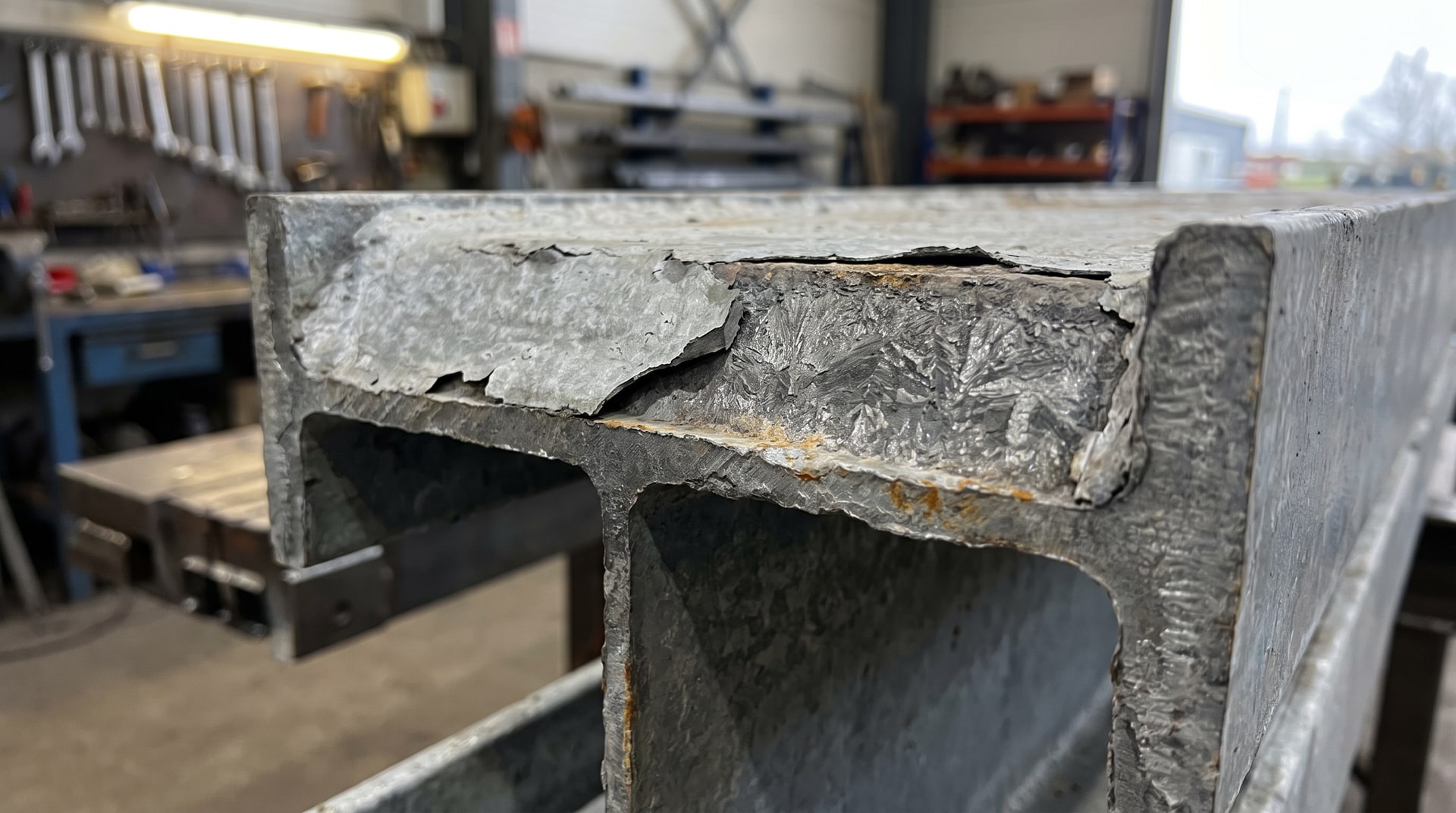
When a piece of galvanized steel leaves our facility, the coating it carries is the result of a carefully controlled metallurgical reaction between zinc and steel. Most of the time, that coating performs exactly as expected: it bonds tightly, resists corrosion for decades, and requires no special maintenance. But occasionally, a coating defect appears that causes real concern on the job site or during inspection: peeling. The outer zinc layer lifts away from the steel in sections, leaving what looks like a compromised or incomplete coating.
The instinct in the field is often to assume the steel was not properly galvanized, or that the coating was poorly applied. In most cases, neither of those assumptions is accurate. Peeling is a specific metallurgical phenomenon tied to what happens during and immediately after the galvanizing reaction, and understanding its root cause requires a closer look at the coating's internal structure.
The American Galvanizers Association addresses this directly in their article on peeling of the galvanized coating. At V&S Galvanizing, we expand on that foundation to explain what is actually happening at the material level, how cooling rate and temperature influence performance, and why this defect is often misunderstood in the field.
How the Galvanized Coating Is Actually Structured
To understand peeling, you first need to understand what the galvanized coating actually is. It is not a simple layer of zinc sitting on top of steel. When steel is immersed in a molten zinc bath at the temperatures used in hot-dip galvanizing, a series of iron-zinc intermetallic alloy phases form at the steel surface. These phases, which develop progressively from the steel outward, are distinct compounds with their own hardness, ductility, and bonding characteristics.
The outermost layer of the coating is the eta layer: nearly pure zinc, relatively soft and ductile, and the layer most visible to the eye. This is the bright, silvery surface you see immediately after a piece is withdrawn from the zinc bath. Beneath it sit the intermetallic layers, progressing from the zeta phase to the delta phase to the gamma phase, each one increasingly iron-rich as you move toward the steel substrate.
The integrity of the entire coating depends on how well these layers bond to each other and to the base steel. Under normal processing conditions, those bonds are strong enough that the coating behaves almost as an extension of the steel itself rather than a separate material applied to its surface. Peeling is what happens when that relationship breaks down specifically at the interface between the eta layer and the intermetallics beneath it.
What Peeling Actually Looks Like on the Part
Peeling is sometimes confused with flaking, but they are not the same thing. Flaking typically involves brittle fracture of the intermetallic layers themselves, often related to steel chemistry or mechanical stress. Peeling, by contrast, is the separation of the outer eta zinc layer from the underlying intermetallic zones, and it has a distinct appearance and a specific cause.
When you encounter a peeled area and take a coating thickness measurement on the exposed surface, you do not read zero. There is still coating present, typically in the range of 2 to 6 mils. That reading tells you something important: the steel did not lose its galvanized protection entirely. What peeled away was the outermost zinc layer. The intermetallic phases are still there, still bonded to the steel, and still providing a meaningful level of corrosion resistance. The coating is not gone. Its outer zinc reserve, however, has separated.
This is a meaningful distinction from a performance standpoint. A part that has experienced peeling is not the same as an uncoated part, and it should not be treated as such during inspection or remediation decisions.
The Role of Temperature: Why Cooling Rate Matters More Than Most People Realize
The galvanizing reaction does not stop the moment a piece is pulled from the zinc bath. As long as the part remains above a certain temperature threshold, zinc and iron continue to react and the intermetallic phases continue to grow. Under controlled conditions, this is not a problem. The part cools quickly enough that the reaction stops before it causes structural issues within the coating.
The problem arises when a piece cools extremely slowly or when it is subjected to elevated temperatures after galvanizing. Specifically, when galvanized steel remains above 600 degrees Fahrenheit for a prolonged period, the galvanizing reaction continues past its intended endpoint. The eta layer, that outer zone of relatively pure zinc, becomes the source material for this continued reaction. Zinc from the eta layer is consumed to feed ongoing intermetallic formation deeper in the coating.
As the eta layer is progressively consumed from below, voids begin to form at the interface between what remains of the eta layer and the intermetallic layers beneath it. Once enough of the bonding material has been consumed and enough void space has developed, the outer zinc layer no longer has sufficient mechanical attachment to stay in place. It separates. That is peeling.
The same mechanism can be triggered not just by slow cooling after galvanizing, but also by exposing already-galvanized steel to high temperatures in service. Any prolonged exposure to temperatures in excess of 400 degrees Fahrenheit carries the risk of continuing the galvanizing reaction and setting off this same chain of events.
The Kirkendall Effect: A Named Metallurgical Phenomenon
When peeling occurs through this mechanism, it is given a specific name in materials science: the Kirkendall Effect. The name comes from research conducted by Ernest Kirkendall in the 1940s, which demonstrated that diffusion rates in metallic alloy systems are not equal across all atomic species. In other words, when two metals are in contact at elevated temperatures, the atoms of each metal do not migrate across the interface at the same rate.
In the context of galvanizing, iron and zinc atoms diffuse in both directions across the intermetallic boundary, but not at the same rate. When the system is held at high temperatures for too long, zinc atoms migrate faster out of the eta layer than iron atoms migrate in from the steel side. The net result is a flux imbalance that leaves behind vacancy clusters at the eta-intermetallic interface. Those vacancies accumulate into the voids that eventually cause the outer zinc layer to lose adhesion.
Understanding that peeling in galvanizing is a manifestation of the Kirkendall Effect is important because it removes the ambiguity around causation. This is not random. It is not a quality control failure at the bath surface or a contamination issue. It is a predictable outcome when time-at-temperature exceeds what the eta layer can sustain without being consumed. The physics of atomic diffusion drive it.
Which Parts Are Most at Risk
Not every galvanized part faces equal exposure to this risk. The variables that increase the likelihood of Kirkendall-driven peeling are largely tied to mass, geometry, and how the part behaves thermally after it leaves the zinc bath.
Heavy, thick-sectioned steel parts retain heat longer than light structural members. When a large weldment or a thick plate cools slowly in still air, the time it spends above 600 degrees Fahrenheit is substantially longer than a small angle or a light tube section. This extended dwell time at elevated temperature gives the galvanizing reaction more opportunity to continue consuming the eta layer. Similarly, parts that are stacked or bundled immediately after galvanizing may insulate each other thermally and slow cooling even further.
The other scenario worth calling out is post-galvanizing heat exposure in service. If galvanized steel is installed near heat sources, used in applications involving cyclic thermal exposure, or welded after galvanizing (which introduces very high localized temperatures), the eta layer is at risk of being consumed in the affected zone. This is one reason why welding on galvanized steel requires thoughtful handling: beyond the fume concerns, the thermal effect on the surrounding coating can initiate exactly this kind of void formation.
How We Approach This at V&S
Preventing peeling comes down to controlling the thermal history of the part through the galvanizing process, and that starts with how we manage our zinc bath, how we handle parts after withdrawal, and how we sequence work involving heavy or thermally complex pieces.
Bath temperature control is fundamental. The galvanizing reaction is temperature-dependent, and holding within the correct operating range keeps the intermetallic growth rate in check. Parts that spend excessive time at bath temperature, or that are galvanized at temperatures significantly above the normal operating range, carry a higher risk of accelerated intermetallic growth and eta layer consumption even before they leave the bath.
Quenching is another tool. Many galvanizers, including our team when appropriate, use a water quench after withdrawal from the zinc bath to accelerate cooling and cut short the continued galvanizing reaction. Quenching reduces the time the part spends above the threshold temperature where eta layer consumption becomes significant. For heavy sections especially, quenching is a meaningful process control that reduces peeling risk.
We also communicate with fabricators and engineers about heat exposure after galvanizing. If galvanized parts will be exposed to sustained elevated temperatures in service, that information should inform both the specification review and any decisions about coating system selection. In some cases, a duplex system or a different coating approach may be more appropriate than relying solely on the galvanized coating in a high-temperature environment. Our team at hot-dip galvanizing works through these considerations before and during the project, not after a problem surfaces.
What Peeling Does Not Mean for Corrosion Performance
It is worth addressing what a peeled area actually means for the long-term performance of the part, because the tendency in the field is to treat visible coating separation as a catastrophic failure requiring full remediation.
Because the intermetallic layers remain intact and bonded to the steel even after the eta layer has peeled, the part is not bare. A coating thickness reading of 2 to 6 mils in a peeled zone confirms that there is still a zinc-containing coating present. The intermetallic phases are themselves corrosion-resistant, though they do not provide the same level of sacrificial cathodic protection that the free zinc in the eta layer would. The remaining coating will continue to provide barrier protection.
Whether that remaining coating meets specification, and whether touch-up is warranted, depends on the applicable standard requirements for the project and the environment in which the part will be used. A part destined for a highly corrosive coastal environment warrants a different assessment than one used in a sheltered interior application. What should not happen is reflexive rejection of a part based solely on the visual appearance of peeling without measuring the remaining coating and evaluating the performance context.
Work With a Team That Understands Coating Behavior at the Metallurgical Level
Peeling is one of those galvanizing defects that generates a lot of concern precisely because it looks dramatic. Seeing the outer layer of a coating lift away is unsettling, and in some contexts it signals a real problem. But the cause is specific, the mechanism is well understood, and the risk can be managed through proper process control and informed specification decisions.
At V&S Galvanizing, we have built our process around the metallurgical realities of the hot-dip galvanizing reaction, including the temperature-driven phenomena that can lead to outcomes like Kirkendall-Effect peeling. When a question arises about coating appearance or performance, we work from that underlying understanding rather than defaulting to surface-level explanations. That is what allows us to give engineers, fabricators, and inspectors answers that are actually useful.
If you have a project involving heavy sections, thermally complex geometry, or specifications that raise questions about coating behavior, reach out to us directly through our contact page. We are glad to work through the details with your team before material hits the floor.
Frequently Asked Questions About Galvanized Coating Peeling
What is the difference between peeling and flaking in a galvanized coating?
Peeling refers specifically to separation of the outer eta (free zinc) layer from the underlying intermetallic alloy layers. Flaking typically involves brittle fracture within or between the intermetallic phases themselves, often related to steel chemistry or mechanical stress. Peeling leaves measurable coating behind (typically 2 to 6 mils), while flaking may involve loss of the intermetallic layers as well. The two defects have different causes and call for different responses.
If the outer zinc layer has peeled, is the steel still protected against corrosion?
Yes, to a meaningful degree. When peeling occurs, the intermetallic iron-zinc alloy layers remain bonded to the steel surface and continue to provide barrier corrosion protection. Coating thickness measurements in peeled areas typically read 2 to 6 mils, confirming that residual coating is still present. The sacrificial cathodic protection provided by free zinc is reduced, but the steel is not bare. Whether the remaining coating meets project specification requirements depends on the applicable standard and the service environment.
What is the Kirkendall Effect and how does it relate to galvanizing?
The Kirkendall Effect is a materials science phenomenon in which the unequal diffusion rates of two metals across a shared interface create vacancy clusters that accumulate into voids. In hot-dip galvanizing, when a coated part stays above approximately 600 degrees Fahrenheit for a prolonged period, zinc atoms diffuse out of the eta layer faster than iron atoms diffuse in. This creates voids at the eta-intermetallic interface, eventually causing the outer zinc layer to lose adhesion and peel away.
At what temperature does peeling risk become significant for galvanized steel?
Two thresholds matter. The galvanizing reaction continues when a freshly galvanized part remains above 600 degrees Fahrenheit during cooling, which can consume the eta layer and create voids. For steel already in service, prolonged exposure to temperatures in excess of 400 degrees Fahrenheit carries a similar risk by reactivating diffusion at the zinc-intermetallic interface. Both scenarios, whether during processing or during service, should be evaluated when specifying galvanized coatings for applications involving sustained heat exposure.
Does quenching after galvanizing prevent peeling?
Quenching, typically in water immediately after withdrawal from the zinc bath, accelerates cooling and reduces the time the part spends above the temperature threshold where continued galvanizing reaction consumes the eta layer. For heavy or thick-sectioned steel parts that would otherwise cool slowly in air, quenching is an effective process control for reducing peeling risk. It does not change the fundamental metallurgy of the coating, but it limits the time available for Kirkendall-driven void formation to progress.
Can welding on galvanized steel cause localized peeling?
Yes. Welding introduces very high localized temperatures in the heat-affected zone adjacent to the weld. In that zone, the galvanizing reaction can be reactivated and the eta layer consumed through the same diffusion mechanism that causes peeling during slow post-bath cooling. The localized thermal spike from welding is typically brief, but it can be intense enough to initiate void formation at the eta-intermetallic interface in the surrounding area. This is one reason that welding on galvanized steel requires careful consideration of coating behavior, not just fume management.
What coating thickness remains after peeling, and how should it be evaluated against specification?
After peeling, coating thickness measurements in the affected area typically fall in the range of 2 to 6 mils. Whether this meets a given specification depends on the applicable ASTM standard and the minimum coating thickness requirements for the steel category being evaluated. A thickness reading in that range does not automatically constitute a rejection-level failure, and parts should not be rejected based on visual appearance alone. Measurement data, the project specification, and the service environment should all inform the evaluation.
Are certain steel geometries or section sizes more prone to Kirkendall peeling?
Yes. Heavy, thick-sectioned steel parts retain heat longer after galvanizing and spend more time above the temperature threshold where eta layer consumption continues. This makes them more susceptible to Kirkendall-driven peeling compared to light structural members that cool quickly. Parts that are stacked or bundled immediately after galvanizing compound this risk by insulating each other and slowing cooling further. Understanding how section mass and handling affect cooling rate is part of managing this outcome during processing.
