

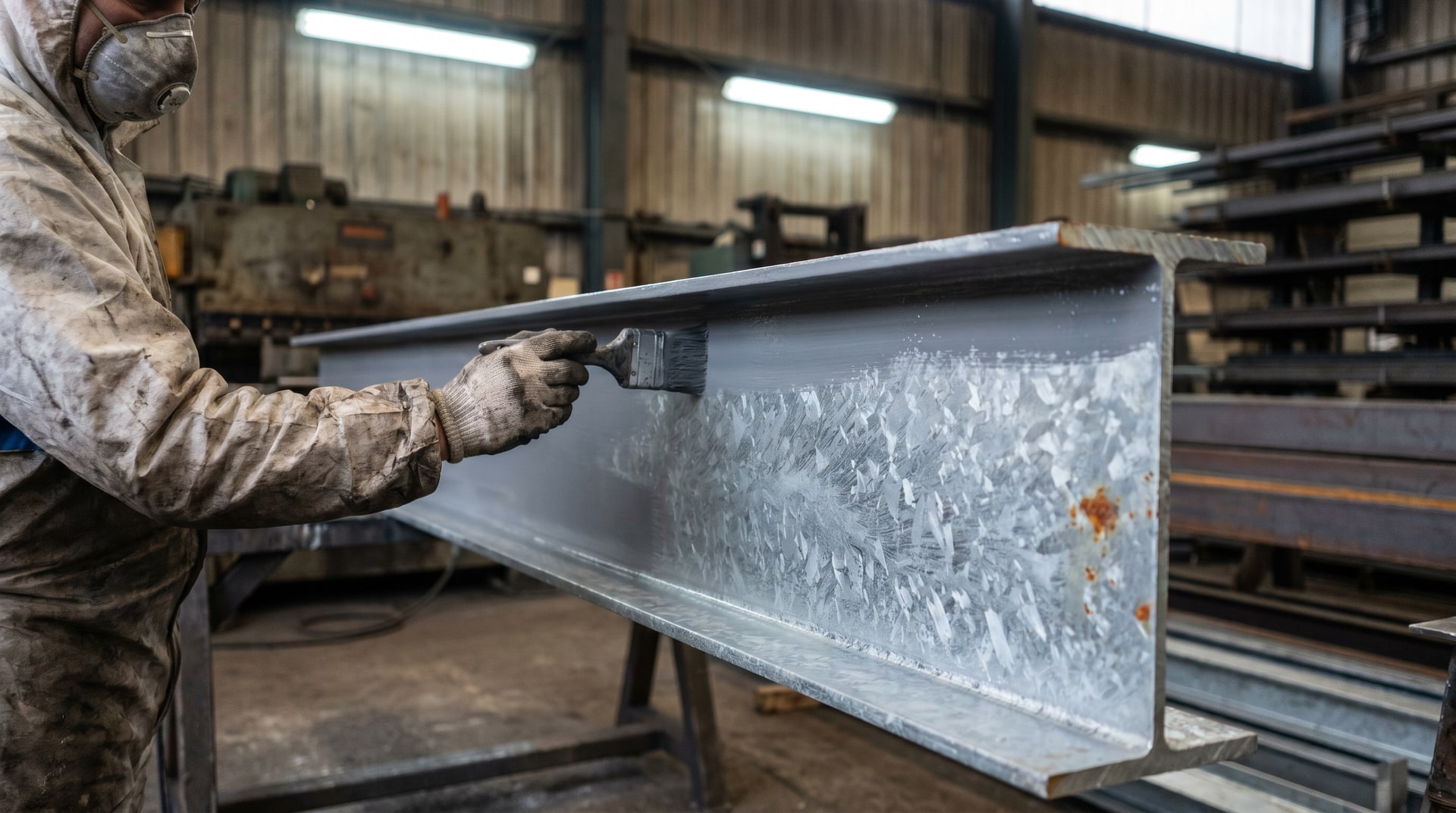
There is a persistent assumption in the field that galvanized steel and paint do not mix well, that the zinc surface is too slick or chemically incompatible for coatings to stick reliably. That assumption leads to poor prep practices, premature adhesion failures, and a general wariness about specifying so-called duplex systems on projects where both corrosion resistance and color are required. The reality is more nuanced and, when handled correctly, more promising than the skepticism suggests.
The American Galvanizers Association addresses this directly in their article on the specific requirements for painting over galvanized steel. At V&S Galvanizing, we expand on that foundation to explain what is actually happening at the material level, how surface condition influences adhesion performance, and why this topic is so often misunderstood in the field.
Why Galvanized Steel Presents a Unique Painting Challenge
Hot-dip galvanized steel is not bare steel. That distinction matters more than most people realize when a coating is going to be applied on top. The outer surface of a freshly galvanized part is predominantly free zinc, and depending on how much time has passed since galvanizing, it may have developed zinc oxide or zinc carbonate layers through atmospheric reaction. Each of these surface states behaves differently under a paint or powder coating.
Free zinc is relatively smooth and chemically active. It does not offer the mechanical profile that bare steel provides after abrasive blasting, and certain paint systems will react poorly with it if the chemistry is not matched correctly. Zinc oxide, which forms within hours of atmospheric exposure, is a loosely adherent white powder that must be removed before painting or it will act as a bond-breaker beneath the coating film. Zinc carbonate, which develops after weeks or months of outdoor weathering, is actually a more stable and paintable surface, but it still requires cleaning before paint is applied.
Understanding these surface states is the starting point for getting a duplex system right. The condition of the galvanized surface at the time of painting dictates which preparation method is appropriate, and skipping that assessment is where many projects go wrong.
The Governing Standards: ASTM D6386 and D7803
Two ASTM standards govern surface preparation of hot-dip galvanized steel ahead of organic coatings. ASTM D6386 covers preparation for painting, while ASTM D7803 covers preparation for powder coating. These are not interchangeable documents, and the distinction between them matters because powder coating involves an electrostatic application and a high-temperature cure cycle that impose different demands on the surface compared to liquid paint.
Both standards recognize that newly galvanized steel, partially weathered galvanizing, and fully weathered galvanizing each require a tailored approach. The standards provide the technical framework, but they do not replace the need for judgment. A fabricator working with steel that was galvanized last week faces a different challenge than one working with material that has been sitting in an outdoor yard for six months.
These ASTM documents are the specifications that engineers, coating applicators, and quality inspectors should reference when developing a project-specific duplex system plan. Specifying the work without referencing them leaves the surface preparation requirements open to interpretation, which introduces risk.
Surface Preparation Methods and When Each Applies
The AGA and the underlying ASTM standards describe several surface preparation approaches, and each targets a specific contamination type or surface condition. Selecting the right one requires knowing where the galvanized steel is in its weathering cycle.
Solvent cleaning removes oils, grease, and other organic contaminants that may have been introduced during fabrication, handling, or storage. It does not address zinc oxide or carbonate layers on its own, but it is often a necessary first step before any other preparation method is applied. Alkaline cleaning uses a high-pH solution to remove the same contaminants and can be more effective on heavier oil deposits than solvent alone. Ammonia cleaning is specifically useful for removing zinc salts and surface reactants without damaging the zinc coating itself.
Profiling, which is the mechanical roughening of the surface to improve mechanical adhesion, requires careful media selection when working over zinc. Abrasive media that is too aggressive will cut through the zinc layer, which defeats the purpose of galvanizing and may cause the duplex system to fail prematurely at the exposed steel. The AGA specifies using media softer than zinc for this purpose, with corn cob granules being one commonly referenced example. This creates a surface profile suitable for paint adhesion without damaging the protective zinc beneath.
Conversion coatings represent a different approach entirely. Rather than mechanically altering the surface, a conversion coating chemically reacts with the zinc to produce a new compound layer, typically a phosphate or chromate-based product, that is more receptive to organic coatings. These coatings are common in industrial finishing operations and are particularly useful when mechanical profiling is not practical.
The Role of the Galvanizer and Paint Manufacturer in a Successful Duplex System
One of the most consistently overlooked requirements in duplex coating work is communication across the supply chain. The AGA is explicit about this: the galvanizer should be notified before the job is processed that the material will be painted or powder coated after galvanizing. This matters because the galvanizer can make adjustments to the process, particularly around quenching and surface chemistry, that will improve the compatibility of the zinc surface with subsequent coatings.
Our team at V&S Galvanizing regularly works with fabricators and contractors on projects where a duplex system is planned. Knowing that paint or powder coat will follow galvanizing changes how we think about the job. Surface finish uniformity, residual flux removal, and the avoidance of post-quench treatments that could interfere with adhesion all become considerations when we know a coating is coming.
Equally important is coordination with the paint or powder coat manufacturer. Not every coating product on the market is formulated for application over zinc. Some primers and topcoats contain components that react unfavorably with zinc, particularly in the early stages of curing. Paint systems specifically formulated for use on zinc coatings account for the chemistry of the substrate and are tested for adhesion and long-term performance on galvanized surfaces. Using a product without that formulation history, even a high-quality one designed for bare steel, introduces unnecessary risk.
What the Synergistic Effect Actually Means for Long-Term Performance
The primary driver for specifying a duplex coating system is often color. An architect wants a specific finish, or a project requires color-coding for safety or identification. But the performance benefit of combining galvanizing with an organic coating extends well beyond aesthetics, and understanding that benefit helps justify the added cost and coordination effort.
A properly applied duplex system does not just add the service life of galvanizing and paint together. Research shows that it extends the combined coating life to 1.5 to 2.5 times the sum of the two coatings used independently. This is the synergistic effect, and it has practical engineering significance.
The mechanism behind this is straightforward. The organic topcoat reduces the rate at which the zinc corrodes by limiting the exposure of the galvanized surface to moisture and atmospheric corrosives. The zinc, in turn, provides cathodic protection to any areas where the organic coating is damaged or begins to fail. Because the two systems support each other rather than simply stacking, the combined performance exceeds what additive math would predict. For infrastructure, industrial, and coastal projects where decades of low-maintenance service life are required, this effect is a compelling reason to specify a duplex system from the outset.
Newly Galvanized vs. Weathered Galvanizing: Matching Prep to Condition
The timing of paint application relative to galvanizing has a direct effect on what preparation work is required and how difficult that work will be. Newly galvanized steel, processed within the past day or two, presents a chemically active, smooth zinc surface. At this stage, the surface may still carry trace amounts of flux residue or handling oils, and the zinc itself has not yet developed a stable oxide layer. Painting immediately after galvanizing is possible but requires very specific surface preparation to avoid adhesion failure.
Partially weathered galvanizing, which has had weeks of atmospheric exposure, may have developed a patchy zinc oxide layer. This is one of the more challenging conditions because the surface is neither cleanly metallic nor uniformly weathered. Preparation must address the inconsistency across the surface, and mechanical profiling or conversion coating becomes particularly important at this stage.
Fully weathered galvanizing, which has developed a stable zinc carbonate patina after months of outdoor exposure, is often considered the most paint-ready condition. The carbonate layer is more chemically stable than the zinc oxide that precedes it, and it offers better mechanical anchorage for coatings than bare zinc does. Even so, cleaning is still required before painting. The AGA is clear that no condition of galvanized steel can be painted without proper preparation, and fully weathered galvanizing is not an exception to that rule.
Common Misconceptions That Lead to Adhesion Failures
Several recurring errors in the field are worth addressing directly, because they appear consistently in projects where duplex systems have underperformed.
The first is the assumption that if galvanized steel looks clean, it is paint-ready. Visual cleanliness does not confirm chemical or mechanical suitability for coating. Zinc oxide layers are nearly invisible in thin form, and contamination from handling oils may not be obvious without testing. Surface preparation according to ASTM D6386 or D7803 is required regardless of how the surface appears.
The second is the use of standard steel primers without verifying their compatibility with zinc. Alkyd-based primers, for example, are known to saponify in contact with zinc, a chemical reaction that produces a soap-like byproduct and causes the paint film to delaminate. This failure mode is well documented and entirely preventable by selecting a primer confirmed by the manufacturer to be compatible with zinc substrates.
The third is aggressive abrasive blasting over the zinc surface. Using hard angular media to blast galvanized steel in an attempt to create profile can remove the zinc entirely in high-velocity areas, leaving exposed steel that will rust rapidly under the organic topcoat. The soft media requirement exists for a reason, and substituting standard steel grit or sand is not an acceptable shortcut.
Design and Specification Considerations for Duplex Systems
Getting a duplex system right starts at the specification stage, not at the coating line. Engineers and architects specifying galvanized steel for projects that also require color or additional corrosion resistance should reference ASTM D6386 and D7803 in their coating specifications, identify the applicable surface condition at the time of painting, require that the galvanizer be notified of the duplex intent, and require written confirmation from the paint or powder coat manufacturer that the selected product is compatible with hot-dip galvanized steel.
Project specifications that omit these requirements create ambiguity that typically gets resolved at the field level, often incorrectly. Including them upfront reduces rework risk, supports quality inspection, and ensures that the synergistic performance benefit is actually achieved rather than assumed.
For structural applications, coastal exposures, or infrastructure with long design service lives, the duplex approach is one of the most technically sound and cost-effective corrosion protection strategies available. The key is treating it as a system, not as two independent coating steps that happen to occur on the same piece of steel.
Work With a Team That Understands the Full System
Duplex coating systems deliver exceptional long-term performance when they are planned and executed correctly. The zinc provides cathodic protection at any breach in the organic coating. The paint or powder coat reduces the rate of zinc consumption. Together, they produce a combined service life that neither coating could achieve independently, making them a strong choice for projects designed to operate maintenance-free for decades.
At V&S Galvanizing, we work with engineers, fabricators, and contractors who need a galvanizing partner that understands how the process fits into a larger coating system. When you notify us early that paint or powder coat will follow galvanizing, we can help ensure the surface comes out of our facility in the best possible condition for the next step. Good outcomes in duplex coating work depend on coordination across the supply chain, and that coordination starts with a conversation.
If you are specifying or planning a duplex system and want to discuss how galvanizing fits into that work, reach out through our contact page and we will connect you with our technical team.
Frequently Asked Questions About Painting Over Galvanized Steel
What ASTM standards govern surface preparation of galvanized steel before painting or powder coating?
ASTM D6386 covers preparation of hot-dip galvanized steel surfaces for painting. ASTM D7803 covers preparation specifically for powder coating. These are separate documents because powder coating involves an electrostatic application process and elevated cure temperatures that impose different surface requirements than liquid paint systems.
Why does the condition of the galvanized surface matter for paint adhesion?
Newly galvanized steel has a chemically active free zinc surface that may carry flux residue or oils. Partially weathered zinc develops a zinc oxide layer that is loosely adherent and must be removed. Fully weathered zinc forms a more stable zinc carbonate patina that is generally more paint-receptive. Each condition requires a different preparation approach, and applying paint without addressing the specific surface state is a leading cause of adhesion failure.
Can any abrasive media be used to profile galvanized steel before painting?
No. Abrasive media must be softer than zinc to avoid cutting through the galvanized layer. Hard angular media such as steel grit can remove the zinc entirely in areas of high impact, exposing bare steel that will corrode beneath the organic coating. Corn cob granules are one example of an appropriate soft media for creating surface profile on galvanized steel without damaging the zinc.
What is the synergistic effect in a duplex coating system?
The synergistic effect refers to the extended service life produced when paint or powder coat is applied over hot-dip galvanized steel. A properly applied duplex system lasts 1.5 to 2.5 times as long as the sum of each coating used independently. This occurs because the organic topcoat slows zinc corrosion by reducing moisture and atmospheric exposure, while the zinc provides cathodic protection at any point where the organic coating is breached.
Why is it important to notify the galvanizer before processing if the steel will be painted afterward?
The galvanizer can adjust process parameters, such as surface finish and post-processing treatments, to produce a zinc surface better suited for subsequent coating. Without this notification, the galvanizer may apply treatments that improve the appearance of the zinc but reduce its compatibility with paint or powder coat, potentially compromising adhesion.
Are all paint primers compatible with galvanized steel?
No. Some primers, including certain alkyd-based products, are chemically incompatible with zinc. Alkyd primers can undergo saponification in contact with zinc, producing a soap-like reaction product that causes the coating to delaminate. Paint products intended for use over galvanized steel must be specifically formulated and tested for zinc compatibility, and the manufacturer's written confirmation of that compatibility should be obtained before application.
Is a conversion coating better than mechanical profiling for preparing galvanized steel for paint?
Neither method is universally superior. Conversion coatings chemically react with the zinc surface to create a more paint-receptive layer, which is practical when mechanical profiling is difficult or impractical. Soft-media profiling creates mechanical anchorage for the coating film but requires careful media selection to protect the zinc. The choice depends on the surface condition, the coating system being applied, and the project environment. ASTM D6386 and D7803 provide guidance on selecting the appropriate method for each scenario.
When is a duplex coating system the right specification choice?
A duplex system is appropriate when a project requires both color and long-term corrosion protection, when extended maintenance-free service life is a design requirement, or when the structure will be exposed to a highly corrosive environment such as coastal or industrial atmospheres. The combination of galvanizing and an organic coating provides performance that neither can deliver alone, making it particularly well-suited for infrastructure, architectural steel, and industrial applications with decades-long service life expectations.
