

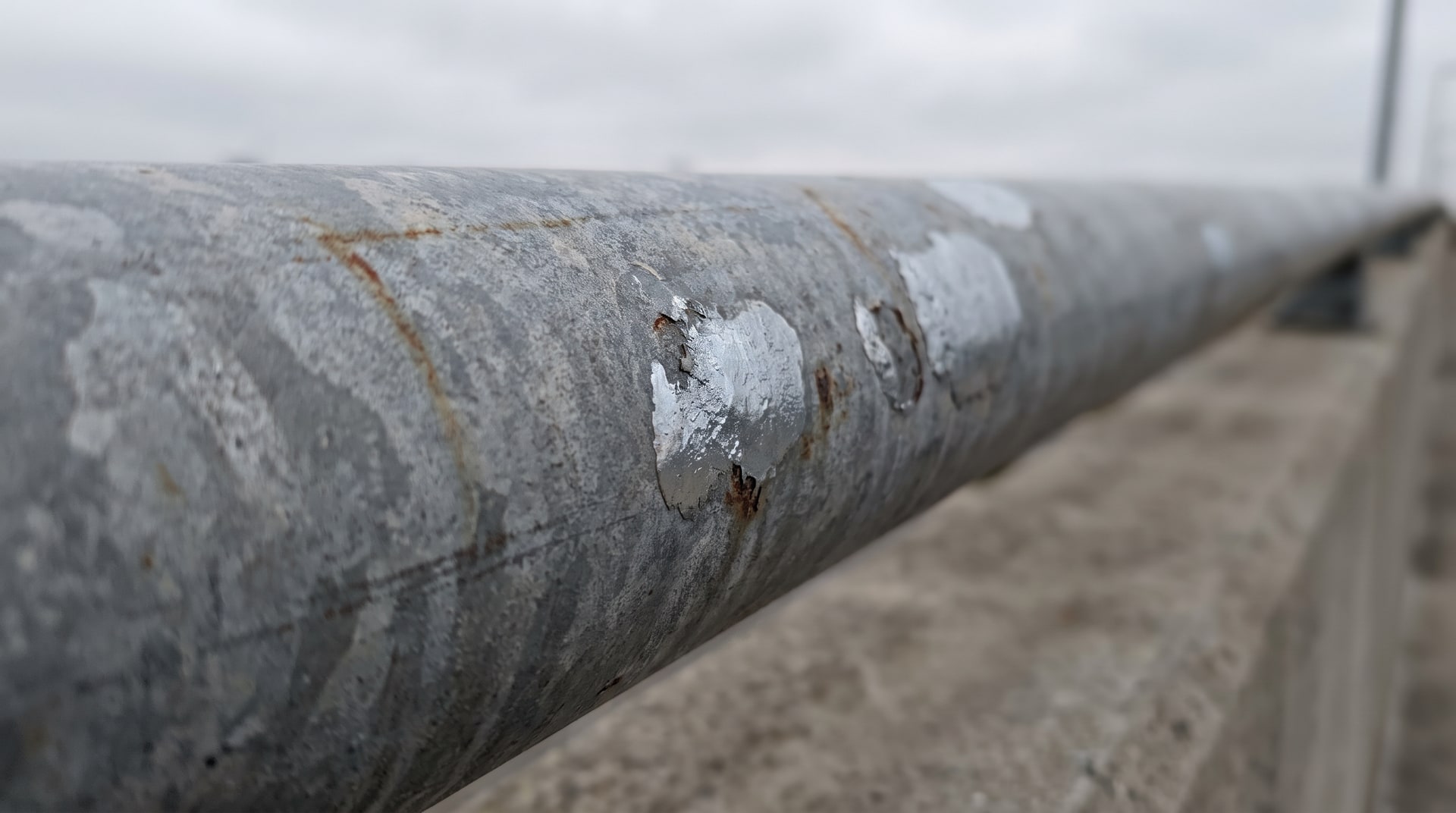
Anyone who has worked with hot-dip galvanized steel long enough has seen it happen: a freshly galvanized assembly leaves the plant looking clean and uniform, the touch-up repairs blending seamlessly with the surrounding coating. A year or two later, after installation and exposure to the elements, the base galvanizing has developed its characteristic matte gray patina while the repaired areas still look bright silver. What was once a uniform finish is now visibly splotchy, and there is no easy fix once it has reached that point.
This is not a random outcome or a quality failure in the usual sense. It is the predictable result of a material behavior that is easy to anticipate if you understand how zinc weathers, and easy to avoid if repair color selection is made with the long-term environment in mind rather than the short-term appearance at the plant.
The American Galvanizers Association addresses this directly in their article on the long-term effects of weathering on the aesthetics of repaired HDG steel. At V&S Galvanizing, we expand on that foundation to explain what is actually happening at the material level, how repair paint color selection influences long-term appearance, and why this is often misunderstood in the field.
Why Hot-Dip Galvanized Steel Does Not Stay Shiny
Fresh hot-dip galvanizing has a bright, silvery appearance that comes from the outer free zinc layer at the surface of the coating. That layer is not inert. When exposed to air and moisture, it begins reacting almost immediately, progressing through a well-understood sequence of surface chemistry changes that ultimately produce a stable, tightly adherent zinc patina.
In the first weeks of exposure, zinc oxide and zinc hydroxide form on the surface. These compounds are relatively soluble and can be washed away by rain, which is part of why early weathering can look uneven. Over time, carbon dioxide from the atmosphere reacts with these intermediate compounds to produce zinc carbonate, often referred to as the zinc patina. Zinc carbonate is insoluble, chemically stable, and self-sealing. It is this compound that gives long-weathered galvanizing its uniform, flat, gray-silver appearance and that dramatically slows the rate of ongoing zinc consumption.
The full transition from bright silver to mature matte gray typically takes somewhere between six months and two years, depending on local atmospheric conditions, rainfall patterns, humidity, and pollutant levels. In sheltered or low-humidity environments, the process can take longer. In highly corrosive industrial or coastal atmospheres, it can happen faster. What is consistent is the direction: bright galvanizing always moves toward matte gray, and it does not move back.
What Zinc-Rich Paint Repair Materials Actually Do
ASTM A780/A780M is the governing standard for the repair of damaged and uncoated areas on hot-dip galvanized coatings. It outlines three acceptable methods: zinc-based solder, zinc-rich paint, and thermal spray zinc (also called zinc metallizing). Of these, zinc-rich paint is by far the most commonly used in the field. It is economical, widely available, requires minimal equipment, and can be applied quickly to small areas where the galvanized coating has been damaged during fabrication, welding, or handling.
Zinc-rich paints work by providing a high enough concentration of zinc pigment in the dry film that the coating can deliver cathodic protection to the exposed steel substrate, similar in principle to how the galvanized coating itself works. The zinc pigment particles must be in sufficient electrical contact with each other and with the substrate to allow galvanic protection to function. When properly applied over a cleaned and prepared surface within the area limits specified by ASTM A780, these paints provide meaningful corrosion protection to the repaired zone.
What they do not do is replicate the metallurgical structure of a hot-dip galvanized coating. The intermetallic zinc-iron alloy layers that form during galvanizing are not present in a zinc-rich paint repair. This has implications for both long-term corrosion performance on larger damaged areas and, more immediately relevant to this discussion, for how the repair surface weathers visually compared to the surrounding galvanized steel.
The Core of the Problem: Two Surfaces Weathering at Different Rates and to Different End States
The visual mismatch that develops between zinc-rich paint repairs and the surrounding hot-dip galvanizing comes down to the fact that these are two different materials, and they do not weather in the same way or toward the same appearance.
Hot-dip galvanizing weathers through the surface chemistry sequence described above, transitioning from bright metallic silver to matte gray as the zinc patina matures. The specific texture and gray tone of the final patina are influenced by the coating's steel chemistry, the thickness of the outer free zinc layer, and environmental exposure conditions.
Zinc-rich paint, by contrast, contains zinc pigment suspended in a binder system. The binder type (epoxy, moisture-cure urethane, inorganic silicate, or others) and the zinc particle morphology both affect how the paint surface changes over time. Some zinc-rich paints retain a relatively bright or metallic appearance for years. Others chalk or develop a dull surface more quickly. But the weathering trajectory of a zinc-rich paint does not mirror that of a hot-dip galvanized coating, and the end-state color and sheen of a weathered paint surface often differs measurably from the mature zinc patina of the surrounding steel.
When a shiny, silver-colored zinc-rich paint is used to match the initial appearance of fresh galvanizing, the two surfaces look similar at the time of application. But as the galvanizing weathers toward matte gray and the paint retains more of its original sheen, the repaired areas become increasingly visible. This is not a flaw in the paint or a failure of the galvanizing. It is a predictable consequence of matching appearance at the wrong point in the weathering timeline.
The George Washington Bridge: A Real-World Illustration
The clearest illustration of this problem is the pedestrian handrailing on the George Washington Bridge, spanning between New York City and Fort Lee, New Jersey. When repairs were made to the freshly galvanized handrails, a shiny zinc-rich paint was selected to match the bright, unweathered appearance of the galvanized coating at the time of installation. The initial result looked uniform.
Over time, the surrounding galvanized coating progressed through its natural weathering cycle and developed the expected matte gray patina. The repaired areas, coated with a paint that did not weather to the same appearance, remained comparatively bright and shiny. The contrast became pronounced enough that the repair locations are visible to pedestrians and observers, creating an uneven, splotchy appearance across what should be a continuous, uniform surface.
This is not an unusual situation. It plays out on bridges, structural steel, handrails, highway hardware, and architectural elements any time repair color selection focuses on matching the day-of-installation appearance rather than the long-term weathered state. The bridge example is useful precisely because it demonstrates the outcome at scale, in a high-visibility public setting, where the consequences of the initial decision are now permanent and highly visible.
How Repair Paint Color Selection Changes the Outcome
The solution is straightforward once the weathering mechanism is understood. If a structure will be installed outdoors and exposed to atmospheric conditions, the repair paint color should be selected to match the mature, weathered appearance of the galvanized coating rather than its initial bright silver color.
Matte gray zinc-rich paint products are available from multiple manufacturers, and several suppliers are listed in the AGA's repair material directory. When a matte gray paint is used for touch-up and repair on a structure that will be exposed to the elements, the initial appearance on the day of installation will show some contrast between the dull repair area and the still-bright surrounding galvanizing. That initial contrast is temporary. As the galvanizing weathers toward its mature matte gray state, the surrounding coating moves toward the repair paint color rather than away from it. Over time, the surface becomes more visually uniform, not less.
This is a case where accepting a slightly imperfect initial appearance produces a better long-term result than optimizing for uniformity at installation. For exterior structures, selecting the matte gray repair paint is the right call. For applications where long-term weathering uniformity is the priority, that trade-off is entirely worth making.
Interior vs. Exterior: Why the Environment Determines the Right Approach
Not all galvanized steel is exposed to the weather, and the repair strategy should reflect the actual service environment of the structure. The guidance for exterior applications does not apply universally.
Interior HDG structures installed in climate-controlled environments, such as structural members inside conditioned buildings, mechanical rooms, or enclosed industrial facilities, are not exposed to the atmospheric moisture and carbon dioxide cycling that drives zinc carbonate patina formation. Without meaningful weathering exposure, the galvanizing on these structures will not transition to a matte gray appearance over time. The bright or silver-toned initial appearance is likely to remain essentially stable throughout the service life of the coating.
For these applications, matching the initial shiny or silver appearance of the galvanizing with a similar repair paint color is entirely appropriate. Since neither the galvanizing nor the repair paint will weather significantly, the initial uniformity achieved at installation is the appearance that will persist. In this context, selecting a matte gray repair paint would create a permanent mismatch rather than prevent one.
The key question before selecting a repair method and color is simple: will this surface be exposed to atmospheric conditions? If yes, select a repair approach that accounts for how the galvanizing will look after the patina forms. If no, match the initial appearance. Getting this determination right is the single most important decision in managing repair aesthetics for HDG steel.
Thermal Spray Zinc and Solder as Alternative Repair Methods
While zinc-rich paint is the dominant repair method for practical reasons, ASTM A780/A780M recognizes two other approaches: zinc-based solder and thermal spray zinc (metallizing). Each has different cost profiles, equipment requirements, and performance characteristics that make them more or less suited to specific repair scenarios.
Thermal spray zinc involves melting zinc wire or powder and projecting it onto the prepared steel surface using compressed gas and a heat source. The resulting coating is metallic zinc, not a zinc-pigmented paint, which means its weathering behavior more closely parallels that of the surrounding hot-dip galvanized coating. For large repair areas or situations where long-term aesthetic uniformity is a critical requirement, thermal spray zinc offers better visual integration over time because the repair surface and the galvanized surface are more similar materials that weather through more similar mechanisms. The trade-off is equipment cost and operator training.
Zinc-based solder is typically reserved for small defects and has application constraints that limit its use. For most field repair situations involving damaged coating areas within the limits specified by A780, zinc-rich paint remains the practical standard. But understanding that alternatives exist, and that they carry different aesthetic implications, is useful when specifying repair procedures for high-visibility or architecturally sensitive applications.
Specifying Repair Procedures to Protect Long-Term Appearance
For engineers and architects specifying galvanized steel on exterior structures, the repair paint color selection is worth addressing explicitly in project specifications rather than leaving it to field discretion. Without a specification requirement, the default in the field is often to select whatever zinc-rich paint is on hand or locally available, which frequently means a bright silver product matched to unweathered galvanizing.
A specification that requires matte gray zinc-rich paint for exterior repair applications ensures that the weathering dynamic works in the project's favor. It is a minor detail in a specification document but a significant one for long-term appearance. Pairing that requirement with a reference to ASTM A780/A780M for surface preparation and application procedures provides a complete framework for repair quality and appearance management.
Contractors and fabricators benefit from understanding this as well, because the decision is often made at the shop level rather than in the engineering office. When the crew performing touch-up understands why a matte gray paint produces a better long-term result on an exterior structure, they can apply that knowledge consistently even when project specifications are less detailed. Our team at V&S Galvanizing discusses repair considerations directly with fabricators and customers to help ensure the right approach is applied before the steel ships.
Work With a Team That Understands the Full Service Life of the Coating
Managing the aesthetics of hot-dip galvanized steel is not just about how it looks leaving the plant. It is about anticipating how the zinc coating will evolve over years of service, and making decisions early in the process that account for that evolution. The weathering behavior of zinc is well understood and predictable. The challenge is applying that knowledge at the right decision point, which is when repair materials are being selected, not after the structure has been installed for two years and the mismatch has already developed.
At V&S Galvanizing, we work with engineers, fabricators, and contractors throughout the process to make sure these details are addressed before they become problems. If you are working on a project involving exterior galvanized steel and want to discuss repair specifications, coating selection, or long-term performance expectations, reach out through our contact page and we will be glad to help.
Frequently Asked Questions About HDG Repair Weathering and Aesthetics
Why does hot-dip galvanized steel turn matte gray over time?
Freshly galvanized steel has a bright, shiny outer layer of free zinc. When exposed to air and moisture, this zinc reacts to form zinc oxide, then zinc hydroxide, and eventually zinc carbonate through reaction with atmospheric carbon dioxide. Zinc carbonate is chemically stable and insoluble, and it forms the matte gray patina that characterizes weathered galvanizing. This transition typically takes six months to two years depending on the environment.
What makes a zinc-rich paint repair stand out after weathering?
Zinc-rich paint contains zinc pigment in a binder, not a metallurgical zinc coating. Its weathering behavior does not mirror that of hot-dip galvanizing. When a shiny silver paint is used to match fresh galvanizing, the surrounding galvanized steel weathers to matte gray while the paint retains more of its original sheen, creating a visible contrast that worsens over time rather than improving.
What repair paint color should be used for exterior HDG structures?
For exterior structures that will be exposed to atmospheric conditions, matte gray zinc-rich paint should be used for touch-up and repair. Although the repair area will initially look slightly darker or duller than the surrounding fresh galvanizing, the galvanized coating will weather toward that same matte gray appearance, producing a more uniform surface over time.
Does the repair paint color advice apply to interior galvanized steel as well?
No. Interior HDG structures in climate-controlled environments do not experience meaningful atmospheric weathering, so the galvanized coating will not transition to a matte gray appearance over time. For these applications, matching the initial shiny or silver appearance with a similar repair paint color is the appropriate approach, since both surfaces will remain essentially stable and uniform throughout service life.
What standard governs hot-dip galvanizing touch-up and repair?
ASTM A780/A780M is the governing standard for touch-up and repair of hot-dip galvanized coatings. It specifies three acceptable repair methods: zinc-based solder, zinc-rich paint, and thermal spray zinc (zinc metallizing). The standard also addresses surface preparation requirements and area limitations for each method.
Is thermal spray zinc a better option for aesthetic repairs than zinc-rich paint?
For applications where long-term visual uniformity is a priority, thermal spray zinc may produce better results because the repair surface is metallic zinc rather than a pigmented paint, meaning it weathers through mechanisms more similar to the surrounding hot-dip galvanized coating. The trade-off is that thermal spray requires specialized equipment and trained operators, making it less practical for routine field repairs than zinc-rich paint.
Can the appearance mismatch between repairs and HDG ever be corrected after installation?
If a shiny repair paint was used on an exterior structure that has since weathered, the contrast between the repair areas and the surrounding matte galvanizing is effectively permanent without further intervention. The galvanizing will not revert to a brighter appearance, and the paint is unlikely to weather down to match the patina. Correcting the appearance at that stage would require removing and reapplying the repair coating using a matte gray product.
Should repair paint color be addressed in project specifications?
Yes. For exterior galvanized steel projects, explicitly specifying matte gray zinc-rich paint for touch-up and repair prevents the common field default of selecting whatever silver product is on hand. Pairing that requirement with a reference to ASTM A780/A780M for application and surface preparation provides a complete specification framework and reduces the likelihood of long-term aesthetic problems on high-visibility structures.
