

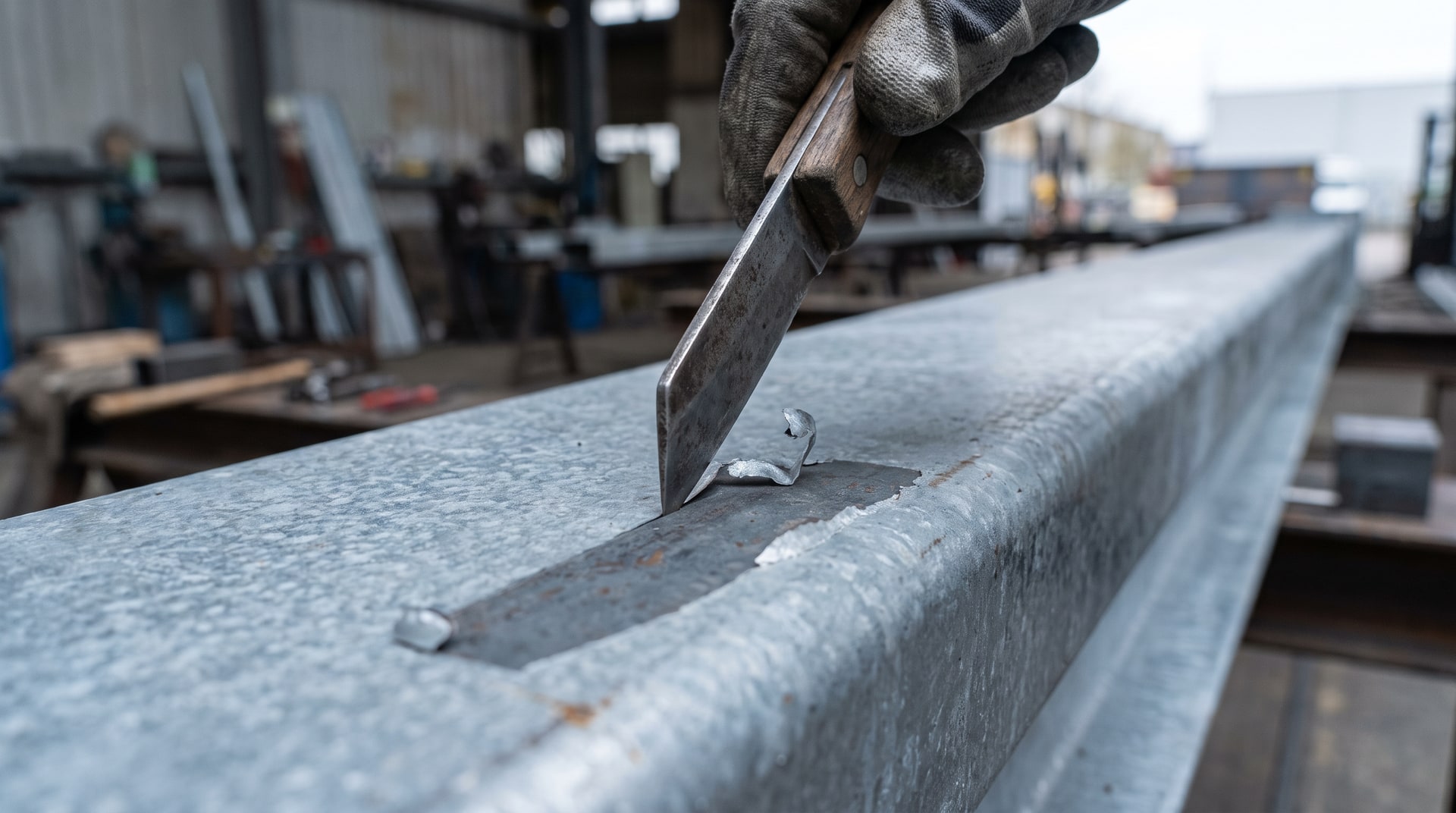
When a freshly galvanized part arrives on a job site or leaves a galvanizing facility, the visible surface tells part of the story. Color, texture, and overall uniformity give experienced eyes an early read on coating quality. But appearance alone cannot confirm whether the zinc metallurgical bond is sound. A coating that looks perfectly acceptable can still fail prematurely if it does not adhere properly to the base steel. That is where physical adhesion testing comes in, and the method specified for hot-dip galvanized steel is known widely as the stout knife test.
Adhesion failure in a galvanized coating is not simply cosmetic. When the zinc-iron alloy layers separate from the steel substrate, the entire corrosion protection mechanism is compromised. The sacrificial, barrier, and cathodic protection properties of a well-formed HDG coating depend on a continuous, well-bonded zinc layer. An unbonded coating is structurally hollow in the most critical sense: it may hold its shape and appearance under gentle handling, but it cannot perform its protective function under real service conditions.
The American Galvanizers Association addresses this directly in their article on stout knife testing for hot-dip galvanized coatings. At V&S Galvanizing, we expand on that foundation to explain what is actually happening at the material level, how applied force and technique influence test outcomes, and why this test is frequently misapplied or misunderstood in the field.
What the Stout Knife Test Is Actually Measuring
The stout knife test is the ASTM A123/A123M-specified method for evaluating whether the zinc coating has achieved adequate metallurgical adhesion to the steel substrate. When steel is properly prepared and immersed in a molten zinc bath, a series of zinc-iron alloy layers forms at the interface through a diffusion reaction. These layers, from the steel surface outward, become progressively richer in zinc and culminate in the outer pure zinc layer visible on a finished part.
That layered alloy structure is what gives HDG its characteristic durability. It is not paint applied on top of steel; it is a bonded metallic coating that is partially integrated into the steel surface. A properly formed coating cannot be cleanly separated from the base metal without significant mechanical force. When it can be separated easily, or when it flakes off in discrete pieces, that indicates the alloy layers did not form correctly, the steel surface was inadequately prepared, or the chemistry and processing conditions produced a brittle, poorly bonded coating.
The stout knife test applies a standardized mechanical challenge to that bond. It does not measure coating thickness, and it does not quantify adhesion in numerical terms. What it tells you is whether the bond is sufficient to resist a deliberate, firm attempt to mechanically separate the coating from the steel. That binary outcome, intact or flaking, is the result the test is designed to produce.
When Stout Knife Testing Is Warranted
It is worth being direct about this: the stout knife test should not be performed routinely or indiscriminately on every galvanized part. ASTM A123/A123M is explicit that adhesion tests are subject to mutual agreement between the galvanizer and the purchaser. The test is reserved for situations where there is a valid concern about coating adhesion, such as when visible signs of peeling, flaking, or an embrittled coating are already present.
Conducting the test without cause introduces unnecessary risk of damaging a coating that is perfectly sound. The knife blade, pressed with considerable force, will always leave some mark. On a coating in good condition, that mark is a shallow cut or score that does not compromise corrosion protection meaningfully. But if the test is performed carelessly, repeatedly, or in the wrong location, the damage can become significant. This is why the standard does not mandate routine testing and why the frequency and number of tests should be agreed upon between parties before any inspection begins.
The decision to test should be driven by observed anomalies during visual inspection. Coating that appears to lift at edges, shows visible delamination, produces a hollow sound when tapped, or has a powdery or brittle surface texture all represent legitimate triggers for stout knife testing. Absent those indicators, the test adds little information and carries a real cost to the coating surface.
Choosing the Right Knife for the Job
The term "stout knife" implies a specific class of tool, and the choice of knife is not trivial. A standard pocketknife or thin-bladed utility cutter is not appropriate. You need a sturdy, non-serrated blade that can transmit firm, controlled force without flexing or slipping. The blade needs enough mass and rigidity to press firmly into the coating without the handle becoming a leverage hazard to the user.
A knife large enough to grip with two hands is the recommended configuration. Two-handed control gives the inspector far better command over the applied force and direction of the cut, reducing the risk of slipping and applying excessive or uncontrolled pressure. If a folding knife is used, a locking blade mechanism is essential. A blade that closes unexpectedly under the kind of pressure required for this test poses a serious injury risk, and no test result justifies that exposure.
The knife in Figure 3 from the AGA source material shows a heavy-duty utility knife with a fixed or lockable blade that exemplifies the right tool class. Whatever knife is selected, it should be capable of penetrating a galvanized coating with firm, direct pressure, not one that requires sawing, hacking, or repeated strokes to engage the coating surface.
Executing the Test Correctly: Technique Matters
The ASTM A123/A123M language describing the stout knife test is worth quoting directly: "Determine adhesion of the zinc coating to the surface of the base metal by cutting or prying with the point of a stout knife, applied with considerable pressure in a manner tending to remove a portion of the coating." That language is precise in what it prescribes and equally precise in what it does not permit.
The correct sequence begins by firmly pressing the knife blade into the coating, driving it downward toward the steel substrate. Once the blade has penetrated to or near the substrate, the motion transitions to a prying or peeling action intended to lift a portion of the coating free. The test requires one clean, firm attempt. Not two. Not a series of strokes. One deliberate effort to peel a flake of coating away from the steel.
What the test explicitly prohibits is whittling, gouging, or hacking at the coating. These actions do not measure adhesion; they measure how much damage a sustained mechanical attack can inflict on any coating. Even a perfectly bonded galvanized surface can be mechanically degraded by repeated blows or abrasion. Applying excessive force beyond what one clean prying motion requires invalidates the test entirely. The result of an improperly executed test tells you nothing useful about coating adhesion and risks damaging a coating that was performing correctly.
Location selection also matters. The test should never be performed on edges or corners. These geometric features create stress concentrations in the coating during galvanizing and are inherently more susceptible to mechanical damage. Testing at corners inflates the apparent failure rate and does not reflect the adhesion performance of the coating across the broader surface. Test on flat or gently curved surface areas where the coating has formed uniformly.
Reading the Result: What Flaking Actually Indicates
There are two possible outcomes, and they need to be interpreted with care. If the knife prying action causes a discrete piece of coating to separate from the steel, the coating has failed the stout knife test. That separation, called flaking, indicates inadequate adhesion between the zinc coating and the base metal. The coating did not achieve the metallurgical bond that a properly formed HDG coating should exhibit.
Flaking during a stout knife test typically points to one of a few root causes at the process level. Steel surface contamination prior to galvanizing, such as residual mill scale, inadequate pickling, or surface soils that were not fully removed, can prevent the zinc-iron diffusion reaction from proceeding uniformly. Certain steel chemistries, particularly those with silicon or phosphorus content in ranges that accelerate zinc-iron reactivity, can produce an overly thick, brittle alloy layer that is more prone to separation under mechanical stress. Processing anomalies like excessive dross inclusions at the coating-steel interface can also produce areas of poor adhesion that flaking will expose.
When the coating survives the test intact, as shown in Figure 2 from the AGA source, the result is a cut or score mark in the surface, but the coating does not separate. The zinc layers remain bonded to the steel. That outcome confirms adequate adherence for the purposes of ASTM A123/A123M. The coating may show a visible mark, but that mark does not represent a structural failure of the protective system.
The Relationship Between Stout Knife Testing and Sweep Blast Preparation
One area where the stout knife test is frequently over-relied upon is in predicting how a galvanized coating will respond to abrasive (sweep blast) cleaning before painting or powder coating. In a duplex system, HDG is often sweep blasted to create a surface profile that improves mechanical adhesion for the topcoat. That process subjects the coating to a different kind of mechanical stress than a knife prying action.
The stout knife test is the best available indication of overall coating adhesion, but the AGA is clear that it offers only limited information about susceptibility to sweep blast damage specifically. A coating that passes the stout knife test may still suffer surface degradation under abrasive blast conditions if incorrect media, pressure, or nozzle angles are used. The variables in abrasive blasting are complex enough that passing a knife test does not serve as a reliable guarantee of sweep blast performance.
For projects that will involve duplex coating, the recommendation is to follow established guidance on abrasive media selection and blasting procedures designed specifically for HDG surfaces. Relying solely on the stout knife test result as a predictor of blast survivability is an incomplete approach, and teams responsible for that transition should consult applicable process guidance rather than extrapolating from adhesion test outcomes alone. Our team at V&S Galvanizing is familiar with the considerations involved in preparing galvanized surfaces for duplex coating systems and can speak to those requirements directly.
Coordinating Test Requirements Before the Work Begins
Because ASTM A123/A123M does not specify how many stout knife tests are required or at what frequency they should be conducted, the absence of a pre-agreed protocol is a common source of disputes. A purchaser who expects a test on every piece will approach inspection differently than a galvanizer who interprets the standard as requiring tests only when adhesion concerns are already visible. Neither interpretation is wrong in isolation, but the conflict between them creates real project friction.
The standard explicitly calls for mutual agreement between the galvanizer and purchaser on both the need for testing and its scope. That agreement should happen at the specification or contract stage, before fabrication is complete and before any parts enter the galvanizing process. Defining test frequency (for example, one test per heat number, or one test per defined surface area), the specific areas to be tested, and the conditions that trigger testing creates a shared understanding that protects both parties.
Engineers and project managers writing galvanizing specifications for structural steel or fabricated products should include this language explicitly. Vague references to "adhesion testing per ASTM A123" leave the frequency and scope undefined, which is exactly what the standard acknowledges and expects the parties to resolve contractually. Resolving this before the project begins costs nothing and avoids significant disagreement during or after inspection.
Work With a Team That Understands Coating Quality at Every Stage
The stout knife test is a simple tool, but applying it correctly requires genuine understanding of what the test is measuring, when it is appropriate, and how to execute it in a way that produces meaningful results. A test performed without cause, at the wrong location, or with improper technique does not improve quality assurance. It damages coatings, wastes time, and generates data that cannot be reliably interpreted. Getting the test right means understanding the adhesion mechanism behind it, not just knowing how to hold a knife.
At V&S Galvanizing, we take coating quality seriously across every step of the process: from surface preparation and bath chemistry management to post-galvanizing inspection and customer communication. When adhesion concerns arise on a project, our team can walk through the relevant ASTM requirements, help establish a rational testing protocol, and interpret results in context. If you have questions about galvanizing specifications, inspection procedures, or how to address a specific coating quality concern, reach out through our contact page and we will get you a direct, technically informed response.
Frequently Asked Questions About the Stout Knife Test for HDG Coatings
What standard governs the stout knife test for hot-dip galvanized coatings?
The stout knife test is the adhesion test method provided in ASTM A123/A123M, the primary specification for hot-dip galvanized coatings on iron and steel products. The standard describes the test procedure but does not mandate the number or frequency of tests, which must be agreed upon between the galvanizer and the purchaser in advance.
What does it mean when a galvanized coating flakes during the stout knife test?
Flaking during the stout knife test indicates inadequate adhesion between the zinc coating and the base steel. It means the zinc-iron alloy layers did not achieve the metallurgical bond that properly galvanized steel should exhibit. Possible causes include surface contamination prior to galvanizing, steel chemistry factors that produce a brittle alloy layer, or processing anomalies at the coating-substrate interface.
Should the stout knife test be performed on every galvanized part?
No. ASTM A123/A123M states that adhesion testing is subject to mutual agreement between the galvanizer and purchaser, and the test should not be conducted without valid concerns of peeling, flaking, or an embrittled coating. Routine testing of every part is not required or recommended, as unnecessary testing can damage a sound coating without providing useful quality information.
Why is it important not to test at edges or corners?
Edges and corners are geometric stress concentrations where coatings are inherently more susceptible to mechanical separation, even when the bond quality across the broader surface is entirely acceptable. Testing at these locations produces results that do not reflect overall adhesion performance and can generate misleading failure indications on an otherwise sound coating.
Can a coating that passes the stout knife test still be damaged during sweep blast cleaning?
Yes. While the stout knife test is the best available indicator of coating adhesion, ASTM A123/A123M and the AGA note that it provides only limited information about susceptibility to abrasive sweep blast cleaning. Sweep blasting involves different mechanical dynamics, and even a coating that passes the knife test can be damaged if incorrect abrasive media, excessive pressure, or improper nozzle angles are used during blast preparation for painting or powder coating.
What kind of knife is appropriate for the stout knife test?
A sturdy, non-serrated blade knife capable of being gripped with two hands is recommended. If a folding knife is used, it must have a locking blade mechanism to prevent accidental closure under applied force. The blade must be rigid enough to transmit firm, controlled pressure without flexing. Thin-bladed utility cutters or pocketknives are not appropriate for this test.
How many times should the knife be applied during the test?
Only once. ASTM A123/A123M and proper test execution require a single clean, firm attempt to cut or pry the coating. Whittling, hacking, or making repeated strokes at the same location is explicitly not permitted. Multiple attempts do not measure adhesion; they measure how much mechanical damage can be accumulated, which is not the same thing and invalidates the test result.
How should the frequency of stout knife testing be established for a project?
The frequency and scope of stout knife testing should be defined by mutual agreement between the galvanizer and purchaser before the project begins, ideally at the specification or contract stage. The agreement should address how many tests are required, on which surfaces or components they will be performed, and what conditions trigger testing. Leaving this undefined invites disagreement during inspection, since ASTM A123/A123M does not specify default testing frequencies.
