
It is one of the most practical questions a project owner or engineer can ask: how long will this galvanized coating last, and can we make it last longer by specifying more zinc? The instinct behind the question is sound. Zinc is a sacrificial coating that corrodes gradually to protect the underlying steel, so more of it should mean more years of protection. That much is true. But the full picture is more nuanced, and the variables that shape real-world service life go well beyond what any single coating thickness measurement can capture.
The American Galvanizers Association addresses this directly in their article on lifetime vs. coating thickness for hot-dip galvanized coatings. At V&S Galvanizing, we expand on that foundation to explain what is actually happening at the material level, how environment influences performance, and why the traditional service life charts are more conservative than current conditions warrant.
The Core Relationship: Zinc Thickness and Time
The fundamental principle is straightforward. A thicker zinc coating contains more sacrificial material, which means it takes longer for corrosion to consume it down to the steel surface. Regardless of the environment, a coating that starts thicker will always outlast an identical coating that starts thinner, all other variables being equal. This relationship holds across every exposure category, from rural atmospheric to marine coastal to industrial settings.
What changes between environments is the rate at which that zinc is consumed. A coastal atmosphere with high chloride content accelerates zinc corrosion compared to a temperate inland setting. A historically industrial atmosphere with elevated sulfur dioxide levels attacks zinc more aggressively than clean rural air. The coating thickness determines the reservoir of protection; the environment determines how quickly that reservoir is drawn down.
This is why thickness alone cannot answer the service life question without environmental context. A 3-mil zinc coating in a mild rural setting may last decades longer than the same coating in a chemically aggressive environment. The two variables are inseparable when projecting real-world performance.
How the Traditional Service Life Chart Was Built
The familiar chart that plots coating thickness against time to first maintenance has been a reference tool in the galvanizing industry for a long time. The data underlying those curves was gathered primarily in the 1940s and 1950s by researchers who conducted atmospheric exposure tests across different environments. The resulting curves allowed engineers and specifiers to estimate how many years a given zinc thickness would survive before the coating reached the point where maintenance was needed.
That chart became so widely used that it took on an almost authoritative permanence. Engineers cite it, specifications reference it, and customers ask whether a coating meets the threshold for a particular service life projection. The problem is that the chart reflects atmospheric conditions that no longer exist in the United States.
The environmental baseline used to build those curves was shaped by mid-twentieth-century industrial activity. Urban and industrial air in that era carried significantly higher concentrations of sulfur dioxide and other corrosive pollutants than we see today. Those pollutants are directly implicated in accelerating zinc corrosion, and the data from those decades reflects that more aggressive atmosphere.
Why Air Quality Improvements Change the Equation
Over the past several decades, sustained regulatory effort and industrial modernization have dramatically reduced sulfur dioxide emissions and other atmospheric pollutants across the United States. The AGA notes that this improvement has been thorough enough that there are effectively no regions that still qualify as "heavy industrial" by the environmental standards that shaped the original chart categories. Every classification has improved relative to its historical baseline.
For galvanized steel, this shift has a direct and favorable consequence. Sulfur dioxide reacts with zinc oxides and hydroxides at the coating surface to form zinc sulfate, which is a relatively soluble corrosion product that washes away and exposes fresh zinc to further attack. Lower sulfur dioxide concentrations slow this cycle, allowing more protective zinc carbonate patina to form instead. Zinc carbonate is significantly less soluble, adheres well to the surface, and acts as a partial barrier that reduces the ongoing corrosion rate.
In practical terms, the same zinc coating thickness applied today, in a modern atmospheric environment, will last meaningfully longer than the curves on the historical chart would suggest. We are, by the AGA's own assessment, underestimating service life when we use that chart as written. Ongoing atmospheric exposure testing programs are collecting data to produce updated curves that reflect contemporary air quality, but until those revised charts are published, specifiers and project teams should understand that the traditional chart represents a conservative lower bound rather than an accurate prediction for most current U.S. locations.
What "Time to First Maintenance" Actually Means
The metric used on the service life chart is time to first maintenance, and it is worth being precise about what that threshold represents. It does not mean the coating has failed or that the steel has begun to corrode. It marks the point at which the zinc has been consumed enough that visible rust staining or localized bare steel may start to appear, and the structure should be evaluated for touch-up or supplemental coating to extend its service life further.
A galvanized coating that has reached its time-to-first-maintenance point still has residual zinc present. The structure is not ruined. With appropriate inspection and targeted repair using zinc-rich paint or other compatible materials, the overall protection system can continue to perform for many additional years. This is an important distinction for project owners who equate "first maintenance" with "coating failure." The chart is projecting a service milestone, not a failure event.
This also means that specifying additional coating thickness as a buffer is a legitimate engineering decision, particularly for structures in aggressive environments or for applications where access for future maintenance is difficult or costly. In those cases, starting with a thicker coating and building in a longer maintenance interval is sound practice, not overengineering.
The Challenge of Issuing Coating Lifetime Guarantees
When customers ask whether we can guarantee that a galvanized coating will last 30 years or more, the honest answer requires unpacking what a guarantee actually covers. The AGA frames this clearly: a service life guarantee is genuinely difficult to issue as a blanket commitment because so many variables outside the galvanizer's control affect how the coating performs once it leaves the plant.
The galvanizer controls the zinc coating thickness and its adherence to the steel substrate. What happens after that depends on where the structure is installed, what it is exposed to, how it is maintained, whether it is cleaned periodically to remove surface deposits, and whether any localized damage to the coating is repaired promptly. A guarantee that ignores those variables would be commercially irresponsible and technically meaningless.
A well-constructed guarantee can be written, but it requires careful qualification. It must carve out exceptions for unusual corrosion conditions, specify the environmental category assumed, and define what "service life" means in measurable terms. It cannot simply state that the coating will last a minimum number of years under all circumstances. When those conditions are met and the guarantee is written correctly, the service life chart can serve as the technical basis for the projection. Without those qualifications, the chart cannot be used as the sole justification for any guarantee.
Specifying Coating Thickness for Performance Rather Than Just Compliance
Most galvanized steel produced through hot-dip galvanizing is specified to meet ASTM A123 or similar standards, which establish minimum average coating thickness requirements based on the steel category and thickness. Those minimums are real floors, not targets. Meeting the minimum is the starting point for compliance, but it is not necessarily the right answer for every project.
Engineers designing for aggressive environments, long service intervals, or difficult maintenance access should approach coating thickness as a performance variable and use the service life chart accordingly. If the chart, even in its conservative form, shows that a minimum-compliant coating will not reach the desired maintenance interval for a given environment, that is useful information at the design stage. The appropriate response might be to specify a heavier steel section (which tends to produce a thicker zinc coating due to the reaction kinetics of hot-dip galvanizing), to request coating thickness measurements at acceptance inspection, or to consider whether a duplex system adding paint over galvanizing is warranted for the most demanding exposures.
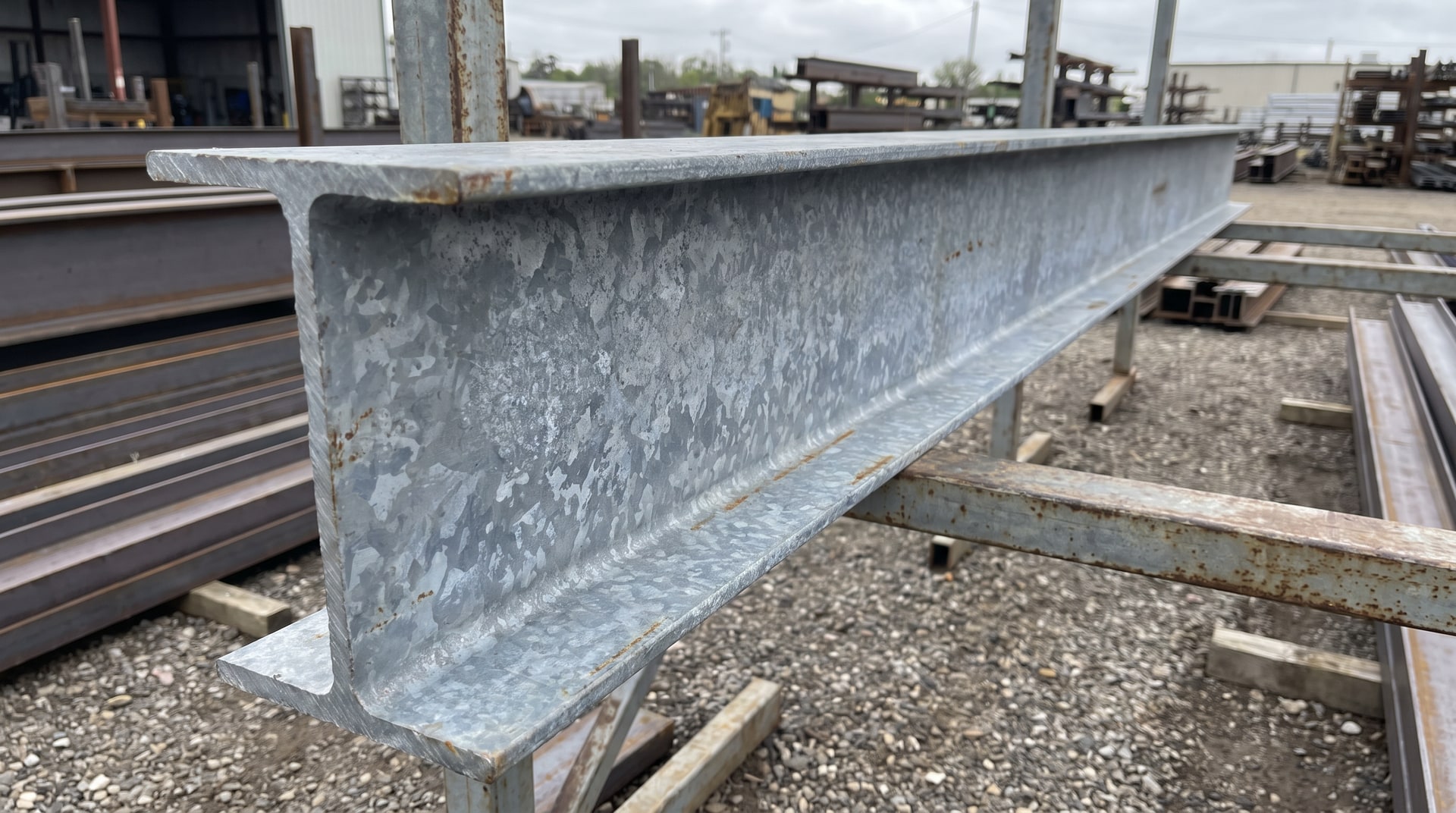
The relationship between steel thickness and zinc coating thickness is worth noting here. In hot-dip galvanizing, thicker steel sections tend to retain more heat during the galvanizing process, which promotes the growth of the zinc-iron alloy layers. The result is that structural shapes and heavy plate naturally produce thicker coatings than thin sheet or light fasteners, which is part of why the ASTM minimums vary by steel category. This is not a flaw in the process; it is a characteristic that works in favor of the structural applications where corrosion protection matters most.
Environmental Classification and What It Means for Your Project
The service life chart organizes performance projections by environmental category. Broadly, these range from rural and suburban atmospheric exposures with low pollution and low humidity, through temperate and industrial urban categories, up to marine environments with aggressive chloride loading. Each category represents a different zinc corrosion rate, which translates to a different slope on the time-versus-thickness curves.
Accurately classifying the environment where a structure will be installed is genuinely important, and it is also genuinely difficult in some cases. A bridge in an inland region may seem straightforward, but if it carries road traffic and receives de-icing salt spray during winter, the underside of the bridge deck is experiencing a microenvironment significantly more aggressive than the regional classification would suggest. Coastal structures must account for the distance from the shoreline and whether prevailing winds carry salt-laden air inland. Industrial facilities may have localized emission sources that elevate the corrosivity of the immediate vicinity well above the regional average.
These are the kinds of site-specific details that a blanket guarantee cannot accommodate and that responsible service life projections must confront. We encourage engineers and project owners to think carefully about the actual exposure conditions the structure will face over its design life, not just the general regional category, when using the service life chart to set performance expectations.
Work With a Team That Understands Coating Performance in Context
Service life is not a number stamped on a coating. It is the result of a zinc thickness interacting with an environment over time, with maintenance practices, design geometry, and steel chemistry all playing supporting roles. The historical service life chart is a useful starting tool, but it tells only part of the story, and as atmospheric conditions continue to improve across the United States, it consistently understates how long a well-applied galvanized coating will actually perform.
At V&S Galvanizing, we bring direct process knowledge and application experience to these conversations. Whether you are designing a structure that needs to meet a 50-year service interval, evaluating whether a coating thickness specification is appropriate for a corrosive environment, or trying to understand what a galvanizing guarantee actually covers, we can help you work through the technical and practical dimensions of the question. Reach out to our team through our contact page to discuss your project requirements.
Frequently Asked Questions About Galvanized Coating Lifetime and Thickness
Does a thicker zinc coating always mean a longer service life?
Yes, within any given environment, a thicker zinc coating will always outlast a thinner one. More zinc means more sacrificial material available before the coating is consumed down to the steel surface. However, the rate at which that zinc is consumed depends heavily on the corrosivity of the environment, so a thick coating in an aggressive atmosphere may still fail sooner than a thinner coating in a mild setting.
Why does the traditional galvanizing service life chart underestimate modern coating performance?
The data used to build the chart was collected primarily in the 1940s and 1950s, when atmospheric sulfur dioxide levels and industrial pollution were significantly higher than they are today. Sulfur dioxide accelerates zinc corrosion, so the corrosion rates embedded in the original curves are more aggressive than current conditions in the United States warrant. Modern air quality improvements mean the same zinc thickness will typically last longer than the chart projects.
What does "time to first maintenance" mean for a galvanized structure?
It marks the point at which visible rust staining or localized bare steel may begin to appear and the coating should be evaluated for touch-up. It does not indicate that the coating has completely failed or that structural steel is in danger. Residual zinc is usually still present, and targeted repair at this stage can extend the structure's protected service life significantly.
Can a galvanizer guarantee a specific coating service life?
A blanket guarantee of minimum service years is not technically defensible because so many variables outside the galvanizer's control, including environment, maintenance, and handling, affect coating performance. A properly qualified guarantee, one that specifies the assumed environment, defines measurable service criteria, and carves out exceptions for unusual corrosion conditions, can be written using the service life chart as its technical basis.
How does steel section thickness affect the zinc coating thickness produced?
Thicker steel sections retain more heat during the hot-dip galvanizing process, which extends the zinc-iron alloy reaction and results in a thicker overall zinc coating. This is why ASTM A123 minimum thickness requirements are higher for heavier steel categories. Specifying a heavier section is one practical strategy for achieving a thicker coating where longer service life is required.
How should engineers account for microenvironments when projecting galvanized coating service life?
The regional atmospheric classification is a starting point, but structures are often exposed to localized conditions far more aggressive than the regional average. Bridge undersides exposed to road salt spray, structures near industrial point sources, and coastal installations exposed to salt-laden wind all require site-specific evaluation rather than reliance on the broad environmental category alone. Overly conservative or optimistic assumptions at this stage can lead to significant errors in service life projection.
Is there an updated version of the coating thickness versus service life chart that reflects current air quality?
As of the time the AGA published their source article, efforts were underway to produce an updated chart using more recent atmospheric exposure test data that reflects modern air quality conditions. Until an updated chart is formally published, the existing chart should be treated as a conservative lower bound for most current U.S. locations, not as a precise prediction of actual service life.
When does it make sense to specify a duplex system instead of relying solely on coating thickness?
A duplex system, where paint or powder coating is applied over hot-dip galvanized steel, is worth considering when the environment is highly corrosive, maintenance access is difficult or costly, or when the target service interval exceeds what the zinc coating thickness alone can reliably deliver in that environment. The zinc and organic coating work synergistically, each extending the effectiveness of the other, often producing a total service life greater than either coating would provide on its own.
