

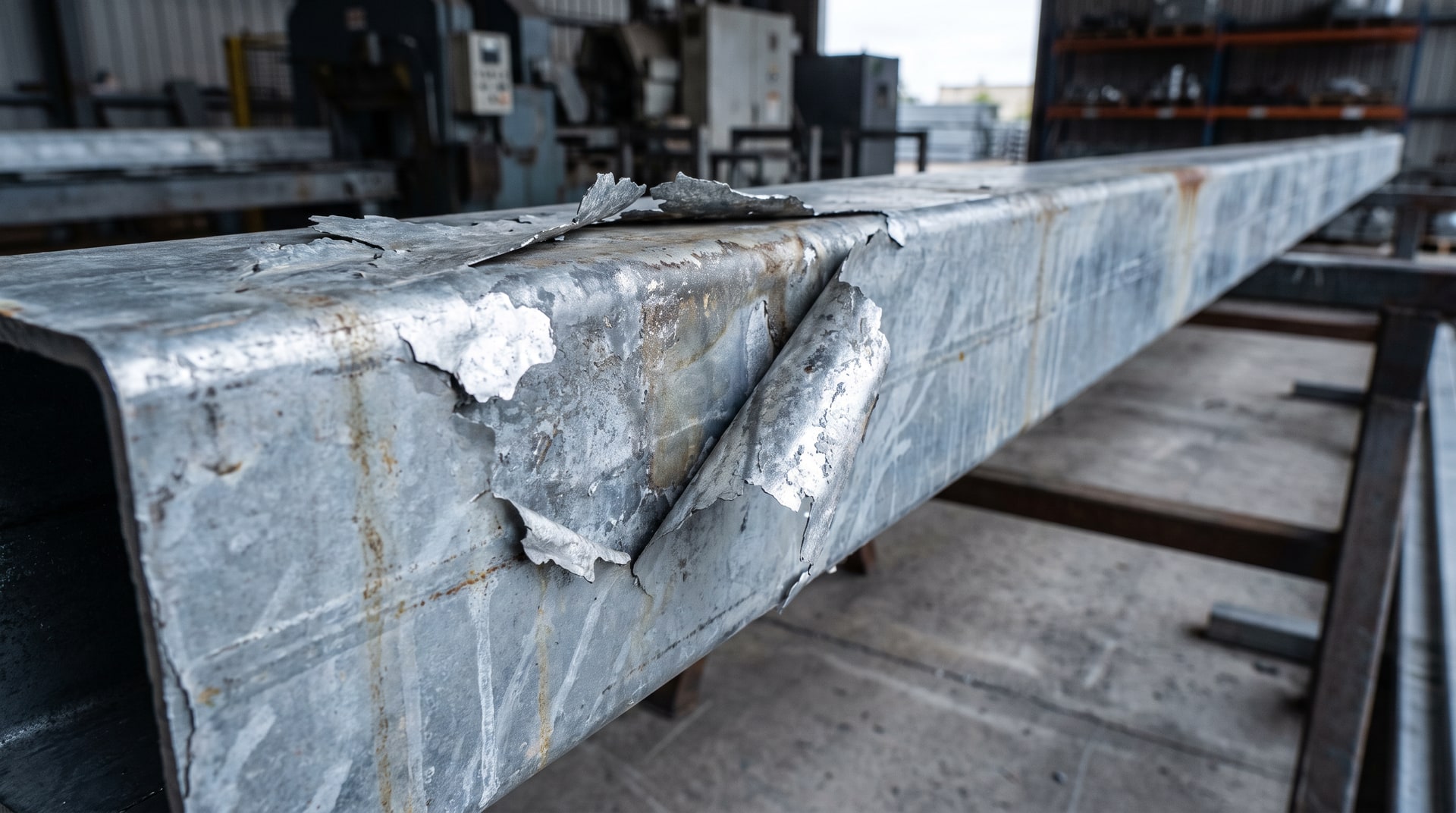
Most galvanizers and fabricators who encounter peeling on a freshly galvanized part instinctively look at the largest, heaviest sections first. That instinct is usually correct. The Kirkendall effect, the phenomenon responsible for a specific type of coating delamination in hot-dip galvanized steel, is classically associated with thick-walled components, large-diameter tubes, and heavy structural assemblies that retain heat long after withdrawal from the zinc kettle. But what happens when peeling appears on a relatively thin-walled piece that should have cooled quickly? What causes a localized pocket of delamination on a component that otherwise looks perfectly normal?
These isolated cases are not random. They follow the same underlying physics as the classical Kirkendall effect, but the heat source is internal rather than inherent to the base steel mass. Understanding why that distinction matters requires a closer look at what the Kirkendall effect actually is, how dross behaves inside hollow fabrications, and what design details can prevent the conditions from occurring in the first place.
The American Galvanizers Association addresses this directly in their article on isolated instances of the Kirkendall effect. At V&S Galvanizing, we expand on that foundation to explain what is actually happening at the material level, how localized heat retention influences coating performance, and why this phenomenon is often misdiagnosed in the field.
What the Kirkendall Effect Actually Is
The Kirkendall effect is a metallurgical phenomenon that occurs when two dissimilar metals in contact undergo diffusion at unequal rates. In the context of hot-dip galvanizing, it describes what happens when galvanized steel remains above 390 degrees F (200 degrees C) for an extended period after being withdrawn from the molten zinc bath.
During normal galvanizing, zinc and iron interdiffuse to form a series of alloy layers: gamma, delta, and zeta, moving outward from the base steel, with a pure zinc eta layer on the outermost surface. This layered structure is what gives a properly galvanized coating its combination of barrier protection and cathodic protection. The diffusion that creates these layers is controlled and brief under normal cooling conditions.
When the steel remains elevated in temperature after galvanizing, that diffusion continues beyond the point of equilibrium. Because zinc diffuses into iron faster than iron diffuses into zinc under these conditions, the net atomic movement is directional. The imbalance leaves behind microscopic voids at the interface between the eta and zeta layers. As those voids accumulate, they coalesce and eventually undermine the bond holding the outer eta layer in place. The result is peeling: the pure zinc surface layer lifts and separates while the underlying zinc-iron alloy layers remain fully bonded to the steel.
It is worth emphasizing what the Kirkendall effect does not do. The zinc-iron alloy layers beneath the eta layer stay intact and continue to provide full corrosion protection. The concern is primarily aesthetic, though secondary coatings applied over a delaminated surface face obvious adhesion challenges. For structural performance and corrosion resistance, the underlying alloy layers are doing their job.
Why Large Mass Has Always Been the Classic Trigger
The reason thick steel sections have historically been the primary setting for Kirkendall effect peeling comes down to thermal mass and cooling rate. A heavy tube wall or a thick structural plate simply holds more heat energy. After galvanizing, that thermal reservoir takes much longer to dissipate. The steel stays above the critical 390-degree threshold far longer than a lighter section would, giving the diffusion imbalance more time to generate voids.
Large-diameter tubes and thick-walled tanks are the textbook examples because their geometry compounds the problem. A thick wall conducts heat slowly toward the outer surface, while the large overall mass means the temperature gradient from core to surface is gradual. The result is a prolonged window during which the Kirkendall mechanism is active.
This is why galvanizers processing heavy fabrications pay close attention to post-galvanizing cooling management. Forced air quenching, water quenching at appropriate stages, and careful racking to promote airflow are all strategies used to shorten the time a component spends above that critical temperature. The goal is not to cool the steel so rapidly that thermal shock becomes a concern, but to avoid the extended dwell time that enables void accumulation.
When Peeling Appears Where It Should Not
The more diagnostically interesting cases are the ones that break the pattern. When a 4-inch square hollow structural section (SHS) with relatively thin walls shows localized Kirkendall peeling on one face while all surrounding areas look normal, the classical explanation does not hold. The steel is not thick enough to retain dangerous amounts of heat on its own. Something else is providing the sustained temperature.
The AGA case study documents exactly this scenario. On a small SHS fabrication, peeling appeared on the outer wall of one specific face. Inspection of the corresponding interior wall revealed a deposit of galvanizing dross frozen to the inside surface directly beneath the external peel location. The geometry of the internal space and the absence of properly sized vent and drain holes had allowed molten zinc and dross to become trapped inside the section during the galvanizing process.
Dross, a zinc-iron intermetallic compound that forms at the bottom of the galvanizing kettle, is known within the industry for its thermal properties. It retains heat effectively and releases it slowly, which is why dross accumulation in a kettle creates persistent hot spots that galvanizers must manage carefully. When that same material is frozen to the inside wall of a fabricated assembly, it acts as a localized insulating mass, keeping the steel immediately adjacent to it at elevated temperature long after the rest of the section has cooled.
The external wall never knew the difference between being adjacent to a dross deposit and being a section of thick steel with high thermal mass. From the diffusion mechanism's perspective, the input is simply heat duration. The dross provided exactly that, and the Kirkendall effect responded accordingly on that specific area of the outer surface.
The Role of Vent and Drain Holes in Preventing Trapped Material
The reason zinc and dross become trapped inside hollow sections in the first place is almost always a fabrication design issue, specifically the sizing, placement, or complete absence of vent and drain holes.
When hollow structural steel enters a galvanizing kettle, the internal cavity fills with molten zinc. On withdrawal, that zinc must drain completely and quickly. If the vent and drain holes are too small, positioned incorrectly for the orientation of the part during drainage, or absent entirely, zinc and any suspended dross can remain inside the section. As the part cools, that material solidifies against the inner walls.
This is not a rare failure of craftsmanship. It is a predictable outcome of geometric designs that do not account for galvanizing process requirements. ASTM A385, the standard practice for providing high-quality zinc coatings, addresses vent and drain hole requirements specifically for this reason. Fabricators designing assemblies with hollow sections, closed-end tubes, or internal cavities need to treat hole sizing and placement as a functional engineering parameter, not an afterthought.
Beyond the Kirkendall effect, improperly vented sections create other galvanizing hazards. Sealed cavities can trap moisture, flux, and air, creating steam pressure during immersion that risks violent rupture. Properly placed holes protect both the quality of the finished coating and the safety of the galvanizing operation itself. Our team at V&S works with fabricators during the design review phase to identify these issues before steel arrives at the plant, which is consistently the most cost-effective point in the process to address them. More on our hot-dip galvanizing process and the design review support we provide is available on our services page.
Distinguishing Kirkendall Effect from Other Forms of Delamination
Not every instance of coating separation on a galvanized surface is caused by the Kirkendall effect, and that distinction matters when diagnosing a problem and deciding how to respond.
Flaking and peeling in HDG coatings can also result from stacking hot parts directly after galvanizing, where pressure between components disrupts the surface before the coating has fully stabilized. They can also result from surface contamination on the base steel prior to galvanizing, excessively reactive steel chemistry (particularly high silicon or phosphorus content), or mechanical damage incurred during handling, transport, or erection.
The Kirkendall effect is specifically a thermal diffusion phenomenon. Its signature is peeling that originates at the eta-zeta interface, leaving the alloy layers intact and bonded. If you probe a Kirkendall-affected area and the underlying zinc-iron layers are firmly attached, the mechanism is almost certainly diffusion-driven. If the alloy layers themselves are loose or absent, you are likely looking at a different failure mode.
For isolated occurrences on thin or standard-weight sections, the investigation should include a careful look at whether the part had internal cavities, what the drainage geometry was, and whether there is any evidence of trapped material on interior surfaces. The presence of frozen dross or excess zinc inside the section is a strong indicator that localized heat retention caused the problem.
Corrosion Protection Is Not Compromised
One of the more important points to communicate to clients and specifiers when Kirkendall effect peeling is identified is that the corrosion protection of the steel is not meaningfully diminished. The eta layer that has delaminated is the pure zinc surface layer. What remains is the series of zinc-iron alloy layers: gamma, delta, and zeta. These layers are themselves corrosion-resistant and, critically, they are still cathodically protective. Zinc at any alloy ratio will still preferentially sacrifice itself to protect exposed steel in the event of a coating breach.
The AGA source article is clear on this point: the remaining zinc-iron alloy layers continue to provide corrosion protection even after eta-layer peeling. The primary concerns after a Kirkendall event are cosmetic and practical rather than structural. The visual appearance of peeling may be unacceptable to architects or specifiers with strict aesthetic requirements. And if a duplex system applying paint or powder coat over galvanizing is planned, the adhesion profile of a delaminated surface is compromised and will need to be addressed before topcoat application.
In applications where appearance is secondary and no topcoat is planned, Kirkendall peeling is often an aesthetic nuisance rather than a performance deficiency. That said, any time peeling occurs, the surface warrants documentation and evaluation against the applicable specification to determine whether repair is required.
Practical Implications for Fabricators and Specifiers
Understanding isolated Kirkendall effect cases changes how fabricators should think about hollow section design for galvanizing. The lesson from the SHS case study is not simply that dross can cause problems. The deeper lesson is that any internal thermal mass, regardless of whether it is structural steel or a galvanizing byproduct, can sustain the diffusion conditions needed to generate void accumulation and eta-layer delamination.
For fabricators, this translates into specific design practices. Vent and drain holes must be sized and positioned to allow complete drainage of the internal cavity in the actual orientation the part will assume during withdrawal. For complex fabrications with multiple internal compartments, each chamber needs its own drainage path. Relying on a single hole at one end of a long assembly is often insufficient.
For specifiers and inspectors receiving galvanized steel, isolated peeling on a surface that otherwise looks sound deserves a methodical investigation rather than an immediate rejection or a shrug. Checking whether the affected area corresponds to an internal feature, a cavity, or a location where drainage would have been restricted will usually tell you what happened. That information is more useful for preventing recurrence than simply grinding off the affected area and moving on.
Work With a Team That Understands the Whole Process
Galvanizing quality does not begin at the kettle. It begins with how a part is designed, fabricated, and prepared before it ever reaches a galvanizing plant. Isolated Kirkendall effect events on thin or standard sections are relatively rare, but when they occur they almost always trace back to a design or drainage issue that was present long before galvanizing started. Identifying those conditions early, through design review and pre-galvanizing inspection, is the most reliable way to prevent them.
At V&S Galvanizing, our team works closely with engineers and fabricators throughout the process, not just at the point of coating application. When unusual coating behavior occurs, we investigate it methodically and communicate findings clearly, because understanding what happened is the only way to prevent it from happening again on the next order.
If you have questions about coating performance, design requirements for galvanizing, or how to evaluate peeling or delamination on a part, reach out through our contact page and we will get you a direct answer from our technical staff.
Frequently Asked Questions About the Kirkendall Effect in Hot-Dip Galvanizing
What temperature threshold triggers the Kirkendall effect in galvanized coatings?
The Kirkendall effect becomes active when galvanized steel remains above 390 degrees F (200 degrees C) for an extended period after withdrawal from the zinc kettle. Below this threshold, the rate of zinc-iron interdiffusion is insufficient to generate meaningful void accumulation at the eta-zeta layer interface.
Does Kirkendall effect peeling mean the steel has lost its corrosion protection?
No. When the eta layer peels due to the Kirkendall effect, the underlying zinc-iron alloy layers (gamma, delta, and zeta) remain bonded to the steel and continue to provide corrosion protection. The steel is not unprotected, though the surface may require evaluation against specification requirements and may need attention if a topcoat system is planned.
Can the Kirkendall effect occur on thin-walled hollow sections, not just heavy steel?
Yes, and this is a common misconception. While thick steel sections are the classic setting due to their inherent thermal mass, thin-walled hollow sections can also develop localized Kirkendall peeling if a source of sustained internal heat is present. Dross frozen to the inside wall of an insufficiently vented section has been documented as a cause, acting as insulation that keeps the adjacent steel above the critical temperature long enough for voids to form.
What is dross, and why does it cause localized hot spots inside hollow sections?
Dross is a zinc-iron intermetallic compound that forms in the galvanizing kettle and settles at the bottom. It is known for retaining heat effectively. When dross becomes trapped inside a hollow fabrication due to inadequate venting or drainage, it solidifies against the inner wall and slowly releases heat to the surrounding steel, creating a localized thermal condition that can sustain Kirkendall diffusion in an area that would otherwise cool quickly.
How do vent and drain hole design affect the risk of Kirkendall peeling on hollow sections?
Improperly sized or positioned vent and drain holes prevent complete drainage of molten zinc and dross from internal cavities after the part is withdrawn from the kettle. This allows galvanizing byproducts to remain inside the section and retain heat against specific areas of the internal wall. Correct hole sizing and placement, designed for the actual withdrawal orientation of the part, is the primary preventive measure for this type of localized Kirkendall event.
How is Kirkendall effect peeling different from other types of HDG coating delamination?
Kirkendall effect peeling is specifically a thermal diffusion phenomenon originating at the eta-zeta interface, where void accumulation undermines the bond of the outer pure zinc layer. The alloy layers beneath remain intact. Other delamination causes include stacking hot parts under pressure, highly reactive steel chemistry, surface contamination prior to galvanizing, and mechanical damage. If the zinc-iron alloy layers are also loose or absent, the failure mode is likely not Kirkendall in origin.
Is peeling caused by the Kirkendall effect an automatic rejection under galvanizing specifications?
Not necessarily. The zinc-iron alloy layers remain adherent and protective, and the practical impact depends on the application. Whether the condition constitutes a rejection under a specific project specification depends on the applicable standard, the aesthetic requirements of the project, and whether a subsequent topcoat system requires a continuous bonded surface. Any peeling should be documented, investigated, and evaluated against the governing specification before a determination is made.
At what stage in the project can isolated Kirkendall risk be most effectively prevented?
Design review before fabrication is the most cost-effective intervention point. Identifying hollow sections with insufficient drainage geometry, sealed internal compartments, or vent holes that are too small allows corrections to be made in the drawing stage rather than after galvanizing. Once a part arrives at the galvanizing plant, the drainage geometry is fixed and the risk of trapping dross or zinc internally cannot be fully mitigated.
