

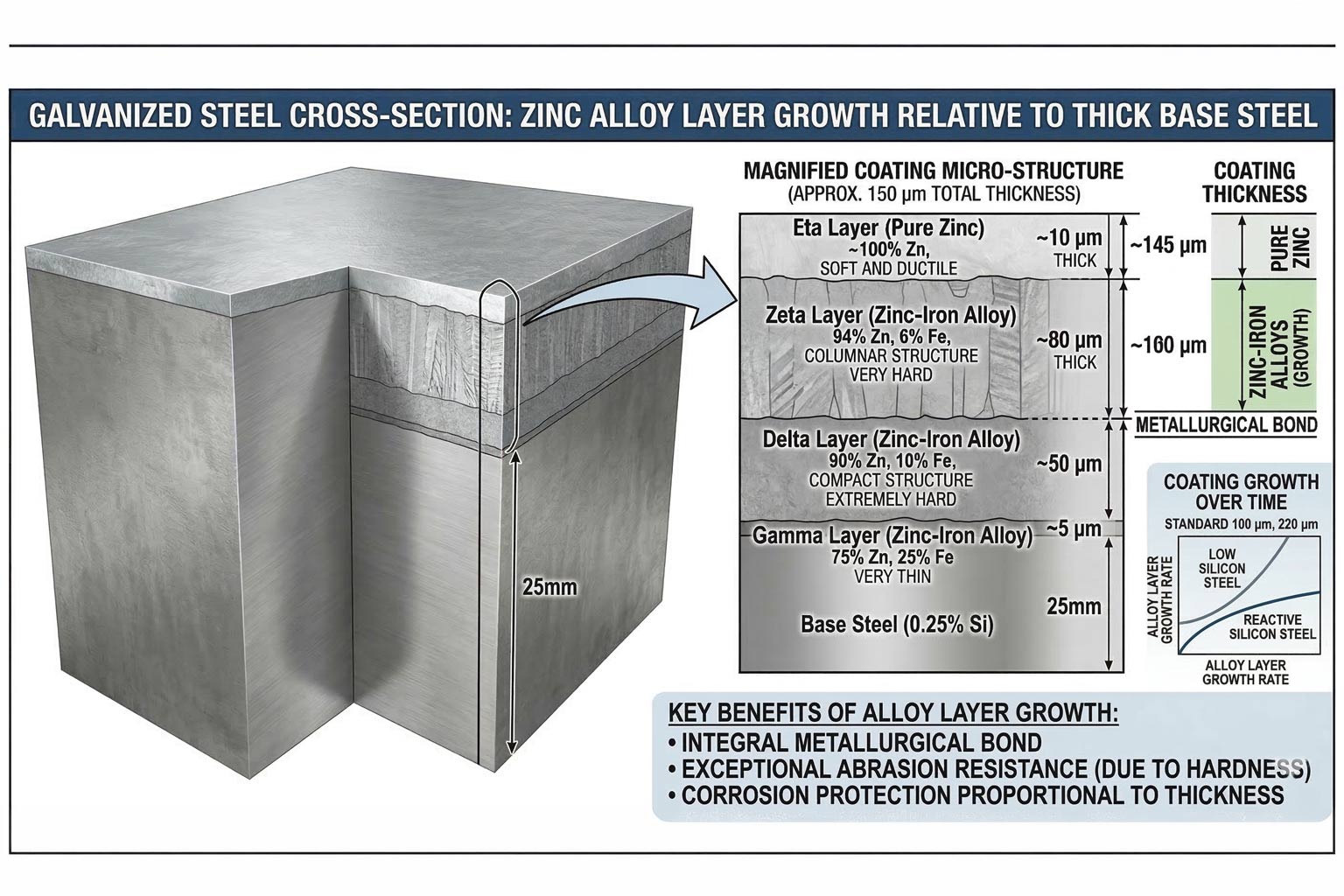
One of the most frequently misunderstood aspects of hot dip galvanizing is why thicker steel sections often develop thicker zinc coatings. At first glance, coating thickness might appear unrelated to base metal thickness. However, metallurgical reaction kinetics and heat transfer behavior explain this consistent relationship.
The American Galvanizers Association addresses this topic in its knowledgebase article discussing why galvanized coating thickness depends on steel thickness. Our article expands on that foundation by examining diffusion driven alloy layer formation, thermal mass effects, and how ASTM thickness categories reflect predictable metallurgical behavior.
Metallurgical Basis of Coating Growth
Hot dip galvanizing is a diffusion controlled process. When steel is immersed in molten zinc at approximately 840 to 850 degrees Fahrenheit, iron and zinc react to form a sequence of zinc iron intermetallic layers.
Coating growth is governed by:
- Temperature
- Immersion duration
- Steel chemistry
- Heat transfer rate
- Diffusion kinetics
The reaction continues as long as iron and zinc remain in contact at elevated temperature.
Because coating formation is not simply a surface deposit but a metallurgical transformation, base metal characteristics directly influence the result.
Thermal Mass and Reaction Time
Thicker steel sections possess greater thermal mass.
When immersed in molten zinc:
- Thicker sections retain heat longer
- Cooling rate after withdrawal is slower
- Intermetallic growth may continue for a longer effective period
In contrast, thin sheet or light gauge material reaches thermal equilibrium quickly and cools rapidly once withdrawn.
This difference in heat retention affects how long the diffusion reaction can proceed.
The result is typically heavier coating growth on thicker steel sections.
Diffusion Kinetics and Layer Development
Zinc iron alloy layers form sequentially from the steel surface outward. The rate of growth follows diffusion principles.
As thicker steel sections maintain elevated temperature longer:
- Iron diffusion into zinc continues
- Intermetallic layer thickness increases
- Total coating thickness grows proportionally
Diffusion rate decreases as alloy layers thicken, but longer elevated temperature duration supports greater total growth.
Steel thickness indirectly influences coating thickness by affecting reaction time.
ASTM Thickness Categories
ASTM A123 recognizes this predictable behavior by establishing minimum coating thickness values based on steel thickness ranges.
For example:
- Thin material categories have lower minimum required coating thickness
- Heavy structural plate categories have higher minimum required coating thickness
These categories reflect the consistent metallurgical relationship between base metal thickness and coating growth.
Specification compliance is evaluated according to the appropriate thickness category for the steel section being galvanized.
Influence of Steel Chemistry
Although steel thickness plays a major role, chemistry remains an important variable.
Elements such as silicon and phosphorus influence reactivity and may accelerate alloy layer formation.
When thicker steel also contains reactive chemistry:
- Coating thickness may increase significantly
- Matte gray appearance may develop
- Alloy layers may dominate the coating structure
Thickness outcome is therefore a function of both thermal mass and chemical composition.
Performance Implications
Service life of galvanized steel in atmospheric environments is approximately proportional to coating thickness.
Because thicker structural members naturally receive heavier coatings:
- Structural steel often achieves extended service life
- Infrastructure components benefit from increased zinc mass
- Long term durability improves without additional process modification
This natural alignment between structural mass and protective coating thickness supports lifecycle efficiency.
Inspection and Measurement
Inspection focuses on:
- Measuring coating thickness using calibrated magnetic gauges
- Comparing values to ASTM minimums for the applicable steel thickness category
It is important not to compare coating thickness of thin sheet to heavy plate without recognizing the governing category differences.
Acceptance criteria are specific to steel thickness classification.
Design Considerations
Engineers specifying hot dip galvanizing should understand:
- Coating thickness is not uniform across all material types
- Heavier sections will typically produce heavier coatings
- Corrosion modeling should reflect measured thickness values
Where uniform thickness across different material sizes is desired for aesthetic reasons, coordination may be required.
From a corrosion protection standpoint, thicker structural members inherently receive increased zinc mass due to metallurgical principles.
If you would like to review coating thickness expectations for your structural assembly or evaluate thickness categories for a specific project, please reach out through our contact page.
Clear understanding of thickness behavior supports predictable inspection outcomes and lifecycle planning.
Galvanized coating thickness depends on steel thickness because of diffusion driven alloy layer growth and thermal mass effects during immersion. Thicker steel retains heat longer, allowing extended intermetallic formation and resulting in heavier coatings. ASTM standards reflect this predictable relationship through defined thickness categories. Recognizing this metallurgical principle ensures accurate specification, inspection, and performance modeling.
Frequently Asked Questions About Coating Thickness and Steel Thickness
Why does thicker steel receive a thicker galvanized coating?
Thicker steel retains heat longer during galvanizing, allowing the zinc iron diffusion reaction to proceed for a longer period. This results in greater intermetallic layer growth and increased total coating thickness.
Is coating thickness controlled only by immersion time?
No. Immersion time influences growth, but steel thickness and chemistry significantly affect reaction kinetics and final thickness.
Does ASTM account for differences in steel thickness?
Yes. ASTM A123 establishes minimum coating thickness requirements based on steel thickness categories, recognizing predictable metallurgical behavior.
Can thin steel achieve the same coating thickness as heavy plate?
Typically no. Thin material cools more rapidly and does not sustain diffusion long enough to produce the same alloy layer growth as heavy sections.
Does heavier coating mean better corrosion protection?
In atmospheric environments, thicker coatings generally provide longer service life because corrosion rate is relatively constant per unit thickness.
How is thickness verified during inspection?
Calibrated magnetic gauges measure coating thickness at representative locations, and values are compared to ASTM minimum requirements for the applicable steel thickness category.
Does steel chemistry override thickness effects?
Steel chemistry can amplify or reduce coating growth, but base metal thickness remains a fundamental factor influencing thermal retention and diffusion duration.
Should designers rely on natural thickness increase for aggressive environments?
Designers should evaluate environmental exposure and lifecycle requirements. Thicker sections naturally produce heavier coatings, but chemistry and specification coordination remain important.
