

Welding is a fundamental part of steel fabrication, and galvanized steel shows up in practically every structural and industrial application you can name. So the question of whether these two processes can coexist is not academic at all. It comes up on job sites, in fabrication shops, and in pre-construction planning meetings constantly. The short answer is yes, you can weld galvanized steel, but doing it correctly requires more preparation and more discipline around safety than welding bare steel does.
The American Galvanizers Association addresses this directly in their article on welding galvanized steel. At V&S Galvanizing, we expand on that foundation to explain what is actually happening at the material level, how zinc behavior influences both the weld quality and worker safety, and why this topic is often misunderstood or underestimated in the field.
Why the Zinc Coating Complicates Welding
Hot-dip galvanizing produces a zinc coating that is metallurgically bonded to the steel substrate. It is not paint. It is not a surface film you can simply push aside with heat. When an arc or flame contacts galvanized steel, the zinc in the immediate area vaporizes almost instantly because zinc has a boiling point of roughly 907 degrees Celsius, well below the temperatures reached during arc welding. That vaporization is at the core of most of the challenges associated with welding galvanized steel.
From a weld quality standpoint, vaporizing zinc produces gas porosity in the weld pool. The escaping zinc vapor can cause weld spatter, incomplete fusion, and surface defects in the bead. None of these outcomes are acceptable on structural connections, and that is precisely why the AWS specification governing this work takes such a firm position on preparation.
The AWS Specification and What It Actually Requires
Welding specifications for galvanized steel are governed by the American Welding Society's AWS D19.0, Welding Zinc Coated Steel. The central requirement of that specification is straightforward but often skipped in practice: the weld must be made on steel that is free of zinc. Even though the component has already been galvanized, the zinc coating must be removed from the intended weld zone before any welding begins.
The AWS specification calls for removing the zinc coating at least 1 to 4 inches from either side of the intended weld, and this applies to both sides of the workpiece. That clearance zone is not arbitrary. It accounts for the heat-affected zone (HAZ) that extends beyond the visible weld bead, where zinc remaining on the steel can still volatilize during the welding operation and contaminate the weld or produce hazardous fumes.
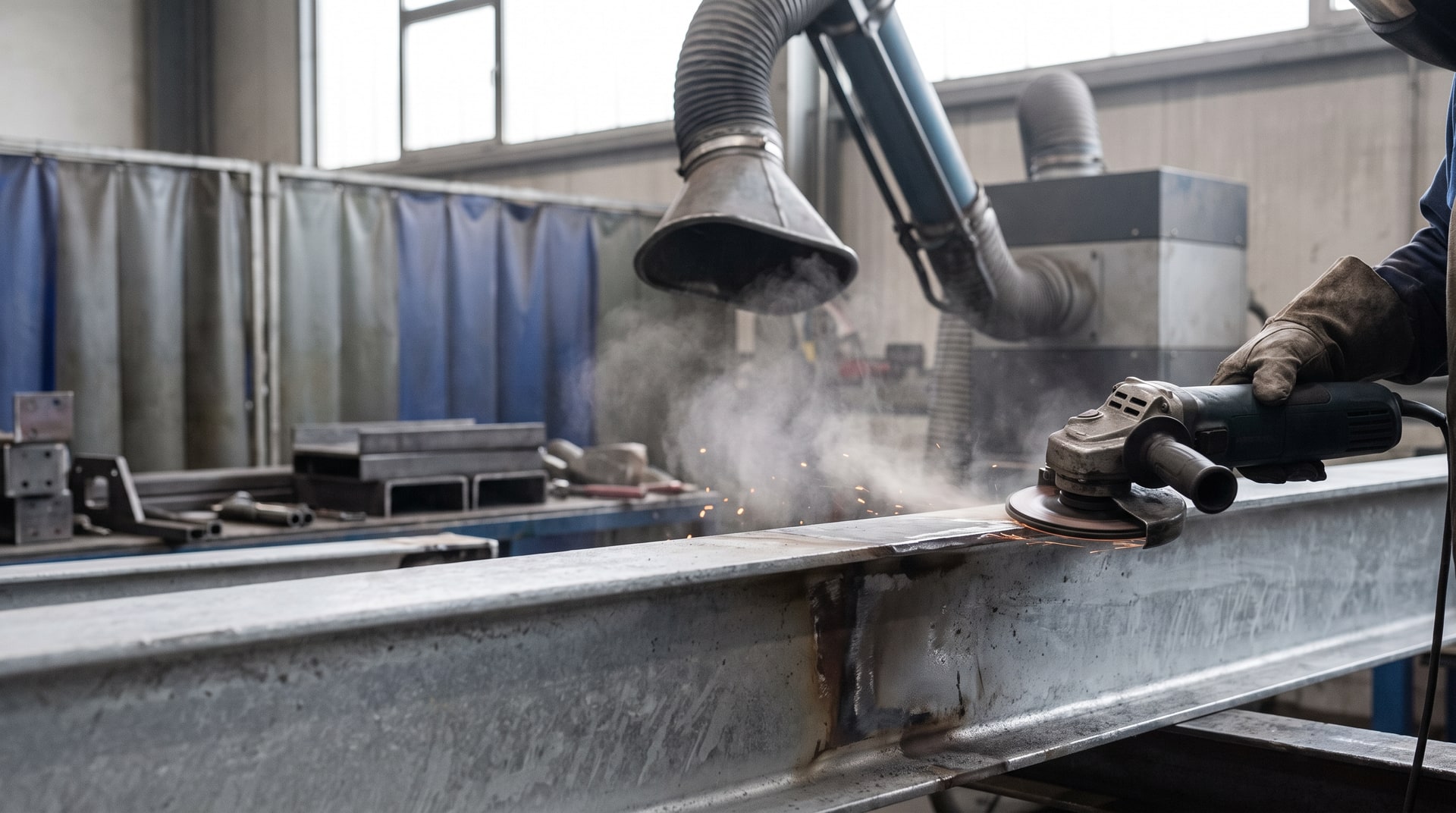
Grinding is identified as the most effective method for removing the galvanized coating prior to welding. Angle grinders with appropriate abrasive wheels can remove both the outer pure-zinc layer and the zinc-iron alloy layers beneath it efficiently. The goal is to expose clean steel across the full clearance width before the first arc is struck.
What Happens to the Coating at and Near the Weld
Even with proper zinc removal in the weld zone, the heat generated during welding affects the galvanized coating in the surrounding area. All welds on galvanized surfaces destroy the zinc coating directly at the weld site and damage the coating adjacent to the weld. This is an unavoidable consequence of the heat involved, and it means that a completed weld on a galvanized member will always leave some zone of compromised or absent corrosion protection.
That compromised zone matters a great deal from a long-term performance perspective. Zinc's primary protective mechanism is galvanic, meaning it sacrifices itself preferentially to protect adjacent steel. But that galvanic protection has a limited range. Small bare areas can be protected by the surrounding zinc, but larger damaged zones need active restoration to maintain the corrosion resistance that the original galvanized coating was specified to provide.
Restoring the Coating After Welding: ASTM A780 Requirements
Once welding is complete, the protective coating must be restored at every location where it has been removed or damaged. This is not optional, and it is not a cosmetic consideration. The restoration requirement exists because the bare steel exposed at and around the weld will corrode at the same rate as unprotected carbon steel if left untreated.
Restorations must be carried out in accordance with ASTM A780. This standard specifies acceptable repair methods and materials, with paint containing zinc dust being the primary permitted product for field repair situations. The zinc-rich paint must be applied to achieve the film thickness required by the standard. Zinc-rich coatings work by the same galvanic mechanism as the original hot-dip coating: the zinc particles in the paint are in electrical contact with one another and with the underlying steel, allowing sacrificial protection to function even from a paint film.
It is worth noting that zinc-rich paint repair is not equivalent in performance to the original hot-dip galvanized coating, which provides a metallurgically bonded, dense zinc layer. The repair is a functional compromise that restores a meaningful level of protection, but structural members in aggressive environments may warrant closer inspection intervals after field-welded repairs.
Fume Hazards: Understanding What You Are Actually Breathing
The health dimension of welding galvanized steel deserves serious attention. Fumes from welding galvanized steel can contain zinc, iron, lead, and other potentially toxic substances. The specific composition and concentration of those fumes depends on the base metal chemistry, the zinc coating itself, the welding current, the voltage, and the process type being used.
This variability is part of why quantifying the health effects of galvanized welding fumes has been difficult to pin down with certainty. Studies on human exposure present contradictory and often inconclusive results, and that is not simply because the science is weak. Working conditions vary enormously even within the same welding process. A welder's posture alone can make a significant difference: someone working with their head directly in the fume plume is exposed to far higher concentrations than someone positioned to the side of it. Something as specific as whether a welding helmet covers the front of the neck can change exposure levels meaningfully.
Allied thermal processes carry similar risks. Oxyfuel heating and cutting, plasma-arc cutting, and air-arc gouging all generate fumes and gases when applied to galvanized steel. The precautions that apply to arc welding apply equally to these processes.
Metal Fume Fever: Recognizing and Preventing Zinc Overexposure
Overexposure to zinc oxide fumes during welding can cause a condition commonly called metal fume fever, sometimes referred to in the trades as zinc chills, zinc shakes, or galvanize poisoning. It is one of the better-documented occupational health effects associated with welding galvanized steel, and fabricators and their workers should know what it looks and feels like.
The illness typically begins a few hours after exposure, more often during the evening or night following the workday rather than immediately. Symptoms include a sweet or metallic taste in the mouth, dryness of the throat, fatigue, nausea, vomiting, chills, and fever that rarely exceeds 102 degrees Fahrenheit. Most affected workers recover fully within 24 to 48 hours. While repeated exposure to moderate concentrations of zinc oxide has not been shown to cause permanent harm, that does not mean overexposure should be treated as acceptable. The discomfort alone is significant, and concentrations high enough to trigger symptoms should be eliminated through engineering controls rather than tolerated.
The relevant standard for detailed precautionary guidance is ANSI/ASC Z49.1, Safety in Welding, Cutting and Allied Processes. This document covers personnel protection, ventilation requirements, fire prevention, and confined space procedures. Anyone cutting or welding metals that contain zinc or lead should consult it before work begins.
Ventilation Strategies That Actually Work
Good ventilation is the primary engineering control for managing fume exposure during galvanized steel welding, and the type of ventilation matters as much as its presence. Simply opening a door is not a ventilation strategy for this application.
Dilution ventilation using fans can reduce contaminant concentrations by mixing clean air with fume-laden air, but it has limits. In situations where a welder is stationary and a fume exhaust hood is positioned overhead, the smoke may rise through the welder's breathing zone before reaching the hood capture area. This is why source-capture ventilation is more effective than general dilution in most shop welding scenarios. A source extractor draws fumes away from the weld area before they can disperse upward into the breathing zone. Gun-mounted fume extractors positioned near the tip of the welding gun offer the most immediate capture and preserve the welder's range of motion at the same time.
Confined spaces create a categorically different level of risk. Workers welding in deep open tanks should have a positive air supply directed into the space by a fan or blower, positioned below the worker's breathing level. In truly enclosed spaces such as pressure vessels or closed tanks, each worker must be equipped with an approved air-supplied respirator. These are not situations where portable exhaust hoods are adequate substitutes. OSHA regulations govern all of these scenarios, and fabricators are responsible for identifying the applicable hazards and training workers to operate within compliant conditions.
When adequate ventilation simply cannot be provided for a given situation, workers must be equipped with hose masks or air respirators before work begins. There is no acceptable middle ground here.
Applying These Principles on Real Projects
The practical sequence for field-welding galvanized structural members can be summarized by what the standards require at each stage. Before welding: grind the zinc coating a minimum of 1 to 4 inches from each side of the weld on both faces of the workpiece. Confirm ventilation is adequate for the space. Ensure workers have appropriate respiratory protection if ventilation cannot meet requirements. During welding: follow standard welding procedures appropriate for the base steel, recognizing that weld quality is directly tied to how cleanly the zinc was removed. After welding: restore the coating at all damaged and removed areas in accordance with ASTM A780 using zinc-rich paint or other permitted products to the required film thickness.
One common field misconception is that the zinc will simply burn off during welding and that removal beforehand is unnecessary extra work. In reality, the residual zinc volatilizing during the weld is precisely what causes porosity, spatter, and hazardous fume concentrations. Pre-removal is not a redundancy; it is what allows a sound, inspectable weld to be made at all.
Work With a Team That Understands the Full Picture
Welding galvanized steel is a manageable process when it is planned properly and executed with discipline around preparation and safety. The standards that govern it exist because the interaction between arc welding and zinc coatings creates real risks, both to weld quality and to worker health. Following the AWS D19.0 specification, removing zinc to the required clearance distance, restoring the coating per ASTM A780, and managing fume exposure through engineering controls and respiratory protection are the framework that makes galvanized welding work reliably and safely. None of these steps should be treated as optional on a project where the original specification called for hot-dip galvanized protection for a reason.
If you have questions about how fabrication welding interacts with your galvanizing specification, or if you need guidance on restoration requirements for a specific project, our team is glad to help. Reach out through our contact page and we will connect you with the right technical resource.
Frequently Asked Questions About Welding Galvanized Steel
How much zinc coating needs to be removed before welding galvanized steel?
The AWS D19.0 specification requires removing the zinc coating at least 1 to 4 inches from either side of the intended weld, and this removal must be done on both sides of the workpiece. Grinding is the most effective method for achieving clean, zinc-free steel in the weld preparation zone.
Does welding galvanized steel produce a structurally sound weld?
Yes, if the zinc has been properly removed prior to welding. Zinc remaining in the weld zone causes porosity, spatter, and incomplete fusion in the weld bead. Removing the coating to the required clearance distance before striking an arc is what allows a sound, full-penetration weld to be achieved.
What standard governs coating restoration after welding galvanized steel?
ASTM A780 governs the repair and restoration of damaged or removed hot-dip galvanized coatings. After welding, all areas where the zinc coating has been destroyed or damaged must be restored using paint containing zinc dust or other products permitted under that standard, applied to the film thickness the standard requires.
What is metal fume fever and how does it relate to galvanized welding?
Metal fume fever is an acute condition caused by overexposure to zinc oxide fumes generated when welding galvanized steel. Symptoms typically appear several hours after exposure and include a sweet metallic taste, sore throat, fatigue, nausea, chills, and fever not usually exceeding 102 degrees Fahrenheit. Most cases resolve within 24 to 48 hours. It is prevented through adequate ventilation and respiratory protection.
Is general shop ventilation enough when welding galvanized steel?
General dilution ventilation may be insufficient in many configurations, particularly when overhead exhaust hoods allow fumes to pass through the welder's breathing zone before capture. Source-capture ventilation, including gun-mounted fume extractors positioned near the weld tip, provides more reliable protection. In confined spaces, a positive air supply or approved air-supplied respirator is required.
Does zinc-rich paint repair restore the same corrosion protection as the original galvanized coating?
Not exactly. Zinc-rich paint repairs work by the same galvanic mechanism as hot-dip galvanizing, protecting the underlying steel sacrificially. However, the original hot-dip coating is metallurgically bonded and denser. Field paint repair per ASTM A780 is an appropriate and specified restoration method, but members in aggressive environments may benefit from closer inspection intervals at repaired weld zones.
What safety standard covers detailed fume precautions for galvanized steel welding?
ANSI/ASC Z49.1, Safety in Welding, Cutting and Allied Processes, is the primary reference for safety precautions when welding or cutting metals that contain zinc or lead. It covers personnel protection, ventilation design, fire prevention, and confined space requirements. It should be consulted before beginning any work on galvanized or zinc-coated steel.
Do cutting processes like plasma-arc cutting also produce hazardous fumes on galvanized steel?
Yes. Allied thermal processes including oxyfuel heating and cutting, plasma-arc cutting, and air-arc gouging all generate fumes and gases when applied to galvanized steel. The same ventilation controls and respiratory protection requirements that apply to arc welding apply equally to these cutting and heating operations.
