

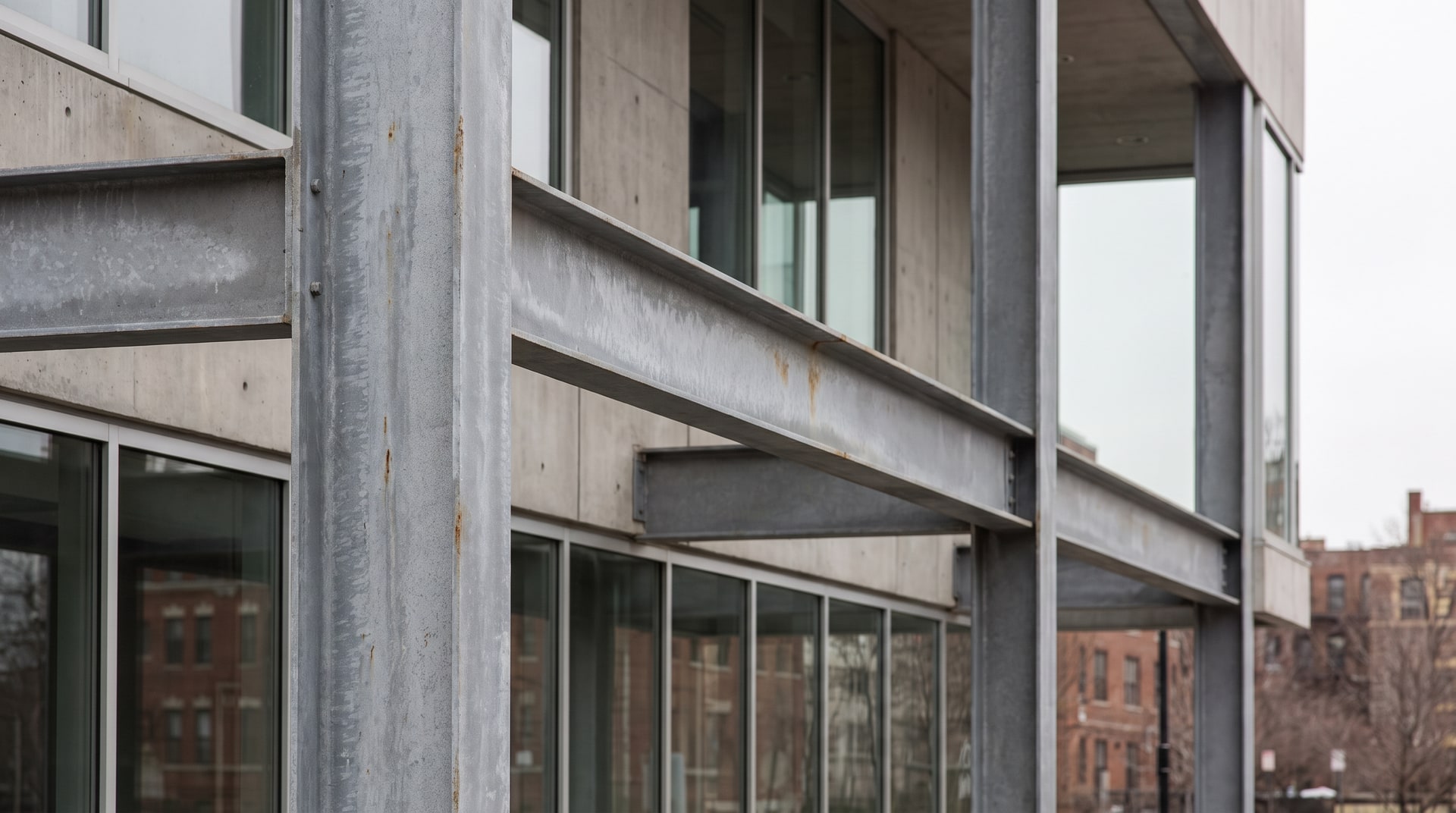
When architects and structural engineers first encounter hot-dip galvanized steel in an architecturally exposed context, they often wrestle with a fundamental question: what will this actually look like in five years? The initial appearance of freshly galvanized steel can range from bright, almost mirror-like silver to a patchwork of darker matte zones, and in some cases both finishes exist side by side on structurally identical pieces pulled from the same galvanizing bath. For anyone specifying Architecturally Exposed Structural Steel, that variability can feel like a liability rather than an asset.
The American Galvanizers Association addresses this directly in their article on maximizing HDG aesthetics for AESS projects. At V&S Galvanizing, we expand on that foundation to explain what is actually happening at the material level, how zinc patina development influences long-term appearance, and why the initial surface variation that concerns so many specifiers is often misunderstood in the field.
Why Freshly Galvanized Steel Looks the Way It Does
The appearance of a newly galvanized coating is shaped by several interacting variables: the silicon and phosphorus content of the base steel, the rate at which the part cools after withdrawal from the zinc bath, and any mechanical stress introduced during rolling or fabrication. These factors influence whether the coating solidifies with a bright, crystalline structure or takes on a darker, more reactive matte finish tied to the growth of iron-zinc alloy layers through the coating cross-section.
This is not a defect. It is a consequence of how zinc metallurgy works. Steel with certain reactive chemistries tends to develop a thicker, alloy-dominant coating with less free zinc at the surface, producing a darker initial appearance. Steel with a more galvanizing-friendly composition produces the spangle-patterned bright finish most people associate with new galvanizing. When both types of steel are welded into the same assembly, the result is a mixed appearance after coating, even when every process step was performed correctly.
The critical point for AESS planning is that this variability is front-loaded. The coating is doing exactly what it is supposed to do metallurgically. And the appearance divergence is temporary.
The Natural Weathering Process and What the Patina Actually Is
Once galvanized steel is installed and exposed to the environment, a predictable transformation begins. Atmospheric moisture initiates a series of chemical reactions at the zinc surface. Zinc oxide forms first, followed by zinc hydroxide, and over time these convert to zinc carbonate in the presence of carbon dioxide. It is the zinc carbonate layer, sometimes called the zinc patina, that gives weathered galvanized steel its characteristic soft, flat, medium-gray appearance.
This patina is not just cosmetic. It is chemically stable and relatively insoluble, which is precisely why it slows further corrosion of the underlying zinc so effectively. But for the purposes of AESS planning, what matters is its optical uniformity. Because the patina forms across the entire exposed surface through the same atmospheric chemistry, it levels out differences in the underlying coating structure. Zones that were bright and crystalline and zones that were dark and matte both converge toward the same visual result.
According to AGA guidance, this uniform matte gray appearance typically develops within six months to two years depending on the exposure environment. In wetter climates with more frequent wet-dry cycling, patina development tends to accelerate. In drier or sheltered environments, the timeline extends. Either way, the endpoint is the same: a consistent, low-gloss gray surface across the entire structure.
What This Means for Visual Samples and Aesthetic Benchmarks
The AISC and CISC categorical frameworks for AESS require visual samples for AESS 3 and AESS 4 elements, and list them as optional for AESS 2. Samples are genuinely useful for evaluating the galvanizer's and fabricator's capabilities around smoothness, dimensional tolerances, and coating quality. Where they become problematic is when they are treated as binding color or finish standards for every piece in the project.
It is technically impractical to expect a precise appearance match across all galvanized members in a large project. Even pieces galvanized simultaneously from the same steel heat can produce different initial finishes. Specifying that every member must match a sample taken on a particular day creates an impossible standard and puts galvanizers in a position where they cannot succeed regardless of process quality.
The better framing is to use visual samples as evidence of process capability and coating quality rather than as a color chip. If the sample demonstrates smooth handling, adequate corrosion protection, acceptable surface condition under ASTM A123, and appropriate treatment of welds and edges, it has served its purpose. The aesthetic uniformity that ties everything together will arrive on its own timeline after installation.
AESS Categories and How the Weathering Timeline Should Inform Specification
The AISC and CISC categorical approach assigns different appearance requirements based on viewing distance and the functional role of the steel element. AESS 1 covers basic structural members not prominently visible; AESS 2 addresses feature elements seen from more than 20 feet; AESS 3 covers elements within 20 feet of the viewer; and AESS 4 applies to showcase elements intended for close-up viewing and touch. A fifth designation, AESS C, allows fully custom requirements written into the contract documents.
Understanding patina development should directly shape how these categories are applied across a project. For elements specified at AESS 1 or AESS 2 that will be viewed from a distance, the natural weathering process is especially forgiving. Initial appearance variation is less perceptible at distance, and the convergence to uniform gray over the first one to two years of service means that any early-stage patchiness effectively disappears from view. Requiring extensive surface smoothing or costly detailing for high-mounted AESS 2 elements is difficult to justify when weathering accomplishes much of the visual harmonization at no additional cost.
For AESS 3 and AESS 4 elements, the calculus shifts. Elements viewed within 20 feet, or designed to be touched, will be scrutinized before weathering completes. In those cases, additional fabrication detailing (blended welds, filled surfaces, smooth thermally cut edges) and galvanizer process controls are warranted and the cost premiums in the AESS framework reflect that. But even here, patina development should be part of the project narrative. If the owner or design team understands that the finish will continue to evolve and improve visually over the first year or two, early-stage inspections can be evaluated in proper context.
| Category Characteristics | AESS 4 Showcase Elements | AESS 3 Feature Elements <20 ft | AESS 2 Feature Elements >20 ft | AESS 1 Basic Elements |
|---|---|---|---|---|
| General Cost Premium | 100-150% | 40-75% | 25-30% | 10-20% |
| Steel surface prep SSPC-SP 6 | X | X | X | X |
| Sharp edges ground smooth | X | X | X | X |
| Continuous weld appearance | X | X | X | X |
| Standard structural bolts | X | X | X | X |
| Weld spatters removed | X | X | X | X |
| Visual samples | X | X | Optional | +5-25% |
| One-half standard fabrication tolerances | X | X | X | +5-15% |
| Fabrication marks not apparent | X | X | X | +5-15% |
| Welds uniform and smooth | X | X | X | +5-15% |
| Mill marks removed | X | X | +5-15% | +5-15% |
| Butt and plug welds ground smooth and filled | X | X | +5-10% | +5-10% |
| HSS weld seam oriented for reduced visibility | X | X | +1-5% | +1-5% |
| Cross-sectional abutting surface aligned | X | X | +5-15% | +5-15% |
| Joint gap tolerances minimized | X | X | +5-10% | +5-10% |
| All welded connections | Optional | Optional | +15-30% | +15-30% |
| HSS seam not apparent | X | +5-20% | +5-20% | +5-20% |
| Welds contoured and blended | X | +25-40% | +25-40% | +25-40% |
| Surfaces filled and sanded | X | +30-50% | +30-50% | +30-50% |
| Weld show-through minimized | X | +5-20% | +5-20% | +5-20% |
| Special care in fabrication and erection | X | X | X | X |
| Finish: Galvanizing | +20-40% | +20-40% | +20-40% | +20-40% |
Steel Chemistry, Mixed Materials, and Managing Appearance Variation at the Source
Because patina development eventually unifies the surface appearance, it can be tempting to assume material selection does not matter much for AESS projects. That assumption creates problems during construction and in the early post-installation period when the building is most likely to be photographed and evaluated by owners and design teams.
Combining steels of meaningfully different chemistry or thickness in the same fabricated assembly tends to produce the most dramatic initial appearance contrast. Heavy plates welded to thin-walled hollow sections, for example, may react to the zinc bath quite differently. One section develops a matte alloy-heavy coating while the adjacent section produces a bright, spangle-rich surface. Even with patina development as a long-term equalizer, this kind of contrast can persist through a full season of weathering in low-humidity environments.
The practical mitigation is to address this before galvanizing. Where mixed material conditions are unavoidable, specifying abrasive blasting of all surfaces prior to hot-dip galvanizing reduces the influence of surface chemistry on initial coating appearance by establishing a uniform surface profile. Alternatively, components of significantly different steel chemistries or thicknesses can be sent to the galvanizer separately to allow some degree of process optimization for each group, then assembled after coating. Working directly with the galvanizing plant during the design phase to identify these conditions early is substantially more cost-effective than attempting to address appearance issues after the fact.
Wet Storage Stain: A Common Source of Aesthetic Concern That Resolves on Its Own
One surface condition that sometimes alarms specifiers and owners at the point of delivery is wet storage stain. This appears as a white or gray powdery deposit on the zinc surface, caused by moisture trapped between stacked galvanized parts during storage or transit. The zinc surface reacts with the trapped moisture in the absence of sufficient air circulation, producing zinc hydroxide and zinc oxide compounds that accumulate on the surface.
Light to medium wet storage stain does not compromise corrosion protection. The underlying zinc coating remains intact and the protective mechanism is unaffected. For aesthetic purposes, it can be removed using commercially available cleaning solutions applied with a stiff nylon brush. But it is also worth knowing that wet storage stain will weather away and blend with the developing patina over the same six-month to two-year window as other initial appearance variation. In many cases, particularly for AESS 1 and AESS 2 elements or parts not visible at close range, removal before installation is optional rather than mandatory.
The more important step is storage practice after acceptance. Keeping parts separated and well-ventilated, avoiding ground contact, and protecting against sustained moisture exposure during the interval between delivery and installation significantly reduces wet storage stain development and the associated aesthetic concerns at delivery inspection.
Touch-Up, Repair, and the Long-Term Appearance of Repaired Areas
When galvanized coating is damaged at the fabrication facility or during erection, repair is required, and the repair material chosen has lasting implications for appearance. Zinc-rich paint, zinc-based solder, and zinc spray metallizing are all acceptable repair methods under standard specifications, but they behave differently from a visual standpoint at the time of application.
Zinc spray metallizing and zinc-based solder tend to produce an appearance closer to the original hot-dip coating surface. Zinc-rich paint, depending on formulation and color, may initially create a visible mismatch, particularly if the surrounding HDG coating is still in its bright or partly matte phase. However, this distinction diminishes as weathering proceeds. All hot-dip galvanized surfaces move toward the same matte gray endpoint, and a repair area finished with a gray or weathered-tone zinc-rich paint will integrate visually once the base coating begins to patina.
One specific choice to avoid is silver or bright-tone zinc-rich repair paint. Unlike the gray-toned formulations, a silver repair paint will remain visually distinct after the surrounding galvanizing weathers to matte gray because the paint surface does not go through the same atmospheric chemistry. This creates a permanent visual discontinuity at the repair location, which is obviously problematic for AESS elements. For any exposed repair on AESS 3 or AESS 4 elements, gray matte zinc-rich paint or metallizing is the appropriate choice.
Process Controls That Support Better Initial Appearance Before Weathering Does Its Work
The galvanizer has several levers available to improve initial coating appearance on AESS work, independent of steel chemistry. Hanging parts at the highest practical angle during immersion improves zinc drainage and reduces the likelihood of runs and drips freezing into the surface. Immersing parts quickly into the bath and withdrawing slowly also supports a more even coating. Keeping parts well above the dross layer at the bottom of the kettle prevents dross inclusions that create surface roughness.
Some galvanizers use elemental additions to the zinc bath, such as nickel or bismuth, that improve zinc fluidity and surface drainage. These additions can reduce surface roughness and improve overall coating uniformity. They are not universally applicable, particularly for steels outside the recommended compositional range for reactive galvanizing, but they are worth discussing with the galvanizer during project planning when appearance is a priority.
The key practical point is that these conversations need to happen before bidding, not after. If specific process optimizations are expected, they need to be part of the scope and priced accordingly. A pre-job meeting that brings together the galvanizer, fabricator, and general contractor to walk through appearance requirements, process commitments, and responsibility assignments is one of the most effective tools available for closing the gap between specification intent and finished result.
Work With a Team That Understands Appearance as a Long-Term Material Property
Hot-dip galvanized steel for AESS projects is not a static material. Its appearance at the point of delivery is a starting condition, not the finished state. Architects, specifiers, and owners who understand that the zinc surface is actively evolving toward a stable, uniform matte gray are far better positioned to write realistic specifications, conduct fair acceptance inspections, and communicate credibly with building owners about what to expect in the months after installation.
At V&S Galvanizing, we work with design teams, fabricators, and contractors on AESS projects that require this kind of integrated thinking about process, material behavior, and long-term aesthetics. If you are planning a galvanized AESS project and want to talk through specification strategy, material selection, or process controls before fabrication begins, reach out through our contact page and we will connect you with our technical team.
Frequently Asked Questions About HDG Steel Weathering and AESS Aesthetics
How long does it take for hot-dip galvanized steel to develop a uniform matte gray patina?
According to AGA guidance, the uniform matte gray zinc carbonate patina typically develops within six months to two years after installation, depending on the exposure environment. Wetter climates with more frequent wet-dry cycling accelerate patina development. Sheltered or arid environments extend the timeline, but the eventual result is the same consistent flat gray appearance across the entire structure.
Why do identical galvanized pieces sometimes come out looking different from each other?
Even pieces galvanized simultaneously from the same steel heat can produce different initial finishes. The coating appearance is driven by variables including the silicon and phosphorus content of the steel, cooling rate after withdrawal from the zinc bath, and mechanical stress from prior fabrication. These factors influence how iron-zinc alloy layers develop through the coating cross-section, producing a range of initial appearances from bright and crystalline to darker matte finishes. This variability diminishes as weathering progresses.
Should visual samples be used as binding color standards for AESS galvanizing projects?
No. Visual samples are useful for evaluating process capability, coating smoothness, and overall quality, but it is not technically feasible to guarantee an exact appearance match across all galvanized members in a project. Treating samples as precise color benchmarks creates unrealistic acceptance criteria. Samples should be used to confirm that the galvanizer and fabricator can meet the required quality level, while understanding that aesthetic uniformity across the project will develop naturally through weathering after installation.
What is wet storage stain and does it affect long-term appearance?
Wet storage stain is a white or gray powdery deposit that forms on galvanized surfaces when moisture becomes trapped between stacked parts during storage or transit. Light to medium wet storage stain does not reduce corrosion protection. For aesthetic purposes it can be cleaned off with commercially available solutions, but it will also weather away and blend with the developing zinc patina over the same six-month to two-year period as other initial appearance variation. Proper storage with good air circulation and separation between parts prevents most wet storage stain from forming.
What is the right repair material for touch-up on AESS galvanizing when appearance matters?
For AESS elements where long-term appearance consistency is important, avoid bright silver or high-gloss zinc-rich repair paints. These will remain visually distinct after the surrounding hot-dip galvanized surface weathers to matte gray, creating a permanent mismatch. Zinc metallizing and zinc-based solder more closely match HDG appearance immediately. Matte gray or weathered-tone zinc-rich paint is an acceptable alternative that will blend visually once the base coating develops its patina. The repair paint color choice matters significantly for any exposed AESS 3 or AESS 4 element.
How should the AESS category system guide decisions about where to invest in surface detailing?
The AESS categorical approach exists precisely to prevent over-specifying in areas where it does not matter. AESS 1 and AESS 2 elements viewed from a distance or installed high overhead do not warrant the same level of surface detailing as close-viewed AESS 3 or AESS 4 showcase elements. Because weathering produces visual uniformity over time, high-mounted members with initial surface variation will look consistent with neighboring members well before the building is a few years old. Concentrating AESS 3 and AESS 4 detailing budgets on elements that will actually be scrutinized at close range is both technically sound and cost-effective.
How does combining steels of different chemistry affect the initial appearance of a galvanized AESS assembly?
Steels with significantly different silicon or phosphorus content react differently to the zinc bath and produce coatings with different thicknesses and surface characteristics. When two such steels are fabricated into the same assembly, the result after galvanizing is typically a mixed appearance, with some sections appearing bright and others appearing darker and more matte. Specifying abrasive blasting of all surfaces prior to galvanizing reduces the influence of steel chemistry on initial appearance by standardizing surface condition. Alternatively, dissimilar sections can be galvanized separately and assembled after coating, though this requires careful coordination with the galvanizer and fabricator.
What process controls can a galvanizer use to improve initial coating appearance on AESS work?
Galvanizers can improve initial AESS coating appearance by hanging parts at the steepest practical angle to promote drainage, immersing parts quickly and withdrawing slowly to reduce surface disturbance, and keeping parts well above the dross layer to prevent inclusions. Some galvanizers use elemental bath additions such as nickel or bismuth to improve zinc fluidity and surface smoothness. These measures should be discussed and agreed upon with the galvanizer during the bid phase, as they involve additional effort and cost that should be scoped into the project from the start.
