

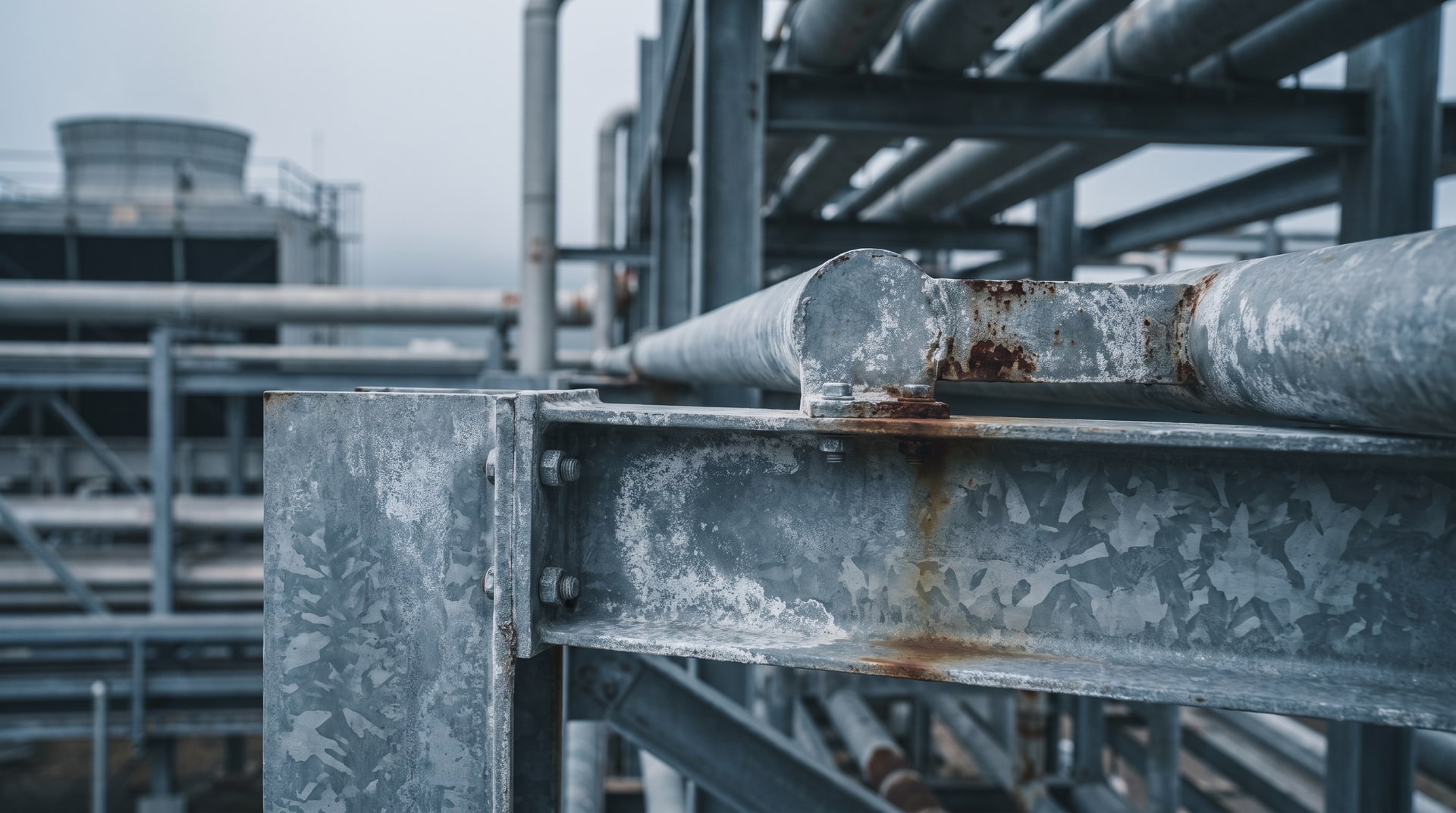
Not every project sits in a clean, neutral environment. Steel specified for wastewater infrastructure, chemical processing facilities, fertilizer plants, or coastal industrial sites has to contend with solutions that may be strongly acidic, moderately alkaline, or somewhere in between depending on the process and season. In those conditions, the question engineers and specifiers often ask is not simply whether galvanized steel will hold up, but how quickly the coating will degrade and whether the expected service life justifies the investment.
The answer depends heavily on one variable that is frequently underweighted during material selection: the pH of the surrounding environment. The American Galvanizers Association addresses this directly in their article on galvanized steel performance and the pH curve. At V&S Galvanizing, we expand on that foundation to explain what is actually happening at the material level, how pH influences zinc corrosion behavior, and why this relationship is often misunderstood or overlooked in the field.
What pH Actually Measures and Why Zinc Responds to It
pH is a measure of hydrogen ion concentration in a solution. The scale runs from 0 to 14, with 7 representing neutral. Acidic solutions sit below 7 and carry a high concentration of hydrogen ions. Alkaline (or basic) solutions sit above 7 and carry a relatively low concentration of those ions. This distinction matters because the solubility of many compounds, including zinc oxides, changes significantly depending on where a solution falls on that scale.
When galvanized steel is exposed to most environments, the outer zinc surface reacts with atmospheric oxygen to form zinc oxide. That oxide layer is the beginning of a progressively more stable patina that, under typical conditions, develops over weeks or months into zinc carbonate, sometimes called the gray patina familiar on older galvanized structures. This carbonate layer is chemically stable and relatively insoluble, which is precisely what gives galvanized steel its long-term durability in most outdoor environments.
The complication with zinc oxide, however, is that it is amphoteric. That is a specific chemical term meaning a compound can behave as either an acid or a base depending on the pH of the surrounding solution. In acidic conditions, zinc oxide dissolves because it reacts with hydrogen ions. In strongly alkaline conditions, it dissolves by reacting with hydroxide ions. In both cases, the protective layer is compromised, and the underlying zinc becomes vulnerable. This dual solubility is why pH at both extremes, not just acidic conditions, presents a corrosion risk.
The Performance Window: pH 5.5 to 12
Based on established electrochemical behavior and field data, galvanized steel performs best in environments with a pH between 5.5 and 12. Within that range, the zinc oxide and zinc carbonate layers that form on the surface remain relatively stable. Corrosion rates stay low, and coating thickness is consumed slowly enough to support decades of service life depending on conditions and initial coating thickness.
Outside that window, the situation changes. In the pH range of 3 to 5.5 on the acidic side, or between 12 and 13.5 on the alkaline side, galvanized steel becomes increasingly vulnerable. The coating is still providing some corrosion protection to the base steel, but the rate of zinc consumption accelerates. In practical terms, this means a coating that might last 40 or 50 years in a neutral atmospheric environment could be reduced to a few years of effective protection under those more aggressive chemical conditions.
This does not necessarily disqualify galvanized steel from these applications. It does, however, require a more deliberate approach to specifying service life expectations and considering supplemental protection where longer performance is required.
How Coating Thickness Translates to Service Life in Aggressive Environments
One of the most useful ways to understand the pH-corrosion relationship in practical terms is to think about it alongside coating thickness. Galvanized coatings are specified in mils (thousandths of an inch) or microns, and the service life of the coating is, in broad terms, proportional to how much zinc is present to be consumed.
The AGA provides a concrete illustration of this principle. Consider a 4-mil thick coating in an acidic environment. At a pH of approximately 3.5, that coating provides roughly five times more service life than the same coating at a pH of approximately 2.5. The corrosion rate increases steeply as pH drops below 4, which means even modest changes in solution chemistry at the low end of the scale can have an outsized effect on how quickly a coating is depleted.
This is why field conditions that fluctuate, such as intermittent acid exposure, washdown cycles with cleaning chemicals, or drainage patterns that concentrate acidic runoff, deserve careful evaluation rather than a simple pass-or-fail based on average pH. A 4-mil coating might tolerate occasional dips into the 4 to 5 range without significant penalty, but sustained exposure below 4 changes the calculus entirely.
| pH Range | Environment Type | Galvanized Steel Performance | Recommendation |
|---|---|---|---|
| Below 3 | Strongly acidic | Rapid corrosion of zinc coating | Not recommended; use stainless steel or polymers |
| 3 to 5.5 | Moderately acidic | Corrosive; coating provides limited protection, lasting only a few years | Duplex system (galvanizing + acid-resistant paint or epoxy) if long service life needed |
| 5.5 to 12 | Near-neutral to mildly alkaline | Best performance; zinc patina stable, low corrosion rate | Galvanized steel recommended |
| 12 to 13.5 | Strongly alkaline | Corrosive; coating provides limited protection, lasting only a few years | Duplex system (galvanizing + base-resistant paint or epoxy) if long service life needed |
| Above 13.5 | Extremely alkaline | Rapid corrosion of zinc coating | Not recommended; use stainless steel or polymers |
Where Galvanized Steel Should Not Be Used: Below pH 3 and Above pH 13.5
At pH values below 3 or above 13.5, galvanized steel is not a recommended solution. In these extreme environments, the zinc coating corrodes rapidly, meaning it offers very little protection before being consumed entirely. The underlying steel is then exposed with no sacrificial barrier remaining. For applications involving strongly acidic solutions such as hydrochloric or sulfuric acid at high concentrations, or strongly caustic solutions such as concentrated sodium hydroxide, alternative materials are necessary.
Stainless steel and polymer-based systems are the typical alternatives for these conditions. The choice between them depends on other environmental and mechanical factors, including temperature, abrasion, and whether conductivity is a concern. The point is simply that galvanized steel's performance envelope has real boundaries, and designing to those boundaries rather than ignoring them is the engineering discipline that leads to structures that actually perform as intended.
It is worth noting that pH alone does not fully define the corrosion environment for zinc. Acid or base concentration, the degree of agitation or flow velocity, the level of aeration in the solution, temperature, whether polarization effects are present, and whether corrosion inhibitors are in use all interact with pH to determine the actual corrosion rate. A moderately acidic solution at low temperature with low agitation may be far less aggressive than the pH value alone would suggest.
When a Duplex System Is the Right Call
For environments where pH falls in the borderline ranges of 3 to 5.5 or 12 to 13.5, and where multi-decade service life is required, a duplex system is the recommended approach. A duplex system combines the hot-dip galvanizing substrate with an acid- or base-resistant topcoat such as an epoxy coating applied over the cured galvanized surface.
The logic behind this approach is layered protection. The topcoat acts as the primary barrier, blocking contact between the corrosive solution and the zinc. If the topcoat is breached by mechanical damage or a pin hole, the zinc underneath still provides sacrificial cathodic protection to the surrounding steel. The combination of a physical barrier and electrochemical protection produces significantly longer service life than either system alone, and it is far more cost-effective over time than repeated maintenance cycles or early replacement.
Specifying a duplex system also gives designers more confidence when project conditions include some uncertainty. If a process environment might trend toward the lower or upper edge of the acceptable pH window depending on operational variables, building in the redundancy of a duplex coating removes a degree of risk from the design.
Real-World Performance in Chemically Challenging Environments
The theoretical performance curves are important, but field evidence gives them weight. One of the most compelling documented examples is Sterling Chemicals' petrochemical plant in Texas City, Texas. The galvanized pipe racks at that facility had been in service for 30 years at the time of evaluation, and some retained coating thicknesses that still exceeded ASTM minimum requirements for newly galvanized steel. This is in a harsh coastal industrial environment where salt air, process emissions, and humidity combine to accelerate corrosion of many coating systems. The fact that the galvanized coating held that well reflects both the quality of the original application and the value of hot-dip galvanizing in conditions where other systems might require frequent recoating.
Fertilizer plants represent another application where galvanized steel has performed reliably despite concerns about chemical exposure. These facilities handle anhydrous ammonia and phosphate-containing compounds, both of which could raise concerns about long-term material compatibility. The key qualifier is that performance requires the absence of excessive heat and moisture interacting with those chemicals. Under controlled conditions, galvanized steel has proven durable. One example is Joffre Nitrogen Operations in Joffre, Alberta, where the majority of steel structures were erected using hot-dip galvanized steel. Construction completed in 1987, and subsequent evaluations found the structures in excellent condition.
These examples do not suggest that galvanized steel is universally appropriate for chemical environments. They illustrate that when conditions fall within the acceptable pH range and other environmental factors are managed, galvanized steel is not a compromise choice. It is a legitimate long-term solution with a track record to support it.
Chemical Storage: Where the pH Curve Meets Everyday Use
Galvanized steel containers are used extensively for storing and transporting chemical solutions across many industries. The reason this works reliably is that many organic chemicals are relatively pH-neutral. When a stored solution does not push toward acidic or alkaline extremes, the zinc patina remains stable, and the container maintains its integrity without contributing contamination to the stored product.
The reference resource for detailed chemical compatibility is Frank Porter's comprehensive text, "Corrosion Resistance of Zinc," which documents over 600 chemicals that have been successfully stored in galvanized steel containers. This kind of reference is valuable not just for reassurance in familiar applications, but for flagging edge cases where a chemical that seems benign may become corrosive under certain concentration or temperature conditions.
For project teams evaluating new chemical storage applications, the appropriate engineering process involves confirming the pH range of the stored solution, accounting for any concentration or temperature changes that could shift that pH, and comparing those conditions against the known performance window for galvanized steel before committing to the specification.
Misconceptions About Alkaline Environments and Galvanized Steel
The acidic side of the pH scale tends to get most of the attention when engineers discuss corrosion risks for galvanized steel. The alkaline side is often underestimated, possibly because concrete and lime mortar, both alkaline, are generally considered compatible with galvanized steel. That compatibility holds, but only within limits.
Fresh concrete, for example, can have a pH as high as 13 or above. At that level, the zinc surface faces real chemical attack from hydroxide ions. In practice, the recommendation for galvanized steel embedded in or in direct contact with fresh concrete is to allow the concrete to cure before exposure, or to apply a barrier coating on the contact surface. Once concrete has carbonated and its pH drops to the 8 to 11 range, the risk diminishes substantially.
The broader lesson is that amphoteric behavior cuts in both directions. Engineers who are careful about acidic environments but casual about alkaline exposure in the pH 12 to 13.5 range may be underestimating a real risk. The performance curve is symmetric in this regard: both extremes accelerate zinc dissolution, and both deserve the same level of scrutiny during design and specification.
Work With a Team That Understands What the Chemistry Demands
Specifying galvanized steel for chemically active environments is not a matter of checking a box. It requires understanding where the performance boundaries lie, how coating thickness translates to service life under specific pH conditions, when a duplex system adds genuine value, and what field conditions might shift the risk profile over time. Getting those answers right during design avoids expensive surprises during service.
At V&S Galvanizing, we work with engineers, fabricators, and project teams who are navigating exactly these kinds of decisions. Whether a project involves routine atmospheric exposure or a chemically complex industrial environment, our team can help evaluate galvanizing specifications, coating thicknesses, and compatibility with the conditions your steel will actually face. To discuss your project or get technical input on a specific application, reach out through our contact page.
Frequently Asked Questions About Galvanized Steel and pH
What pH range is safe for galvanized steel?
Galvanized steel performs best in environments with a pH between 5.5 and 12. Within this range, the zinc oxide and zinc carbonate patina layers remain stable and corrosion rates are low. Outside this window, particularly below pH 3 or above pH 13.5, the coating degrades rapidly and galvanized steel is not recommended without supplemental protection.
Why is zinc amphoteric and what does that mean for corrosion?
Zinc oxide is amphoteric, meaning it can be dissolved by both acidic and alkaline solutions. In acidic conditions, hydrogen ions attack the oxide layer. In strongly alkaline conditions, hydroxide ions cause the same dissolution. This is why the pH performance window for galvanized steel has limits at both ends of the scale, not just on the acidic side.
How much does pH change the service life of a galvanized coating?
The effect is significant and nonlinear. For a 4-mil thick coating, a shift from pH 3.5 to pH 2.5 reduces service life by approximately five times. Corrosion rates rise steeply as pH drops below 4 or rises above 13, so even modest changes at the extremes can have a disproportionate impact on how quickly the coating is consumed.
When should a duplex coating system be specified instead of galvanizing alone?
A duplex system, combining hot-dip galvanizing with an acid- or base-resistant topcoat such as an epoxy, is recommended when the service environment has a pH between 3 and 5.5 or between 12 and 13.5, and when a long service life is required. The topcoat provides the primary barrier while the underlying zinc continues to offer cathodic protection if the topcoat is breached.
Is galvanized steel suitable for contact with fresh concrete?
Fresh concrete can have a pH above 13, which falls outside the safe range for galvanized steel. Direct prolonged contact with fresh concrete can attack the zinc surface. Standard practice recommends allowing concrete to cure and carbonate to reduce its pH, or applying a barrier coating at the contact surface. Once carbonated, concrete typically stabilizes in the pH 8 to 11 range where galvanized steel performs well.
Does pH fully determine corrosion risk for galvanized coatings?
No. pH is a primary factor but not the only one. Corrosion of galvanized steel is also influenced by the concentration of the acid or base, solution temperature, agitation or flow velocity, aeration levels, polarization effects, and whether corrosion inhibitors are present. A complete evaluation of a chemical environment should account for all of these variables, not pH alone.
What alternative materials are recommended when galvanized steel is not suitable due to pH?
For environments with a pH below 3 or above 13.5, galvanized steel is not recommended due to rapid coating degradation. Stainless steel and polymer-based systems are the typical alternatives in these conditions. The best choice depends on additional factors including temperature, mechanical loading, and whether electrical conductivity is a consideration in the application.
Are there proven industrial examples of galvanized steel performing well in chemically active environments?
Yes. Galvanized pipe racks at Sterling Chemicals' petrochemical plant in Texas City, Texas remained in service for 30 years with coating thicknesses still exceeding ASTM requirements for new galvanized steel, despite a harsh coastal industrial environment. Additionally, hot-dip galvanized structural steel at the Joffre Nitrogen Operations ammonia plant in Alberta, erected in 1987, was in excellent condition on subsequent evaluation.
