

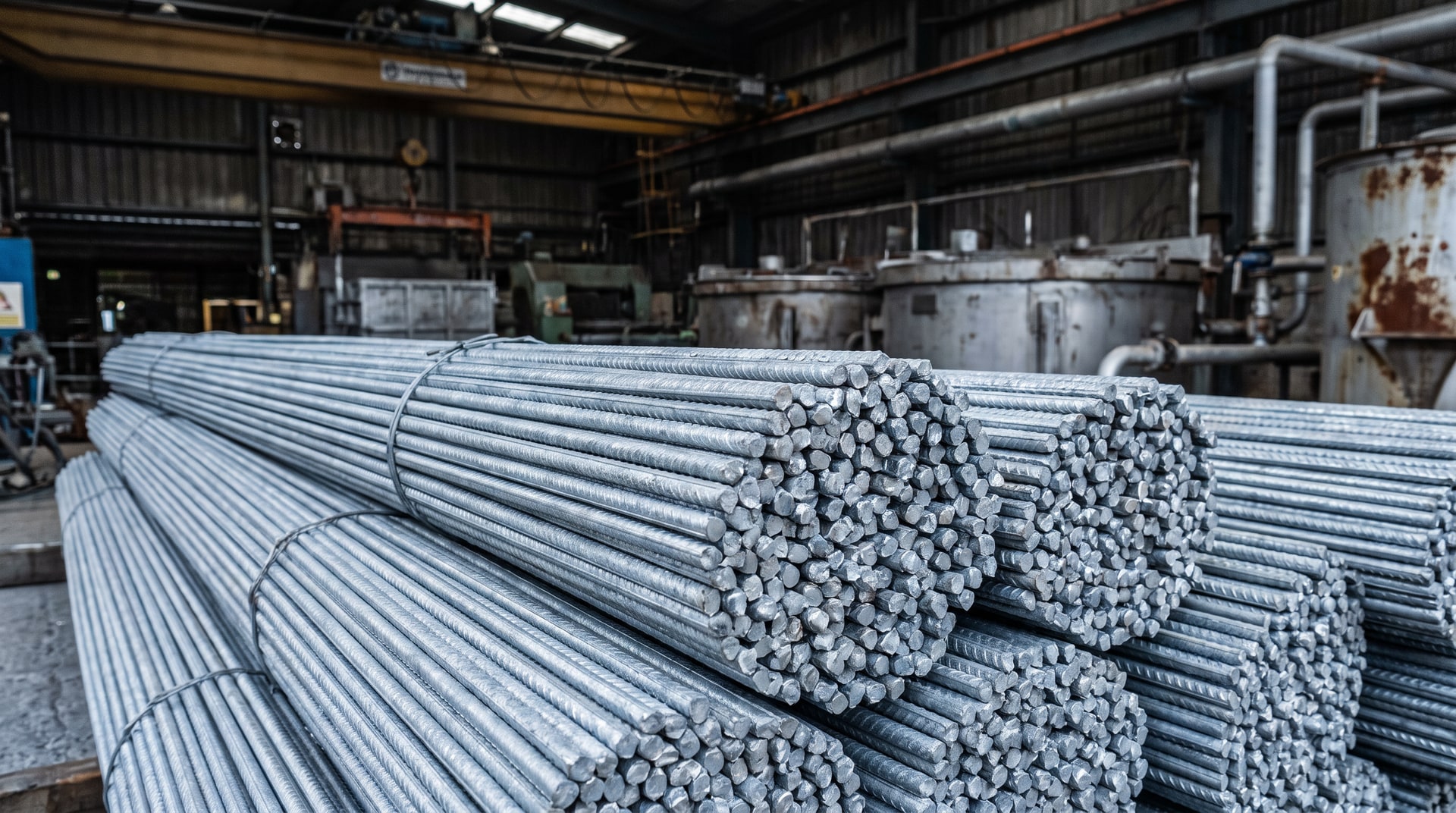
Specifying hot-dip galvanized rebar for bridge decks, parking structures, and other reinforced concrete applications is a well-established strategy for extending service life in corrosive environments. But when galvanized steel meets fresh concrete, a real chemical conversation happens at the interface, and if that conversation goes badly, the consequences show up as reduced bond strength between the rebar and the surrounding matrix. That concern is worth understanding clearly, not dismissing and not overstating.
The American Galvanizers Association addresses this directly in their article on galvanized rebar and reactions in concrete. At V&S Galvanizing, we expand on that foundation to explain what is actually happening at the material level, how concrete pH influences performance, and why the concern about zinc-concrete compatibility is often misunderstood in the field.
The Chemistry Behind the Concern
Fresh concrete is highly alkaline. During the initial curing stages, when the concrete mix is still wet, the pH of the concrete sits at approximately 12.5. At that pH level, zinc behaves as an amphoteric metal, meaning it reacts in both acidic and highly alkaline environments. The wet alkaline environment of fresh concrete is aggressive enough to attack the zinc surface, and that attack generates a byproduct that matters enormously to structural performance: hydrogen gas.
The reaction between zinc and calcium hydroxide in the concrete pore water forms calcium hydroxy-zincate (Ca[Zn(OH)3]2 · 2H2O). This compound does two things. On one hand, it creates a protective layer on the zinc surface that largely stops further corrosion once the concrete hardens. On the other, during the period when it is forming, it releases hydrogen gas at the zinc-concrete interface. That hydrogen evolution is the actual engineering problem, because gas bubbles at the interface disrupt the mechanical bond between the zinc coating and the surrounding concrete matrix.
To be clear about the mechanism: it is not that zinc corrodes catastrophically in concrete. The calcium hydroxy-zincate layer that forms is genuinely protective. The problem is timing. The hydrogen evolves during the wet curing stage, precisely when the bond between rebar and concrete is developing. A more porous, gas-disrupted interface at that stage translates to a weaker bond once the concrete has set.
When pH Becomes the Critical Variable
Not all concrete mixes are equal in this respect. The AGA source is explicit on this point: concrete mixes with a pH above 13.3 have been shown to significantly increase the reactions between concrete and galvanized rebar. Above that threshold, the rate of zinc attack accelerates beyond what would occur in a standard mix at pH 12.5, and the resulting hydrogen evolution can reach levels that create an unacceptably tenuous interface.
This matters practically because certain supplementary cementitious materials, mix proportions, or admixtures can push concrete pH into that upper range. Engineers specifying galvanized rebar should confirm the expected pH of the concrete mix during curing, particularly if the design involves high-alkali cements or specialty admixtures. It is a straightforward pre-construction check that can prevent a real field problem.
Below pH 12.5, the zinc surface actually passivates through a different mechanism. In the pH range of 8 to 12.5, zinc hydroxide forms first, followed by the calcium zinc compound described above. That passivation layer develops and the reaction effectively ceases within a few days of the concrete beginning to cure. The small amount of corrosion product generated in that window is actually beneficial: it provides just enough surface texture and chemical interaction to create a reliable bond when the concrete fully hardens. Tests of bond strength on galvanized rebar have shown performance equal to or slightly better than that of uncoated black rebar.
Chromate Treatment: How It Works and Why It Helps
The standard mitigation for excessive hydrogen evolution is chromate passivation of the galvanized surface. Chromating is applied to galvanized steel immediately after the galvanizing process, and it works by forming a protective gel-like film that physically and chemically limits the attack of alkaline concrete on the zinc surface during curing.
The chemistry is worth explaining in some detail, because it helps clarify why chromate is effective rather than just asserting that it is. Hexavalent chromium reacts with the zinc surface in the presence of acid activators. During this reaction, hexavalent chromium (Cr6+) is partially reduced to trivalent chromium (Cr3+), while zinc is oxidized. The resulting film is a complex mixture, largely composed of hydrated basic chromium chromate (Cr2O3·CrO3·H2O) along with hydrous oxides of chromium and zinc. The trivalent chromium in the film exists as an insoluble hydrated oxide, while the soluble hexavalent chromium fraction gives the coating a self-healing character. When corrosive species such as chloride ions attack the film, the hexavalent chromium can participate in repassivation, restoring the protective layer.
This dual character of the chromate film, combining a stable insoluble matrix with a soluble reactive component, is what makes it effective at slowing the zinc-concrete reaction during curing. By passivating the zinc surface before the concrete is poured, the chromate layer acts as a buffer that limits how rapidly calcium hydroxide can access and attack the underlying zinc.
Application Methods and Dosage Considerations
Chromate can be applied in two ways: directly to the galvanized rebar surface immediately after galvanizing, or as a small addition to the concrete mix itself. Both approaches have been used in practice.
When added to the concrete mix, the question of how much chromate is needed has some variation in the literature. One study cited by the AGA suggests that as little as 20 ppm of chromate in the concrete is sufficient to limit the zinc-concrete reaction. However, the same source recommends providing excess chromate at around 100 ppm to ensure the reaction is reliably controlled. The reasoning is straightforward: 20 ppm represents the minimum threshold observed to be effective, but field conditions involve variability in mixing uniformity, concrete placement, and curing conditions. Providing 100 ppm creates a reasonable safety margin without creating environmental or structural concerns at those concentration levels.
The chromate film applied directly to galvanized steel after processing typically lasts about six weeks before it is consumed through normal weathering and handling. After that window, the steel weathers naturally. For rebar applications, the relevant window is the curing period of the concrete, which is generally completed well within that six-week timeframe. So the natural service life of the chromate passivation layer aligns reasonably well with the protection window required in concrete applications.
What Happens After the Concrete Sets
Once the concrete has fully hardened, the reactive curing phase is over. The calcium hydroxy-zincate layer on the zinc surface is stable, hydrogen evolution has ceased, and the galvanized rebar is effectively encased in a protective matrix. From this point forward, the only pathway for corrosive species to reach the rebar is through the pore structure of the concrete itself.
This is where galvanized rebar demonstrates its long-term value relative to uncoated black rebar. In uncoated steel, corrosion products (iron oxides) occupy significantly more volume than the parent metal. As corrosion advances, those expansive products build pressure against the surrounding concrete. Once that pressure exceeds the tensile strength of the concrete, cracking and spalling follow. The cracks then provide direct channels for additional chloride salts, moisture, and oxygen to accelerate further corrosion. It is a self-reinforcing degradation cycle that is well documented in bridge deck failures and parking structure deterioration.
Zinc corrosion products also occupy more volume than the parent metal, but the behavior at the concrete interface is fundamentally different. Zinc corrosion products disperse into the concrete matrix rather than accumulating as a discrete expansive layer at the rebar surface. The pressure buildup from zinc corrosion products is substantially less than from iron oxides, making cracking and spalling significantly less likely over the service life of the structure. The hot-dip galvanizing process produces a metallurgically bonded zinc coating with the mechanical robustness to remain intact through concrete placement and maintain this protective behavior over decades.
Design Factors That Affect Long-Term Performance
Several concrete design variables influence how the galvanized rebar system performs over its service life, and it is worth knowing which levers matter most.
Water-to-cement ratio has a documented effect: laboratory studies have shown slightly higher corrosion rates of zinc as the water-to-cement ratio of the concrete increases. A higher water-to-cement ratio produces a more porous concrete matrix, which provides easier access for corrosive species to reach the rebar. This is not unique to galvanized systems, of course, but it is worth noting that minimizing water-to-cement ratio benefits galvanized rebar performance for the same reason it benefits black rebar.
Concrete cover thickness also matters. A thicker concrete cover above the galvanized rebar reduces the potential for carbonation reaction products, such as calcium carbonate, to penetrate far enough through the concrete matrix to reach the zinc surface. Carbonation lowers the pH of the concrete pore solution over time, and while this is generally beneficial for zinc (passivation of zinc occurs below pH 12.5), the carbonation front can also carry other reactive species. Greater cover depth simply slows the transport of all these species to the rebar level.
One repair consideration that is easy to overlook: if galvanized rebar is damaged and requires field touch-up, repair compounds containing aluminum must not be used. Aluminum is not stable in concrete and can initiate additional unwanted reactions. Standard zinc-rich repair paints are the appropriate choice for field repairs to damaged areas of galvanized rebar coating.
Addressing the Bond Strength Concern Directly
The concern that zinc reacting with concrete will degrade bond strength is legitimate but context-dependent. If the pH of the concrete remains at or below 12.5 and standard chromate passivation has been applied, the hydrogen evolution during curing is limited to a level that does not meaningfully compromise the bond. Test data bears this out: galvanized rebar has shown bond strength equal to or slightly better than black rebar when these conditions are met.
The risk scenario is specific: high-pH concrete (above 13.3) combined with no chromate passivation. In that combination, hydrogen evolution can be significant enough to create a genuinely weaker interface. The engineering solution is not to avoid galvanized rebar; it is to confirm the mix pH and ensure proper passivation is in place. Those are standard pre-construction steps that any experienced galvanizing partner can guide you through.
The broader picture is that galvanized rebar, properly specified and passivated, provides corrosion protection that extends the service life of reinforced concrete structures well beyond what black rebar can deliver, particularly in chloride-rich environments like coastal zones, bridge decks subject to de-icing salts, and marine infrastructure. The initial chemistry during curing is a manageable variable, not a fundamental limitation of the material system.
Work With a Team That Understands the Full System
Getting galvanized rebar right requires more than just running rebar through a galvanizing kettle. It means understanding the interplay between the zinc coating, the concrete mix chemistry, the curing environment, and the long-term service exposure. At V&S Galvanizing, we have worked with engineers, contractors, and fabricators on projects where this level of technical coordination made the difference between a specification that performed as intended and one that generated field questions nobody wanted to answer mid-pour.
If you are designing or specifying a project that involves galvanized reinforcing steel, or if you have questions about chromate passivation, concrete mix compatibility, or coating performance in your specific exposure environment, reach out through our contact page. We are glad to work through the technical details with your team before the concrete goes in.
Frequently Asked Questions About Galvanized Rebar and Concrete Reactions
Why does galvanized rebar react with concrete during curing?
Fresh concrete has a pH of approximately 12.5, which is alkaline enough to attack zinc, an amphoteric metal. The alkaline pore water reacts with the zinc surface to form calcium hydroxy-zincate, and this reaction releases hydrogen gas at the zinc-concrete interface. The hydrogen evolution is the core concern because it can disrupt bond development between the rebar and the surrounding concrete matrix during the wet curing stage.
At what concrete pH does the zinc reaction become a serious problem?
Concrete mixes with a pH above 13.3 during curing have been shown to significantly increase the rate of reaction between zinc and the concrete. At that level, hydrogen evolution can reach amounts that create an unacceptably weak interface between the galvanized coating and the concrete. Standard concrete mixes at around pH 12.5 are manageable, especially with chromate passivation in place.
What is chromate passivation and how does it protect galvanized rebar in concrete?
Chromate passivation is a chemical treatment applied to galvanized steel after the galvanizing process. It creates a gel-like film composed of trivalent and hexavalent chromium compounds. This film slows the attack of alkaline concrete on the zinc surface during curing, reducing hydrogen gas evolution and preserving the bond strength between the zinc coating and concrete. The hexavalent chromium portion also provides self-healing behavior when the film is attacked by chloride ions.
How much chromate needs to be added to the concrete mix to protect galvanized rebar?
Research cited by the American Galvanizers Association indicates that as little as 20 ppm of chromate in the concrete mix can limit the zinc-concrete reaction. However, providing 100 ppm is recommended to ensure reliable protection given the variability of field conditions, concrete mixing uniformity, and curing environments. Chromate can also be applied directly to the rebar surface immediately after galvanizing as an alternative to concrete-mix additions.
Does galvanized rebar have the same bond strength to concrete as black rebar?
When properly passivated and used with appropriate concrete mixes, galvanized rebar has shown bond strength equal to or slightly better than that of uncoated black rebar. The small amount of calcium hydroxy-zincate that forms on the zinc surface during early curing actually provides a textured interface that supports a strong, reliable bond once the concrete fully hardens. Bond strength is only compromised when pH is very high and passivation is absent.
Why are zinc corrosion products less damaging to concrete than iron corrosion products?
Iron corrosion products (rust) occupy a significantly larger volume than the parent steel and accumulate as a discrete expansive layer at the rebar surface. This creates pressure that cracks and spalls the surrounding concrete over time. Zinc corrosion products also occupy more volume than the parent zinc, but they disperse into the surrounding concrete matrix rather than building up as a pressure-generating layer. The resulting pressure increase is substantially lower, making cracking and spalling much less likely with galvanized rebar.
Can galvanized rebar be repaired in the field if the coating is damaged?
Yes, but the repair compound matters. Compounds containing aluminum must not be used for touch-up repairs on galvanized rebar in concrete applications. Aluminum is not stable in concrete and can initiate additional unwanted reactions. Zinc-rich repair coatings are the appropriate choice for restoring coating continuity at damaged areas before concrete placement.
How do water-to-cement ratio and concrete cover thickness affect galvanized rebar performance?
A higher water-to-cement ratio increases the porosity of the concrete matrix, which allows corrosive species easier access to the rebar surface and results in slightly higher zinc corrosion rates over time. Greater concrete cover depth above the rebar reduces the penetration rate of carbonation reaction products, such as calcium carbonate, that can slowly migrate through the concrete toward the zinc surface. Both factors should be considered when detailing concrete structures with galvanized reinforcing steel in aggressive exposure environments.
