

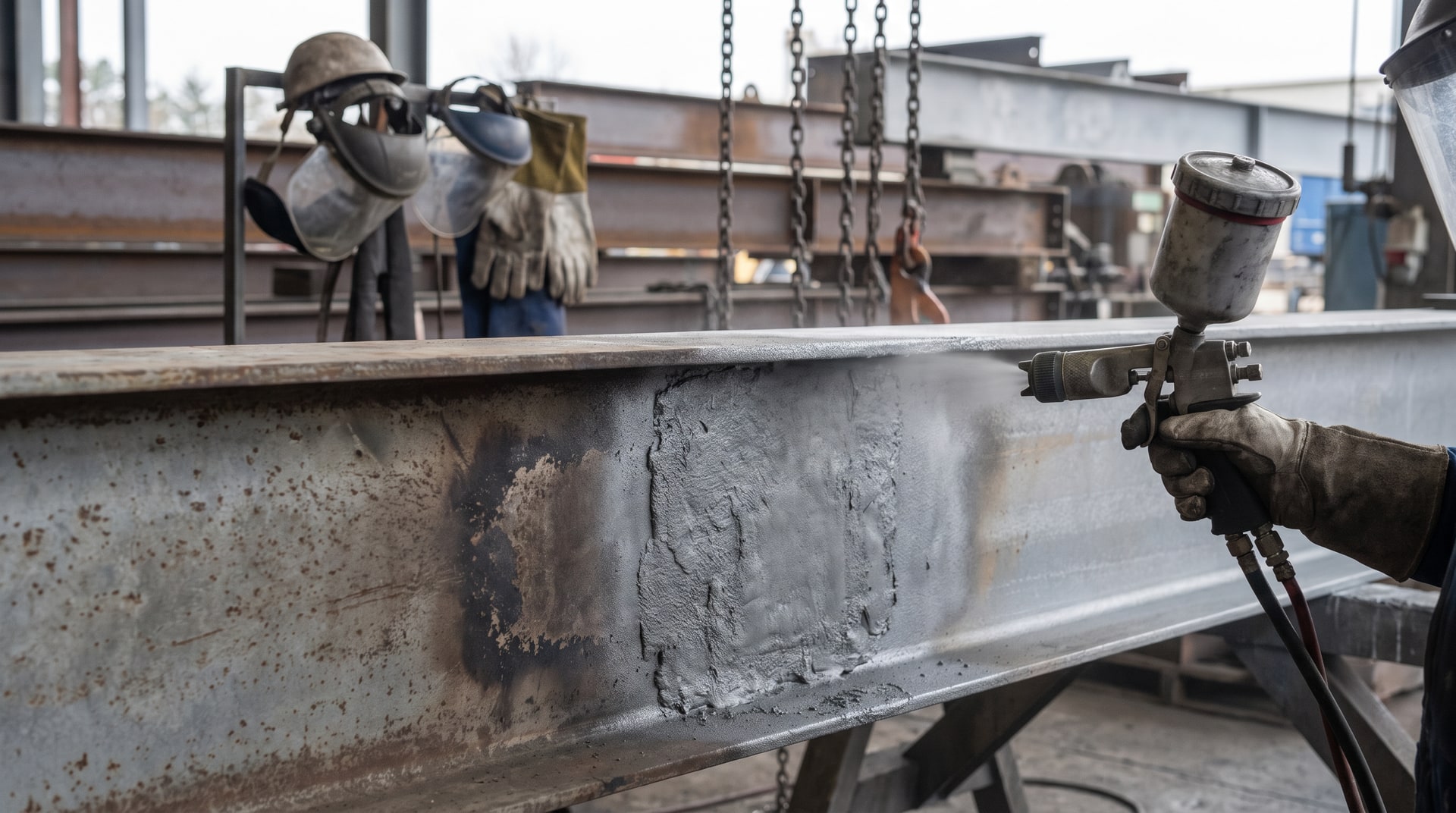
Even a coating as durable as hot-dip galvanizing is not entirely immune to imperfection. Small voids or bare spots can emerge during the galvanizing process itself, or from rough handling after the steel leaves the kettle. On larger fabrications, tight recesses or drainage holes can produce areas where zinc coverage is thin or absent. In service, mechanical damage from installation can strip coating from edges or contact points. In all of these situations, the integrity of the galvanized system depends on how well those areas are repaired.
This is not purely a cosmetic concern. Galvanized steel derives its corrosion protection from two simultaneous mechanisms: barrier protection, where the zinc physically separates steel from the environment, and cathodic protection, where zinc sacrificially corrodes to protect adjacent bare steel. A repair that restores only one of those mechanisms provides only partial protection. Choosing the wrong repair material, or applying the right one incorrectly, can leave a structure more vulnerable than it appears.
The American Galvanizers Association addresses this directly in their article on evaluation of HDG repair materials. At V&S Galvanizing, we expand on that foundation to explain what is actually happening at the material level, how each repair method influences long-term performance, and why the choice between solder, paint, and metallizing is often misunderstood in the field.
What ASTM A780 Actually Requires
ASTM A780, Practice for Repair of Damaged and Uncoated Areas of Hot-Dip Galvanized Coatings, is the governing standard for this work. It applies whether the repair is being performed at the galvanizing plant before shipment or in the field after the steel has been installed and has been in service for years. The same general approach and the same material requirements apply in both contexts.
The standard recognizes three acceptable repair methods: zinc-based solder, zinc-rich paint (in both organic and inorganic formulations), and zinc-spray metallizing. Each has its own annex within A780 detailing application procedures. What the standard does not do is rank these methods against each other or designate one as universally superior. That judgment is left to the specifier and applicator, based on the specific conditions of the project.
One distinction that matters at the point of acceptance from the galvanizer is size. For new products leaving the plant, ASTM A123, A153, and A767 each define maximum allowable repair areas. These limits exist because repairs, while effective, are not metallurgically identical to the original hot-dip coating, and there is a threshold beyond which relying on repair rather than re-galvanizing becomes a quality concern. Once a product has been delivered to a job site or placed in service, however, there is no maximum repair size under ASTM A780. The standard is written to accommodate the realities of field conditions.
For any repair to be considered compliant, three conditions must be met: the area being repaired must qualify (bare areas within allowable criteria), the repair material must meet ASTM A780 Paragraph 4, and the applied thickness must meet the values in the primary galvanizing specification, specifically A123 Paragraph 6.2.3 or A153 Paragraph 4.5 depending on the product type.
The Underlying Performance Mechanisms Each Method Relies On
To choose intelligently between repair methods, it helps to understand what each one is actually doing at the coating level. All three materials provide barrier protection by covering bare steel. Where they differ is in the degree of cathodic protection they offer, their adhesion characteristics, and how well the repair material integrates with the surrounding original coating.
Zinc-based solder works by melting a zinc-alloy material onto the prepared surface with a heat source. The thermal bonding creates a very good mechanical connection to the substrate and to the surrounding galvanized coating. The metallic nature of the solder means it behaves similarly to the original zinc coating in terms of cathodic protection: it can sacrificially protect adjacent steel electrochemically, not just by covering it. The trade-off is that the process of applying a thin layer by hand over a heat source does not lend itself to thick deposits, and low coating thickness limits abrasion resistance.
Zinc-rich paint, by contrast, achieves cathodic protection through zinc dust particles suspended in a binder. When the zinc particle loading is high enough, those particles make sufficient electrical contact with each other and with the steel substrate to create a galvanic couple. Organic zinc-rich paints use polymer binders, while inorganic formulations use silicate or ethyl silicate binders. Inorganic formulations tend to perform better in terms of cathodic protection because the inorganic binder does not insulate the zinc particles as much. The critical limitation across all zinc-rich paints is that their cathodic protection is lower than either solder or metallizing, largely because the zinc is not in the same continuous, metallic form as a sprayed or soldered coating.
Zinc-spray metallizing deposits molten zinc droplets onto the prepared substrate by feeding zinc wire or powder through a thermal spray gun. The droplets solidify on contact and build up a porous but fully metallic zinc layer. Because the zinc is metallic and continuous, this method offers the highest cathodic protection of the three options. The porosity of the sprayed deposit also gives it inherently good adhesion, as the irregular surface profile of blast-cleaned steel interlocks with the incoming zinc droplets. Abrasion resistance is meaningfully better than either paint or solder.
Surface Preparation: The Variable That Can Override Everything
No repair material performs to its rated capability on a contaminated or poorly prepared surface. This point deserves more emphasis than it typically receives on job sites. Zinc-rich paints and metallizing both require clean, blast-prepared surfaces to achieve proper adhesion and to allow zinc particles or droplets to contact the steel directly. Zinc solder requires a chemically clean, oxide-free surface and relies on the heat from the application process to assist bonding.
For zinc-rich paint applied by brush, one of its listed advantages is that the brush-on method facilitates achieving minimum film thickness in a more controlled way than spray application. Spray application of zinc-rich paints tends to produce thinner coatings, which means multiple passes are often needed to build adequate dry film thickness. This is a practical consideration on job sites where painters may be accustomed to single-pass application and may not measure film thickness on every repair spot.
Metallizing is the most demanding in terms of surface preparation. The process requires abrasive blast cleaning to create the anchor profile that allows molten zinc droplets to bond effectively. This equipment requirement is one of the main reasons metallizing carries the highest cost and requires qualified personnel. An applicator who is experienced with thermal spray and who understands surface profile requirements will produce a significantly better repair than one who is not, which is why the source study notes explicitly that quality of repair highly depends on the experience and qualification of the applicator.
Where Appearance Matters and What Each Method Can Deliver
The editor topic for this article focuses on appearance, and that is worth addressing directly. Fresh hot-dip galvanized steel has a characteristic metallic appearance that ranges from bright and spangled to matte gray depending on steel chemistry, bath composition, and cooling conditions. Over time, outdoor exposure causes the surface to weather toward a uniform matte gray as the zinc carbonate patina develops. Repair materials are being applied to a surface that may be anywhere along that weathering spectrum.
Zinc-based solder generally offers the best color match to freshly galvanized steel among the three options. The metallic, shiny character of solder closely approximates the appearance of a newly galvanized surface, which makes it the preferred choice when a repaired area needs to blend in on a product destined for architectural or highly visible applications immediately after galvanizing.
Zinc-rich paints are available in various shades, and manufacturers have developed formulations specifically intended to approximate the appearance of galvanized steel. In practice, achieving a convincing match is challenging, particularly over time as the surrounding coating weathers and the paint ages differently. The source study notes potential for poor appearance match as a disadvantage. This is especially relevant on projects where the galvanized finish will be visible and aesthetics are part of the specification. That said, for utilitarian structural applications where corrosion protection is the priority and appearance is secondary, this limitation is largely irrelevant.
Metallizing produces a surface that is rougher in texture than the original galvanized coating, but its color and metallic character provide a reasonable appearance match that is often better than zinc-rich paint. The source study characterizes this as a good appearance match, placing it between solder (best) and paint (most variable).
Geometry and Accessibility Constraints in Real Projects
One of the more practical dimensions of repair material selection is whether the method is even physically executable given the geometry of the component. Each method has geometry-related limitations that are easy to overlook when selecting a repair approach from a desk or specification sheet.
Zinc solder becomes difficult to apply on curved surfaces, vertical surfaces, and overhead positions. The molten solder tends to run under gravity, and controlling deposition on anything other than a roughly horizontal flat surface requires skill and slows the process considerably. Applying solder over large surface areas is similarly impractical because of the manual, heat-by-heat nature of the work.
Metallizing is well suited to flat and moderately curved external surfaces but becomes difficult or impossible on internal surfaces, recesses, holes, and hidden corners. The spray pattern requires line-of-sight access, and the blast cleaning step has the same limitation. For a structural member with internal box sections, hollow tubes, or tight corner connections, metallizing may not be achievable in the areas that most need repair.
Zinc-rich paint has no inherent geometric limitation. Brush application can reach internal surfaces, recesses, and overhead areas. Spray application is less suited to tight spaces, but brush-on formulations make this the most versatile method from an accessibility standpoint. This is one of the key reasons zinc-rich paint remains the dominant field repair material despite its lower cathodic protection relative to the other two options.
Cost, Equipment, and Who Is Doing the Work
The economics of repair material selection are not just about material cost per unit. They include equipment cost, labor time, qualification requirements, and the probability of achieving a compliant repair thickness on the first application.
Zinc-rich paint is the lowest cost option on all of these dimensions. The material is affordable, widely available, requires no special equipment for brush application, and can be applied by any competent painter following the manufacturer's instructions. For small repairs at a job site where no specialized personnel are on hand, this is often the only practical choice.
Zinc solder falls in the middle range. It requires a heat source, which adds to equipment needs and requires that the applicator understand how to control heat application without damaging surrounding coating or the steel beneath. Overheating can damage the intermetallic layers of the adjacent hot-dip coating, creating a new problem in the process of addressing the original one.
Metallizing carries the highest cost by a significant margin. The thermal spray equipment is expensive and requires maintenance. The abrasive blast cleaning equipment and media add further cost. Qualified metallizing applicators are not universally available in all regions, and mobilizing a metallizing crew to a job site for a handful of small repairs is often cost-prohibitive. Metallizing makes the most economic sense for large repair areas or for projects where the specification explicitly requires it based on performance criteria.
Making the Selection Decision: Criteria That Should Drive the Choice
Given the different performance profiles across these three methods, the decision framework should start with the performance requirements of the project rather than with a default preference. A few questions organize the decision well.
Is maximum cathodic protection critical? If the steel is in a severe environment, submerged, or in direct contact with dissimilar metals, cathodic protection matters more than in a dry indoor application. In that case, metallizing is the strongest performer, followed by solder, with zinc-rich paint at the lower end.
Does appearance need to closely match the surrounding galvanized surface? For architectural applications, visible structural components, or anything specified for aesthetic consistency, solder is the best match on fresh galvanizing. Metallizing is a reasonable second choice. Paint is the most variable and may not satisfy an appearance specification on a visible surface.
What is the geometry of the area being repaired? If the area is a flat, accessible external surface, any of the three methods is physically feasible. If it is a recess, internal cavity, or overhead surface, paint is the only practical option. If it is a large flat area on a critical structure, metallizing may be justified despite its cost.
Is this work happening at the galvanizing plant or in the field? Plant repairs benefit from controlled conditions, better equipment access, and qualified personnel. Field repairs happen under more variable conditions and with whatever materials are on hand. This context often pushes field repairs toward zinc-rich paint by default, even when the project specifier might prefer a different method in principle.
It is worth noting that if the repair method or specific product selected differs from the galvanizer's standard practice, this should be discussed and agreed upon before galvanizing begins, not after the fact.
Work With a Team That Understands Coating Integrity End to End
At V&S Galvanizing, our approach to hot-dip galvanizing is built around producing coatings that minimize the need for repair in the first place: correct steel preparation, proper drainage and venting in fabrication, and rigorous inspection at every stage. When repairs are necessary, we apply them in accordance with ASTM A780, using the method that best fits the size, location, and performance requirements of the specific repair area. We understand that the choice between solder, zinc-rich paint, and metallizing is not arbitrary, and we are equipped to have that conversation with engineers, fabricators, and contractors before the work begins.
If you are specifying a project that involves touch-up and repair requirements, or if you have questions about how a specific repair situation should be handled under ASTM A780, we encourage you to reach out through our contact page. Our team can help you select and apply the right repair approach for your project's performance, appearance, and budget requirements.
Frequently Asked Questions About HDG Repair Materials
What are the three ASTM A780-accepted methods for repairing a hot-dip galvanized coating?
ASTM A780 recognizes three methods: zinc-based solder, zinc-rich paint (in both organic and inorganic formulations), and zinc-spray metallizing. Each has a corresponding annex in the standard detailing application requirements. All three provide barrier protection; they differ in cathodic protection level, application method, and suitability for different surface geometries.
Which HDG repair method provides the best cathodic protection?
Zinc-spray metallizing provides the highest level of cathodic protection among the three accepted methods. Because it deposits a continuous metallic zinc layer, it most closely replicates the electrochemical behavior of the original hot-dip coating. Zinc-based solder offers good cathodic protection, while zinc-rich paint provides the lowest cathodic protection of the three options.
When is there a maximum repair area limit under ASTM galvanizing standards?
Maximum repair area limits apply to new products at the galvanizing plant, prior to acceptance by the customer. These limits are defined in ASTM A123, A153, and A767 depending on the product type. Once a product has been delivered to a job site or placed in service, ASTM A780 does not impose a maximum repair size.
Why does zinc-rich paint have lower cathodic protection than metallizing even though both contain zinc?
In zinc-rich paint, zinc dust particles are suspended in an organic or inorganic binder. The binder partially insulates the particles from each other and from the steel substrate, reducing the efficiency of the galvanic couple. Zinc-spray metallizing deposits metallic zinc in a continuous, particle-to-particle bonded layer with no insulating binder, allowing free electron flow and more effective cathodic protection.
What is the main practical advantage of zinc-rich paint over the other two repair methods?
Zinc-rich paint is the most versatile in terms of application geometry and the lowest in overall cost. Brush-on formulations can reach internal surfaces, recesses, overhead areas, and curved surfaces that are inaccessible to metallizing spray or difficult to solder. It requires no specialized equipment, making it the most practical choice for field repairs in most situations.
How does surface preparation affect HDG repair quality, and which method is most demanding?
Surface preparation is critical to repair performance regardless of method. Metallizing is the most demanding, requiring abrasive blast cleaning to create the surface profile that allows molten zinc droplets to bond properly. Zinc-rich paint also requires a clean, prepared surface for adequate adhesion and zinc particle contact with steel. Zinc solder relies on a chemically clean surface and uses heat during application to assist bonding. Poor preparation can prevent any of the three methods from achieving compliant adhesion or coating thickness.
Which repair method gives the best visual match to freshly galvanized steel?
Zinc-based solder provides the closest color match to freshly hot-dip galvanized steel because its metallic, shiny appearance approximates the original coating surface. Metallizing offers a good appearance match though with a rougher texture. Zinc-rich paint is available in various shades but has the highest potential for a noticeable appearance mismatch, particularly as both the coating and the surrounding galvanized surface age differently over time.
If a project engineer wants to specify a non-standard repair method, when should that conversation happen?
It should happen before galvanizing begins. If the repair method or specific product differs from the galvanizer's standard practice, ASTM A780 and industry guidance both indicate this must be discussed and agreed upon in advance. Addressing it after the fact can create compliance issues, delays, or situations where an agreed-upon repair method is not physically available at the time and location the repair is needed.
