
Steel that has been hot-dip galvanized can, under specific circumstances, exhibit a loss of ductility that is not visible to the naked eye and is not detectable through routine coating inspection. The zinc coating itself may look perfectly sound. The problem, if it exists, lives in the steel substrate. When that steel is placed into service and subjected to tensile or bending loads, the consequences of undetected embrittlement can be severe: sudden, brittle fracture at stresses well below the material's rated yield strength.
This is not a common outcome from galvanizing, but it is a real risk when certain conditions align, and it is one that engineers, fabricators, and specifiers need to understand clearly. The American Galvanizers Association addresses this directly in their article on embrittlement testing for galvanized steel. At V&S Galvanizing, we expand on that foundation to explain what is actually happening at the material level, how steel chemistry and fabrication practice influence susceptibility, and why the topic is often misunderstood or underweighted in the field.
What Embrittlement Actually Means in a Galvanized Steel Context
The word "embrittlement" is used loosely in conversation, but it has a precise meaning in metallurgy. A material that has become embrittled has lost some portion of its ability to deform plastically before fracturing. It may still carry load up to a point, but instead of bending or yielding when that threshold is exceeded, it breaks. The critical distinction is that this fracture can occur at stresses that would ordinarily be safe for the steel grade in question.
In the context of hot-dip galvanizing, two mechanisms are most commonly discussed: hydrogen embrittlement and liquid metal embrittlement (sometimes called liquid metal assisted cracking). Hydrogen embrittlement occurs when atomic hydrogen is absorbed into the steel lattice, typically during acid pickling in the pre-treatment process. Hydrogen atoms are small enough to diffuse into the steel's crystalline structure, where they accumulate at grain boundaries and internal defects, reducing the cohesion of the metal. Liquid metal embrittlement, by contrast, occurs when a grain boundary in the steel is wetted by molten zinc during the galvanizing bath immersion, causing a reduction in grain boundary strength that can allow cracking under stress.
Neither mechanism is inevitable. Both are strongly influenced by steel chemistry, prior cold work, and the geometry of the fabricated part. Understanding which mechanism is plausible in a given scenario shapes how testing should be approached.
When Suspicion Arises: The Conditions That Trigger Testing
Routine galvanizing inspection does not include embrittlement testing. Coating thickness measurements, adhesion checks, and visual surface assessments tell you a great deal about the quality of the zinc coating, but they reveal nothing about whether the steel beneath it has been compromised. Embrittlement testing is triggered by suspicion, not by routine protocol.
What creates that suspicion? Several factors raise the probability that embrittlement may be a concern. High-strength steels with tensile strengths above approximately 150 ksi are more susceptible to hydrogen embrittlement, because the internal stresses associated with high-strength microstructures provide favorable sites for hydrogen accumulation. Cold-worked steel, including material that has been heavily bent, punched, or sheared during fabrication, carries residual stress that similarly increases susceptibility. Fabricated components with complex geometries, tight inside bend radii, or heavily worked sections warrant closer scrutiny than simple flat plate.
The service environment also matters. If a galvanized component is going into a high-stress application, or one where sudden failure would be catastrophic or difficult to detect, the calculus around testing shifts significantly. A decorative railing bracket carries different consequences than a structural tension member or a fastener under sustained load.
The ASTM A143/A143M Standard: What It Actually Prescribes
When testing is warranted, the governing specification is ASTM A143/A143M. This standard establishes the protocol for safeguarding against embrittlement of hot-dip galvanized structural steel products and procedures for detecting embrittlement. The embrittlement tests it describes are designed around a fundamental mechanical principle: apply a known force that produces a stress below the yield stress of the part, and then evaluate whether any fracture or permanent deformation has occurred. If the steel were sound, a sub-yield load should produce no lasting damage. If it fractures or is permanently deformed, the material's effective yield behavior has been altered, which is direct evidence of embrittlement.
This logic is important to hold onto. The tests are not measuring coating adhesion or zinc thickness. They are measuring the ductility of the steel itself, using the zinc coating and the underlying steel together as the test specimen. Because the loads applied are intentionally destructive to the coating and potentially to the part, testing is conducted on a sample group rather than on the entire production lot.
ASTM A143/A143M defines three distinct test methods. The appropriate test depends on the geometry of the product and the nature of the service conditions it will face. Using the wrong test method for a given product type can produce misleading results, so matching the test to the product is not a trivial decision.
The Three Test Methods: Geometry Drives the Choice
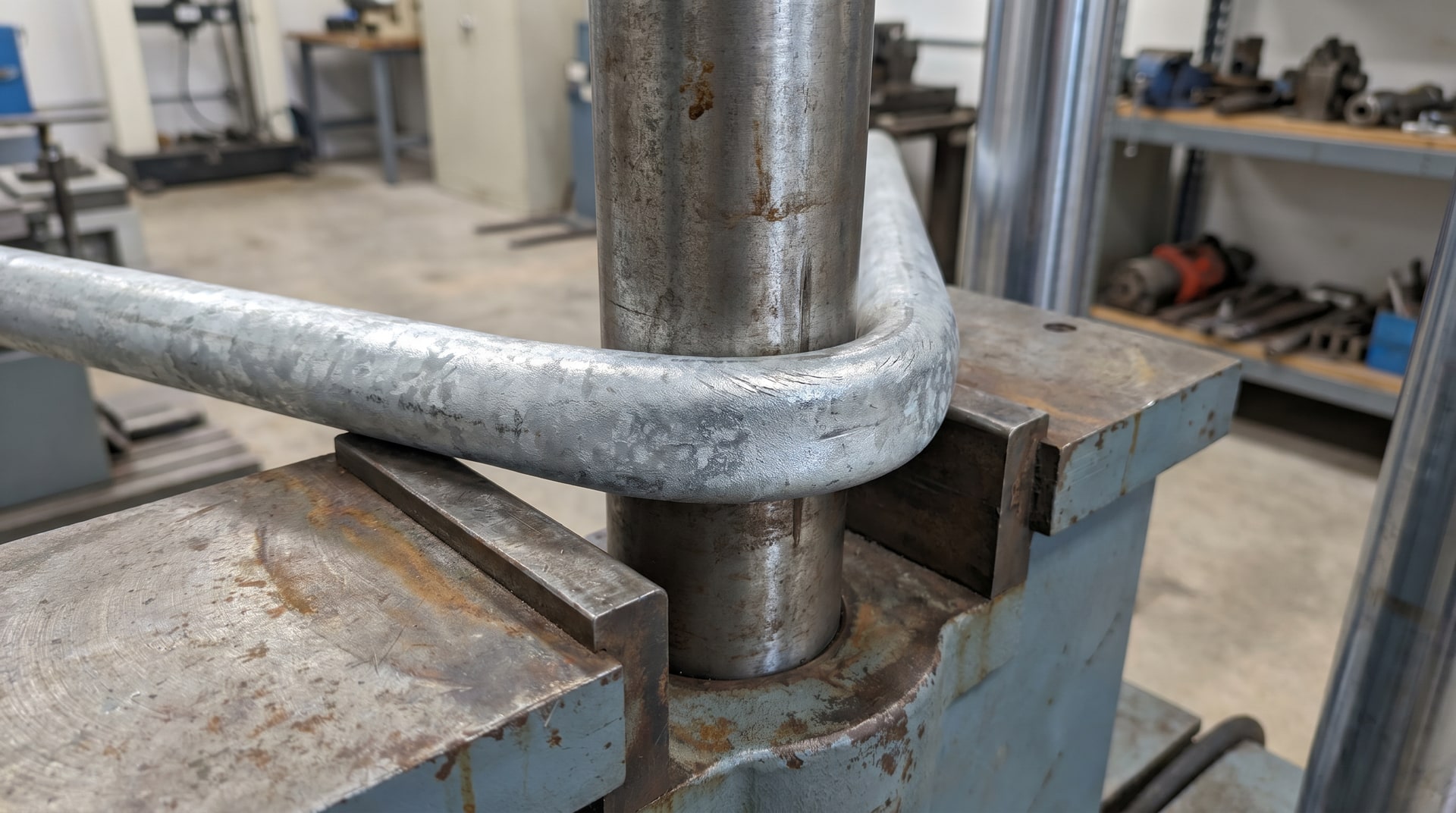
The similar bend radius test is used when the product geometry allows bending as the primary stress mode. The specimen is bent around a mandrel with a radius comparable to what the part would experience in service. The test result is evaluated by examining the bent area for cracking of the steel, not just flaking of the zinc. Because the stress applied is calibrated to remain below the steel's nominal yield point, any fracture observed is attributable to reduced ductility rather than overload.
The sharp blow test is applied to products where impact loading is a relevant service condition, or where the geometry does not lend itself to a controlled bend. A striker delivers a defined impact to the specimen, and the response of the steel is evaluated. Again, the criterion is whether the steel fractures or deforms permanently under a load that a sound piece of that steel should be able to absorb without lasting damage.
The steel angle test is specifically designed for steel angle sections, which are a geometry frequently used in structural applications and commonly galvanized. The test applies a bending load across the angle section and evaluates the response at the interior bend, which is the highest-stress region of the cross section and therefore the most likely location for embrittlement-driven cracking to manifest.
All three tests are inherently destructive to the zinc coating and may be destructive to the part itself. This is why the standard is applied to sample groups rather than to every piece in a production run.
Interpreting Results: What Rejection Means and What It Does Not
The pass/fail criterion under ASTM A143/A143M testing is clear: if a fracture occurs, or if permanent damage is created during the test, the parts must be rejected. This is not a matter of degree or engineering judgment about severity. Any fracture under a sub-yield test load indicates that the steel's ductility has been compromised to a level that cannot be accepted for structural service.
What rejection does not mean, however, is that all galvanizing should be treated with suspicion or that hot-dip galvanizing is inherently damaging to steel. The overwhelming majority of galvanized fabrications pass these tests without incident, and embrittlement remains a relatively uncommon outcome when steel is properly specified and fabricated before galvanizing. The purpose of the test is not to indict galvanizing as a process but to provide a reliable, quantitative method for confirming that a specific batch of parts remains fit for service.
When rejection does occur, the root cause analysis typically points back to one of several upstream factors: steel with a chemistry or strength level that increased susceptibility, cold work applied during fabrication that was not subsequently stress-relieved, or geometry that created stress concentrations during immersion in the galvanizing bath. Identifying the root cause is essential, because without that knowledge, any corrective action is just guesswork.
The Role of Fabrication Practice in Managing Embrittlement Risk
One of the most actionable takeaways from understanding embrittlement mechanisms is that much of the risk is managed well before the steel ever arrives at the galvanizing plant. Fabrication decisions have a large influence on susceptibility. Tight bend radii, for instance, introduce significant cold work at the bend, and that localized work hardening creates a stress concentration that is exactly the type of condition where hydrogen or liquid metal embrittlement is most likely to be triggered.
Stress relief heat treatment prior to galvanizing is one recognized mitigation strategy for fabrications that involve substantial cold work. By heating the steel to an appropriate temperature before pickling and galvanizing, residual stresses from forming and welding are reduced, lowering the driving force for embrittlement. ASTM A143/A143M and related standards address stress relief recommendations, and our team at V&S Galvanizing works with fabricators to identify when this step should be part of the job plan.
Steel selection also matters. Specifying steels with lower susceptibility to hydrogen absorption, or avoiding excessively high-strength grades when the service application allows it, reduces baseline risk. Communicating the intended galvanizing process to a steel service center or mill early in the design phase is not always standard practice, but it can prevent problems that are otherwise discovered only at the point of testing or, worse, in the field.
Why Testing a Sample Group Is Statistically Sound
Some engineers, when they first encounter the sampling approach in ASTM A143/A143M, question whether testing a subset of parts provides meaningful assurance about the rest of the production lot. The answer lies in how embrittlement risk is distributed. Within a single production run of parts made from the same heat of steel, fabricated to the same geometry, and processed through the same galvanizing bath, the conditions that drive embrittlement are largely consistent across the entire lot. If the steel chemistry, cold work level, and processing parameters are uniform, the embrittlement risk is uniform as well.
This means that a sample test is genuinely representative. If the tested pieces pass, the conditions that would have caused failure in the rest of the lot were not present. If the tested pieces fail, the conditions that caused that failure almost certainly affected the rest of the lot as well, which is why the rejection applies to the entire group and not just to the tested specimens.
This is very different from a scenario where each part has independent, random variation in embrittlement risk. In that case, sample testing would be less meaningful. The physical reality of the galvanizing process, with its consistent chemistry and thermal conditions across an entire batch, supports the statistical validity of the sampling approach.
Work With a Team That Understands the Full Picture
Embrittlement testing is one of those topics that sits at the intersection of steel metallurgy, fabrication practice, and coating specification. It is easy to treat it as a checkbox item on a quality plan, something to be invoked only when there is already a visible problem. But the more useful approach is to understand the conditions that create risk and to address them proactively, before testing becomes necessary.
At V&S Galvanizing, we bring working knowledge of ASTM A143/A143M and its test protocols to every job that presents potential embrittlement concerns. When our team reviews an incoming fabrication and identifies geometry, steel grade, or cold-work conditions that warrant a closer look, we raise that conversation before the parts go into the bath. The goal is always to protect both the integrity of the coating and the structural fitness of the steel beneath it. That kind of upstream engagement is what separates a galvanizing partner from a commodity processor.
If you have a project involving high-strength steel, complex fabricated geometry, or service conditions that place unusual demands on ductility, we are glad to discuss the specifics with your team. Reach out through our contact page and let us know what you are working with.
Frequently Asked Questions About Embrittlement Testing for Galvanized Steel
What is the purpose of ASTM A143/A143M in hot-dip galvanizing?
ASTM A143/A143M establishes the protocol for detecting embrittlement in hot-dip galvanized steel. It prescribes three mechanical test methods, each using a known load that should remain below the yield stress of the part, and sets the criterion that any fracture or permanent deformation under that load is grounds for rejection. The standard applies when there is reason to suspect that steel ductility may have been compromised during the galvanizing process.
Why are embrittlement tests destructive, and does that mean every part gets tested?
Embrittlement tests apply mechanical loads that are likely to damage the zinc coating and may fracture the steel itself. This makes them destructive by nature. Because the risk is distributed consistently across a production lot made from the same steel heat and processed under the same conditions, ASTM A143/A143M allows testing on a sample group rather than on every part. If the sample passes, the lot is accepted; if it fails, the entire lot is rejected.
How do you choose which of the three embrittlement test methods to use?
The test method is selected based on the geometry of the product and the type of stress it will experience in service. The similar bend radius test applies where bending is the dominant load mode. The sharp blow test addresses impact-loaded or geometrically complex parts. The steel angle test is specifically designed for angle sections, where the interior bend is the highest-stress location. Selecting the wrong test for a given geometry can produce results that do not accurately reflect real service conditions.
Can a part pass coating inspection and still fail an embrittlement test?
Yes, and this is a critical point. Standard coating inspection, including thickness measurement and adhesion testing, evaluates the zinc layer. It provides no information about the mechanical condition of the steel underneath. A part can carry a perfectly adherent, properly thick zinc coating while the steel substrate has reduced ductility. Embrittlement is a subsurface phenomenon, and only a mechanical test that loads the steel itself will detect it.
What fabrication practices increase the risk of embrittlement during galvanizing?
Cold work is the most significant fabrication-side risk factor. Tight inside bend radii, heavy punching, shearing, and forming operations all introduce residual stress and work hardening into the steel. These conditions make the material more susceptible to hydrogen absorption during pickling and more vulnerable to grain boundary wetting by molten zinc during immersion. Stress relief heat treatment prior to galvanizing is one mitigation strategy for highly worked fabrications.
Does embrittlement risk increase with steel strength?
Yes. Higher-strength steels, particularly those with tensile strengths above approximately 150 ksi, are more susceptible to hydrogen embrittlement because their microstructures contain more internal stress concentrations where hydrogen can accumulate at grain boundaries. This is why the combination of high-strength grade and cold work creates the highest-risk scenario, and why steel selection early in the design process is relevant to galvanizing outcomes.
If parts are rejected after embrittlement testing, what happens next?
Rejected parts cannot be used in service. The next step is root cause analysis to determine whether the problem originated in steel chemistry, fabrication-induced cold work, or process conditions. Without identifying the root cause, any corrective action on subsequent production runs is speculative. Depending on findings, corrective measures might include changing steel specification, incorporating stress relief before galvanizing, modifying fabrication geometry, or some combination of these.
Is embrittlement testing required on every galvanizing project?
No. Embrittlement testing under ASTM A143/A143M is triggered by suspicion of a potential problem, not by routine protocol. It is warranted when specific risk factors are present: high-strength steel, significant cold work in fabrication, tight bend radii, or service conditions where sudden brittle failure would have serious consequences. Most standard structural galvanizing projects do not require embrittlement testing, but recognizing when it should be specified is part of sound engineering judgment.
