

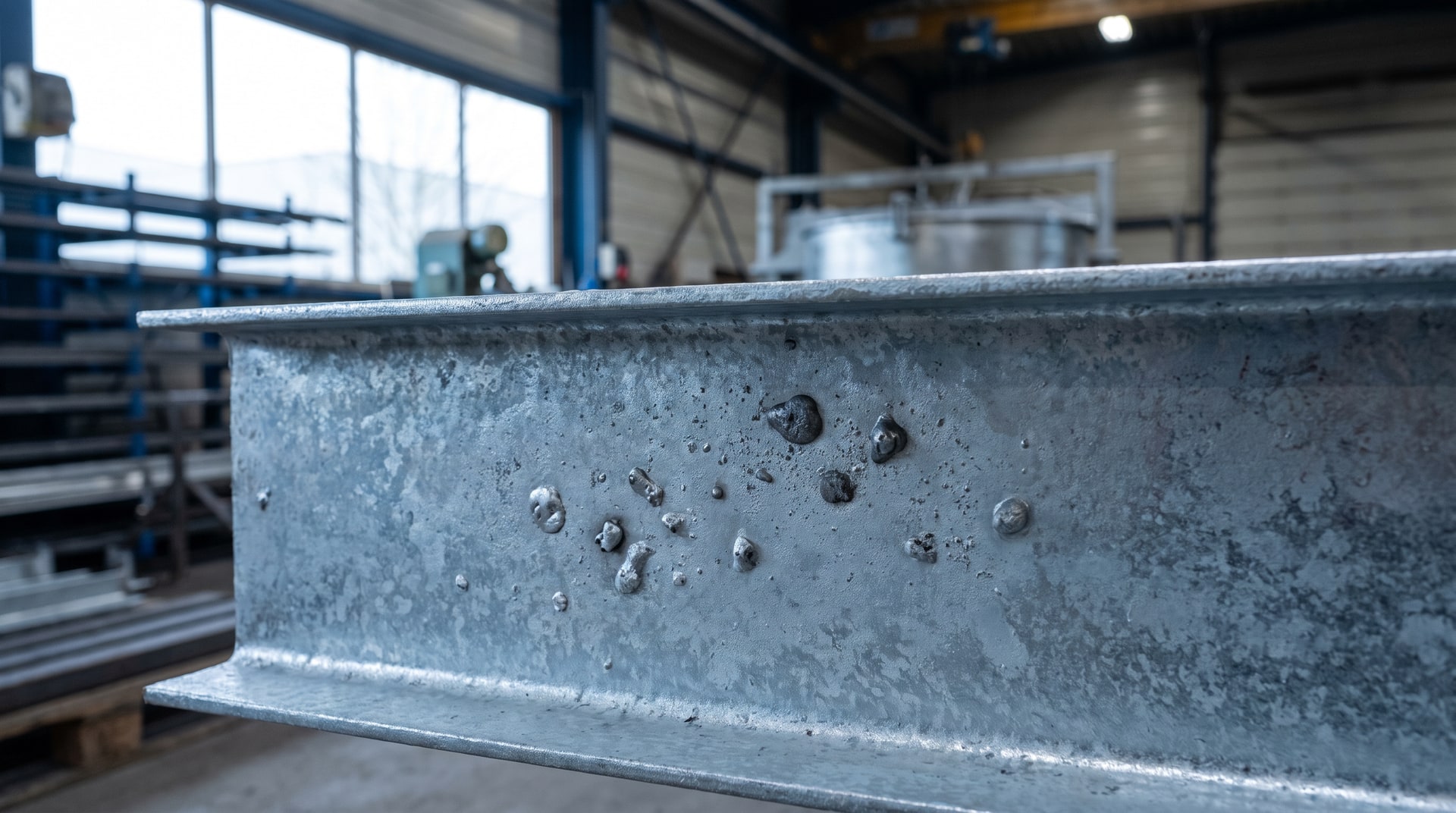
Anyone who has handled hot-dip galvanized steel long enough has noticed it: small raised bumps or rougher patches on an otherwise smooth zinc coating. Some of these surface irregularities are purely cosmetic and have no bearing on corrosion performance. Others are a genuine quality issue that requires intervention before the steel can leave the facility. The difference between the two is not always obvious to fabricators, inspectors, or project owners who have not had a chance to look closely at what is actually forming on the steel surface and why.
The American Galvanizers Association addresses this directly in their article on dross inclusions. At V&S Galvanizing, we expand on that foundation to explain what is actually happening at the material level, how iron concentration and bath temperature influence dross formation, and why the distinction between dross types is often misunderstood in the field.
The Metallurgical Origin of Dross
Dross is not contamination introduced from outside the process. It is a byproduct generated within the galvanizing kettle itself, the direct result of the same metallurgical reaction that makes hot-dip galvanizing work. When steel is immersed in molten zinc, iron from the steel reacts with zinc to form a series of zinc-iron alloy layers. This is the bonded intermetallic structure that gives galvanized coatings their adhesion and durability. The problem arises not from that controlled reaction but from free iron particles that are already suspended in the molten zinc bath.
These free iron particles react with zinc by the same mechanism, but because they are not bound to a substrate, the resulting zinc-iron crystals float or sink through the melt rather than building up as a coherent coating. The outcome is dross: a mesh of zinc-iron alloy crystals encapsulated by molten zinc, distributed throughout the kettle to varying degrees depending on process conditions.
Where the Free Iron Actually Comes From
Understanding dross formation requires tracing the sources of free iron in the bath. There are several, and they operate simultaneously during normal production.
The largest contributor is iron salts carried over from the chemical cleaning and fluxing stages. When steel is cleaned in acid, iron is removed from the surface as dissolved salts. If the rinsing step is incomplete, those salts are dragged into the flux tank and then into the zinc kettle. The flux layer itself, typically a wet ammonium chloride solution used in wet-flux or dry-flux processes, can accumulate iron if its chemistry is not monitored and adjusted consistently.
A secondary source is the kettle itself. The steel walls and floor of the galvanizing vessel are subject to slow dissolution into the zinc bath over time, contributing a low but continuous background level of free iron. The steel being galvanized also contributes, particularly during the initial immersion phase when the surface iron reacts rapidly before the alloy layers stabilize.
Zinc has a remarkably low capacity to hold iron in solution. At a typical galvanizing temperature of 850 degrees F (454 degrees C), the solubility limit for iron in molten zinc is only 0.035 percent, or roughly 35 iron atoms per 100,000 zinc atoms. Any iron concentration above that threshold precipitates out and begins to react metallurgically with the surrounding zinc, building up the dross that accumulates in the kettle.
How Temperature Controls Dross Production
Temperature is one of the most consequential variables in dross behavior, and it is worth understanding the mechanism rather than treating it as a general rule of thumb.
Iron solubility in molten zinc is temperature-dependent. As bath temperature drops, the zinc melt can hold less iron in solution. That means iron that was dissolved at a higher temperature will precipitate when the bath cools, accelerating dross formation. The relationship is not gradual: dross production increases linearly by a factor of four if bath temperature drops from 880 degrees F (471 degrees C) to 810 degrees F (432 degrees C). That is a significant multiplier across a relatively narrow temperature band that falls within the normal operating range for galvanizing.
Temperature variation is not uniform across the kettle. The areas most prone to cooling are along the walls and near the surface of the melt. This is why maintaining consistent temperatures throughout the bath, particularly near the kettle walls, is a specific focus in dross management. Uneven temperature distribution creates zones where iron is more likely to precipitate, and localized dross accumulation follows. When steel is lowered into and raised out of the bath, it also creates convection currents that can redistribute dross from the bottom of the kettle upward, increasing the likelihood that floating dross contacts the steel surface during withdrawal.
Dross Pimples vs. Gross Dross Inclusions: What the Distinction Means in Practice
Not all dross on a galvanized surface represents a problem. ASTM A123, the primary specification governing the quality of hot-dip galvanized coatings on fabricated steel, draws a clear line between two categories of dross that appear on finished surfaces, and the inspection outcome depends entirely on which type is present.
Dross pimples are small, finely dispersed surface irregularities. They are surrounded by continuous zinc coating, they are not easily removed by contact, and they do not compromise the corrosion protection of the underlying steel. Under ASTM A123, galvanized steel exhibiting dross pimples passes inspection. The coating surrounding those pimples is intact, and the steel remains protected. These are the bumps that often look like minor surface texture variation rather than a structural defect.
Gross dross inclusions are a different matter entirely. ASTM A123 defines these as iron-zinc intermetallics present in the coating in a form other than finely dispersed pimples. The specification further clarifies the critical threshold: a gross dross inclusion is one that would expose bare steel if it were removed from the coating. In other words, the inclusion is not embedded within a surrounding zinc layer. It is sitting at or above the steel surface, and removing it opens a gap in the corrosion barrier.
The standard also notes that gross dross inclusions are characteristically raised and can be dislodged by contact with lifting straps, chains, tools, fixtures, or adjacent galvanized parts during handling. This is practically important because galvanized assemblies are regularly handled, stacked, and shipped. A gross dross inclusion that gets knocked off during transit leaves exposed steel at the point of contact, creating a corrosion initiation site that was not apparent at the time of inspection.
What ASTM A123 Requires When Gross Dross Is Found
When gross dross inclusions are identified on a freshly galvanized surface, the specification does not allow them to remain. They must be removed, and the underlying steel exposed by their removal must be repaired in accordance with ASTM A780, the standard covering repair of damaged and uncoated areas of hot-dip galvanized coatings.
The repair process under ASTM A780 generally involves applying zinc-rich paint, zinc-based solder, or a thermally sprayed zinc coating to the exposed area. The specific method depends on the size of the repair area and the service environment the assembly is intended for. Smaller touch-up areas are typically handled with zinc-rich paint meeting the appropriate zinc dust content requirements. What matters from a compliance standpoint is that the repair must be completed before the material ships, and the repaired area must be documented where required by the project specification.
This two-step requirement, removal followed by repair, is sometimes misunderstood in the field. Removing gross dross without repairing the exposed steel does not bring the product into compliance. Both steps are mandatory under the specification.
Why Dross Management Is Fundamentally a Process Control Problem
The most effective way to limit dross inclusions on finished steel is to limit the amount of free iron entering and remaining in the bath. This is a process chemistry and operations discipline, not something that can be addressed after the fact at the inspection stage.
Thorough rinsing of steel after acid cleaning is one of the most direct interventions available. Rinse water that carries iron salts from the cleaning tank into the flux tank elevates iron levels throughout the pre-treatment sequence, and that iron eventually ends up in the kettle. Limiting iron content in the preflux solution and using the lowest effective ammonium chloride concentration in the preflux tank both reduce the iron loading that reaches the zinc bath.
Element additions, particularly nickel and aluminum, influence iron solubility in the zinc melt. Managing those additions on a daily rather than weekly basis gives operators tighter control over bath chemistry and reduces the risk of sudden iron precipitation events that generate large volumes of dross in a short period. Consistent monitoring matters more than periodic adjustment.
Regular drossing of the kettle, the physical process of removing accumulated dross from the bottom and sides of the vessel, is also essential. Dross that is left in the kettle does not simply stay at the bottom. Mechanical disturbance from steel being immersed and withdrawn, combined with thermal convection, keeps portions of the dross suspended in the melt where it can contact and adhere to newly galvanized surfaces.
What Fabricators and Specifiers Should Understand About Dross and Surface Quality
For fabricators and project owners, the practical takeaway is that some degree of surface texture variation on galvanized steel is normal and acceptable. Dross pimples, by themselves, are not a rejection criterion under ASTM A123, and treating them as one leads to unnecessary disputes and rework requests that are not supported by the specification.
Gross dross inclusions are a legitimate quality concern, and they should be identified during post-galvanizing inspection before the material ships. The visual signature is distinct: raised, irregular protrusions that feel unstable under contact rather than firmly bonded pimples that are part of the coating surface. Experienced inspectors can typically distinguish between the two by visual examination and light contact testing, though the formal criterion in ASTM A123 is whether removal would expose bare steel.
If a project involves architectural or structural applications where surface appearance is part of the acceptance criteria, it is worth discussing expectations with the galvanizing team before fabrication. Steel chemistry, surface preparation quality, and part geometry all influence how the zinc coating develops, and some applications have a lower tolerance for surface variation even when that variation would technically pass ASTM A123.
For standard structural applications, galvanized steel featuring dross pimples is fully compliant and fully protective. The corrosion barrier is intact. The zinc coating is bonded. The steel is protected for the intended service life.
Work With a Team That Understands the Difference
Dross is an inherent part of the galvanizing process. It cannot be entirely eliminated, but it can be managed to the point where its impact on finished product quality is minimal and predictable. That requires consistent attention to bath chemistry, temperature control, pretreatment discipline, and regular kettle maintenance. The galvanizers who manage dross well are the ones who treat it as a process variable to be controlled, not an outcome to be explained away after the fact.
At V&S Galvanizing, our team understands the metallurgy behind dross formation and the inspection criteria that govern how it affects product acceptance. If you are working on a project where galvanized coating quality, surface appearance, or ASTM A123 compliance is a concern, we are glad to walk through the specifics with you before fabrication begins. Reach out through our contact page to connect with our technical team.
Frequently Asked Questions About Dross Inclusions
What is the difference between dross pimples and gross dross inclusions?
Dross pimples are small, finely dispersed surface irregularities that are embedded within the zinc coating, firmly bonded, and do not expose bare steel if removed. Gross dross inclusions are larger, raised iron-zinc intermetallic particles that sit at or above the steel surface and would expose bare steel if knocked off. ASTM A123 permits dross pimples but requires removal and repair of gross dross inclusions.
Does dross affect the corrosion protection of hot-dip galvanized steel?
Dross pimples do not affect corrosion protection because the surrounding zinc coating remains intact. Gross dross inclusions are a different situation: if they are dislodged during handling or service, they leave exposed steel that is no longer protected by the zinc coating and must be repaired per ASTM A780.
Why does bath temperature have such a large effect on dross production?
Iron solubility in molten zinc decreases as temperature drops. When bath temperature falls from 880 degrees F (471 degrees C) to 810 degrees F (432 degrees C), dross production increases by a factor of four. This is because iron that was dissolved at higher temperatures precipitates out when the bath cools, reacting with zinc to form additional dross at an accelerated rate.
What does ASTM A780 require when gross dross inclusions are repaired?
ASTM A780 requires that the bare steel exposed after removing a gross dross inclusion be coated with an approved repair material, typically zinc-rich paint with adequate zinc dust content, zinc-based solder, or thermally sprayed zinc. The repair must cover the exposed area completely. Removing the inclusion without repairing the underlying steel does not satisfy the specification.
Where does the free iron in the galvanizing kettle come from?
The largest source is iron salts carried into the flux tank and then the zinc kettle from the acid cleaning stage, particularly when rinsing is incomplete. Additional free iron comes from slow dissolution of the kettle walls and floor over time, and from the steel being galvanized during initial immersion. All of these sources contribute to the iron concentration in the bath.
At what iron concentration does dross begin to form in molten zinc?
At a galvanizing temperature of 850 degrees F (454 degrees C), the solubility limit for iron in molten zinc is approximately 0.035 percent, equivalent to 35 iron particles per 100,000 zinc particles. Any iron concentration above this threshold will precipitate and react metallurgically with the surrounding zinc to form dross.
Can dross inclusions be prevented entirely?
Dross cannot be completely eliminated because free iron is continuously introduced into the bath from multiple sources during normal galvanizing operations. However, its impact can be minimized through thorough rinsing after acid cleaning, controlling iron levels in the preflux, managing element additions (nickel and aluminum) on a daily basis, maintaining consistent bath temperatures, and performing regular kettle drossing to remove accumulated material before it contaminates new work.
How can an inspector distinguish a gross dross inclusion from a dross pimple in the field?
The distinguishing characteristic under ASTM A123 is whether removing the inclusion would expose bare steel. Practically, gross dross inclusions tend to be visibly raised, irregular in shape, and can be dislodged by contact with handling equipment or adjacent parts. Dross pimples are smaller, more uniform in appearance, firmly bonded to the coating surface, and do not detach under normal handling. When there is doubt, a qualified inspector should assess whether the feature meets the specification definition before accepting or rejecting the part.
