
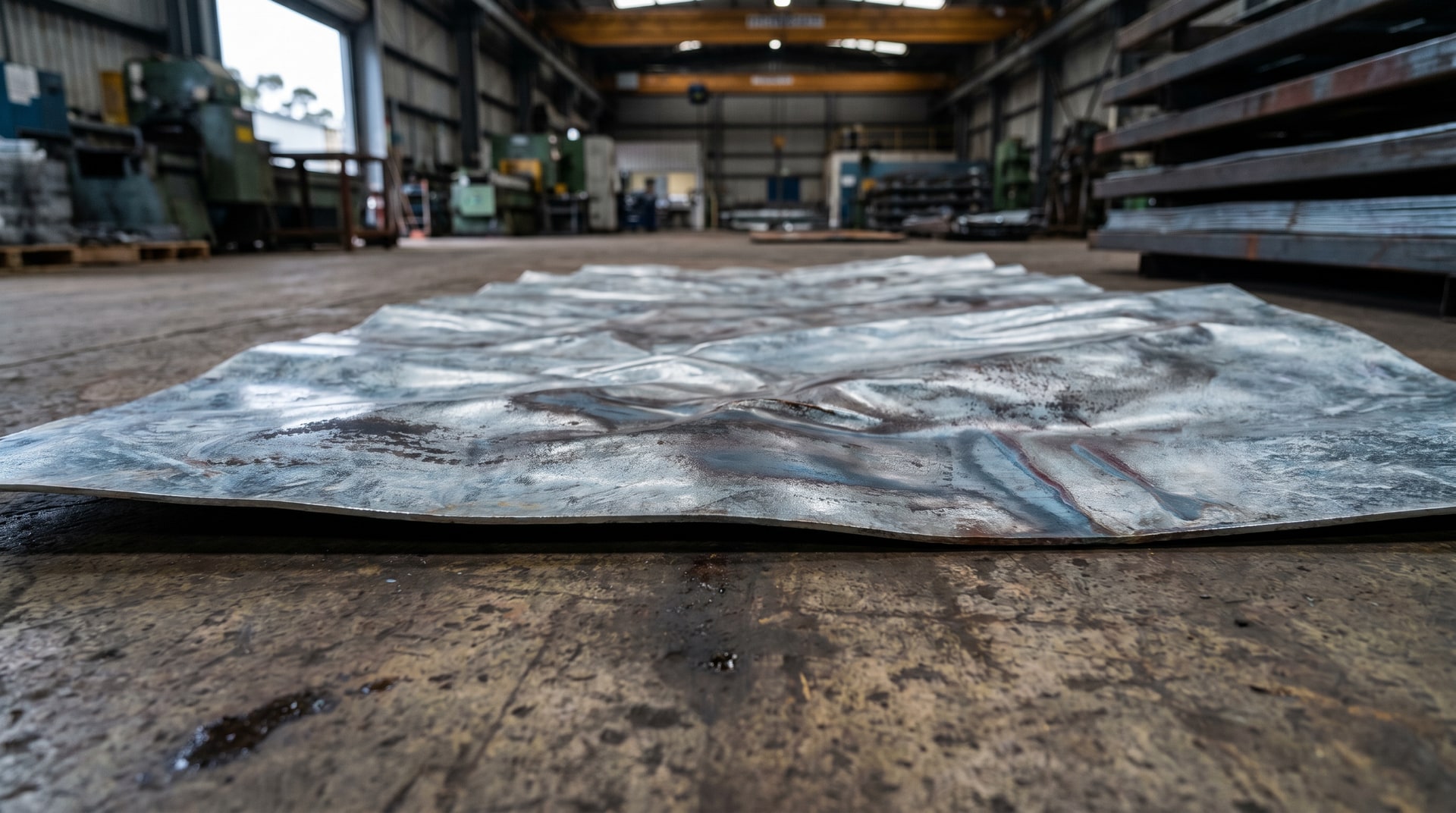
When fabricators send thin steel assemblies through a hot-dip galvanizing line and receive them back with visible warping or buckling, the reaction is often one of confusion or concern. The parts went in flat. They came out bent. What happened, and is the coating still any good? These are fair questions, and the answers lie in a straightforward but frequently misunderstood interaction between thermal energy, material geometry, and weld restraint.
Distortion is not a coating failure. It is a mechanical response of the steel itself to the conditions of the galvanizing process. The American Galvanizers Association addresses this directly in their article on distortion. At V&S Galvanizing, we expand on that foundation to explain what is actually happening at the material level, how geometry and weld configuration influence the severity of distortion, and why this outcome is often mischaracterized as a process defect when it is really a design consideration.
The Physics Behind the Warp
Hot-dip galvanizing requires steel to be immersed in a bath of molten zinc held at approximately 840 degrees Fahrenheit. For most structural steel sections, this is a well-tolerated thermal event. The mass and cross-sectional geometry of beams, channels, angles, and pipe provide enough stiffness to resist the dimensional changes that accompany heating and cooling without any visible consequence.
Thin, flat steel is a different story. When a flat plate or wire mesh heats up rapidly, different zones of the material reach different temperatures at different rates. The surface exposed to the zinc heats faster than the interior. Edges heat faster than the center. Each zone wants to expand at its own rate, and in a free, unrestrained plate, some of that differential movement can actually be tolerated through minor out-of-plane flex.
The problem intensifies when the steel cannot move freely because it has been welded into an assembly. The welds act as fixed constraints. The steel tries to accommodate thermal expansion but has nowhere to go. The internal stress that builds up as a result has to go somewhere, and it is relieved through physical deformation of the part. That deformation is what we call distortion.
Why Welds Make It Worse
A flat steel plate sitting loose in the zinc bath will still experience differential thermal expansion, but it retains some freedom to flex and recover. Once that plate is welded to a frame, a gusset, or another plate, the welded joints become anchors. The steel on one side of a weld may want to move in one direction while the steel on the other side is being pulled in another direction by an adjacent weld. The result is a compounding of stress at multiple points simultaneously.
Weld sequence and weld volume also contribute. Heavy fillet welds around a thin plate perimeter create more rigid anchoring than intermittent welds, which means more stress concentration during the thermal cycle. If the welding itself introduced residual stress during fabrication, those pre-existing stresses combine with the galvanizing thermal load and can tip the part into visible distortion even when it might otherwise have survived the bath without incident.
This is one reason our team regularly encourages fabricators to think about distortion risk before the assembly is built, not after it comes back from the galvanizing line. The design and weld layout decisions made in the shop have a direct influence on how the part behaves at 840 degrees Fahrenheit.
Which Parts Are Most Vulnerable
Thin, flat steel sections carry the highest risk. Sheet steel, plate assemblies with large unsupported spans, wire mesh panels, grating frames with thin infill material, and similar flat configurations are the most common candidates for distortion. The thinner the material and the larger the unsupported flat area, the lower the thermal threshold at which distortion becomes likely.
Parts with significant variation in cross-section thickness are also worth watching. When one part of an assembly is substantially thicker than an adjacent section, the two sections heat and cool at noticeably different rates. That mismatch creates differential expansion across the joint, which the welds must resist. If the thinner section lacks the rigidity to stay stable under that stress, it will deform.
Wire mesh is particularly prone to distortion because the intersecting wires, even when spot-welded, have very little resistance to out-of-plane bending. The thermal mass is low, heating is rapid and uneven, and the geometry offers almost no inherent stiffness against buckling.
Is Distortion a Defect?
This is where a lot of confusion enters the conversation. Distortion is not a coating defect. The zinc metallurgy is unaffected by the buckling of the substrate. The galvanized coating on a distorted plate is typically continuous, well-adhered, and fully protective. The corrosion resistance of the part is not compromised by the shape change.
The AGA is direct on this point: distortion is acceptable unless it prevents the part from fulfilling its intended use. That is the right test. If a galvanized grating panel warps slightly but still fits the opening it was designed for, still supports the required load, and still provides the expected service life, the distortion has not harmed the project. It may look imperfect, but it is performing.
The situation becomes a genuine problem only when distortion takes a part out of dimensional tolerance such that it cannot be installed, cannot perform structurally, or creates a safety concern. At that point, the conversation shifts from cosmetic inconvenience to functional failure, and corrective action is warranted.
Correcting Distortion After Galvanizing
One practical point from the AGA that our team finds underappreciated in the field is that many distorted thin steel parts can be corrected after galvanizing. Bending the part back toward its intended geometry is often possible without damaging the zinc coating, provided the bending is done carefully and does not impose sharply localized stress at a single point.
The galvanized coating is metallurgically bonded to the steel substrate rather than simply adhered to the surface. This means the coating has some capacity to accommodate minor deformation without cracking or delaminating. Gradual, controlled straightening of a bent plate, done cold or with careful application of moderate heat, can bring many parts back within acceptable dimensional tolerances without sacrificing corrosion protection.
That said, not every distorted part is a good candidate for post-galvanizing correction. Parts with tight dimensional requirements, complex three-dimensional geometry, or distortion that has introduced secondary cracking in the base metal require more careful evaluation before any rework is attempted. Our team can help assess whether a distorted part is recoverable or whether it needs to be remanufactured.
Design Strategies That Reduce Distortion Risk
The most effective way to manage distortion is to anticipate it during the design phase. Several engineering choices can reduce the likelihood of significant distortion without fundamentally altering the function or appearance of the final assembly.
Increasing the thickness of flat plates is the most direct intervention. A thicker plate has more thermal mass and more bending stiffness, both of which reduce its tendency to buckle under the temperature differential of the galvanizing cycle. In some cases, switching from a thin plate to a plate with stiffening ribs or a formed cross-section introduces enough rigidity to eliminate the distortion risk entirely.
Weld layout choices also matter. Reducing weld length, using intermittent welds rather than continuous perimeter welds, and avoiding weld patterns that create highly asymmetrical restraint can all lower the magnitude of stress that accumulates during galvanizing. Similarly, specifying balanced welding sequences during fabrication helps minimize residual stress that would otherwise compound with the thermal load in the bath.
For wire mesh or open grid assemblies, the structural design of the framing around the mesh is worth reviewing. A rigid outer frame can sometimes amplify distortion of the infill rather than preventing it, depending on how the mesh is attached. Allowing some float in the mesh attachment points, rather than welding it fully around the perimeter, can give the mesh room to accommodate thermal movement without buckling.
What the Galvanizer Can and Cannot Control
It is worth being honest about the limits of what a galvanizing operation can do to prevent distortion once the fabricated assembly arrives at the plant. The zinc bath temperature is governed by process requirements. The speed of immersion and withdrawal can be varied to some degree, and our team does consider part geometry when handling thin or flat assemblies. Slower, more controlled immersion reduces the thermal shock to the steel and can reduce the severity of distortion in borderline cases.
However, if the fundamental geometry and weld layout of a part create conditions where distortion is highly likely, process adjustments at the galvanizing end can only do so much. The steel's response to thermal stress is ultimately a function of its design. This is why the relationship between the galvanizer and the fabricator matters. When we can review drawings or receive parts for assessment before the production run is complete, we can flag distortion risk early and give the fabricator an opportunity to make changes that prevent the problem rather than manage it after the fact.
Our hot-dip galvanizing process includes material review for exactly this reason. Communicating with the galvanizer before fabrication is complete is not just a courtesy step. It is one of the more practical ways to protect both the schedule and the quality of the finished work.
Work With a Team That Understands Steel Behavior
Distortion is one of those galvanizing outcomes that generates a lot of concern in the field, often more than the situation warrants. In most cases involving thin steel, some degree of distortion is a predictable mechanical consequence of the thermal cycle, not evidence that anything went wrong with the coating process. The zinc is doing exactly what it should. The steel responded to temperature in a way that the design did not fully account for.
Understanding this distinction matters for everyone involved: the engineer specifying the steel thickness and weld detail, the fabricator laying out the assembly, and the contractor receiving the finished parts. When all parties share a clear picture of why distortion happens and what can be done about it, the decisions made at each stage of the project tend to be better ones.
If you have questions about whether a design is likely to experience distortion, want to review a fabrication detail before your run comes in, or need help assessing parts that have already been galvanized, reach out through our contact page. We would rather have that conversation early than troubleshoot it after the fact.
Frequently Asked Questions About Distortion in Hot-Dip Galvanizing
What causes distortion during hot-dip galvanizing?
Distortion occurs when thin, flat steel is immersed in the molten zinc bath and different zones of the steel heat at different rates. The resulting differential thermal expansion creates internal stress. When the steel is welded in place and cannot move freely to accommodate that expansion, the stress is relieved through physical deformation of the part, which we call distortion.
Does distortion mean the galvanized coating has failed?
No. Distortion is a mechanical response of the steel substrate, not a coating failure. The zinc metallurgy is unaffected. A distorted galvanized part typically has a fully continuous, well-adhered coating that provides the same corrosion protection as an undistorted part. The AGA confirms that distortion is acceptable unless it prevents the part from fulfilling its intended use.
Can a distorted galvanized part be straightened after the fact?
In many cases, yes. The AGA notes that many distorted thin steel parts can be bent after galvanizing to bring them to an acceptable final condition. Because the zinc coating is metallurgically bonded to the steel, it can tolerate gradual, controlled straightening without cracking or delaminating, provided the bending is not sharp or highly localized. Parts with complex geometry or secondary cracking should be evaluated before any rework is attempted.
Which steel sections are most likely to distort during galvanizing?
Thin flat plates, wire mesh panels, large unsupported sheet steel sections, and assemblies where a thin section is welded to a much thicker section carry the highest distortion risk. The thinner the material and the larger the flat unsupported area, the more susceptible it is to buckling under the thermal differential of the galvanizing cycle.
How do weld placement and weld volume affect distortion?
Welds act as fixed constraints that prevent the steel from moving freely during thermal expansion. Heavy continuous perimeter welds create more rigid anchoring than intermittent welds, which concentrates stress and increases distortion risk. Residual stress from the welding process itself can compound with the thermal load in the zinc bath, making distortion more likely and more severe.
What design changes can reduce the risk of distortion?
Increasing the thickness of flat plates improves both thermal mass and bending stiffness. Using intermittent welds rather than continuous perimeter welds reduces restraint. Specifying balanced weld sequences during fabrication lowers residual stress. Adding stiffening ribs or formed cross-sections to flat panels introduces rigidity that resists out-of-plane buckling. Reviewing the design with the galvanizer before fabrication is complete is the most reliable way to catch distortion risk early.
Can the galvanizing process itself be adjusted to reduce distortion?
To some extent. Slower, more controlled immersion into the zinc bath reduces the thermal shock experienced by thin or flat parts and can lower the severity of distortion in borderline cases. However, if the part geometry and weld layout create strong conditions for distortion, process adjustments at the galvanizing plant have limited ability to prevent it. The most effective interventions happen at the design and fabrication stage.
Is there a thickness threshold below which distortion becomes a serious concern?
The AGA source does not specify a precise thickness threshold, and in practice the risk depends on a combination of factors including plate thickness, unsupported span, weld configuration, and section asymmetry rather than thickness alone. As a general principle, the thinner and flatter the steel and the larger the unsupported area, the more carefully the distortion risk should be evaluated before proceeding to fabrication.
