

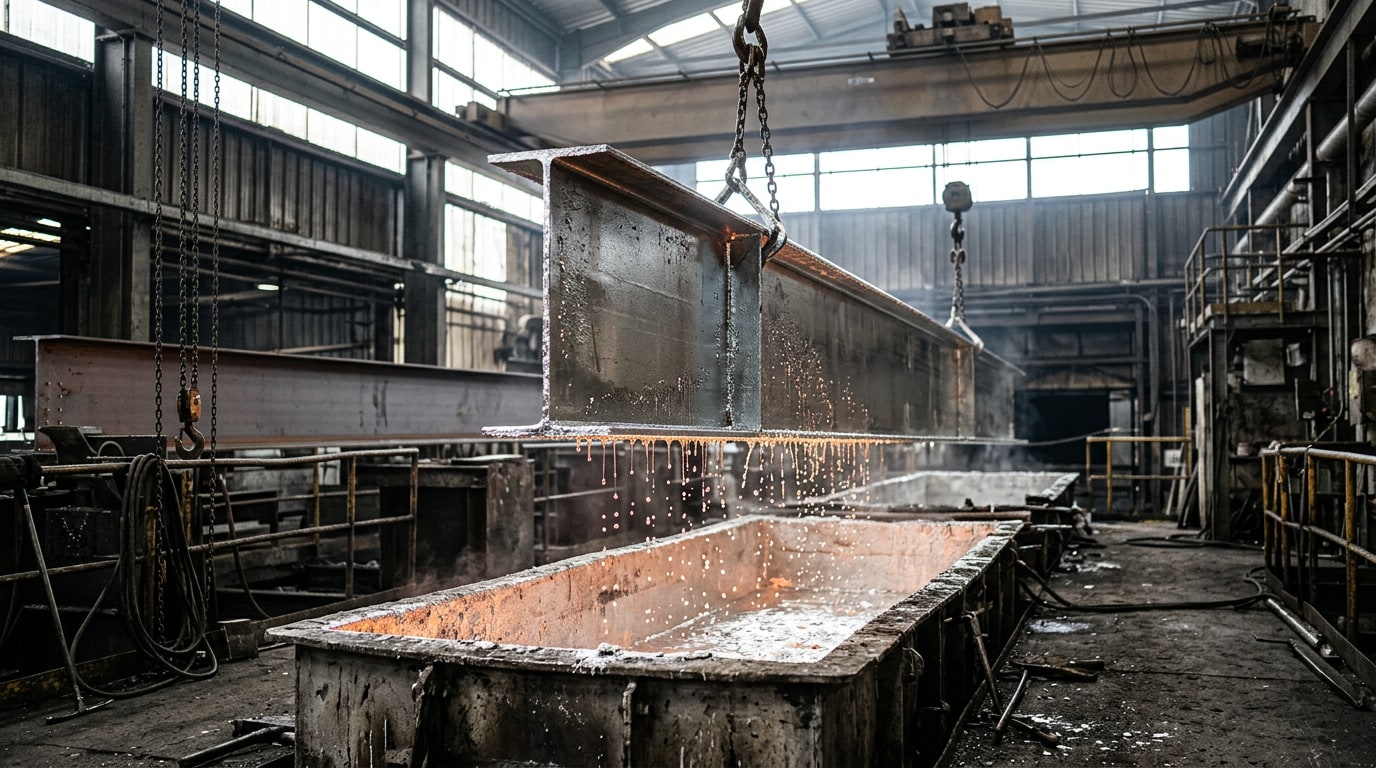
The request comes up more often than you might expect. A fabricator or project manager wants extra corrosion protection, and the logic seems straightforward: if one dip in molten zinc produces a galvanized coating, then two dips should produce a thicker one. It sounds reasonable on the surface, but the metallurgy tells a very different story. In practice, the second immersion does not simply add another full layer of zinc on top of the first. What actually happens at the material level is more nuanced, and understanding it matters for anyone specifying coating performance or trying to meet a corrosion-protection target.
The American Galvanizers Association addresses this directly in their article on double dipping for greater coating thickness. At V&S Galvanizing, we expand on that foundation to explain what is actually happening at the material level, how steel chemistry influences the outcome of a second immersion, and why this practice is often misunderstood in the field.
How a Galvanized Coating Forms in the First Place
To understand why double dipping behaves the way it does, it helps to first understand how the initial coating develops. When steel is immersed in a bath of molten zinc, the zinc and iron at the interface begin to react through a process called diffusion. This is not simply zinc adhering to a steel surface the way paint does. The zinc and iron atoms migrate across the boundary and form a series of distinct zinc-iron alloy layers, each with its own chemical composition and physical properties.
These alloy layers build progressively outward from the steel surface. The outermost layer, which forms when the article is withdrawn from the bath, is free zinc that has not yet reacted with the iron. This eta layer gives galvanized steel its characteristic bright, metallic appearance. Beneath it, the intermetallic alloy layers are harder, more tightly bonded to the steel, and have melting points significantly above that of pure zinc.
For low-silicon steels (those with silicon content below 0.05 percent), this entire diffusion process reaches practical completion within a few minutes of the steel reaching galvanizing temperature. Heavier sections take longer simply because they take longer to heat through, but once they are at temperature, the chemistry runs its course quickly. The coating that forms is dense, metallurgically bonded, and well-characterized.
What the Second Immersion Actually Does
When an already-galvanized article is immersed in the zinc bath a second time, the free zinc surface layer (the eta layer) remelts because its melting point is below the bath temperature. However, the underlying zinc-iron alloy layers do not remelt. Their melting points exceed roughly 850 degrees Fahrenheit, which is above the operating temperature of the bath, so they remain intact and in place against the steel.
From the moment the alloy layers stabilize and the free zinc layer has remelted, the galvanizing process essentially resumes from where it left off after the first dip. The bath zinc is now in contact with the existing alloy zone again, and diffusion continues. If the second immersion lasts the same amount of time as the first, the net result is a coating only slightly thicker than what the first dip produced alone.
That is the critical point: two dips of equal duration do not come close to doubling the coating thickness. The second immersion is not starting from bare steel. It is picking up a reaction that was largely complete, meaning the incremental gain in thickness is small relative to the effort and expectation involved.
The Structural Trade-Off: Increased Alloy Proportion and Brittleness
Beyond the modest thickness gain, the double-dipped coating has a different internal character than a single-dip coating of comparable thickness. Because the second immersion extends the time the steel spends reacting with the zinc bath, the proportion of zinc-iron alloy layers increases relative to the free zinc layer. The coating becomes more alloy-rich overall.
This matters for mechanical performance. The zinc-iron alloy layers, while extremely hard and well-bonded, are less ductile than the free zinc layer. A coating that is disproportionately composed of alloy phases is more prone to cracking or flaking if the steel is subsequently bent, formed, or subjected to impact. The AGA describes this tendency clearly: thicker coatings resulting from extended or repeated immersion have an increased tendency for brittleness.
This does not mean the coating will automatically fail, but it does mean that a double-dipped coating is not simply a better version of the original. It is a structurally different coating, and that difference carries consequences depending on how the steel will be handled, formed, or loaded after galvanizing.
Silicon Steel Behaves Differently, But the Outcome Is the Same
Silicon is a common alloying element in structural steel, and its presence changes how steel reacts with the zinc bath in significant ways. For steels that contain meaningful amounts of silicon, the diffusion reaction does not plateau the way it does with low-silicon steel. Instead, the reaction continues at a roughly linear rate over time, meaning the coating keeps building as long as the steel remains immersed.
On a second immersion, silicon-containing steel picks up right where the first dip left off. The reaction resumes and the coating continues to grow. The end result, however, is effectively the same as if the fabricator had simply used a longer single immersion from the start. There is no meaningful advantage to pulling the article out and reintroducing it. The process does not reset, does not accelerate, and does not produce a fundamentally different outcome than continuous immersion would have.
Silicon steels already tend to produce thicker, more alloy-rich coatings with a matte gray appearance due to their reactivity. Adding a second dip compounds those characteristics: heavier alloy phases, grayer appearance, and the same elevated risk of brittleness that applies to any coating that has grown particularly thick through extended reaction time.
Why This Misconception Persists in the Field
The intuition behind double dipping is not unreasonable at first glance. Many industrial processes work by repetition: additional coats of paint build film thickness, additional passes of a roller increase compaction, additional welding passes fill a joint. It is natural to assume galvanizing works the same way.
The difference is that galvanizing is not an additive surface process in the conventional sense. It is a metallurgical reaction between two materials. Once that reaction has run to completion on a given steel surface, you cannot simply restart it from scratch by reintroducing the metal to the bath. The chemistry does not allow it. The alloy layers that have already formed define the starting condition for any subsequent immersion, and they are far more resistant to further reaction than bare steel was.
Part of the persistence of this misconception also comes from the fact that double dipping is sometimes genuinely necessary, but for a completely different reason. When a fabricated assembly is too long to fit in the available kettle in a single immersion, it must be dipped progressively: one end first, then the other. This is a legitimate and common practice to accommodate large work, not a method for increasing coating thickness. The two should not be confused.
Progressive Dipping for Oversized Work: A Different Application Entirely
Progressive dipping deserves its own clarification because it frequently comes up alongside the double-dip question. When an article exceeds the length of the galvanizing kettle, the galvanizer immerses one portion of the piece, withdraws it, then rotates or repositions the article and immerses the other portion. The overlap zone in the middle receives two immersions, but that is an unavoidable consequence of geometry rather than a deliberate coating strategy.
In the overlap zone, the same metallurgical behavior described above applies: the coating ends up somewhat thicker and more alloy-rich than the single-dip portions, and there may be a visible line at the boundary. For most structural applications this is entirely acceptable. The coating in the overlap zone still meets performance requirements, and the alternative of leaving part of the structure ungalvanized is obviously worse.
What this means for specifiers is that progressive dipping is a fabrication and logistics solution, not a coating specification tool. If your project requires a minimum coating thickness that exceeds what single-immersion galvanizing can reliably achieve, the answer lies elsewhere: in steel selection, in bath chemistry management, or in specifying a duplex system that combines galvanizing with an applied topcoat.
How to Actually Achieve Heavier Coatings When the Project Demands Them
If a project legitimately needs a coating heavier than standard hot-dip galvanizing typically produces, the right approach depends on the application and the steel involved. Steel chemistry is one of the most powerful variables available. Steels with silicon or phosphorus levels in the reactive range produce thicker coatings naturally through faster, more sustained zinc-iron diffusion. Specifying steel with a silicon content in the so-called Sandelin range (roughly 0.04 to 0.14 percent) or above 0.25 percent silicon will result in a heavier coating compared to low-silicon steel processed for the same duration.
Surface preparation also plays a role. Steel that arrives at the galvanizer with a more reactive surface (from shot blasting, for instance) can support more rapid and thorough initial zinc uptake. And for applications where the environment demands exceptional long-term protection, a duplex system that pairs galvanizing with a paint or powder coat topcoat delivers a service life that no amount of re-dipping can match.
Our team works through these variables with fabricators and engineers regularly. The goal is always to get the right coating for the actual service environment, not to exceed specification in ways that introduce other risks like brittleness or dimensional issues from an overly thick alloy zone.
Work With a Team That Understands the Metallurgy
The double-dip question is a good example of how intuition and material science can point in opposite directions. The assumption that a second immersion simply adds more zinc is understandable, but it overlooks the fundamental nature of what hot-dip galvanizing actually is: a controlled metallurgical reaction, not a paint application. The second dip produces only marginal additional thickness at the cost of a more brittle, more alloy-dominated coating structure, and it confers no real advantage over a properly specified single immersion for the same total exposure time.
At V&S Galvanizing, we field these questions because they matter to the long-term performance of the structures our customers are building. Whether the concern is coating thickness, steel chemistry, or how a particular fabrication geometry will behave in the kettle, we bring that technical depth to every project. If you have questions about what approach is right for your application, reach out through our contact page and we will work through it with you.
Frequently Asked Questions About Double Dipping in Hot-Dip Galvanizing
Does double dipping galvanized steel actually double the coating thickness?
No. When a galvanized article is immersed in the zinc bath a second time, the zinc-iron alloy layers already formed do not remelt and the diffusion reaction resumes from where it left off. The coating after a second dip of equal duration is only slightly thicker than after the first. The process does not reset, so thickness does not accumulate the way many people expect.
Why does the double-dipped coating have a tendency toward brittleness?
Extended or repeated immersion increases the proportion of zinc-iron alloy phases relative to the free zinc (eta) layer. The alloy layers are harder and less ductile than free zinc. A coating that is disproportionately composed of these phases is more likely to crack or flake if the steel is subsequently bent, formed, or impacted. This is why thicker coatings resulting from double dipping or long single immersions carry an elevated brittleness risk.
Is the behavior the same for silicon-containing steels during a second dip?
The mechanism is similar but the reactivity is higher. Silicon steels continue reacting with molten zinc at a roughly linear rate rather than plateauing quickly. On a second immersion, the reaction picks up where it left off, producing more additional thickness than low-silicon steel would. However, the end result is no different than if a single extended immersion had been used, and the same brittleness concerns apply to the thicker coating that results.
What is the difference between double dipping for thickness and progressive dipping for oversized work?
Progressive dipping is used when a fabricated assembly is too long to fit in the available kettle in one immersion. One end is dipped first, then the other. The overlap zone receives two exposures to the bath as a geometric necessity, not as a deliberate attempt to increase thickness. The coating behavior in the overlap is the same as any double-dipped zone, but the practice itself is a logistics solution rather than a coating specification strategy.
If I need a heavier galvanized coating, what is the correct approach?
Steel chemistry is one of the most effective levers. Steels with silicon content in the reactive ranges (the Sandelin range or above 0.25 percent silicon) naturally produce thicker coatings due to sustained zinc-iron diffusion. Surface preparation choices also influence initial zinc uptake. For applications requiring maximum long-term protection, a duplex system combining hot-dip galvanizing with a paint or powder coat topcoat delivers service life far beyond what any re-dipping strategy can achieve.
Do the alloy layers in a galvanized coating remelt during a second immersion?
No. The zinc-iron alloy layers that form during the first immersion have melting points above approximately 850 degrees Fahrenheit, which exceeds the operating temperature of the molten zinc bath. Only the outermost free zinc (eta) layer remelts on re-immersion. This is why the second dip does not start the coating formation process over from scratch.
Can the galvanizer control whether a piece gets double dipped?
For pieces that fit the kettle in a single immersion, avoiding a second dip is straightforward. For oversized work requiring progressive dipping, the overlap zone inevitably receives two exposures. A good galvanizer will manage immersion times and withdrawal rates to produce a consistent coating across the piece, and can advise on how the overlap zone will look and perform for a given geometry.
Is a double-dipped coating still protective against corrosion?
Yes, the corrosion protection is not eliminated by a second dip. The coating remains metallurgically bonded to the steel and continues to provide cathodic protection. The concern is not with the protective function itself but with the mechanical properties of the coating: a more alloy-rich, less ductile coating may be more vulnerable to damage from forming operations or impact loading after galvanizing. For static applications where the steel will not be further worked, the practical impact is minimal.
