
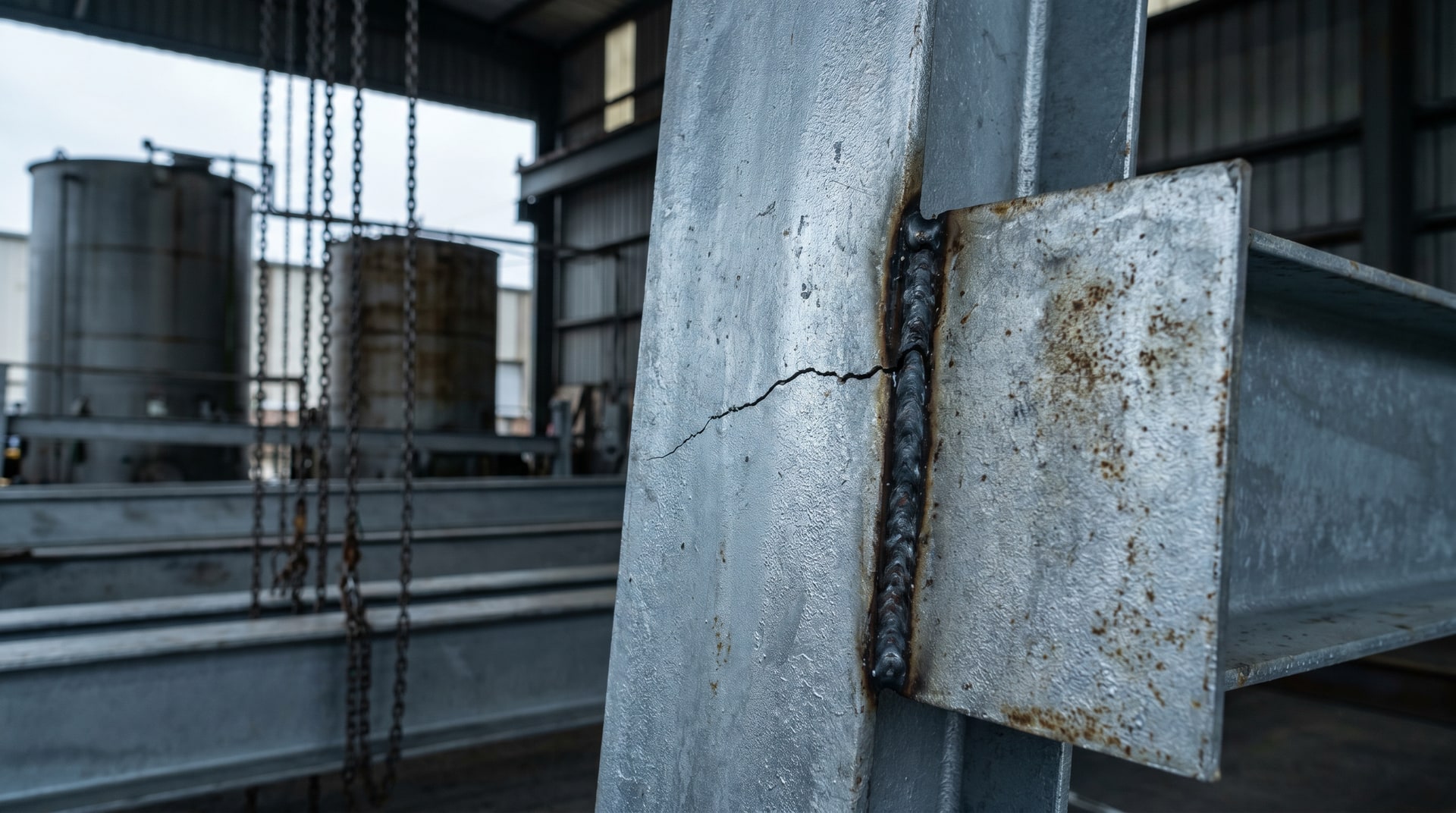
Few things unsettle a fabricator or galvanizer more than lifting a steel assembly out of the kettle and spotting a crack near a weld. The steel looked fine going in. The weld passed inspection. Nothing appeared wrong during fit-up or assembly. Then, after a roughly 840-degree Fahrenheit bath in molten zinc, a small fracture appears in the heat-affected zone, often right at the toe of the weld or just beyond it. It is unsettling precisely because it looks like something catastrophic happened, and the knee-jerk reaction is to assume the part is ruined or unsafe.
The reality is more nuanced, and understanding the mechanics behind this phenomenon changes how you respond to it, how you design around it, and whether you can put the part into service with confidence.
The American Galvanizers Association addresses this directly in their article on cracking in the heat-affected zone. At V&S Galvanizing, we expand on that foundation to explain what is actually happening at the material level, how residual stress influences susceptibility, and why this phenomenon is often misread as general steel embrittlement when the reality is far more localized.
What the Heat-Affected Zone Actually Is
When a weld is made, the arc or flame does not just fuse two pieces of steel together. It creates a thermal gradient that extends outward from the fusion zone into the surrounding base metal. The region that gets hot enough to alter its microstructure, but not hot enough to actually melt, is called the heat-affected zone, or HAZ.
The HAZ is chemically the same steel it always was, but thermally it has been through a localized cycle of rapid heating and cooling that can change its grain structure, residual stress state, and local ductility. Depending on the steel chemistry, the welding procedure, and the geometry of the joint, the HAZ can emerge from the welding process in a condition that is more sensitive to external stresses than the surrounding parent metal.
This matters enormously when that assembly goes into a galvanizing kettle. The steel does not heat uniformly. As different sections expand at different rates, the HAZ, which may already be carrying residual tensile stress from the weld thermal cycle, becomes a concentration point for the additional mechanical stress created by differential thermal expansion. If the combined stress in that zone exceeds the local yield stress of the material, the steel relieves that stress the only way it can: it cracks.
The Role of Liquid Metal Embrittlement
Once that initial crack forms, even a hairline fracture, the situation can escalate through a separate but related mechanism known as liquid metal embrittlement, or LME. This is where the galvanizing process itself becomes a contributing factor rather than simply a passive witness to a pre-existing weakness.
Molten zinc cannot penetrate an opening smaller than roughly 3/32 of an inch under static conditions. But as the steel heats and the crack opens slightly under thermal stress, zinc is drawn into the void by capillary action, a process called wicking. The liquid zinc at the crack tip exerts pressure at the atomic scale on the steel grain boundaries, reducing the cohesive strength of the material and allowing the crack to propagate further into the surrounding steel.
Other low-melting-point metals present in the galvanizing bath, particularly lead and tin, also participate in this process. Because they remain molten longer after the assembly is removed from the kettle, they tend to migrate toward the crack tip rather than solidifying at the surface. Their presence deep inside a crack, near the advancing tip, is actually a reliable indicator that LME was the mechanism at work rather than simple mechanical overload.
It is worth being precise about what LME means here, because the terminology causes real confusion in the field. The steel assembly as a whole is not embrittled. The structural integrity of the member, its yield strength, its load capacity, its long-term performance, none of that is compromised by LME in any global sense. The embrittlement is strictly localized to the HAZ and the immediate vicinity of the crack. Outside that narrow zone, the steel and its zinc coating perform exactly as intended.
Why This Does Not Happen Every Time
One of the genuinely frustrating aspects of HAZ cracking is its inconsistency. The same steel specification, the same weld procedure, the same galvanizer, and it happens on one assembly but not the next. This is not random. It reflects the fact that cracking requires multiple contributing factors to converge simultaneously above a threshold level.
The steel chemistry plays a role. Residual stress from both fabrication and welding plays a role. The geometry of the joint, particularly whether it creates stress concentrations, plays a role. The section thickness influences how quickly heat dissipates and therefore how steep the thermal gradient is in the HAZ. The dipping method matters too, since a progressive dip, where part of a large frame enters the kettle while the rest is still cold, creates far more differential thermal stress than a single full immersion.
No single factor alone is sufficient to cause cracking. It takes a combination of unfavorable conditions all exceeding their individual thresholds at the same time. This is why the occurrence rate in susceptible configurations like cope-cut beams historically ran around 10%, not 100%, and why it defies simple deterministic prediction.
Cope Cuts as a Case Study in Stress Concentration
Cope-cut beams are perhaps the most thoroughly studied instance of this phenomenon. A cope cut creates a notched geometry at the end of a beam where the top flange is cut back to allow the beam to frame into a girder. The 90-degree inside corner of that cut is a textbook stress concentration. When combined with the residual stress already present from the cutting operation and any subsequent welding, the cope region becomes the most vulnerable point on the beam during galvanizing.
The ILZRO research conducted in the mid-1990s examined cope cracking systematically and found that it was not a galvanizing problem per se. It was a fabrication problem that expressed itself under the thermal loading of galvanizing. The most impactful corrective measure that came out of that work was straightforward: apply a weld bead along the edge of the cope on both sides before galvanizing.
The weld bead itself adds very little structural material. Its real function is thermal. Running a weld bead reheats the cope area and allows some of the locked-in residual stress from the original cut and any prior welding to redistribute and relax. This stress relief, applied at the fabrication stage rather than the galvanizing stage, reduces the total stress state in the cope below the threshold needed for cracking to initiate. The result has been a dramatic reduction in occurrence frequency, from roughly 10% down to less than 1%.
Progressive Dipping and Its Contribution to HAZ Stress
For large fabricated frames that cannot fit entirely within a standard kettle, progressive dipping is sometimes the only practical option. The assembly is partially submerged, allowed to reach temperature, then repositioned to coat the remaining sections. This staged approach is effective for coating coverage, but it introduces a thermal loading condition that single-dip immersion does not.
When only part of the assembly is in the kettle, the submerged sections are expanding rapidly while the sections still in air remain cool and dimensionally stable. The weld connections between those zones are then subjected to bending and shear stresses driven purely by differential thermal expansion, loads that were never part of the original design intent for those joints. If a HAZ in that transition region is already carrying residual stress from fabrication, the additional stress from progressive dipping may push it over the threshold.
Our team communicates this risk clearly with fabricators before any progressive dip. If there is a finite probability of weld-zone cracking, the fabricator needs to understand that going in, review the geometry with their engineer, and make an informed decision about whether to proceed or explore alternatives such as designing the project around a larger kettle. That conversation, documented and confirmed before the work begins, is the professional standard for managing this risk responsibly.
Repairing a Cracked Member After Galvanizing
When cracking does occur, the appropriate response is not to immediately condemn the part. Experience accumulated over decades of cope-crack remediation shows that many affected members can be repaired and placed into service with full structural confidence.
The repair procedure involves gouging out the crack to approximately one half inch beyond the visible crack tip. This step is critical. The crack tip is where the LME propagation has been most active, and simply filling the visible portion of the crack without removing the stressed material at the tip leaves the most vulnerable zone intact. Once the cracked and affected material is removed, the excavated area is backfilled with weld material, restoring the section geometry.
Because the galvanized coating has been disrupted in the repair area, corrosion protection must be restored in accordance with ASTM A780, which covers repair of damaged and uncoated areas of hot-dip galvanized coatings. Touch-up applied per ASTM A780 provides a corrosion barrier comparable in longevity to the surrounding galvanized surface for most service environments.
The repaired assembly then goes to the engineer of record for review and approval before being placed into service. This is not a formality. The engineer needs to confirm that the excavation and weld repair did not compromise the structural capacity of the member for its intended application. In practice, beams repaired using this process have performed without further issues in service, with some documented cases running beyond 15 years without recurrence or structural concern.
What Fabricators and Engineers Should Take Away From This
HAZ cracking during galvanizing is not a galvanizing defect in the conventional sense. The galvanizing process is a thermal event that reveals stress conditions already present in the fabricated assembly. The molten zinc contributes to crack propagation through LME once a crack initiates, but it does not cause the crack to form in steel that is below its yield stress threshold.
This distinction matters for accountability and, more importantly, for prevention. Fabricators working with weld-intensive assemblies destined for hot-dip galvanizing should give particular attention to residual stress management in areas of geometric discontinuity. Cope cuts, notches, and re-entrant corners are the highest-risk locations. Pre-galvanizing stress relief, whether through a weld bead at a cope or through formal thermal stress relief where warranted, is the most controllable intervention available at the fabrication stage.
Engineers specifying galvanized assemblies benefit from understanding that progressive dipping of large frames carries inherent thermal stress risks that single-dip immersion largely avoids. Where kettle size is a constraint, that constraint should inform the design of the welded joints and their expected residual stress state, not just the logistics of the galvanizing operation.
Work With a Team That Understands the Metallurgy, Not Just the Process
HAZ cracking is one of those phenomena that sits at the intersection of welding metallurgy, structural design, and galvanizing process engineering. Managing it well requires fluency in all three. Our team at V&S Galvanizing engages these conversations before work begins, not after a crack appears. We review fabrication drawings, flag geometry concerns, and coordinate with fabricators on dipping strategy for large or complex assemblies. When cracking does occur, we document it, communicate it clearly, and walk through the repair pathway in accordance with ASTM A780 so the affected member can return to service with proper engineering review.
If you are working on a project that involves welded steel assemblies, cope-cut beams, or large frames requiring progressive dipping, reach out to us before fabrication is complete. The earlier these conversations happen, the more options are on the table. Visit our contact page to connect with our technical team directly.
Frequently Asked Questions About HAZ Cracking in Hot-Dip Galvanizing
What causes cracking in the heat-affected zone during hot-dip galvanizing?
Cracking in the HAZ results from a combination of residual stress from welding, stress concentrations at geometric discontinuities, and the additional thermal stress introduced when the steel assembly heats unevenly in the galvanizing kettle. When the combined stress in the HAZ exceeds the local yield stress of the steel, the material relieves that stress by forming a crack. No single factor is sufficient on its own; it requires multiple conditions to converge above a threshold simultaneously.
Is liquid metal embrittlement the same as hydrogen embrittlement in galvanized steel?
No. Liquid metal embrittlement (LME) and hydrogen embrittlement are distinct mechanisms. LME occurs when molten zinc or other low-melting-point metals such as lead or tin wick into an existing crack and propagate it further by reducing grain boundary cohesion. Hydrogen embrittlement involves atomic hydrogen diffusing into the steel lattice under stress. In the context of HAZ cracking during galvanizing, LME is the relevant mechanism, and it is localized to the crack zone, not a global condition affecting the whole member.
Does a crack in the HAZ mean the entire steel member is compromised?
Not necessarily. LME-driven cracking is localized to the HAZ and the immediate crack zone. The structural capacity of the member outside that region is unaffected. Many cracked members can be repaired by gouging out the crack to approximately one half inch beyond the visible tip, backfilling with weld material, and restoring corrosion protection per ASTM A780. The repaired assembly must be reviewed and approved by the engineer of record before returning to service.
Why do cope-cut beams crack more frequently than other welded members?
Cope cuts create a 90-degree re-entrant corner, which is a stress concentration by geometry. Combined with residual stress from the cutting and welding operations, the cope region carries a higher baseline stress than most other parts of the beam. During galvanizing, that pre-loaded zone is subjected to additional thermal stress, making it disproportionately susceptible to cracking. The ILZRO research from the mid-1990s found a historical occurrence rate of roughly 10% for cope cracking before corrective fabrication practices were introduced.
What is the most effective way to prevent HAZ cracking before galvanizing?
The most controllable preventive measure is reducing residual stress in vulnerable areas before the assembly enters the kettle. For cope-cut beams, applying a weld bead along the edge of the cope on both sides has been shown to reheat the area and relieve residual stress, reducing cope cracking frequency from approximately 10% to less than 1%. More broadly, minimizing stress concentrations through thoughtful joint geometry and managing welding sequence to reduce locked-in stress are the primary tools available to fabricators.
How does progressive dipping increase the risk of weld-zone cracking?
Progressive dipping submerges only part of a large assembly at a time, which means different sections of the steel are at very different temperatures simultaneously. The submerged sections expand thermally while the sections still in air do not. Weld connections across that thermal boundary experience bending and shear stress driven by differential expansion, loads that compound any residual stress already present in the HAZ. Single full immersion eliminates this differential because the entire assembly heats more uniformly.
Can zinc penetrate a crack that is too small to see?
Zinc cannot penetrate openings smaller than approximately 3/32 of an inch under static conditions. However, once a crack begins to open under thermal stress during galvanizing, the opening enlarges dynamically and zinc is drawn in by capillary wicking action rather than relying on static pressure alone. This is why the crack propagation associated with LME can occur even from a very small initial defect: the thermal loading opens the crack just enough for wicking to begin, and the presence of molten metal at the crack tip then assists further propagation.
What standard governs touch-up and repair of galvanized coatings after weld repair of a cracked member?
ASTM A780 covers the repair of damaged and uncoated areas on hot-dip galvanized steel, including areas disturbed by weld repair of HAZ cracks. Touch-up applied in accordance with ASTM A780 restores the corrosion barrier in the repaired zone. After the weld repair and coating touch-up are complete, the engineer of record must review and approve the member before it is placed into service.
