

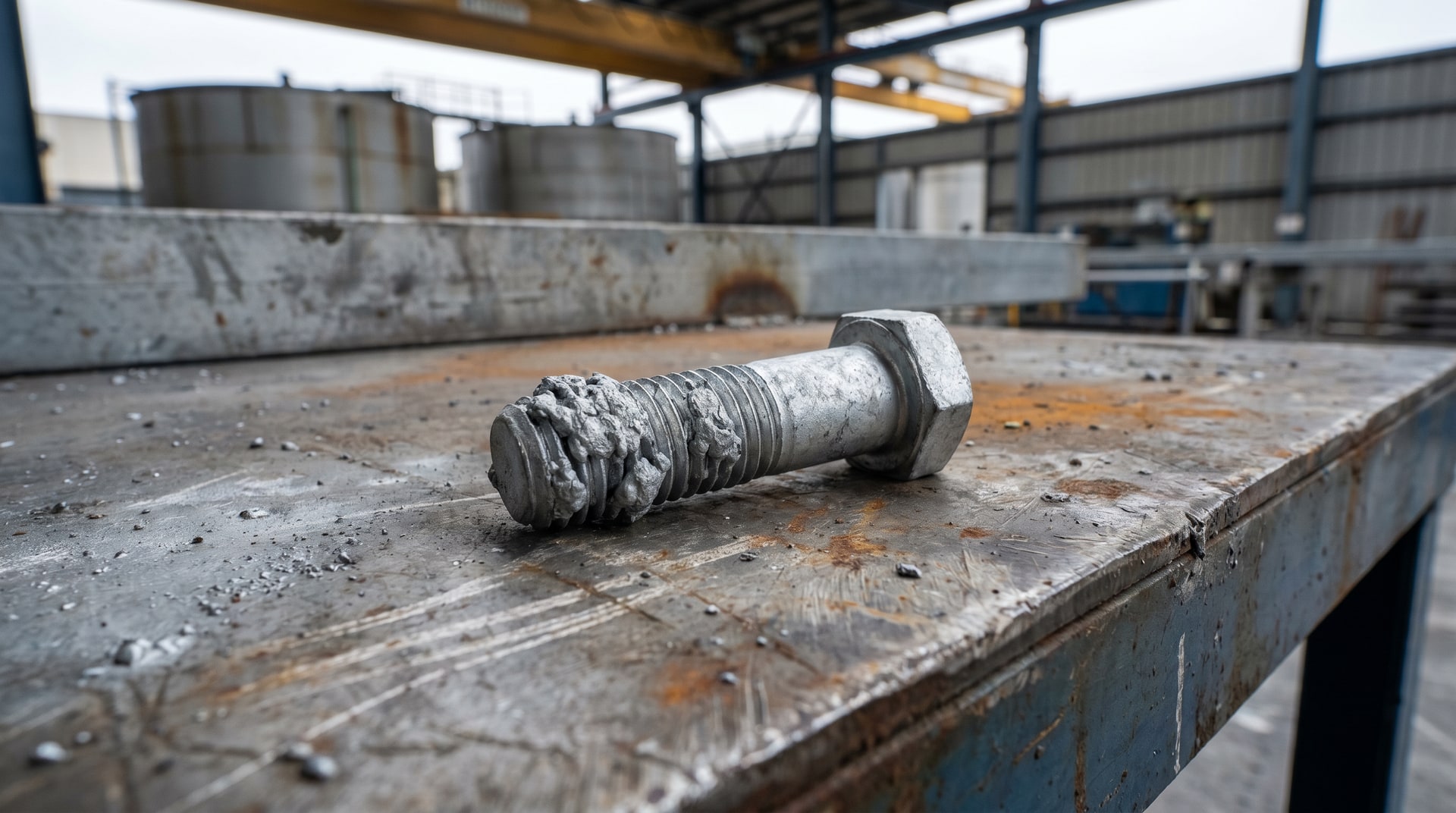
When threaded fasteners or assemblies come out of a hot-dip galvanizing kettle, the ideal outcome is a smooth, adherent zinc coating that follows the contours of the threads without filling them in. In practice, that does not always happen. Excess zinc can pool and solidify in the thread valleys before it drains completely, leaving a rough, bridged buildup that prevents mating parts from assembling correctly. It is one of the more common complaints in the field, and it is one of the more preventable quality issues in the process.
The American Galvanizers Association addresses this directly in their article on cleanup of clogged threads. At V&S Galvanizing, we expand on that foundation to explain what is actually happening at the material level, how drainage behavior influences zinc retention in threaded profiles, and why this is often misunderstood in the field.
What Actually Causes Threads to Clog
The root cause is straightforward: poor drainage of the threaded section after the part is withdrawn from the galvanizing kettle. Molten zinc clings to steel surfaces through a combination of surface tension and the metallurgical bonding that characterizes the hot-dip process. When a part is withdrawn at the correct angle and speed, gravity pulls most of the free zinc off the surface before it solidifies. Threads, however, present a challenge that flat or tubular surfaces do not.
Thread profiles are intentionally complex. The helical geometry creates recesses where molten zinc can accumulate, and the relatively close spacing of thread crests means that zinc bridging across adjacent thread valleys is physically easy. If the part is withdrawn slowly, held at the wrong angle, or if the zinc in the kettle is slightly above the temperature range that produces optimal fluidity, the zinc that has pooled in the thread geometry may not have time to fully drain before it transitions from liquid to solid.
This is not a surface contamination problem or a flux residue issue. The zinc that clogs threads is fully metallurgically bonded zinc that simply accumulated in excess before it could drain. That distinction matters because it defines how cleanup is approached.
Why Thread Geometry Makes This Worse Than It Looks
Standard fastener threads are designed with tight tolerances. The thread form geometry, whether UN, UNC, metric coarse, or another standard, dictates a specific clearance between male and female threads. Hot-dip galvanizing adds zinc to all exposed surfaces, including thread flanks, roots, and crests. When done well, this added thickness is accommodated by tapping female threads oversize before galvanizing, or by specifying that the galvanizer produce coating thicknesses within the range that still allows assembly.
When threads clog, those tolerances become irrelevant. A bridge of solidified zinc spanning two adjacent thread valleys can add several times the nominal coating thickness in a single location, making it physically impossible to thread a nut onto a bolt regardless of how the nut was prepared. Even a partial clog, where zinc has built up unevenly on one flank of a thread form, can cause galling or cross-threading during assembly that damages both the zinc coating and the base metal.
This is why specification compliance specifically requires that clogged threads be addressed before a part is accepted. The coating may technically cover the substrate and meet thickness requirements in other areas, but if the threaded section is not functional, the part does not meet specification.
The Two Primary Cleanup Methods
The AGA identifies two accepted post-galvanizing cleanup operations for clogged threads: centrifuging and thermal cleaning followed by wire brushing. Each works on the same principle but suits different production contexts.
Centrifuging is used for small parts, typically fasteners like bolts, nuts, and washers that are galvanized in bulk using a spin basket or drum. After the basket of parts is withdrawn from the kettle, it is placed into a centrifuge that spins at high speed. The centrifugal force throws excess zinc off the surfaces before it solidifies, including out of thread valleys. This method is highly effective and is standard practice for galvanizing fasteners at commercial scale. The result is a much more uniform coating with significantly reduced thread fill compared to parts that were simply rack-galvanized without centrifuging.
For parts that are too large to centrifuge, or for individual pieces where clogging was not caught before the zinc had solidified, the thermal method applies. The clogged area is heated with a torch to approximately 500 degrees Fahrenheit (260 degrees Celsius). At that temperature, the zinc softens enough to be mechanically displaced without requiring the sustained heat that would compromise the metallurgical bond across the rest of the coating. Once softened, a wire brush removes the excess zinc from the thread profile. The part is then inspected to confirm that threads are clear and that the remaining coating is intact.
Understanding the 500 F Threshold
The temperature specified for thermal cleanup, approximately 500 F (260 C), is not arbitrary. It sits in a range that is high enough to make excess zinc workable but low enough to avoid damaging the underlying zinc-iron alloy layers that form during galvanizing.
The hot-dip galvanizing coating is not a single homogeneous layer of zinc. It is a series of zinc-iron intermetallic alloy layers that form through diffusion during immersion in the kettle, topped by a layer of relatively pure zinc. These alloy layers, sometimes called the gamma, delta, and zeta phases depending on their iron content, are harder and more brittle than the outer zinc layer. They are also what gives the coating its strong adhesion to the base steel.
Heating the coating significantly above 500 F risks accelerating further zinc-iron diffusion, which can alter the microstructure of the coating in ways that affect its long-term performance. More immediately, temperatures above approximately 750 F can begin to thermally stress the zinc coating itself. The 500 F target gives the technician enough thermal softening of the excess zinc to work with a wire brush effectively while staying well below the range where the rest of the coating becomes a concern.
Proper technique matters here. The torch should be applied locally to the clogged section, not swept broadly across the part. The goal is to soften the excess zinc, not to reheat the entire assembly. Once the excess material is brushed away, the threads should be inspected under adequate lighting to confirm complete cleanup.
What the Specification Actually Requires
The language in the AGA guidance is direct: clogged threads must be cleaned before the part will meet specification. This is not a cosmetic requirement. Thread functionality is a performance requirement, and a part with non-functional threads has not been successfully galvanized in any practical sense, regardless of what the coating looks like everywhere else.
For projects governed by ASTM A123 (structural steel and fabricated products), ASTM A153 (hardware and fasteners), or ASTM F2329 (bolts, nuts, and similar threaded fasteners), the relevant specification will define coating thickness requirements, but the underlying expectation in all cases is that the coating is applied in a manner consistent with the part remaining usable. A clogged thread fails that expectation.
When inspecting galvanized threaded components, inspectors should verify that a nut, fitting, or mating part can be assembled without excessive force and without damaging the coating. If resistance is felt during assembly and the source is zinc buildup rather than substrate damage, the part needs to go back for cleanup before acceptance.
Prevention Is More Reliable Than Cleanup
While cleanup methods are effective, preventing thread clogging at the point of processing is always preferable. The quality of drainage during withdrawal from the kettle depends on several controllable factors: the angle at which the part enters and exits the zinc bath, the withdrawal speed, the zinc temperature, and whether the part geometry has been designed to facilitate drainage.
For parts with threaded sections at the ends of rods or studs, positioning those ends downward during withdrawal allows gravity to do most of the drainage work. When threaded holes are located in areas where the geometry traps zinc regardless of orientation, the galvanizer may recommend plugging those holes before processing and cleaning them out after. This is a fabrication-side consideration that is worth discussing before a job goes to the shop floor.
Our team at V&S Galvanizing works with fabricators to review fixturing and drainage planning before parts are processed, particularly for assemblies with multiple threaded connections. Addressing drainage geometry in advance reduces the likelihood of cleanup work after the fact and helps keep project timelines on track.
Field Misconceptions Worth Addressing
One common misconception is that clogged threads can simply be retapped to restore function. While retapping does physically restore thread geometry, it removes zinc from the thread flanks and roots in the process. That zinc was providing corrosion protection to the most vulnerable part of the thread profile. Retapping after galvanizing should be treated as a last resort, not a routine fix, and the exposed base metal at the retapped surfaces should be treated with a zinc-rich repair compound to restore corrosion protection in those areas.
Another misconception is that clogged threads are always the galvanizer's fault. Fabrication variables play a real role. Parts with very fine thread pitches accumulate zinc more readily in the thread valleys simply because the geometry offers less clearance for drainage. Specifying a coarser thread pitch where strength requirements allow it can significantly reduce the likelihood of clogging. Similarly, parts that arrive at the galvanizer with thread surfaces that were not properly prepared during fabrication may have surface conditions that affect zinc drainage behavior.
There is also occasional confusion between clogged threads and what might more accurately be called thickened threads, where the coating has been applied within normal parameters but the cumulative coating thickness on thread flanks has reduced the effective thread clearance enough to cause assembly difficulty. This is a design consideration addressed by pre-galvanizing thread modification, not a cleanup issue. The two conditions look similar on inspection but have different causes and different appropriate responses.
Work With a Team That Understands Thread Behavior at Every Stage
Threaded connections in galvanized steel are functional components, not decorative ones. The zinc coating that protects them has to meet specification and preserve usability, and when clogging occurs, the right cleanup method applied correctly makes the difference between a compliant part and one that causes problems in the field. Understanding the thermal behavior of zinc, the geometry of thread profiles, and the specification requirements that govern acceptance is what separates a galvanizer that simply runs parts through a kettle from one that takes responsibility for the finished product.
If you have questions about how threaded assemblies are handled during processing, what drainage planning looks like for complex fabrications, or how to approach a project where thread performance is critical, reach out through our contact page. Our team is glad to work through the details with you before processing begins.
Frequently Asked Questions About Clogged Threads in Hot-Dip Galvanizing
What causes threads to clog during hot-dip galvanizing?
Clogged threads are caused by poor drainage of the threaded section after the part is withdrawn from the galvanizing kettle. Molten zinc accumulates in thread valleys and solidifies before gravity can pull it clear, particularly when withdrawal angle, speed, or zinc temperature is not optimized for the part geometry.
Can clogged galvanized threads be cleaned without damaging the coating?
Yes. The two accepted methods are centrifuging (for small parts processed in bulk) and heating the clogged area to approximately 500 F (260 C) with a torch followed by wire brushing. Both methods remove excess zinc while preserving the metallurgically bonded coating on the rest of the thread surface.
Why is the cleanup temperature set at approximately 500 F (260 C)?
At 500 F, excess zinc softens enough to be displaced with a wire brush without accelerating zinc-iron diffusion in the underlying alloy layers or thermally stressing the coating. Temperatures significantly above this range risk altering the microstructure of the coating or compromising its adhesion.
Is retapping clogged threads an acceptable solution?
Retapping is generally a last resort. It removes zinc from the thread flanks and roots, reducing corrosion protection in those areas. If retapping is necessary, the exposed base metal should be treated with a zinc-rich repair compound to restore protection at the retapped surfaces.
Do clogged threads fail specification?
Yes. Regardless of whether the coating meets thickness requirements in other areas, a part with non-functional threads does not meet specification. ASTM A153, A123, and F2329 all require that coatings be applied in a manner that preserves the usability of the component. Clogged threads must be cleaned before the part can be accepted.
How can thread clogging be prevented during fabrication planning?
Positioning threaded ends downward during kettle withdrawal improves drainage. Specifying coarser thread pitches where strength allows it reduces zinc accumulation in thread valleys. For threaded holes in areas with drainage challenges, plugging before processing and cleaning out after galvanizing is an effective preventive measure worth discussing with the galvanizer before parts are processed.
What is the difference between clogged threads and thickened threads?
Clogged threads result from excess zinc pooling and bridging across thread valleys during processing. Thickened threads occur when the coating is applied within normal parameters but the cumulative thickness on thread flanks reduces effective clearance. Clogged threads require cleanup; thickened threads are addressed through pre-galvanizing thread modification and design planning.
Are centrifuged fasteners less likely to have clogged threads?
Significantly less likely. Centrifuging spins excess zinc off all surfaces, including thread valleys, before it solidifies. It is standard practice for bulk fastener galvanizing and produces much more consistent thread clearance than rack galvanizing without centrifuging.
