
When an engineer specifies hot-dip galvanizing for a structural or mechanical component, the conversation usually centers on corrosion protection, coating thickness, and service life. But every once in a while, a project brings friction into the equation. A large drive shaft, a high-strength bolted connection, or a slip-critical joint suddenly requires a number that most galvanizing references do not prominently feature: the coefficient of friction, or more precisely in structural engineering terms, the slip factor of the zinc coating.
This is not an obscure concern. In drive mechanisms, motor sizing depends on knowing how much resistance a shaft surface presents to adjacent components. In bolted structural connections, slip-critical joint design depends directly on the friction characteristics of the faying surfaces. Getting this number wrong can mean undersized motors, premature joint movement, or a connection that does not perform as intended under load.
The American Galvanizers Association addresses this directly in their article on coefficient of friction for zinc. At V&S Galvanizing, we expand on that foundation to explain what is actually happening at the material level, how surface condition influences slip resistance, and why this topic is often misunderstood or overlooked during the design phase.
Slip Factor vs. Coefficient of Friction: Why the Distinction Matters
The terms "coefficient of friction" and "slip factor" are related but not interchangeable in engineering practice. The coefficient of friction is a material property describing the ratio of the frictional force resisting lateral movement to the normal force pressing two surfaces together. It shows up in introductory physics and is a staple of mechanical engineering coursework.
Slip factor, on the other hand, is used specifically in the context of high-strength bolted connections. It incorporates not just the friction between surfaces, but also the behavior of the joint assembly under load, including how bolt preload distributes clamping force and how the joint resists slip before any significant movement occurs. For a structural engineer sizing a slip-critical connection, the slip factor is the more relevant and useful value.
When fabricators or engineers ask us about the friction properties of a galvanized coating, the slip factor is what they actually need. For drive mechanism applications, the slip factor serves as a reasonable proxy for understanding the relative slipperiness of the zinc surface compared to other material conditions. The key point is that both applications benefit from the same core data.
What the Data Actually Shows
The reference values most widely cited in this area come from research by W.H. Munse on high-strength bolting of galvanized connections. That work established baseline slip factor values for zinc-coated steel under several surface conditions, and those values remain the standard reference today.
| Surface Condition | Average Slip Factor |
|---|---|
| As-Galvanized | 0.14 |
| Weathered Galvanized | 0.20 |
| Galvanized Wire Brushed | 0.31 |
| Galvanized Grit Blasted | 0.31 |
| Bare Steel, As Rolled | 0.35 |
The as-galvanized slip factor of 0.14 is notably lower than the 0.35 value for clean as-rolled bare steel. In practical terms, a freshly galvanized surface is roughly 60 percent more slippery than uncoated rolled steel. This difference is significant enough to affect motor sizing calculations, joint performance under cyclic loading, and connection behavior in seismic or dynamic applications.
The reason for this reduced friction lies in the nature of the zinc coating itself. Hot-dip galvanizing produces a surface that, when freshly processed, has a relatively smooth, crystalline zinc outer layer. The zinc-iron alloy layers beneath are harder, but the free zinc at the surface has less mechanical interlocking texture than the mill scale and surface irregularities present on as-rolled steel. The result is a surface that offers less resistance to lateral sliding forces.
How Weathering and Surface Treatment Change the Picture
The slip factor for galvanized steel is not fixed. It changes meaningfully depending on what happens to the surface after galvanizing. Weathered galvanized steel shows a slip factor of 0.20, which is notably higher than the freshly galvanized value of 0.14. Wire brushing or grit blasting the surface brings the slip factor up to 0.31, approaching the baseline for bare as-rolled steel.
This progression makes physical sense. When a galvanized surface is exposed to the atmosphere over time, zinc reacts with oxygen, moisture, and carbon dioxide to form zinc carbonate, commonly known as zinc patina. This conversion coating is more textured and chemically different from the smooth metallic zinc of a fresh galvanized surface. The patina provides more mechanical grip between mating surfaces, which is why the slip factor rises from 0.14 to 0.20 after weathering.
Mechanical surface preparation takes this further. Wire brushing physically abrades the zinc surface, creating micro-scale roughness that dramatically increases the contact friction. Grit blasting does the same at a more aggressive level, producing surface profiles that allow the mating surfaces to interlock more effectively. Both methods bring the slip factor to 0.31, which is close to but still below the bare steel baseline of 0.35.
For engineers designing connections where slip-critical performance is essential, this range of possible values is important. A joint designed assuming a slip factor of 0.14 will be considerably more conservative than one designed around 0.31, and the difference in required bolt count or plate size can be substantial on large structural assemblies.
Implications for Drive Mechanism and Shaft Applications
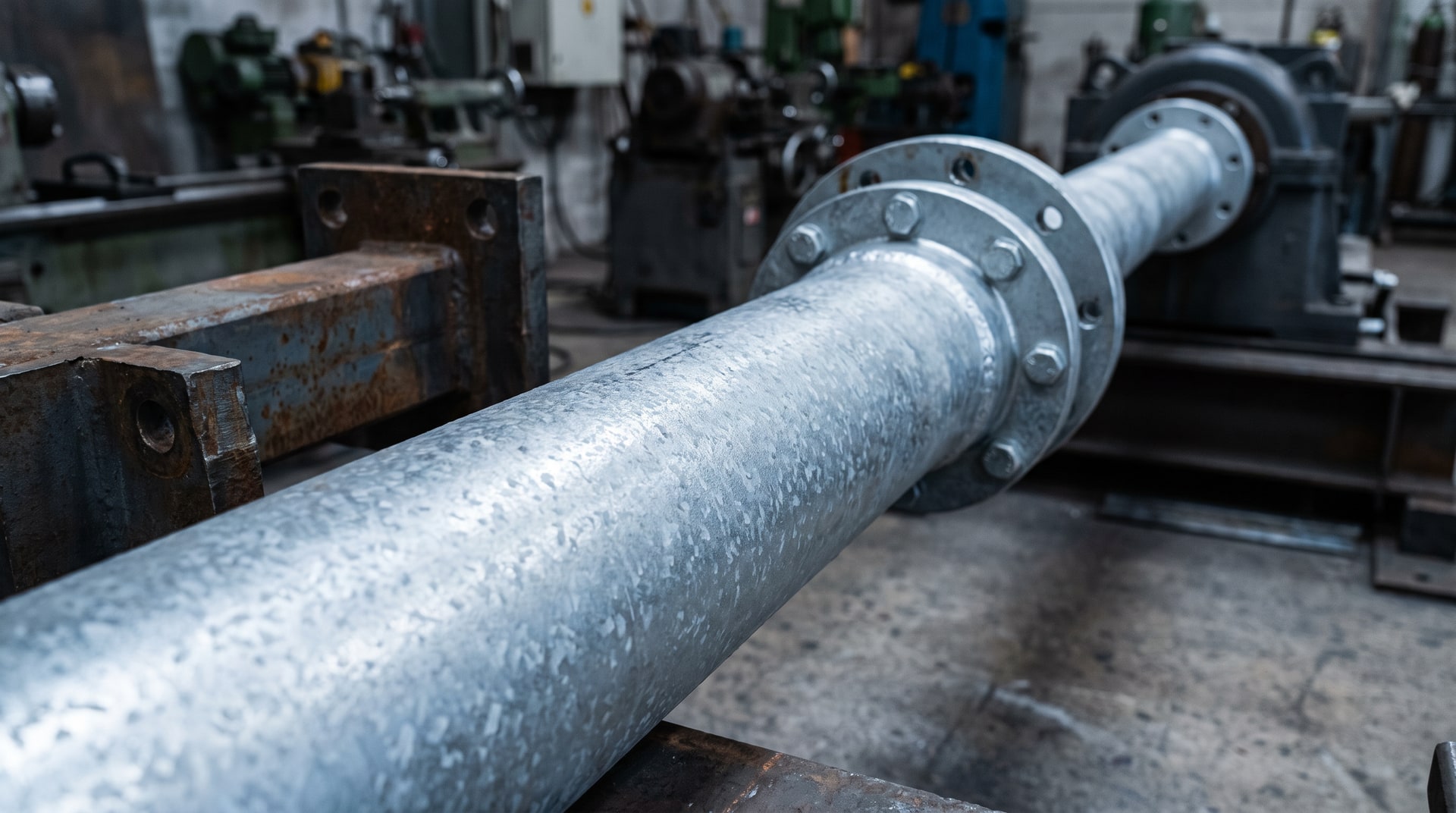
The scenario that prompted the original AGA question, a large shaft in a drive mechanism, illustrates a real engineering challenge. When galvanizing is applied to a rotating shaft or a component that transfers torque through contact friction, the slip factor of the zinc coating directly affects how much force or torque the surface can transmit before relative motion occurs between parts.
A motor sized based on bare steel friction values will be oversized for a galvanized shaft. Conversely, if a designer assumes bare steel friction and then specifies galvanizing without adjusting the calculation, the motor may not generate enough torque to drive the mechanism under load. Neither scenario is acceptable in a well-engineered drive system.
The appropriate approach is to use the slip factor corresponding to the actual surface condition the shaft will have in service. If the shaft will be installed with a fresh galvanized surface, 0.14 is the right value. If the assembly will be exposed to the environment before installation and the zinc will have time to weather, 0.20 may be more representative. If the shaft surface is mechanically prepared before assembly, values approaching 0.31 are appropriate.
Communicating this to the design engineer early in the project prevents costly redesign later. We regularly work with fabricators and engineers during the pre-fabrication phase to flag exactly these kinds of material property questions before they become field problems.
Slip-Critical Bolted Connections: Where the Numbers Carry Real Structural Consequence
In structural steel construction, slip-critical connections are joints where the design does not permit any significant relative movement between connected parts under service loads. High-strength bolts are pretensioned to a specified level, and the joint relies on the friction between the faying surfaces to resist shear. If the faying surfaces slip before the design load is reached, the connection has failed its performance requirement even if no bolts have broken.
For galvanized structural connections, the slip factor of 0.14 for as-galvanized surfaces means that a standard bolted connection designed for bare steel performance will be inadequate if the steel is subsequently galvanized without adjusting the connection design. This is not a theoretical concern. It has real consequences for bridge components, industrial platforms, crane rails, and other structures where connection stiffness matters.
The AISC design specifications and related standards address slip-critical connections by specifying Class A and Class B faying surfaces, each with defined slip coefficients. Galvanized surfaces at 0.14 fall into Class A territory, while wire-brushed or grit-blasted galvanized surfaces at 0.31 approach Class B. Designers who need a specific performance class must specify the appropriate surface preparation condition, not just the coating type.
This is one reason why our team emphasizes coordination between the galvanizing specification and the connection design. If a structural engineer specifies slip-critical connections and hot-dip galvanizing on the same drawing without specifying surface preparation of the faying surfaces, there is a good chance the intended slip performance will not be achieved with the as-galvanized coating alone.
Common Misconceptions About Zinc and Friction
One misconception we encounter fairly often is the assumption that because zinc is a relatively soft metal, a galvanized surface must be rough or grippy. In reality, the smoothness of a freshly galvanized finish is one of the things that surprises people who handle the material for the first time. The bright, spangled finish of a new galvanized surface is visually and tactilely smoother than mill-scale steel, and the slip factor confirms what the hand test suggests.
Another common misunderstanding is treating the slip factor as a fixed property of zinc rather than a property of a surface condition. The same zinc coating can have a slip factor of 0.14 fresh out of the kettle and 0.31 after grit blasting. The zinc is the same material; the surface geometry and texture are what change. This distinction is important because it means engineers have some control over the friction characteristics of a galvanized surface through specification and surface treatment choices.
There is also occasional confusion between the slip factor and the coefficient of kinetic friction used in mechanical calculations. For a rotating shaft or a sliding component, the relevant value is kinetic friction, which describes resistance during motion rather than the threshold force required to initiate slip. The slip factor data from bolted connection research is most directly applicable to static or quasi-static slip in structural joints. For dynamic mechanical applications, the slip factor values serve as a useful relative reference, but a mechanical engineer may need additional testing for high-precision drive system design.
Practical Guidance for Specifiers and Designers
For most structural applications, the as-galvanized slip factor of 0.14 is the baseline to use unless the connection design accounts for weathering or surface preparation. If a project requires slip-critical performance above what the as-galvanized condition provides, the specification should call out wire brushing or grit blasting of the faying surfaces after galvanizing. This adds a step to the fabrication process but brings the slip factor to 0.31, which is substantially more capable.
For drive mechanism and rotating shaft applications, the motor sizing engineer should be provided with the applicable slip factor value based on the intended service condition of the galvanized surface. Providing a range, from 0.14 as-galvanized to 0.20 weathered, gives the engineer a conservative and a more moderate value to bracket the design.
When detailing connections, it is worth noting that only the faying surfaces of a joint require treatment to achieve a specific slip factor. The rest of the galvanized coating continues to provide full corrosion protection regardless of whether the faying surfaces have been wire brushed or grit blasted. The protective function of the coating outside the connection zone is unaffected by localized surface preparation at the joint interface.
Our team at V&S Galvanizing has worked on projects across industrial, structural, and infrastructure applications where slip factor has been a legitimate design input. Early coordination between the galvanizing contractor, fabricator, and structural engineer is the most effective way to ensure the finished assembly meets the design intent without surprises during installation or inspection.
Work With a Team That Understands How Coating Properties Affect Connection Performance
Hot-dip galvanizing is a well-understood process, but its interaction with structural and mechanical design goes deeper than most project teams expect until a specific question surfaces late in the design cycle. Slip factor is one of those properties that rarely comes up until it suddenly becomes critical, and at that point the options for addressing it without disrupting the schedule depend heavily on how well the specification was written at the outset.
At V&S Galvanizing, we bring process knowledge and materials understanding to these conversations early. Whether the question involves a drive shaft, a slip-critical bolted frame, or a structural assembly where faying surface preparation needs to be coordinated with coating requirements, our team can provide the technical input that keeps the project on track. If you have a project where coating friction properties are a design consideration, reach out through our contact page and we will work through it with you.
Frequently Asked Questions About Slip Factor and Zinc Coating Friction
What is the slip factor of a freshly hot-dip galvanized surface?
The slip factor for a conventional as-galvanized coating is approximately 0.14, based on research by W.H. Munse on high-strength bolting of galvanized connections. This is notably lower than the 0.35 slip factor of clean as-rolled bare steel, meaning a freshly galvanized surface is considerably more slippery than uncoated mill steel.
How does weathering affect the slip factor of galvanized steel?
Weathering increases the slip factor from 0.14 to approximately 0.20. As zinc reacts with atmospheric oxygen, moisture, and carbon dioxide over time, it forms a zinc carbonate patina that is more textured than fresh metallic zinc. This added surface texture provides greater mechanical resistance to sliding, which is reflected in the higher slip factor value.
Can surface preparation be used to increase the slip factor of a galvanized connection?
Yes. Wire brushing or grit blasting a galvanized surface after coating raises the slip factor to approximately 0.31. Both methods mechanically abrade the zinc surface to create a rougher profile that increases contact friction between faying surfaces. This is a common approach when slip-critical performance above the as-galvanized level is required by the connection design.
Does grit blasting after galvanizing damage the corrosion protection of the coating?
Localized grit blasting of faying surfaces does remove some zinc from those specific areas, which reduces coating thickness at the treated locations. However, when applied only to the faying surfaces of a connection, the rest of the galvanized assembly retains its full protective coating. The joint surfaces themselves are typically enclosed between mating plates after assembly, limiting their direct exposure to the corrosive environment.
Is the slip factor the same as the coefficient of friction used in mechanical drive calculations?
Not exactly. Slip factor is a structural engineering term applied to the behavior of pretensioned high-strength bolted joints and describes the threshold force required to initiate relative slip between clamped surfaces. The coefficient of kinetic friction used in mechanical drive calculations describes resistance during ongoing relative motion. The slip factor data provides a useful relative reference for comparing surface conditions, but dynamic mechanical applications may require additional testing for precise motor sizing.
How does the galvanized slip factor compare to bare steel in bolted connection design?
Bare as-rolled steel has a slip factor of 0.35, while as-galvanized steel is 0.14. This means a slip-critical connection designed for bare steel will not achieve the same performance when the steel is galvanized without adjusting the connection design. Engineers specifying both hot-dip galvanizing and slip-critical connections need to account for the lower slip factor or specify surface preparation to raise it.
At what point in the project should slip factor be communicated to the design engineer?
Ideally, slip factor should be discussed during the connection design phase, before fabrication drawings are finalized. If the engineer knows early that the surface will be hot-dip galvanized, they can size the connection appropriately for the applicable slip factor. Raising this after fabrication is complete limits the available remediation options and can require significant redesign of the connection.
Does the zinc alloy layer structure affect the slip factor, or is it only the outer zinc surface that matters?
The slip factor is determined by the outermost surface that contacts the mating material in a joint. In a freshly galvanized part, that is the free zinc outer layer, which is relatively smooth and produces the 0.14 slip factor. The underlying zinc-iron alloy layers are harder and more textured, but they only become the functional faying surface if the outer zinc layer is removed or significantly altered by mechanical preparation or prolonged weathering.
