
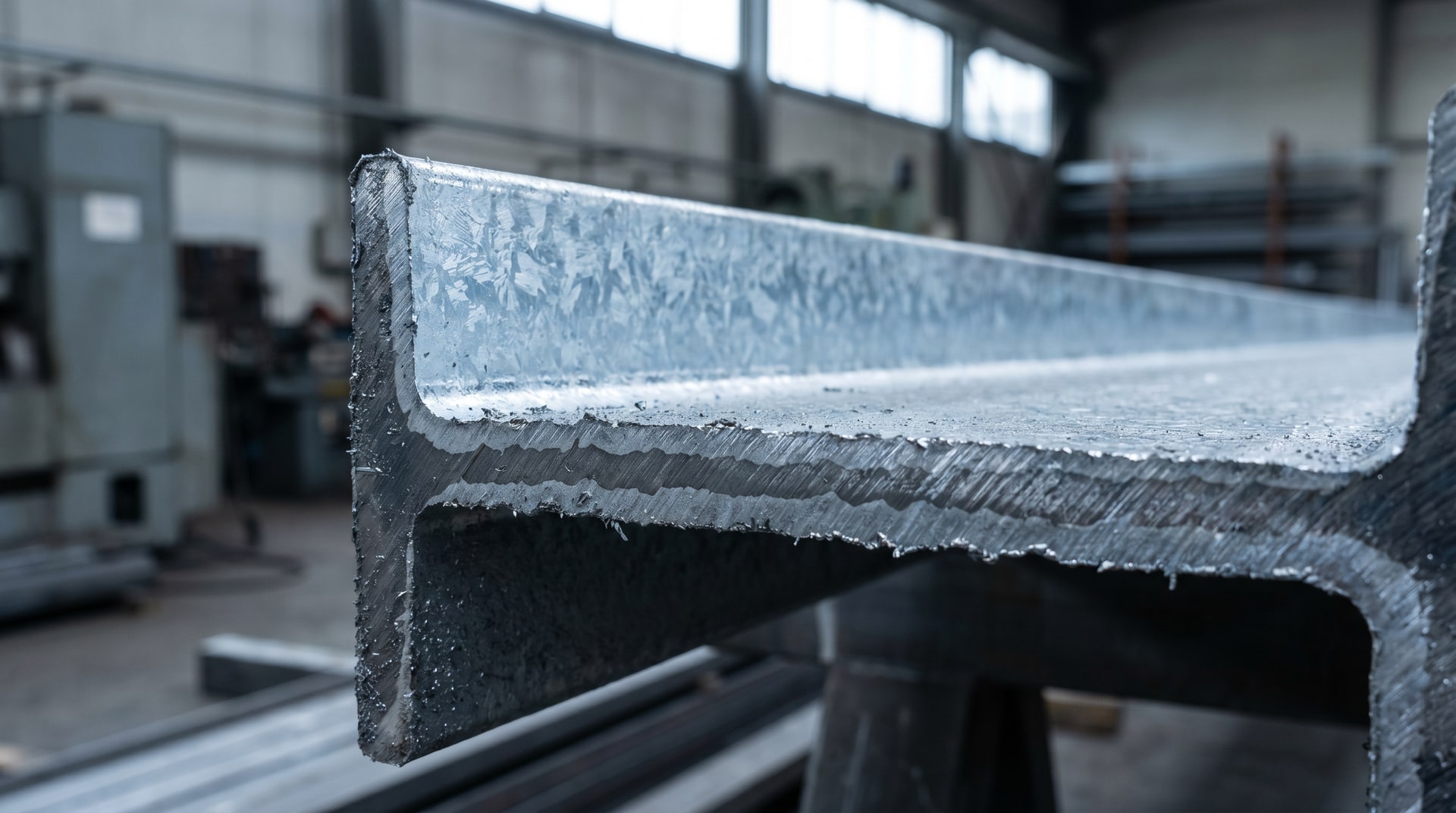
When a structural steel component comes out of the galvanizing kettle, what you see on the surface is not simply a paint-like layer of zinc applied to the outside of the steel. What has actually formed is a layered metallurgical structure, bonded at the atomic level to the base steel, with properties that differ meaningfully from any coating that is mechanically applied. Understanding what that structure is, how it forms, and what it means for long-term performance is fundamental to specifying, designing for, and inspecting galvanized steel correctly.
Engineers and fabricators often work with galvanized steel for years without fully appreciating the distinction between the zinc-iron alloy layers that make up most of the coating and the thin pure zinc layer at the surface. That distinction matters for hardness, abrasion resistance, and the way the coating responds to damage. It also shapes how coating thickness should be interpreted against service-life expectations.
The American Galvanizers Association addresses this directly in their article on coating characteristics of batch hot-dip galvanizing. At V&S Galvanizing, we expand on that foundation to explain what is actually happening at the material level, how the layered zinc-iron structure influences performance, and why this is often misunderstood in the field.
A Metallurgical Bond, Not a Surface Application
The most important thing to understand about batch hot-dip galvanizing is that the coating does not sit on top of the steel the way paint or powder coat does. When steel is immersed in the molten zinc bath, iron from the steel surface reacts with the zinc to form a series of zinc-iron intermetallic alloy layers. These layers grow outward from the steel surface, and a final layer of relatively pure zinc solidifies at the outermost surface as the part is withdrawn from the bath.
This reaction-based formation is what gives galvanizing its exceptional adhesion. The bond strength between the coating and the steel has been measured in the range of several thousand psi, which is why galvanized coatings do not peel or delaminate under normal service conditions. The coating is not adhered to the steel; it is, in a real metallurgical sense, part of the steel. This is a distinction that matters enormously when comparing galvanizing to organic or mechanical zinc coatings.
The practical consequence is that the coating cannot be stripped away by handling, transport, or the ordinary mechanical stresses of installation in the way a thin paint film can. Localized damage is possible, of course, but the failure mode is fundamentally different from a delaminating coating.
The Layer Structure and What Each Zone Does
The galvanized coating is not a single homogeneous layer. Moving outward from the steel surface, it consists of a progression of zinc-iron alloy phases, each with a distinct iron and zinc composition, transitioning to a surface zone of essentially pure zinc. The alloy layers immediately adjacent to the steel contain the highest iron content and are the hardest. The zinc content increases with each successive layer moving outward, until reaching the outer pure zinc layer.
This gradient is not incidental. It means that the interface between the steel and the coating is not an abrupt boundary but a gradual compositional transition, which contributes to the coating's toughness and resistance to cracking under impact or bending. The coating flexes and responds with the steel rather than fracturing cleanly away from it.
The outer pure zinc layer plays a distinct role from the alloy layers beneath it. It is more ductile and more chemically reactive with the atmosphere, which is actually useful: the outer zinc reacts with moisture, oxygen, and carbon dioxide to form stable zinc carbonate patina over time. This patina is what gives weathered galvanized steel its matte gray appearance and provides a barrier that slows further corrosion of the zinc itself.
Hardness: Why the Alloy Layers Outperform Pure Zinc
One of the less obvious but practically significant properties of the batch hot-dip galvanized coating is the hardness of the zinc-iron alloy layers. These layers have hardness values that approach or exceed those of the most commonly galvanized structural steels. In fact, the alloy layers are harder than the base steel they are protecting.
This has direct implications for applications where abrasion resistance matters. Stairs, walkways, grating, handrails, and floor plates are all subjected to repeated foot traffic, dragging loads, and contact wear. A coating that is softer than the steel would wear through relatively quickly in these conditions. The zinc-iron alloy layers resist that wear effectively precisely because their hardness is competitive with the steel itself.
This is a point of frequent confusion when galvanizing is compared to zinc-rich paint or thermal spray zinc. Those coatings consist of zinc particles in a binder or a spray-deposited zinc matrix, neither of which develops the intermetallic alloy structure that gives batch hot-dip galvanizing its hardness. They serve as effective sacrificial coatings, but they do not offer the same abrasion resistance as the alloy layers formed in the hot-dip process.
Coating Thickness: How Standards Define Minimum Performance
Batch hot-dip galvanizing consistently produces coatings that are thicker than those achievable by most other zinc coating processes. The specific minimums required depend on the type of steel product and the thickness of the steel being galvanized, and these are defined by several ASTM standards and the CSA specification G 164.
For structural steel products such as plates, shapes, and fasteners, ASTM A123 is the most widely referenced specification. ASTM A153 governs hardware items such as bolts, nuts, and other small parts. ASTM A767 applies to reinforcing steel bars used in concrete construction. Each of these standards establishes minimum coating thickness requirements appropriate to the product type and intended application.
The reason coating thickness matters so directly is its relationship to service life. A thicker zinc coating takes longer to consume in a given corrosive environment, which translates to a longer period before the underlying steel is exposed. The chart referenced by the AGA in their source article on this topic illustrates this relationship visually: as coating thickness increases, so does the estimated time to first maintenance. The shaded region on that chart corresponds to the minimum thicknesses required under ASTM A123, anchoring the practical baseline for structural applications.
| Standard | Applicable Product Type | Notes |
|---|---|---|
| ASTM A123 | Structural steel products: plates, shapes, rolled bars, fabricated assemblies | Most common specification for structural and fabricated steel; minimum thickness varies by steel category and thickness |
| ASTM A153 | Iron and steel hardware: bolts, nuts, washers, castings, small parts | Minimum thickness varies by hardware class; accounts for geometry and mass of small components |
| ASTM A767 | Zinc-coated steel bars for concrete reinforcement (rebar) | Two coating classes defined based on exposure severity and design requirements |
| CSA G 164 | General fabricated steel (Canadian standard) | Canadian equivalent covering similar product scope to ASTM A123 for projects under Canadian codes |
It is worth noting that actual coating thickness on a given piece will often exceed the specification minimum. The reactive chemistry of galvanizing means that higher-silicon steels or steels with particular surface conditions can produce significantly thicker coatings. This is generally beneficial from a corrosion protection standpoint, though it can affect dimensional tolerances in tightly fit assemblies.
Uniformity on Edges, Corners, and Threads
Hot-dip galvanizing has a geometric advantage that is easy to overlook: the coating is generally uniform across the entire surface of a part, including edges, corners, and threaded sections. In fact, edges and corners typically receive coatings at least as thick as flat surfaces, and often thicker.
This runs counter to what happens with most applied coatings. Paint, powder coat, and electroplated coatings all tend to thin at sharp edges and corners due to surface tension effects during application or limited throwing power during electrodeposition. These are precisely the locations where corrosion initiates most readily, so a thin coating there represents a structural vulnerability.
With hot-dip galvanizing, the liquid zinc wets the entire surface and the zinc-iron reaction proceeds uniformly. If anything, the zinc tends to accumulate slightly at corners and edges as the part drains from the bath, providing extra material at locations that might otherwise be underprotected. For structural components where edge corrosion is a concern, such as angle iron, grating, and fasteners, this characteristic is a meaningful performance advantage.
Sacrificial Protection: What Happens When the Coating Is Scratched
Both the pure zinc outer layer and the zinc-iron alloy layers beneath it are anodic to steel. In electrochemical terms, this means zinc has a more negative corrosion potential than iron, so when zinc and steel are electrically connected in the presence of an electrolyte, the zinc preferentially corrodes and the steel is protected. This is the principle behind galvanic or sacrificial protection.
The practical consequence is significant. If the galvanized coating is scratched, nicked, or cut, exposing bare steel at the surface, the surrounding zinc does not simply stop protecting at the damage boundary. The anodic zinc continues to corrode preferentially, providing cathodic protection to the exposed steel. As long as the exposed area is small relative to the surrounding zinc and sufficient coating thickness remains, the bare steel will not rust.
This behavior is what distinguishes galvanizing from barrier-only coatings like paint. A scratched paint film exposes the steel directly to the environment with no protective mechanism other than whatever remains of the intact film. A damaged galvanized coating continues to suppress corrosion of the steel through the sacrificial action of the surrounding zinc. The protection is not unlimited, and very large damaged areas or near-depleted coatings will eventually allow rust to develop, but the mechanism provides a meaningful margin of safety during the service life of the coating.
What This Means for Design and Specification Decisions
Understanding the coating structure informs several practical decisions that engineers and fabricators make when specifying or designing for batch hot-dip galvanized steel.
For applications involving abrasion, such as industrial flooring, stair nosings, or equipment exposed to sliding contact, the hardness of the zinc-iron alloy layers is a genuine asset rather than just an incidental property. Specifying galvanizing for these applications is justified not only by its corrosion protection but by its mechanical wear resistance.
For tight-tolerance assemblies, particularly threaded connections, the thickness behavior of the coating has to be accounted for in the design. The metallurgical bond and the characteristic thickness distribution mean that threads on galvanized fasteners may require oversized tapping to maintain proper fit. ASTM standards address this, and our team is familiar with the dimensional adjustments that keep assemblies functional after galvanizing.
For projects where service life against corrosion drives material selection, coating thickness is the primary variable to understand. The minimum thicknesses established in ASTM A123, A153, and A767 represent floors, not targets. Specifying sufficient steel thickness and appropriate surface preparation helps ensure the coating meets or exceeds those minimums, and in many cases substantially exceeds them.
When touch-up or repair is required for damaged areas, the sacrificial protection mechanism provides some tolerance, but repairs should still be made using appropriate zinc-rich paint or other ASTM-compliant methods to restore full barrier protection. The galvanic protection is a safety net, not a substitute for maintaining coating integrity.
Work With a Team That Understands the Coating From the Inside Out
The performance characteristics of batch hot-dip galvanizing are rooted in a metallurgical process that most coating systems simply cannot replicate. The zinc-iron alloy layers that form during immersion in the molten zinc bath are not a byproduct of the process; they are the process. The hardness, adhesion, uniformity, and sacrificial behavior that define galvanizing performance all trace directly back to those intermetallic phases and the conditions under which they form.
At V&S Galvanizing, we process a wide range of structural steel products and work closely with engineers, fabricators, and contractors who need to understand not just that galvanizing works, but how and why it works in their specific application. Whether you are evaluating coating thickness requirements for a corrosive service environment, troubleshooting a dimensional tolerance issue with threaded hardware, or simply trying to understand what to specify and why, we bring the technical depth to help you make the right call.
If you have questions about coating characteristics, specification requirements, or how galvanizing fits your project, reach out through our contact page and our team will follow up directly.
Frequently Asked Questions About Batch Hot-Dip Galvanizing Coating Characteristics
What is the difference between the zinc-iron alloy layers and the outer pure zinc layer in a galvanized coating?
The zinc-iron alloy layers form through a metallurgical reaction between iron from the steel surface and zinc from the bath during immersion. These layers are harder than the base steel and provide the coating's abrasion resistance and strong adhesion. The outermost pure zinc layer is more ductile and reacts with the atmosphere to form a zinc carbonate patina that further slows corrosion over time. Both layers are anodic to steel and provide sacrificial protection.
How strong is the bond between the galvanized coating and the steel?
The metallurgical bond between a batch hot-dip galvanized coating and the steel substrate has been measured in the range of several thousand psi. Because the zinc-iron alloy layers form through a chemical reaction with the steel surface rather than being mechanically applied, the coating is integral to the steel rather than merely adhered to it. This is why galvanized coatings resist peeling and delamination under normal service and handling conditions.
Which ASTM standards govern minimum coating thickness for batch hot-dip galvanizing?
ASTM A123 covers structural steel products including plates, angles, and shapes. ASTM A153 applies to iron and steel hardware such as bolts, nuts, and small castings. ASTM A767 governs zinc-coated steel bars for concrete reinforcement. The Canadian equivalent for general fabricated steel is CSA G 164. Each standard specifies minimum coating thickness based on steel product type and steel thickness, since both factors influence how thick a coating the galvanizing process will produce.
Why is the zinc-iron alloy layer harder than the base steel?
The intermetallic zinc-iron compounds that form during hot-dip galvanizing have an inherently high hardness due to their crystalline structure. The specific alloy phases that develop are brittle and hard at a microstructural level, with hardness values that approach or exceed those of common structural steels. This is a property of the intermetallic chemistry itself, not a function of heat treatment or processing speed. It is what makes galvanized surfaces resistant to abrasion in high-wear applications.
Does a galvanized coating protect steel even after it is scratched or damaged?
Yes, within limits. Zinc is anodic to steel, meaning it has a more negative electrochemical potential. When the coating is breached and zinc and bare steel are both present in a corrosive environment, the zinc corrodes preferentially, protecting the exposed steel through galvanic (sacrificial) action. This protection is effective for small damaged areas where the surrounding zinc can sustain the protective current. For larger damaged areas, zinc-rich paint repair is recommended to restore both barrier and sacrificial protection.
Why do edges and corners on galvanized steel typically have thicker coatings than flat surfaces?
During batch hot-dip galvanizing, the liquid zinc wets the entire steel surface uniformly. As the part is withdrawn from the bath, zinc tends to accumulate slightly at edges and corners rather than draining away as readily as it does from flat surfaces. The result is that edges and corners carry coatings at least as thick as adjacent flat areas, and often modestly thicker. This is the opposite of what occurs with most applied coatings, which thin at edges due to surface tension effects.
How does coating thickness relate to the expected service life of galvanized steel?
In a given environment, zinc corrodes at a relatively predictable rate. A thicker zinc coating takes proportionally longer to deplete before the underlying steel is exposed. This means that coating thickness is the primary variable controlling how long a galvanized steel component will perform without requiring maintenance. The ASTM A123 minimum thickness requirements establish a baseline for structural applications, but actual coatings often exceed those minimums, which extends service life further.
Is batch hot-dip galvanizing thicker than other zinc coating processes, and does that matter?
Yes, batch hot-dip galvanizing consistently produces thicker coatings than processes such as electroplating or continuous sheet galvanizing. The immersion-based reactive process allows more zinc to accumulate on the surface, and the zinc-iron alloy layer formation adds to the total coating depth. For structural and industrial applications where long service life without maintenance is the goal, the greater coating thickness of batch galvanizing translates directly to better corrosion performance over time.
