

Hot-dip galvanized steel is built to perform with minimal intervention, but that does not mean the coating is immune to surface contamination. Dirt accumulates on structural members. Moisture trapped between stacked pieces produces a chalky white oxide layer. Grease from fabrication equipment or spray paint from job site marking ends up on a surface that was never designed to absorb it. In each of these situations, the temptation is to reach for whatever solvent is close at hand, or to apply the highest-pressure wash available, neither of which is always the right call.
The American Galvanizers Association addresses this directly in their article on cleaning hot-dip galvanized steel. At V&S Galvanizing, we expand on that foundation to explain what is actually happening at the material level, how the nature of the contaminant influences which approach is appropriate, and why the wrong cleaning method is one of the more underappreciated ways galvanized coatings get damaged in the field.
Why Cleaning Method Depends on Contaminant Type
The galvanized coating is not simply a paint layer sitting on top of steel. It is a metallurgically bonded zinc-iron alloy system, with the outermost layer being relatively pure zinc. That outer zinc surface is chemically reactive in ways that many cleaning chemicals exploit, and not always in a beneficial direction. Zinc is amphoteric, meaning it reacts with both strong acids and strong bases. Understanding that basic chemistry is the starting point for selecting an appropriate cleaning approach.
This is why the first diagnostic step before picking up a brush or a chemical is identifying what is actually on the surface. Mud behaves differently than wet storage stain, and wet storage stain behaves differently than oil-based grease or spray paint. Each contaminant sits on or interacts with the zinc surface in a distinct way, and each therefore calls for a different removal strategy. Applying a strong solvent to remove simple dirt, or using an abrasive on a stain that would respond to mild chemistry, risks coating damage that was entirely avoidable.
Removing Dirt and Mud Without Compromising the Zinc Surface
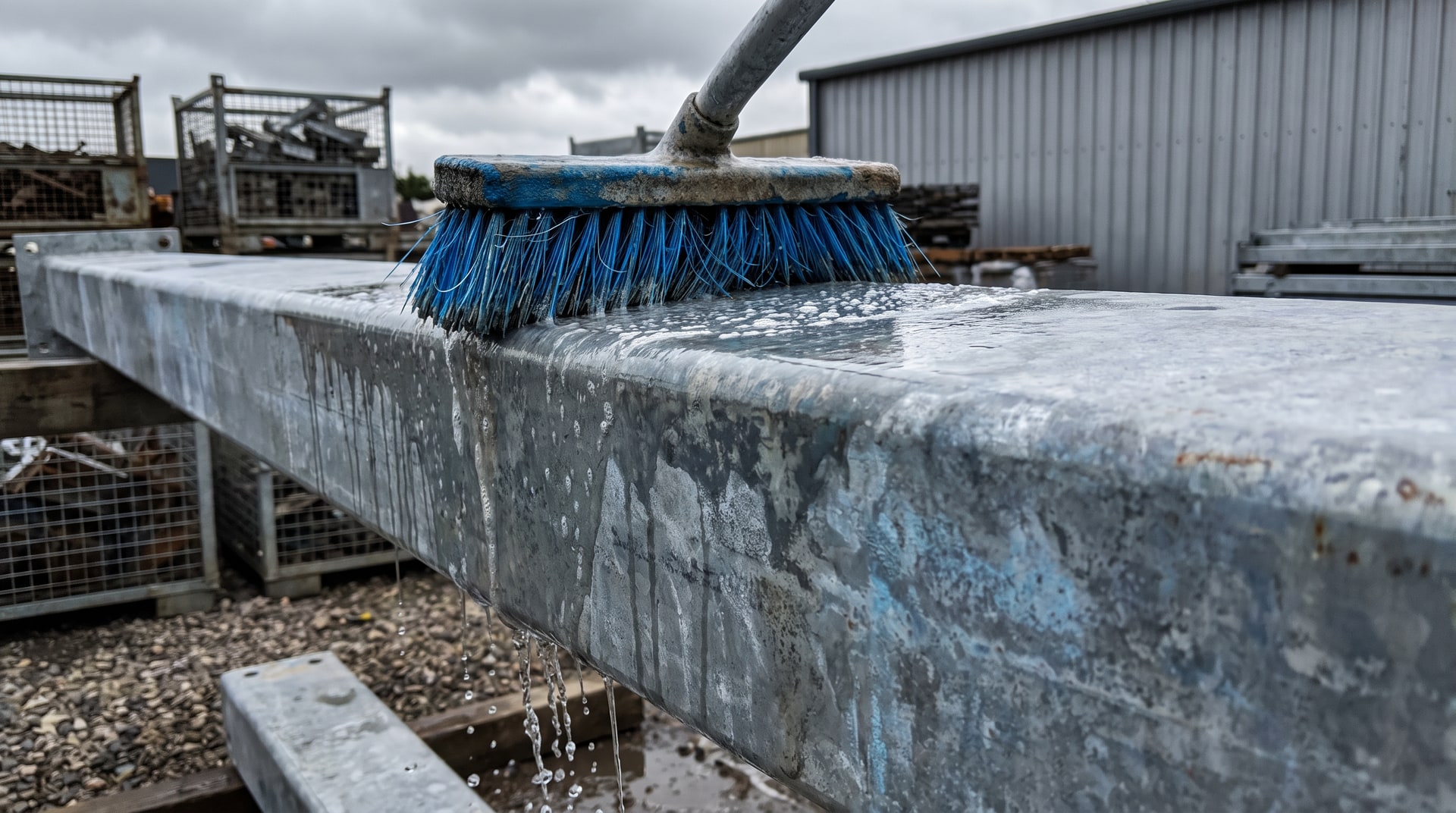
For straightforward soiling, such as dust, mud, or general construction grime, the solution is deliberately uncomplicated. A plain water rinse is usually all that is needed. The zinc surface does not form a strong bond with inorganic particulates, so water alone dislodges them effectively. If the contamination has dried and caked onto the surface, a nylon bristle brush provides the gentle mechanical action necessary to break it loose without scratching or abrading the coating.
Where pressure washing becomes part of the workflow, the key constraint is blast pressure. The threshold is 1,450 psi. Exceeding that value risks physically damaging the outer zinc layer, especially at the relatively thin regions near edges or at drainage points where the coating may be at its minimum thickness. This limit is not conservative by a wide margin, it reflects real coating vulnerability under directed hydraulic force. Anyone incorporating galvanized components into a maintenance wash program should confirm that their equipment operates within this ceiling, and should avoid directing the nozzle at a sustained angle against a single point on the surface.
Understanding Wet Storage Stain Before Treating It
Wet storage stain is the most commonly misidentified condition on freshly galvanized steel. It appears as a white, powdery or chalky deposit, sometimes with a bulkier volume than one might expect from what is essentially a surface oxide. The mechanism is straightforward: when zinc is in prolonged contact with moisture without access to moving air, it cannot form the stable zinc carbonate patina that normally develops outdoors. Instead, zinc hydroxide forms as an intermediate product, and this is what manifests visually as wet storage stain.
The important distinction is between stain that is cosmetic and stain that has consumed meaningful coating thickness. Light staining that has not penetrated deeply into the zinc layer is not structurally significant, and in many cases it can simply be left alone. If the steel is going into service in an environment with adequate airflow, the stain will convert and stabilize over time. Aggressive cleaning of light staining can do more harm than the stain itself.
When the stain is moderate in severity, a diluted ammonia solution is the recommended approach: one part ammonia to ten parts fresh water, applied with a nylon brush. The ammonia is alkaline enough to dissolve zinc hydroxide deposits without attacking the underlying metallic zinc with the aggressiveness of a strong acid. After treatment, the surface must be rinsed thoroughly with clean fresh water and allowed to dry completely. Compressed air can accelerate drying, provided the air stream is not directed with enough force to damage the coating.
One point that cannot be overstated: strong acids are not an acceptable substitute. Hydrochloric, sulfuric, and muriatic acids will aggressively attack the zinc coating itself, not just the stain sitting on top of it. Using them to clean a galvanized surface trades a cosmetic problem for a structural one.
When Wet Storage Stain Has Gone Too Far
Heavy wet storage stain changes the calculus entirely. When staining has progressed to the point where black spots are visible on the coating surface, or where the underlying steel is actually being affected, the situation has moved past surface cleaning. Black discoloration typically indicates that iron from the steel substrate is involved in the corrosion reaction, which means the zinc protection has been locally depleted.
At that stage, there are two practical paths depending on the extent of the damage. If the heavy staining is distributed across the entire article, complete stripping and re-dipping through the hot-dip galvanizing process is generally the most reliable route to restoring full corrosion protection. If the heavy staining is localized to a specific section, mechanical removal of the compromised coating in that area combined with a zinc-based touch-up per ASTM A780 methods is a viable field repair. What is not appropriate is continuing to treat a severely damaged coating as though surface cleaning is a sufficient remedy.
Commercially Tested Products for Wet Storage Stain Removal
Beyond the ammonia solution, the American Galvanizers Association conducted testing to evaluate commercially available products for their effectiveness against wet storage stain. The criteria were meaningful: the products had to remove the stain effectively and do so without dulling the coating surface. Both conditions matter, because a cleaning product that strips the stain but leaves the zinc surface chemically altered or visually degraded has not truly solved the problem for applications where appearance is part of the specification.
The products found to meet both criteria include CLR, lime juice, Naval Jelly, rust dissolver, pickle, 10G, and white vinegar. These span a range of chemical mechanisms, from mild organic acids to chelating agents, but they share the characteristic of being aggressive enough toward zinc oxide and hydroxide deposits while remaining sufficiently mild toward the metallic zinc layer itself. For detailed application instructions with any of these products, the AGA's Galvanizing Note on cleaning wet storage stain from galvanized surfaces provides the appropriate procedural guidance.
Dealing With Grease, Oil, Permanent Marker, and Spray Paint
Organic contaminants present a different challenge than mineral deposits. Grease and oil from handling, fabrication equipment, or site conditions bond to the zinc surface through physical adhesion rather than chemical reaction. Permanent marker and spray paint introduce film-forming polymers or resins that can be difficult to dislodge without a solvent capable of dissolving them.
The AGA's study on contaminant removal tested multiple chemical types against permanent marker, oil, grease, and spray paint to identify what worked without marring the coating. Two product categories consistently proved most effective at complete removal without damaging the zinc surface. The commercially available products in those categories include Kean-Strip, Graffiti Remover, and Motsenbocker's Lift Off 4. These products are formulated to cut through organic residue through solvent or surfactant action while leaving the underlying zinc intact.
For field applications, the practical takeaway is to avoid petroleum-based solvents that are not specifically vetted for zinc compatibility. Some common degreasers are alkaline enough to etch zinc if left in contact for extended periods, and certain solvent blends can interact with the outer zinc layer in ways that affect subsequent paint adhesion if a duplex system is planned. When in doubt, test on a small inconspicuous area and rinse promptly.
Preserving Coating Appearance Through Proper Cleaning Practice
For projects where the visual outcome matters, whether architectural metalwork, exposed structural elements, or any context where surface aesthetics are part of the specification, cleaning technique directly affects the final appearance. The zinc surface can be dulled by abrasive mechanical action, by chemical overreach, or simply by using a wire brush rather than a nylon one. Each of these is avoidable.
A few principles hold across contaminant types. Use the gentlest effective method first, escalating only if needed. Rinse thoroughly after any chemical treatment. Avoid tools with metal bristles or abrasive pads on the coating surface. Dry completely after cleaning, since residual moisture on a zinc surface that has already shown susceptibility to wet storage stain is counterproductive.
Pressure washing within the 1,450 psi limit keeps the option of hydraulic cleaning available without risking the physical integrity of the coating. Staying below that threshold is especially important on galvanized articles that have thinner coatings, such as sheet products or light-section steel where the total zinc thickness may be near the specification minimum. For heavier structural members with thicker coatings, the risk is comparatively lower, but the limit still applies as good practice.
Work With a Team That Understands What the Coating Is Doing
Cleaning hot-dip galvanized steel is not complicated, but it requires matching the approach to the specific condition. The coating is a functional corrosion barrier, and the way it is maintained in the field has direct implications for service life. Choosing the wrong chemical, exceeding safe pressure limits, or misreading heavy staining as a surface issue rather than a structural one are all mistakes that can shorten the performance life of an otherwise well-specified coating system. Getting this right is a straightforward matter of understanding what is on the surface and responding accordingly.
Our team at V&S Galvanizing works with engineers, fabricators, and project managers throughout the project cycle, from pre-galvanizing design review through post-galvanizing inspection and maintenance guidance. If you have questions about coating condition, appropriate cleaning methods, or whether a specific product or method is safe for your application, reach out through our contact page and we will give you a direct answer.
Frequently Asked Questions About Cleaning Hot-Dip Galvanized Steel
What is the maximum safe pressure wash setting for hot-dip galvanized steel?
The blast pressure for pressure washing galvanized steel should remain below 1,450 psi. Pressures above this threshold can physically damage the zinc coating, particularly at edges, corners, and areas where coating thickness is near the specification minimum.
Can you use muriatic or hydrochloric acid to clean galvanized steel?
No. Strong acids including hydrochloric, sulfuric, and muriatic acid will aggressively attack the zinc coating itself, not just the surface contamination. Their use on galvanized steel trades a cosmetic problem for a structural loss of corrosion protection.
What does wet storage stain indicate about the condition of a galvanized coating?
Wet storage stain is a white or chalky zinc hydroxide deposit that forms when galvanized steel is stored in contact with moisture without adequate airflow. Light staining is primarily cosmetic and the coating beneath is typically intact. Black spots or involvement of the underlying steel indicate that zinc protection has been depleted locally and more significant remediation is needed.
What ammonia concentration is safe for cleaning wet storage stain from galvanized steel?
A solution of one part ammonia to ten parts fresh water is the recommended dilution. This concentration is sufficient to dissolve zinc hydroxide deposits while remaining mild enough to avoid attacking the metallic zinc layer. Stronger concentrations are not necessary and increase the risk of coating damage.
Which commercially available products are effective for removing wet storage stain without dulling the zinc coating?
Products tested and confirmed effective by the AGA include CLR, lime juice, Naval Jelly, rust dissolver, pickle, 10G, and white vinegar. These products removed wet storage stain in AGA testing without dulling the galvanized surface, meeting both functional and appearance criteria.
What products are recommended for removing spray paint, grease, or permanent marker from galvanized steel?
AGA testing found that Kean-Strip, Graffiti Remover, and Motsenbocker's Lift Off 4 were the most effective products for removing organic contaminants including spray paint, oil, grease, and permanent marker without damaging the zinc coating.
When is re-dipping necessary rather than cleaning or spot repair?
Re-dipping is warranted when heavy wet storage stain has produced black spots across the coating or when the underlying steel is visibly corroding, indicating widespread depletion of zinc protection. If the damage is confined to a specific section, localized mechanical removal and zinc touch-up per ASTM A780 methods may be a sufficient alternative to full re-galvanizing.
Why is a nylon bristle brush specified for cleaning galvanized steel rather than a wire brush?
Wire brushes can abrade the outer zinc surface, creating micro-scratches that dull the coating appearance and can disrupt the natural formation of the protective zinc carbonate patina. Nylon bristles provide enough mechanical action to dislodge dirt and light deposits without scratching or marring the metallic zinc layer.
