

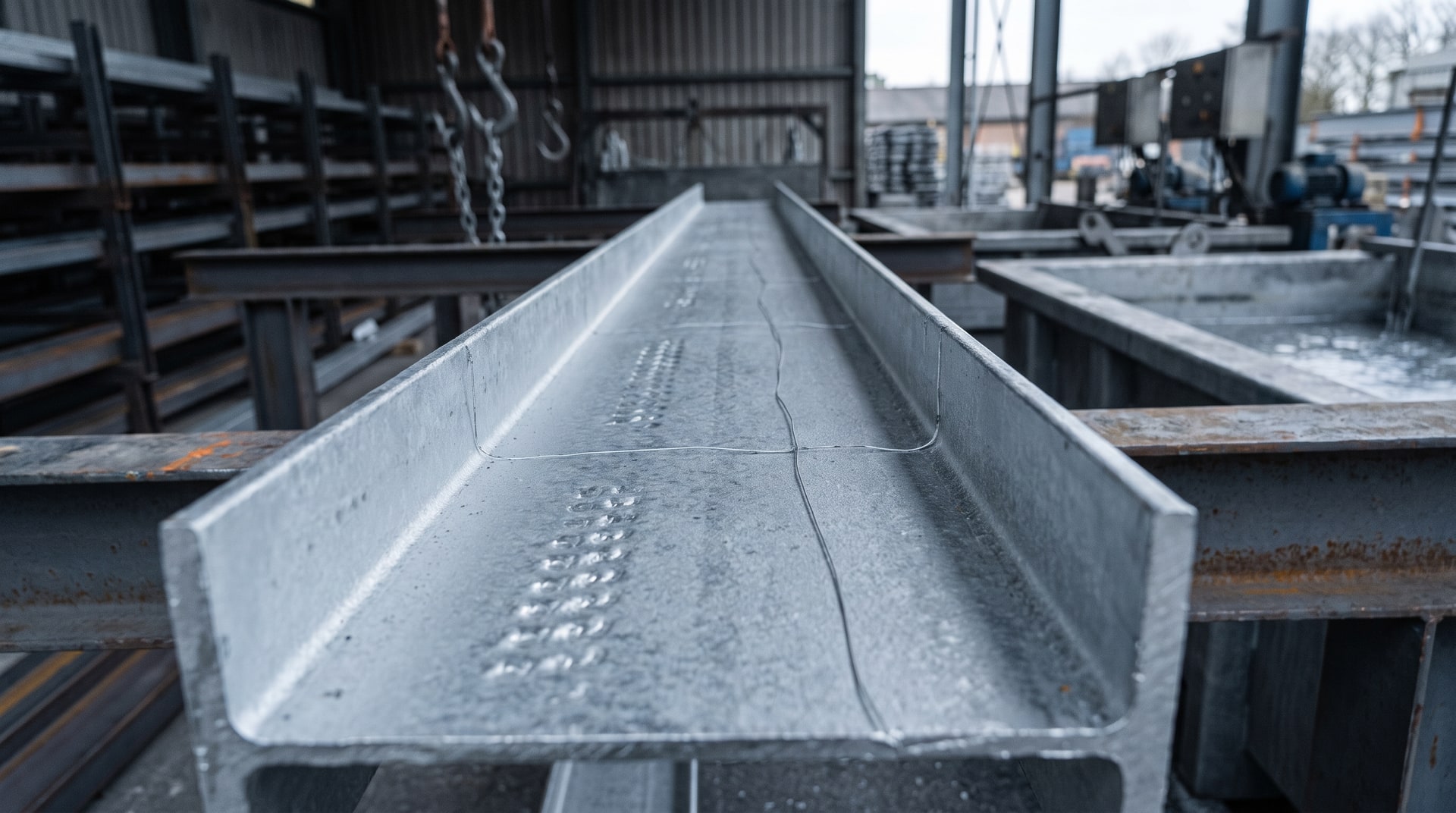
When a fabricator or contractor receives a freshly galvanized order and notices linear impressions, partially uncoated patches, or small bare zones on the steel surface, the instinctive reaction is often concern. These marks look like damage. In many cases, they draw questions about whether the coating was applied correctly, whether the steel will corrode prematurely, and whether the product even meets specification. The reality is more nuanced than a simple pass-or-fail judgment, and understanding what actually creates these marks, and what the relevant standards say about them, is the key to making the right call on the shop floor or in the field.
The American Galvanizers Association addresses this directly in their article on chain and wire marks in hot-dip galvanized products. At V&S Galvanizing, we expand on that foundation to explain what is actually happening at the material level, how handling geometry and part configuration influence coating outcomes, and why these defects are often misunderstood in the field.
How Parts Move Through a Galvanizing Plant
Hot-dip galvanizing is not a static process. Steel fabrications move through a sequence of chemical pre-treatment baths, a flux bath, and finally the molten zinc kettle, all while suspended from overhead cranes via lifting fixtures, chains, and wires. Once the part is withdrawn from the zinc at the correct immersion angle and drainage is complete, it moves again for quenching, inspection, and staging for shipment.
Every one of those movements involves contact between the steel or the freshly coated surface and some form of lifting hardware. Chains are the most common culprit because they conform to irregular shapes well, but they also apply concentrated point and line loads across the zinc surface. Wires serve the same function for lighter or more delicate parts. The marks these attachments leave are a direct consequence of how galvanizing plants must physically handle steel at scale.
This context matters because it shifts the framing from "something went wrong" to "this is a predictable outcome of the process, and the standards account for it." The question is not whether marks occur, but whether they expose bare steel, and if so, how extensive that bare area is.
What Chain and Wire Marks Actually Are
Chain marks appear as elongated impressions or linear patterns in the zinc coating, typically following the profile of individual chain links. Wire marks are similar but finer, often resembling narrow creases or thin uncoated lines running across a surface. In both cases, the mechanism is the same: when molten zinc is displaced or blocked from bonding at a specific area by the presence of a lifting attachment, that zone either receives a thinner coating or receives no coating at all.
The critical distinction is whether the mark is superficial or whether it exposes bare steel. A superficial mark means the zinc coating was compressed or slightly disrupted but still present. The iron-zinc alloy layers beneath the outer zinc surface may remain intact, which means the cathodic protection the coating provides is not meaningfully compromised. A bare spot, by contrast, means the coating thickness at that location is effectively zero. That is where corrosion risk becomes a real engineering concern.
The galvanizing industry uses the phrase "bare spot" specifically to mean a location where the coating is absent down to the steel substrate. Chain and wire marks can produce bare spots if the attachment point is tight enough, if the chain digs into the zinc while it is still in the semi-solidified state, or if the part shifts during handling and the chain drags across the surface.
Touch Marks: A Related but Distinct Problem
Touch marks arise from a different handling scenario entirely. When multiple small parts are suspended from the same lifting fixture, which is common practice for efficiency on items like brackets, clips, cleats, and hardware, those parts hang in close proximity. As the fixture is lowered into the zinc bath, the parts may swing, jostle, or press against one another. Wherever two galvanized surfaces make contact before the coating has fully solidified, neither surface receives proper zinc coverage at the contact point. The result is a partially coated or completely uncoated spot at each contact location.
The physics here are straightforward. Liquid zinc cannot flow into the interface between two surfaces that are touching. Even if the surfaces briefly separate and zinc enters, the re-contact while the zinc is still mobile can push it away again. The outcome is the same as a chain or wire mark in terms of what the standard must address: a spot that may or may not expose bare steel.
Touch marks can sometimes be mitigated through fixture design. Increasing the horizontal or vertical spacing between parts reduces the probability of contact in the kettle. Alternating the hanging heights of adjacent parts is another approach, because parts hung at different elevations are less likely to contact each other even if they swing. When fixture density is reduced, fewer parts per lift, the incidence of touch marks drops considerably. None of these approaches eliminates the risk entirely, and for some part geometries, touch marks are essentially unavoidable given practical batch sizes.
When Marks Are Caused by Lifting Devices Themselves
There is a third category worth distinguishing. Separate from the chain and wire marks that result from how parts are suspended throughout the plant, marks can also be left by the lifting attachment points themselves at the moment the part is extracted from the kettle. As a fixture rises from the molten zinc, the point where chain or wire contacts the steel is the last zone to drain. The zinc there is often thicker, then disturbed by the weight and angle of the chain as it tightens during the lift. This can leave a localized uncoated zone directly at the attachment point, even if the rest of the surface is fully coated.
These lifting-device marks are often concentrated at the same spot on every similar part processed together. Galvanizers who handle the same part type regularly learn where these marks tend to occur and can factor that into their inspection and repair workflow. The standard treatment is the same as for any other bare spot: assess the extent, determine whether repair is required, and apply the appropriate touch-up method per ASTM A780 if the area qualifies.
What ASTM A123 Says About Acceptability
ASTM A123, the governing specification for hot-dip galvanized coatings on iron and steel products, does not require a coating surface to be visually perfect. It does, however, draw a firm line at bare spots, locations where coating thickness is zero.
Bare spots are not acceptable as-delivered under ASTM A123. However, the standard does define a threshold for what constitutes a repairable area rather than cause for outright rejection. The total area of bare spots on a product must not exceed 0.5% of the accessible surface area to be coated, or must not exceed 36 square inches per short ton (256 square centimeters per metric ton), whichever of those two limits is smaller. If the bare spots on a part fall within that threshold, the galvanizer is required to repair them in accordance with ASTM A780 before the part is acceptable for delivery. The part itself is not rejected; it requires rework.
If the bare spots exceed that threshold, the product must be rejected. The practical remedy in that case is stripping and re-galvanizing, which is a more significant undertaking but one that restores the coating to full performance. The key point is that the responsibility sits with the galvanizer: minimizing surface defects through proper handling is part of the service, and repairing any bare spots that do occur before the product leaves the facility is a non-negotiable obligation.
Marks that are superficial, meaning they leave an impression or discoloration but do not expose bare steel, are not grounds for rejection under ASTM A123. The coating may look disturbed at those locations, but if zinc is still present, the part meets specification.
Repair Requirements Under ASTM A780
When bare spots do require repair, ASTM A780 governs the acceptable methods. The standard allows several approaches depending on the size and location of the bare area, including zinc-based repair paints, zinc soldering, and thermal spray zinc. Each method has its own performance envelope, and the choice of repair material should account for the environment in which the part will ultimately serve.
Zinc-rich paints are the most commonly applied touch-up material in the field because they are easy to apply and widely available, but they do not replicate the metallurgical bond of a hot-dip coating. The iron-zinc alloy layers that give hot-dip galvanizing its adhesion and a significant portion of its barrier protection are absent in a paint repair. The cathodic protection zinc provides is still present if the zinc content is high enough, but the long-term performance of a repaired area will typically not match the surrounding hot-dip coating, particularly in aggressive environments.
This is not an argument against repair. Properly executed repairs on areas within the ASTM A123 allowable limits perform well and allow parts to be put into service without stripping and re-processing. It is simply a reason to minimize the frequency and extent of bare spots through careful handling upstream, which is exactly where galvanizers can and should direct their attention.
What Proper Hanging Technique Can and Cannot Prevent
The AGA source article notes that chain and wire marks can sometimes be avoided by proper hanging and transporting techniques, but it also acknowledges that some products must be hung in a way that will create marks in order to be galvanized at all. That qualifier deserves more attention than it typically receives.
Certain part geometries leave no practical option. A long structural section hung vertically requires chain attachment near one or both ends. A heavy plate or grating may require multiple attachment points distributed across the surface. A ring or frame may need to be suspended from its interior, placing chain contact directly on the finished face. For these parts, the goal is not to eliminate contact marks but to position them in low-visibility locations when possible, to minimize their extent, and to ensure bare areas are identified during inspection and repaired before shipment.
Where geometry does allow flexibility, hanging practice makes a meaningful difference. Parts oriented to drain freely reduce the chance of zinc pooling and then tearing during the lift. Attachment points placed at structural sections rather than finished faces minimize contact with visible surfaces. Consistent spacing between multiple hanging items reduces the probability of touch marks. These are the kinds of operational decisions that separate a galvanizer with strong quality discipline from one that treats the kettle as a black box and inspects only at the end.
At V&S Galvanizing, our handling practices are designed around the understanding that every contact point is a potential defect site. We work to minimize those contact points, position them thoughtfully, and catch any resulting bare spots before product ships. That discipline is part of what our quality system is built around.
Work With a Team That Treats Surface Quality as a Process Variable
Surface defects like chain marks, wire marks, and touch marks are inherent risks in any hot-dip galvanizing operation. What separates quality galvanizing from mediocre galvanizing is whether those risks are managed deliberately at every stage: how parts are racked, how fixtures are loaded, how parts are lifted from the kettle, and how the finished product is inspected against a clear standard before it ever leaves the plant.
ASTM A123 provides the framework for what is acceptable and what requires repair or rejection. Understanding that framework helps engineers and fabricators evaluate incoming product accurately, ask the right questions when marks appear, and distinguish between a cosmetic irregularity and a genuine coating failure. Not every visible mark is a defect worth rejecting. Not every smooth surface means the coating underneath is performing correctly. The details matter, and so does working with a galvanizer who understands them.
If you have questions about surface quality on a current or upcoming project, or if you want to discuss how part design and hanging geometry will influence your coating outcome, reach out through our contact page. Our team is available to work through the specifics with you before fabrication is complete, which is almost always the better time to have that conversation.
Frequently Asked Questions About Chain Marks, Wire Marks, and Touch Marks in Galvanizing
Are chain marks on a galvanized surface always a reason to reject the product?
No. Chain marks are not automatically cause for rejection. Superficial marks that leave an impression or slight surface disturbance without exposing bare steel are acceptable under ASTM A123. Rejection is only required when bare spots (coating thickness of zero) exceed the repairable area threshold defined by the standard.
What is the ASTM A123 threshold for repairable bare spots from handling marks?
Under ASTM A123, the total area of bare spots must not exceed 0.5% of the accessible surface area to be coated, or 36 square inches per short ton (256 square centimeters per metric ton), whichever limit is smaller. Bare spots within that threshold must be repaired per ASTM A780. Bare spots exceeding that threshold require rejection of the part.
How are bare spots from chain or wire marks repaired on a galvanized part?
Repairs are performed in accordance with ASTM A780, which permits methods including zinc-rich paint, zinc soldering, and thermal spray zinc. The chosen method depends on the size and location of the bare area and the intended service environment. Zinc-rich paint is the most commonly used field repair material, though it does not replicate the metallurgical bond of the original hot-dip coating.
What causes touch marks specifically, and how are they different from chain marks?
Touch marks occur when two parts suspended on the same lifting fixture make contact with each other while submerged in the zinc bath. At the contact interface, molten zinc cannot flow in, leaving a partially coated or uncoated spot on both surfaces. Chain and wire marks, by contrast, result from the lifting hardware itself contacting the steel or the freshly coated surface during handling. Both can produce bare spots, but the mechanisms and prevention strategies differ.
Can touch marks be eliminated by changing how parts are hung on the fixture?
They can often be reduced but not always eliminated. Increasing horizontal and vertical spacing between parts on the same fixture lowers the probability of contact during immersion. Alternating the hanging heights of adjacent parts is another effective approach. For some part geometries and batch sizes, touch marks are effectively unavoidable, and the focus shifts to post-process inspection and repair.
Do galvanizers have an obligation to repair bare spots before shipping the product?
Yes. ASTM A123 places the responsibility for minimizing surface defects and repairing any qualifying bare spots squarely on the galvanizer. Parts with repairable bare spots must be touched up in accordance with ASTM A780 before they are considered acceptable. Parts with bare spots exceeding the repairable threshold must be rejected; stripping and re-galvanizing is the standard remedy in those cases.
Does a superficial chain mark affect the corrosion protection of the galvanized coating?
A truly superficial mark, one where zinc is still present at the surface even if slightly compressed or visually disturbed, does not meaningfully reduce corrosion protection. The iron-zinc alloy layers beneath the outer zinc remain intact, and cathodic protection is not compromised. The risk increases only when the mark removes zinc entirely, exposing bare steel. That is the threshold where repair becomes mandatory and where long-term performance is affected.
Why do some part shapes always produce chain or wire marks regardless of hanging technique?
Certain geometries require attachment points on visible or functional surfaces because no other support location exists. Long sections, heavy plates, rings, frames, and irregular fabrications may leave the galvanizer no practical choice but to attach chain at a location that will produce a mark. In these cases, the objective shifts to minimizing the extent of the mark, positioning it in low-visibility zones when possible, and ensuring any resulting bare spots are caught during inspection and properly repaired before shipment.
