

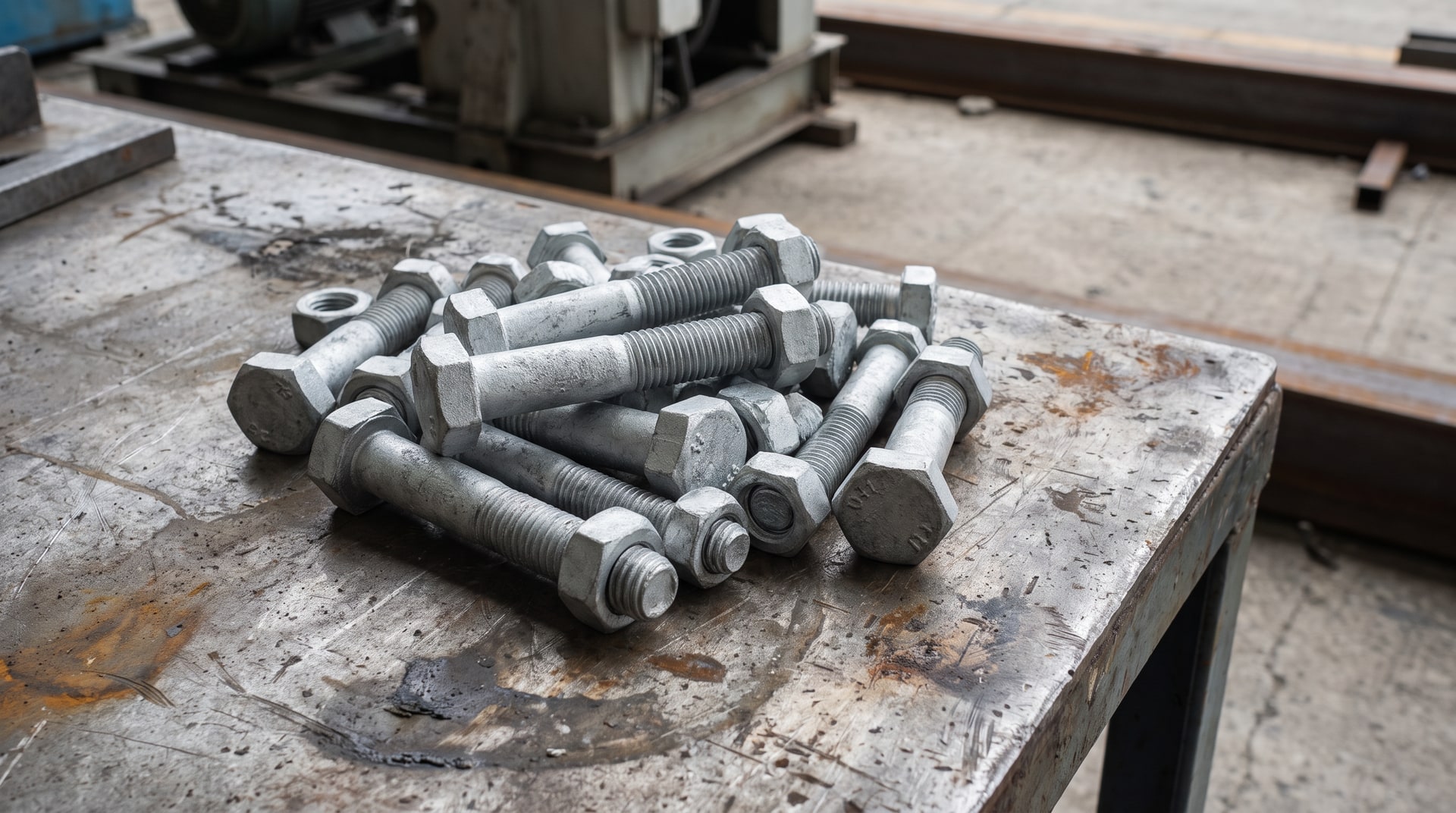
When a project spec calls for corrosion-resistant fasteners, the range of available coating options can make the selection feel straightforward. Zinc plating, mechanical galvanizing, epoxy, paint, and hot-dip galvanizing are all commonly offered, and at first glance they might seem interchangeable. But fasteners are not flat plates. They are threaded, headed, curved, and handled repeatedly before they ever reach their final installation point. Every one of those characteristics puts stress on a protective coating in ways that expose real differences between processes.
The American Galvanizers Association addresses this directly in their article on the advantages of HDG fasteners. At V&S Galvanizing, we expand on that foundation to explain what is actually happening at the material level, how coating formation influences performance across threads, edges, and curved surfaces, and why the differences between these processes are often underestimated or misunderstood in the field.
Why Fastener Geometry Changes Everything About Coating Selection
Most discussions about protective coatings center on flat or gently curved surfaces, and for good reason: that is where coverage is easiest to evaluate and measure. Fasteners are different. A standard hex bolt has a head with six distinct edges, a shank that transitions into helical threads, and a tip that is often chamfered or pointed. Each of these geometric features represents a location where a coating applied by deposition or spraying can become dangerously thin.
The physics behind this is straightforward. Electroplating and painting are driven by processes where coating material is deposited onto a surface from an external source. At sharp edges and corners, the applied material tends to thin out rather than build up. This is a well-documented limitation of these methods and it has direct consequences for fastener protection. If the coating is thinnest exactly where the geometry concentrates stress and moisture exposure, those locations become initiation points for corrosion.
Hot-dip galvanizing behaves fundamentally differently because the zinc coating is not deposited from outside the steel. It forms through a metallurgical reaction between the zinc bath and the iron in the base steel. That reaction proceeds perpendicularly to the steel surface regardless of whether that surface is flat, curved, or a sharp 90-degree edge. The result is that corners and edges receive coatings that are at least as thick as those on flat surfaces, sometimes thicker. For fasteners, this distinction is not a minor technical footnote. It is the difference between a coating that protects the whole bolt and one that leaves the most vulnerable geometry exposed.
Threads Are Where Coating Failures Get Dangerous
Thread geometry is essentially a repeating series of tight peaks and valleys with acute angles at each crest. For any coating process that relies on mechanical deposition or spray application, consistent coverage across those features is a genuine engineering challenge.
Mechanical galvanizing uses glass beads in a tumbling process to peen zinc powder onto the steel surface. The peening action does compact the zinc, but the uniformity across complex geometry is inherently limited compared to a reaction-based process. The beads physically cannot reach every point of a thread profile with equal intensity, and the resulting coating can vary in thickness and compaction across the thread cross-section.
Zinc plating produces even thinner coatings overall, and the electroplating process magnifies the edge-thinning problem. The result is coatings that may meet dimensional tolerances but provide minimal actual protection on the thread crests themselves. Zinc plating is generally considered suitable only for indoor or otherwise sheltered environments for exactly this reason.
For hot-dip galvanized bolts, the zinc-iron alloy layers form across the entire thread profile through the same metallurgical mechanism that governs flat surfaces. The reaction does not distinguish between geometries. As long as the steel surface is properly cleaned and fluxed before entering the zinc bath, the coating forms uniformly. This matters enormously in practice because thread corrosion does not just affect appearance. It reduces thread engagement, compromises clamping force, and in structural applications it can create a genuine safety hazard. Bolt heads are similarly at risk: a corroded bolt head rounds off under a wrench, making removal and inspection far more difficult and costly.
Coating Density and What It Means for Zinc per Unit Area
For zinc coatings, the primary variable governing corrosion protection is how much zinc is actually present per unit of surface area. A thicker coating obviously contains more zinc, but coating density also plays a role. A denser coating delivers more zinc mass per unit of thickness, which translates directly to longer service life before the zinc is consumed and the base steel is exposed.
Hot-dip galvanizing produces a coating with a density of approximately 0.6 oz/ft²/mil. Mechanical galvanizing produces a coating with a density of approximately 0.45 oz/ft²/mil. That difference means that at equal coating thickness, a hot-dip galvanized fastener carries at least 30% more zinc than a mechanically galvanized one. In service, that 30% margin translates directly to longer time before first corrosion of the base steel, which is the metric that actually matters when evaluating long-term performance.
| Coating Process | Coating Density (oz/ft²/mil) | Relative Zinc per Unit Area |
|---|---|---|
| Hot-Dip Galvanizing | 0.60 | Baseline (100%) |
| Mechanical Galvanizing | 0.45 | Approximately 75% (at least 30% less zinc per unit area) |
This density advantage compounds with the edge and corner coverage advantage. A mechanically galvanized bolt is operating at lower zinc density AND potentially thinner coverage at the thread crests. A hot-dip galvanized bolt delivers higher density across a more uniformly covered surface. The combined effect on service life is significant, particularly in outdoor, marine, or industrial exposure environments.
The Built-In Quality Control That Other Processes Cannot Match
One of the less-discussed advantages of hot-dip galvanizing is what happens when something goes wrong during processing. The metallurgical reaction that creates the zinc-iron alloy layers requires a chemically clean steel surface. If the surface preparation is inadequate, if contamination is present, or if flux coverage is incomplete, the reaction simply does not occur at that location. The result is a visible bare spot that can be identified and addressed before the product ships.
This self-revealing quality control mechanism is inherent to the process itself. It does not depend on an inspector catching a defect after the fact. The galvanizing reaction will not form over contamination, so any failure of surface preparation shows up immediately and unambiguously.
Compare that to epoxy coating. The curing process for epoxy can develop voids, holidays, or incomplete cure zones that may not be visible on the surface. A bolt can leave an epoxy coating facility with subsurface voids that expose the base steel, and those defects may not be detectable without destructive testing. The AGA notes that this means it is possible for epoxy coated bolts to begin corroding before they even leave the processing facility. That is a significant quality risk for any application where fastener integrity is critical.
Mechanically galvanized bolts carry a similar risk. Coatings that are not properly compacted during the peening process can contain bare spots or regions of poor adhesion that are not immediately obvious. The process does not have the same self-revealing mechanism that the metallurgical reaction in hot-dip galvanizing provides.
Hardness, Abrasion Resistance, and the Handling Problem
Fasteners are not installed directly from the galvanizing plant into their final position. They are packaged, shipped, stored in bins or on pallets, handled by workers, run through impact wrenches, and often re-sorted or counted multiple times before installation. Every one of those steps is an opportunity for abrasion damage to the coating.
For paint and epoxy coatings, the concern is obvious. Both are polymer-based and significantly softer than steel. They can be scratched away from the base steel by contact with other fasteners during handling, and once the coating is breached in an area that does not have cathodic protection benefit, corrosion can begin at the bare spot.
The iron-zinc alloy layers that form in hot-dip galvanizing are actually harder than the base steel itself. This is a direct consequence of the intermetallic compound formation during the galvanizing reaction. The alloy layers, particularly the harder inner layers adjacent to the steel, provide abrasion resistance that other zinc coatings cannot match. Zinc plating and mechanically galvanized coatings are at best approximately half as hard as the base steel, which means they are substantially more vulnerable to abrasion during the handling sequence that every fastener goes through.
In practical terms, a bucket of hot-dip galvanized bolts that gets dropped, bounced around in a truck bed, and sorted by hand multiple times will arrive at the job site with substantially more coating integrity than a comparable batch of zinc-plated or mechanically galvanized fasteners that went through the same treatment.
Cathodic Protection: The Zinc Advantage Over Paint and Epoxy
All zinc-based coatings share one advantage that paint and epoxy cannot replicate: cathodic protection. When the zinc coating is scratched or damaged and bare steel is exposed, the zinc surrounding the damage acts as a sacrificial anode. Zinc is electrochemically more active than iron, so in the presence of moisture, the zinc corrodes preferentially and the base steel is protected. The bare spot effectively heals itself galvanically until the surrounding zinc is consumed.
Paint and epoxy provide only barrier protection. If the coating is scratched through to bare steel, there is no electrochemical mechanism to arrest corrosion at the damage site. Moisture penetrates, and corrosion can undercut the coating from the damage point outward. For fasteners in outdoor or aggressive environments, this distinction is consequential. A coating that cannot provide cathodic protection is one that requires complete, uninterrupted surface coverage to function, and as discussed above, maintaining complete coverage across fastener geometry is exactly where non-HDG processes struggle most.
Bond Strength and Long-Term Coating Adhesion
Coating adhesion is sometimes treated as a secondary consideration, but for fasteners it deserves careful attention. A coating that peels or lifts from the base steel creates an accelerated corrosion scenario because moisture can migrate under the lifted coating, contacting a large area of bare steel in a confined space that is difficult to inspect or treat.
Hot-dip galvanizing has a bond strength of approximately 3,600 PSI. The metallurgical bond between the zinc-iron alloy layers and the base steel is not an adhesive joint in the conventional sense. The alloy layers are continuous with the iron substrate at the atomic level, which is why the bond strength is so high. Zinc plating and paint, by contrast, have bond strengths measured in only a couple hundred PSI. Those coatings rely on mechanical adhesion rather than metallurgical continuity, and they are correspondingly more susceptible to delamination under the mechanical stresses that fasteners routinely encounter.
For engineers specifying fastener coatings in structural or high-vibration applications, bond strength is not an abstract specification number. It is the property that determines whether the coating stays on the bolt through years of service or begins to peel at the first opportunity.
Work With a Team That Understands Fastener Coating From the Inside Out
The performance differences between hot-dip galvanizing and competing fastener coatings are not marginal. They are rooted in fundamental differences in how each coating forms, how it bonds to steel, and how it behaves under the mechanical and electrochemical stresses of real service conditions. Edge and corner coverage, coating density, abrasion resistance, bond strength, built-in quality control, and cathodic protection all favor hot-dip galvanizing, and the gap is widest exactly where fasteners are most demanding: at threads, corners, and across the handling chain from plant to installation.
At V&S Galvanizing, our team processes fasteners and structural components with the same attention to surface preparation and process control that the metallurgical quality control mechanism requires. If you are evaluating coating options for a fastener application, whether that is a bridge deck hardware package, an industrial structure, or a below-grade assembly, we are glad to walk through the specifics with you. Reach out through our contact page and let us know what you are working on.
Frequently Asked Questions About Hot-Dip Galvanized Fasteners
Why does hot-dip galvanizing provide better coverage on bolt threads than zinc plating?
Hot-dip galvanizing forms through a metallurgical reaction that grows perpendicularly to the steel surface regardless of geometry. This means thread crests, valleys, and edges receive coating that is at least as thick as flat surfaces. Zinc plating relies on electrodeposition, which thins out at edges and corners due to current distribution effects, leaving thread profiles with reduced coating thickness exactly where protection is most needed.
What is the coating density difference between hot-dip galvanizing and mechanical galvanizing?
Hot-dip galvanizing produces a coating density of approximately 0.6 oz/ft²/mil, compared to approximately 0.45 oz/ft²/mil for mechanical galvanizing. This means hot-dip galvanized coatings deliver at least 30% more zinc per unit area at equal thickness, which translates directly to longer service life before the zinc is consumed and base steel is exposed.
Are hot-dip galvanized bolt coatings harder than the base steel?
Yes. The iron-zinc alloy layers that form during hot-dip galvanizing are harder than the base steel itself. Other zinc coatings such as zinc plating and mechanical galvanizing are at best approximately half as hard as the base steel. This hardness advantage gives HDG fasteners significantly better abrasion resistance during handling, shipping, and installation.
How does the bond strength of hot-dip galvanizing compare to zinc plating and paint?
Hot-dip galvanizing achieves a bond strength of approximately 3,600 PSI because the zinc-iron alloy layers are metallurgically continuous with the base steel rather than adhesively attached. Zinc plating and paint have bond strengths of only a couple hundred PSI. This difference matters for fasteners because low bond strength coatings are vulnerable to delamination under the mechanical stresses of installation and service.
Can epoxy coated bolts develop corrosion before they are even installed?
Yes, this is a documented risk. The epoxy curing process can produce voids or holidays in the coating that may not be visible on the surface. If those voids expose bare steel, corrosion can begin at the processing facility before the bolts ship. Hot-dip galvanizing does not carry this risk because the metallurgical reaction will not form over contaminated or incompletely prepared surfaces, making defects immediately visible for correction.
Do hot-dip galvanized fasteners provide cathodic protection if the coating is scratched?
Yes. All zinc coatings, including HDG, provide cathodic protection. When the zinc coating is scratched through to bare steel, the surrounding zinc acts as a sacrificial anode and corrodes preferentially to protect the exposed steel. Paint and epoxy coatings provide only barrier protection and cannot offer this electrochemical safeguard when the coating is breached.
Is zinc plating an acceptable substitute for hot-dip galvanizing on outdoor fasteners?
Generally, no. Zinc plating produces very thin coatings that are considered suitable only for indoor applications. The coating density is lower, edge and corner coverage is thinner, and the bond strength is significantly less than hot-dip galvanizing. In outdoor or aggressive environments, zinc-plated fasteners will corrode far sooner than their hot-dip galvanized equivalents.
What quality control advantage does hot-dip galvanizing have that mechanical galvanizing lacks?
The metallurgical reaction in hot-dip galvanizing will not proceed on a surface that is not properly cleaned and fluxed. Any area of inadequate surface preparation shows up as a visible bare spot that can be identified and addressed before shipping. Mechanically galvanized coatings can have areas of insufficient zinc compaction that are not apparent on the surface, creating the possibility for hidden bare spots that do not reveal themselves until corrosion begins in service.
