

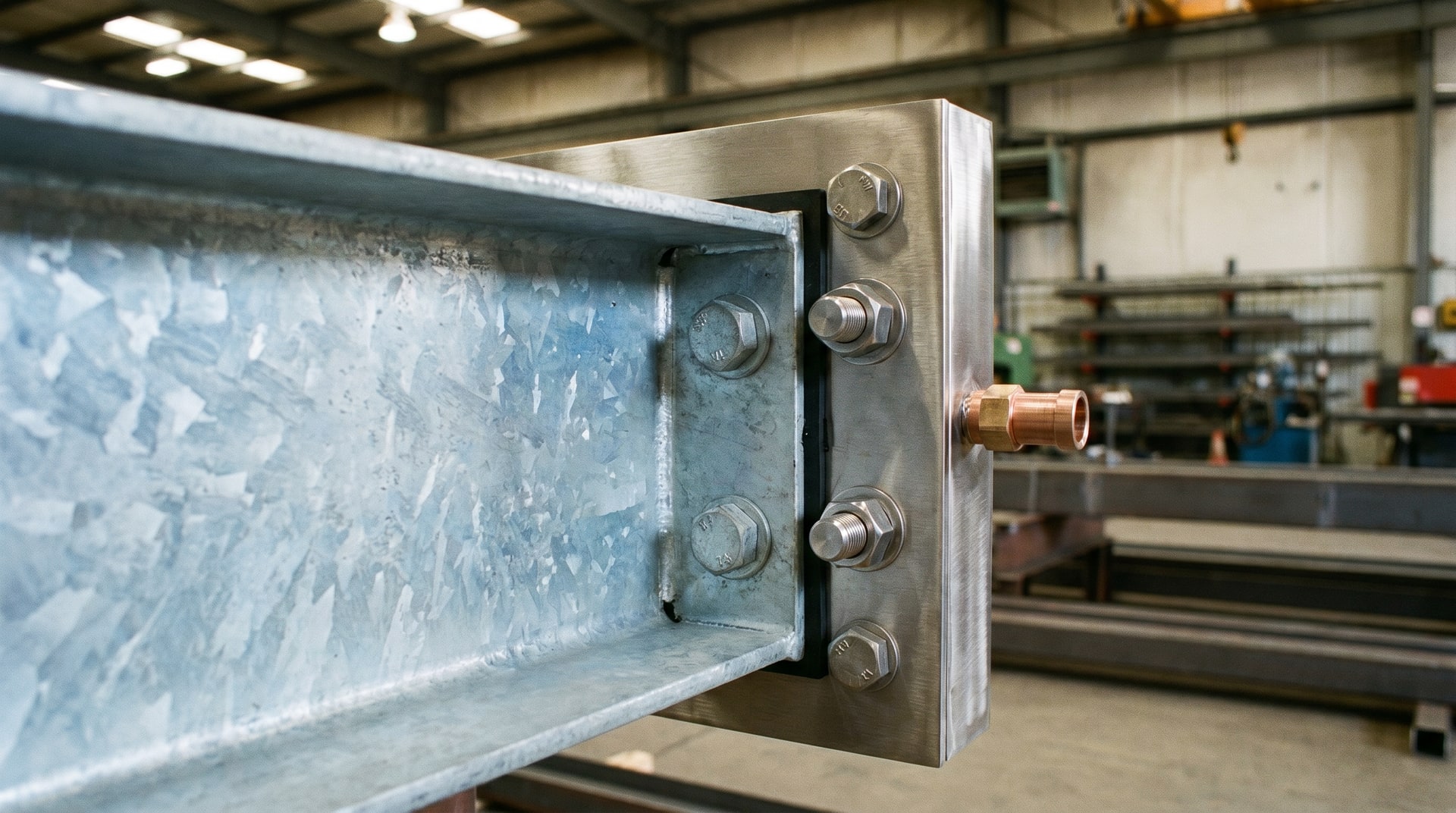
When galvanized steel is used in real-world applications, it rarely exists in isolation. It is often connected to, fastened with, or installed alongside other metals such as aluminum, stainless steel, or copper alloys. These mixed-metal conditions introduce an important engineering consideration: galvanic corrosion.
At V&S Galvanizing, we regularly work with engineers and fabricators to evaluate how galvanized steel will interact with adjacent materials in the field. While zinc coatings provide excellent corrosion protection, understanding how they behave in contact with other metals is critical to ensuring long-term performance.
The American Galvanizers Association provides foundational guidance on this topic, which we build on here with deeper insight into how galvanic relationships actually behave in service conditions.
The Science Behind Metal-to-Metal Corrosion
When two dissimilar metals are in electrical contact in the presence of an electrolyte (such as water), a galvanic cell is created. This results in one metal acting as the anode and the other as the cathode.
In this relationship:
- The anodic metal corrodes preferentially
- The cathodic metal is protected
Zinc, which forms the coating in hot dip galvanizing, is intentionally anodic relative to steel. This is what allows it to protect exposed steel areas through sacrificial corrosion.
However, when zinc comes into contact with other metals, its position in the galvanic series determines how it behaves.
Where Zinc Sits in the Galvanic Series
Zinc is more anodic than many commonly used metals, including:
- Steel
- Stainless steel
- Copper
- Nickel alloys
This means that when galvanized steel is electrically connected to these materials in a wet environment, the zinc coating will corrode preferentially.
This is not a defect. It is the same mechanism that provides protection to the base steel—but when paired with more noble metals, the zinc may be consumed at an accelerated rate depending on the conditions.
Why Environment Changes Everything
One of the biggest misconceptions about dissimilar metal contact is that it always leads to rapid corrosion. In reality, the environment determines whether galvanic corrosion will even occur.
For galvanic corrosion to be active, three conditions must exist simultaneously:
- Electrical contact between the metals
- Presence of an electrolyte (moisture)
- A conductive path for ionic transfer
If any one of these is removed, the corrosion cell is effectively interrupted.
For example:
- Dry interior environments rarely experience galvanic corrosion
- Intermittent moisture exposure creates slower reaction rates
- Constant wet or marine environments accelerate the process significantly
This is why the same material pairing may perform perfectly in one application and degrade quickly in another.
Relative Surface Area: The Hidden Multiplier
One of the most important but often overlooked factors is the ratio of surface areas between the two metals.
If a small amount of galvanized steel is connected to a large area of a more noble metal:
- The zinc coating can be consumed more rapidly
- Corrosion is concentrated at the smaller anodic area
Conversely:
- A large galvanized surface connected to a small noble metal area results in much slower corrosion rates
This relationship is critical in connection design and hardware selection.
Common Metal Pairings and What to Expect
Galvanized Steel and Stainless Steel
This is a common pairing in fasteners and structural systems. Stainless steel is more noble than zinc, so the zinc will act as the sacrificial metal. In most environments, this pairing performs well, especially when exposure to moisture is limited or intermittent.
Galvanized Steel and Aluminum
Zinc and aluminum are closer in the galvanic series, which reduces the driving force for corrosion. In many cases, this pairing performs well, particularly in non-aggressive environments.
Galvanized Steel and Copper
This is one of the more aggressive combinations. Copper is significantly more noble than zinc, which can accelerate zinc corrosion in wet conditions. Direct contact is typically avoided or isolated in design.
Galvanized Steel and Weathering Steel
While both materials are corrosion-resistant, their interaction depends heavily on environmental exposure. Careful evaluation is required, especially in areas with persistent moisture.
Practical Design Strategies to Prevent Issues
Rather than avoiding dissimilar metals entirely, most successful projects manage the interaction through design.
Effective strategies include:
- Isolating metals using non-conductive materials such as gaskets or coatings
- Designing connections to shed water and promote drying
- Avoiding configurations that trap moisture
- Matching fastener materials to the primary structure where possible
- Considering surface area ratios during connection design
These approaches interrupt or slow the galvanic process and significantly extend service life.
Why Galvanizing Still Performs in Mixed-Metal Systems
Even when zinc is the anodic material, galvanizing remains a highly effective corrosion protection system.
This is because:
- The zinc coating is typically thick enough to provide long-term sacrificial protection
- Corrosion rates are often slow in real-world conditions
- Proper design can minimize or eliminate galvanic interaction
In many applications, the service life of galvanized steel still exceeds project requirements even when paired with other metals.
The Role of Specification and Coordination
Material compatibility is rarely addressed in isolation. It should be part of a broader corrosion protection strategy that considers:
- Environmental exposure classification
- Coating thickness requirements
- Connection details
- Maintenance expectations
Early coordination between engineers, fabricators, and galvanizers ensures that these factors are aligned before materials are selected and fabricated.
Work With a Team That Understands Real-World Applications
Dissimilar metal contact is not inherently a problem—but it is something that must be understood and managed correctly. The difference between long-term performance and premature corrosion often comes down to small design decisions.
At V&S Galvanizing, we help project teams evaluate material compatibility, environmental exposure, and coating performance so that galvanized steel performs as expected in real-world conditions. If you have questions about using galvanized steel alongside other metals or want to review your project design, reach out to our team through our contact page.
Galvanized steel can be successfully used in contact with other metals when the relationship between materials, environment, and design is properly understood. Zinc’s position in the galvanic series means it will act as the sacrificial material in many pairings, but this behavior can be managed through thoughtful design, proper material selection, and environmental awareness. If you are planning a project that involves mixed-metal systems, reach out to our team through our contact page to ensure your design is aligned for long-term performance.
Frequently Asked Questions About Galvanized Steel and Dissimilar Metals
Does galvanized steel corrode faster when touching other metals?
It can, depending on the environment. In the presence of moisture and electrical contact, zinc may corrode faster when paired with more noble metals.
Is it safe to use stainless steel fasteners with galvanized steel?
Yes, in many applications. However, in consistently wet environments, the zinc coating may corrode more quickly due to galvanic interaction.
Why is copper not recommended with galvanized steel?
Copper is significantly more noble than zinc, which can accelerate zinc corrosion when the two are in contact in moist environments.
Can galvanic corrosion occur in dry environments?
No. Without an electrolyte such as water, galvanic corrosion cannot occur.
How can galvanic corrosion be prevented?
It can be reduced or eliminated by isolating metals, preventing moisture accumulation, and designing for drainage and airflow.
Does surface area affect galvanic corrosion?
Yes. A small anodic area (zinc) connected to a large cathodic area (more noble metal) can accelerate corrosion.
Is galvanized steel still a good choice in mixed-metal systems?
Yes. With proper design and environmental consideration, galvanized steel performs well in most mixed-metal applications.
Should material compatibility be reviewed during design?
Yes. Early evaluation of metal combinations helps prevent corrosion issues and ensures long-term performance.
