

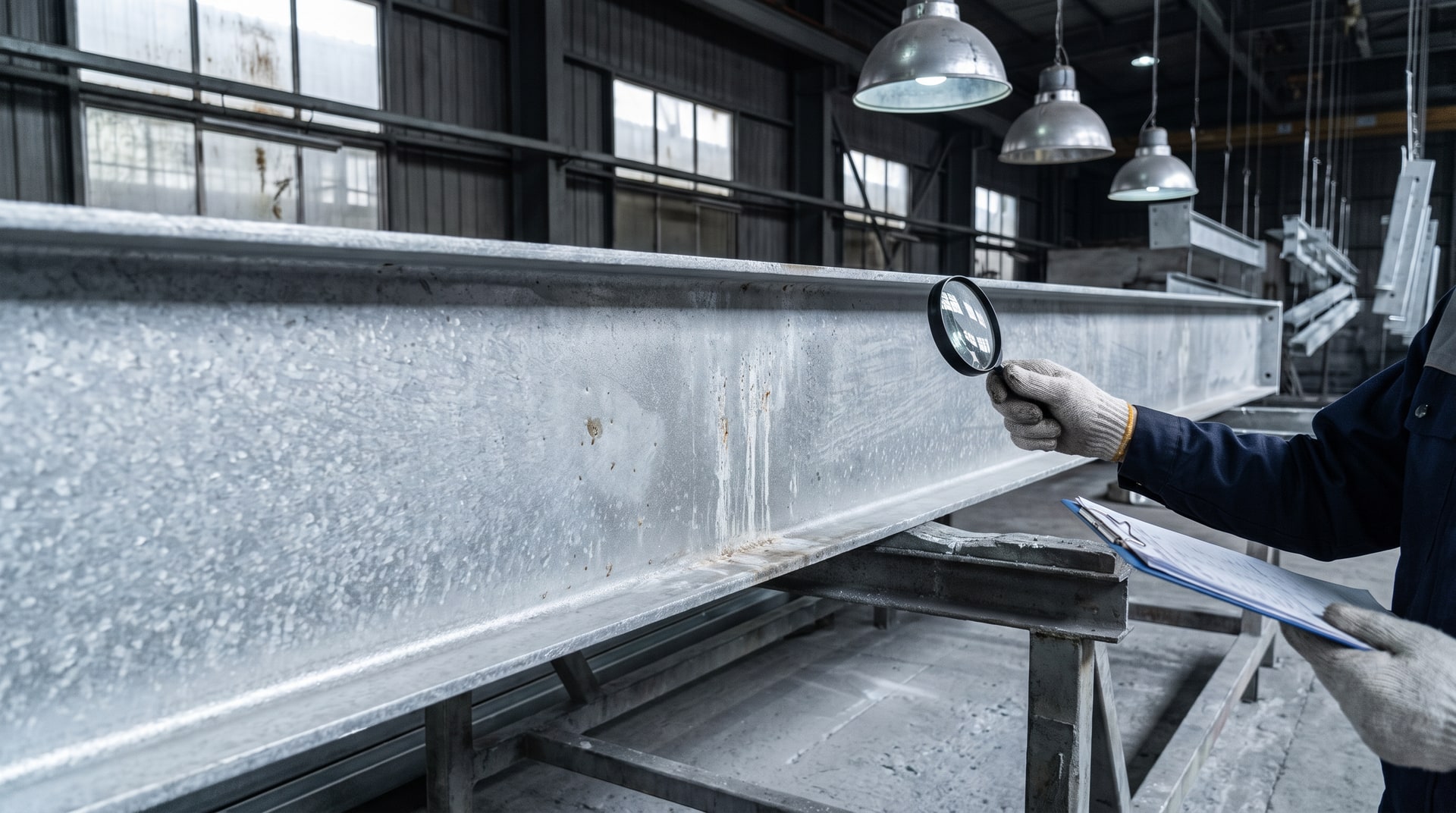
When a fabricator submits steel for hot-dip galvanizing, the specification governing that coating matters far more than most people realize until something goes wrong. A coating that looks slightly rough, carries an embedded dross particle, or measures a few microns below target can trigger a rejection, a dispute, or a field repair that costs time and money. The specification used to define what is acceptable shapes all of those outcomes. In North America, ASTM A123 is the dominant standard. But in Canada, and increasingly for utility and communications infrastructure work, CSA G164 enters the picture, and the two standards do not agree on everything.
The American Galvanizers Association addresses this directly in their article on differences between ASTM A123 and CSA G164-18. At V&S Galvanizing, we expand on that foundation to explain what is actually happening at the material level, how specification choice influences surface appearance, coating thickness acceptance, and repair limits, and why this is often misunderstood in the field.
Why CSA G164 Came Back Into Relevance
CSA G164 had been dormant for a long time. The previous revision dated to 1992, and most galvanizers in North America had little reason to reference it. ASTM A123 covered the same general territory and was actively maintained. That changed in 2018 when the Canadian Standards Association issued a substantially updated version of G164.
The 2018 revision was not a minor housekeeping update. It changed the scope of the standard to place explicit emphasis on products intended for electrical and communications systems, added a reference to the newly updated CSA C83 standard for power and communication line hardware, replaced coating weight values with coating thickness values to align with modern measurement practice, and introduced an informative annex describing alternative galvanizing methods including thermal diffusion galvanizing and mechanical galvanizing. That last point reflects a broader industry conversation about corrosion protection options, even if batch hot-dip galvanizing remains the primary subject of the standard.
The practical consequence is that utility contractors, communications infrastructure fabricators, and Canadian project owners now have a more current version of G164 to reference. When one of those customers submits a purchase order specifying G164-18 compliance, a galvanizer needs to know precisely where that standard diverges from A123.
Bath Composition: Where the Two Standards Actually Agree
One area where confusion sometimes arises is bath composition. Prior to the 2018 update, G164 and A123 had meaningfully different requirements for zinc purity. After the revision, they are functionally identical on this point. Both standards now require that the galvanizing bath contain not less than 98.0% zinc, expressed as "by mass" in G164 and "by weight" in A123. These terms describe the same physical quantity; the difference is only in wording.
Where a real difference does persist is in the accepted purity references. Both standards cite ASTM B6 as an acceptable specification for zinc used in the galvanizing bath. A123 goes further, also accepting ASTM B960, which covers recycled zinc. G164 does not reference B960. For galvanizers who use secondary zinc sources, this distinction matters for traceability and documentation when working under G164.
Material Categories and the Coating Thickness Gap
The most consequential technical difference between the two standards involves how they categorize steel and what minimum coating thicknesses they assign. Understanding this requires looking at both tables side by side.
| Classification | Material | Size / Thickness | Min. Coating Thickness (µm) |
|---|---|---|---|
| 1 | Castings, iron and steel | All | 85 |
| 2 | Rolled, drawn, pressed, or forged steel (except Classifications 3 and 4) | < 1.6 mm | 45 |
| 1.6 mm to < 3.2 mm | 65 | ||
| 3.2 mm to < 4.8 mm | 75 | ||
| > 4.8 mm | 85 | ||
| Structural Steel > 6.35 mm and plates, non-centrifuged | 100 | ||
| 3 | Screws, bolts, nuts, rivets, nails, and similar fasteners | < 12.7 mm diameter; washers < 6.4 mm thick | 42 |
| 4 | Bolts, nuts, and threaded fasteners | > 12.7 mm diameter; washers > 6.4 mm thick | 65 |
| Material Category | <1/16 in (<1.6 mm) | 1/16 to <1/8 in (1.6–3.2 mm) | 1/8 to <3/16 in (3.2–4.8 mm) | 3/16 to <1/4 in (4.8–6.4 mm) | 1/4 to <5/8 in (6.4–16.0 mm) | >5/8 in (>16.0 mm) |
|---|---|---|---|---|---|---|
| Structural Shapes | 45 | 65 | 75 | 75 | 100 | 100 |
| Strip and Bar | 45 | 65 | 75 | 75 | 75 | 100 |
| Plate | 45 | 65 | 75 | 75 | 75 | 100 |
| Pipe and Tubing | 45 | 45 | 75 | 75 | 75 | 75 |
| Wire | 35 | 50 | 60 | 65 | 80 | 80 |
| Reinforcing Bar | - | - | - | - | 100 | 100 |
| Forgings and Castings | - | - | - | 100 | 100 | 100 |
ASTM A123 takes a detailed, material-specific approach. Its thickness table separates structural shapes, strip and bar, plate, pipe and tubing, wire, reinforcing bar, and forgings and castings, then assigns different minimums to each based on steel thickness. The values were developed with real-world coating behavior in mind. Pipe and tubing, for example, is assigned lower minimum thicknesses than structural shapes of the same steel thickness, because the metallurgical interaction between the zinc bath and the steel in tubular sections produces thinner coatings in practice. A123 reflects that reality.
CSA G164 uses broader, more generalized categories: castings, rolled/drawn/pressed/forged steel, small fasteners, and larger bolts and threaded fasteners. The problem is that lumping strip, bar, pipe, and tubing into the same category as heavier structural sections produces minimum thickness requirements that are simply not achievable on those thinner or tubular materials. A 75 or 85 micrometer minimum on thin-walled pipe is not something the galvanizing process reliably delivers on that geometry, regardless of bath temperature, immersion time, or withdrawal speed. Specifying G164 on a project that includes pipe and tubing creates a compliance problem before the steel ever enters the kettle.
Fabricators and specifiers who are accustomed to A123 should flag this when projects involving pipe, tubing, strip, or bar are submitted under G164. It is not that the galvanizer is doing something wrong; it is that the specification imposes a standard the metallurgy of that product family cannot consistently meet.
How Coating Thickness Is Measured and Accepted
Both standards permit the same four measurement methods: magnetic or electronic gauge, weigh-galvanize-weigh, weigh-strip-weigh, and microscopy. The measurement tools are the same; the acceptance criteria are not.
Under G164, every individual coating thickness reading must be at least 90% of the required minimum, and the average of five measurements must meet the table minimum. This means a single low reading on a given specimen can trigger non-conformance even if the overall average is satisfactory. The standard does not allow individual readings to fall below nine-tenths of the threshold.
ASTM A123 takes a more statistically practical approach. The standard requires that the average coating thickness across all specimens tested meet the minimum specified in Table 1. It allows for the average of a single specimen to fall one coating grade below the Table 1 requirement without triggering rejection of the lot. This acknowledges that coating thickness varies across a surface due to drainage patterns, steel reactivity, and geometric factors. A single specimen with a slightly lower average does not necessarily indicate a systemic problem with the coating.
In practical terms, G164's measurement acceptance criteria are more restrictive and can result in rejection of parts that would pass under A123, even when the overall coating quality is comparable. For a galvanizer serving customers under both standards, this difference in how compliance is evaluated needs to be part of the pre-job quality planning conversation.
Finish and Appearance: Where the Language Gets Strict
This is the section most directly relevant to what the coating actually looks like after it comes out of the kettle, and the two standards take noticeably different positions.
CSA G164 requires that the zinc coating be free from imperfections including blisters, gritty or uncoated areas, acid spots, black spots, and dross particles adhering to the coating. That last item is worth dwelling on. Dross is the zinc-iron intermetallic compound that settles to the bottom of the galvanizing bath, but it can also be stirred up and adhere to the steel surface during withdrawal. G164 prohibits any dross particles on the finished coating surface, full stop.
ASTM A123 uses the phrase "gross dross inclusions." That qualifier changes the standard meaningfully. Gross inclusions are those large enough to compromise the coating's protective function or its structural integrity. Minor dross adherence that does not affect coating performance is not grounds for rejection under A123. The standard recognizes that a completely dross-free surface in a production environment is an aspirational ideal, and that not every small imperfection constitutes a defect.
From an appearance standpoint, this matters to end users who care about the visual quality of the finished galvanized surface. A coating that passes A123 inspection may not pass G164 inspection if any dross particles are present. For architectural applications, bridge components, or utility hardware where visual inspection is rigorous, this is a real operational difference. Our team at V&S Galvanizing treats surface appearance as a point of quality pride regardless of which specification governs a job, but understanding where the contractual line falls under each standard prevents disputes at delivery.
Touch-Up, Repair, and What Happens After the Coating Leaves the Plant
Both A123 and G164 require that touch-up and repair of the galvanized coating be performed in accordance with ASTM A780. The mechanics of repair, including the acceptable methods such as zinc-rich paint or zinc solder, are the same under both standards. The differences appear in how much of the surface can be repaired and under what authority.
Both standards set the same baseline: a bare spot subject to repair must be less than 25 mm (1 inch) in its narrowest dimension and must represent less than 0.5% of the coated area. Where they diverge is in how that "coated area" is defined and what exceptions are permitted.
G164 refers to "surface area to be coated," while A123 refers to "the accessible surface area to be coated on that article." The A123 language is more precise. On fabricated assemblies where overlapping surfaces, bolted connections, or box sections create areas that cannot be physically accessed for measurement or repair, only the accessible surface counts in the denominator. On a complex fabrication, this distinction can substantially affect whether a bare spot represents 0.3% or 0.7% of the relevant area.
A123 also adds an absolute upper limit: the repairable area must not exceed 36 square inches per short ton of piece weight, whichever limit is more restrictive than the 0.5% threshold. This provides a weight-normalized cap that prevents the percentage rule alone from permitting large repairs on very heavy pieces.
G164 allows an exception that A123 does not: any area larger than the allowable maximum may be repaired if the galvanizer and purchaser mutually agree to it. A123 does not permit this exception at the galvanizing plant. The piece is either within the repair limits or it is rejectable.
For field repairs after the steel has left the plant, A123 is explicit: there is no limit on the size of the area subject to renovation once parts are at the job site. G164 does not directly address field repairs, though the mutual-agreement clause could conceivably be applied. In practice, field repair decisions on G164 jobs require direct communication between all parties.
Embrittlement Testing and Adherence Verification
Both standards use the stout knife test to verify that the zinc coating adheres properly to the steel substrate. In this test, a sharp blade is applied with significant force at a cutting angle; a properly adherent galvanized coating will resist peeling or flaking. This test is qualitative and operator-dependent, but it remains the standard field method under both specifications.
For embrittlement testing, the two standards diverge in approach and scope. ASTM A123 references ASTM A143, a comprehensive guide specifically for safeguarding against embrittlement of hot-dip galvanized structural steel. A143 focuses on bend testing and provides detailed procedures for identifying hydrogen embrittlement risk factors. A123's approach is to point to that complete external reference rather than reinstate the procedures internally.
CSA G164 takes a different path, providing its own strain-age embrittlement test procedures within the standard itself, covering both bend and impact test methods. Notably, G164 does not include procedures for hydrogen embrittlement testing. Hydrogen embrittlement is a distinct failure mode from strain-age embrittlement and is particularly relevant for high-strength steels that undergo acid pickling during the galvanizing process. The absence of hydrogen embrittlement provisions in G164 is a consideration for fabricators working with cold-worked or high-strength steels under that specification.
Sampling Procedures and Where They Come From
Sampling procedures determine how many pieces from a lot are tested, which areas are measured, and how results are reported. This is where the operational reality of compliance lives.
ASTM A123 contains its sampling protocol directly in Paragraph 7 of the standard. It is self-contained, clearly written, and the reference most North American galvanizers know well. G164 previously had much more general and relaxed sampling guidelines, which was one reason the standard felt less rigorous than A123 before 2018.
The 2018 revision of G164 replaced its internal sampling procedure with a reference to Annex B of CSA C83, the communication and power line hardware standard. This shift ties G164 sampling tightly to the utility industry context that now defines the standard's primary market. For a galvanizer who does not regularly work on utility hardware, accessing and interpreting Annex B of CSA C83 requires obtaining that document separately. It is a workable requirement, but it adds a step that does not exist under A123.
Work With a Team That Understands Which Standard Actually Governs Your Project
Choosing between ASTM A123 and CSA G164-18 is not simply a matter of geography or customer preference. The two standards differ in ways that directly affect what a finished galvanized coating must look like, how thick it needs to be, how it is measured, what surface imperfections are permitted, and how much of a bare area can be repaired before a piece becomes rejectable. On projects that include pipe, tubing, strip, or bar, the thickness requirements in G164 can create compliance problems that do not exist under A123. On projects where dross-free surface appearance matters, G164's stricter finish language may actually serve the project better.
Our team works through these specification questions at the front end of every project, not after steel comes out of the kettle. If your project involves G164 compliance, Canadian utility standards, or any situation where the governing specification is unclear, we are equipped to work through the details with you. Reach out through our contact page and let us talk through what the specification requires before fabrication is complete.
Frequently Asked Questions About ASTM A123 vs. CSA G164-18
What is the primary difference in coating appearance requirements between ASTM A123 and CSA G164-18?
CSA G164-18 prohibits any dross particles adhering to the galvanized coating surface. ASTM A123 only disallows "gross dross inclusions," meaning minor dross adherence that does not affect coating performance is acceptable under A123. This makes G164 more restrictive on surface finish, and parts that pass A123 visual inspection may not pass G164 inspection if any dross is present.
Why do pipe and tubing create a compliance problem under CSA G164 that does not exist under ASTM A123?
CSA G164 groups pipe, tubing, strip, and bar into its general rolled/forged steel category and assigns minimum coating thicknesses that can exceed what is metallurgically achievable on those product forms. ASTM A123 assigns separate, lower minimums to pipe and tubing based on real-world coating behavior. Specifying G164 on a project with pipe or tubing can create a situation where compliance is structurally impossible to achieve regardless of galvanizing quality.
How do the two standards differ in how individual coating thickness readings are evaluated?
Under CSA G164, every individual reading must be at least 90% of the required minimum, with the average of five readings meeting the table minimum. ASTM A123 requires only that the average across all tested specimens meets the Table 1 minimum, and allows a single specimen's average to fall one coating grade below the requirement without triggering lot rejection. G164's approach is more restrictive at the individual reading level.
Can a larger bare spot be repaired under CSA G164 than under ASTM A123?
In certain circumstances, yes. CSA G164 allows repairs exceeding the standard maximum area (less than 25 mm in narrowest dimension and 0.5% of coated area) if the galvanizer and purchaser mutually agree. ASTM A123 does not permit this exception at the galvanizing plant. However, A123 explicitly allows unlimited repair size once the steel has left the plant and is in the field, which G164 does not directly address.
Does CSA G164-18 cover hydrogen embrittlement testing?
No. CSA G164-18 provides its own procedures for strain-age embrittlement testing (bend and impact tests) but does not include hydrogen embrittlement provisions. ASTM A123 references ASTM A143, which addresses both forms of embrittlement and is particularly relevant for high-strength or cold-worked steels that undergo acid pickling during processing.
What zinc purity specification does CSA G164-18 require, and how does it compare to ASTM A123?
Both standards require a minimum of 98.0% zinc in the galvanizing bath and both reference ASTM B6 for zinc purity. The practical difference is that ASTM A123 also accepts ASTM B960, which covers recycled zinc. CSA G164-18 does not reference B960, so galvanizers using recycled zinc sources may face documentation challenges when working under G164.
Why did CSA G164 change its focus in the 2018 revision?
The 2018 revision shifted the standard's primary market emphasis toward products intended for electrical and communication systems. This was reflected in new scope language, the addition of CSA C83 as a reference specification for power and communication line hardware, and updated sampling procedures tied to Annex B of CSA C83. The change was driven by the utility industry's need for a more current and comprehensive Canadian galvanizing standard for infrastructure hardware.
Is ASTM A780 used for coating repair under both ASTM A123 and CSA G164-18?
Yes. Both standards require that touch-up and repair of the hot-dip galvanized coating be performed in accordance with ASTM A780. The acceptable repair methods, such as zinc-rich paint or zinc solder, are the same under both specifications. The differences between the standards apply to the maximum allowable repair area and the process for authorizing repairs beyond that limit, not to the repair methods themselves.
