

Silicon content in steel is one of those variables that sits quietly in a mill certificate and causes real headaches on the shop floor. When a fabricator specifies steel for hot-dip galvanizing, they are generally thinking about strength, weldability, and cost. Silicon rarely enters the conversation until the galvanized parts come out of the kettle looking dramatically different from one another, or until a coating thickness reading comes back well outside the expected range. At that point, the question almost always becomes: can the coating thickness be adjusted, or is this simply an unavoidable consequence of the steel chemistry?
The answer is yes, it can be adjusted, and the mechanism for doing so is more nuanced than most people assume. The American Galvanizers Association addresses this directly in their article on coating thickness control of high and low silicon steels. At V&S Galvanizing, we expand on that foundation to explain what is actually happening at the material level, how silicon content influences zinc coating growth, and why this is often misunderstood in the field.
Why Silicon Content Changes How Zinc Behaves on Steel
Hot-dip galvanizing works by immersing cleaned steel in molten zinc, which triggers a metallurgical reaction at the steel surface. Iron and zinc atoms interdiffuse, forming a series of zinc-iron alloy layers before the outer layer of free zinc solidifies on top. The rate and extent of that interdiffusion is what determines how thick the final coating will be.
Silicon disrupts this process in two very different ways depending on its concentration. This is sometimes called the Sandelin effect, named after the researcher who first mapped the non-linear relationship between silicon content and coating thickness. At very low silicon levels (below about 0.04%) and at moderate levels (roughly 0.15% to 0.25%), galvanizing behavior is relatively predictable. But in the ranges in between, or above 0.25%, the reaction kinetics change significantly, and coating thickness can swing well outside normal expectations.
Understanding why this happens requires looking at what silicon actually does to the iron-zinc reaction at a microscopic level, and that is where the two scenarios diverge sharply.
The Low-Silicon Case: When Diffusion Is the Limiting Factor
Steel with a silicon content below 0.04% produces a coating whose growth is controlled by the rate at which iron and zinc can interdiffuse across the alloy layer boundary. Without much silicon present to accelerate the reaction, the process self-regulates. As the alloy layers build up, they act as a diffusion barrier, slowing further growth. The result is a coating that stays within a normal, predictable thickness range.
The practical implication is that low-silicon steel tends to produce thinner coatings relative to what some specifications require, particularly for thicker base steel. This is not a corrosion concern in most situations, but it can become one when a project demands heavier coating weights for aggressive service environments.
Blast cleaning prior to galvanizing addresses this by physically roughening the steel surface. When the base steel surface has significant peaks and valleys introduced by blast media, the effective surface area available for iron-zinc interdiffusion increases substantially. The rough topography creates more contact points and more diffusion pathways, which allows the alloy layers to develop more aggressively than they would on a smooth surface. The net effect is a thicker coating than would form on unblasted low-silicon steel. Blast cleaning, in this case, is a tool for increasing coating thickness where steel chemistry would otherwise limit it.
The High-Silicon Case: When the Reaction Runs Too Fast
High-silicon steel presents the opposite problem. When silicon content is elevated, it accelerates the iron-zinc reaction dramatically. The zeta layer (the outermost of the zinc-iron alloy phases) grows rapidly, and without the natural self-limiting mechanism that controls growth in low-silicon steels, the coating can become unusually thick, brittle, and prone to poor adhesion.
Heavy coatings on high-silicon steel are not simply a cosmetic issue. They are structurally different from normal galvanized coatings. The alloy layers make up a greater proportion of the total coating thickness, and the outer free-zinc layer is reduced or absent. This matters because the alloy layers, while hard, are more brittle than free zinc. Thick alloy-dominant coatings are more susceptible to cracking and spalling under mechanical stress, and their appearance is typically darker and duller than standard galvanized steel.
Blast cleaning before galvanizing creates a different kind of interference in this scenario. Rather than promoting easier diffusion (as in the low-silicon case), blasting on high-silicon steel creates a rough zeta layer during the galvanizing reaction itself. The peaks and valleys introduced by blasting carry through into the alloy layer structure, and this irregular morphology physically interrupts the rapid, continuous growth that would otherwise occur. The roughness essentially introduces resistance into the reaction, slowing the rate at which the coating builds up. The final coating that forms after blasting is significantly thinner than it would have been on unblasted high-silicon steel.
The Blast Cleaning Process: Media, Method, and Mechanism
Blast cleaning is not a single technique. It encompasses a range of delivery systems and media, each suited to different applications and material conditions. The two primary delivery mechanisms are wheel blasting and air blasting. Wheel blasting uses a rotating wheel to throw heavy media at high velocity and works best with dense materials like metal shot or steel grit. Air blasting uses compressed air to propel lighter media and handles materials that would not respond well to the mechanical force of a wheel system.
The range of blast media in common use is broad. Aluminum oxide, silicon carbide, and steel grit are abrasive choices well suited to profiling a steel surface aggressively. Glass pellets, walnut shells, and crushed corncobs offer less aggressive cleaning action with a different surface profile outcome. Carbon dioxide, dry ice, and baking soda are used in specialized applications where residue on the substrate is a concern. Sand, wire cuttings, and metal shot round out the more common options. The choice of media affects the surface profile depth and texture, both of which influence how the subsequent galvanizing reaction proceeds.
What all of these methods have in common is the goal of changing the physical character of the steel surface before it contacts molten zinc. For galvanizing applications specifically, the surface profile created by blasting is the key variable, not just surface cleanliness. The galvanizer needs to consider what profile depth and texture will produce the desired outcome given the silicon content of the steel being processed.
What the Microstructure Actually Shows
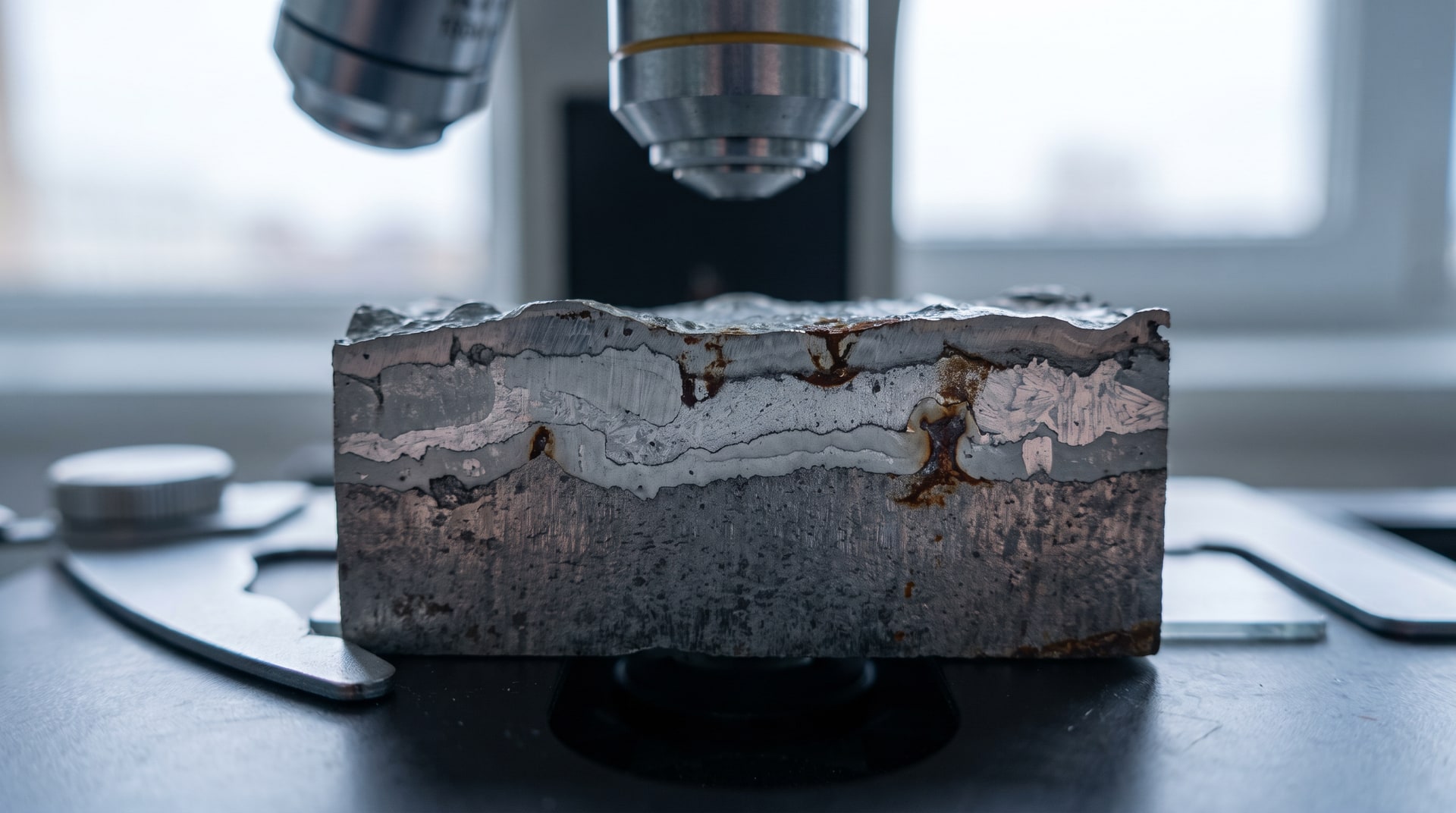
The microstructural evidence for blast cleaning's effect on coating behavior is visible under metallographic examination, and the two cases look distinctly different from each other.
In low-silicon steel that has been blast cleaned prior to galvanizing, the cross-section reveals a thicker overall coating with more developed alloy layers relative to unblasted samples. The rough base steel interface is apparent, and the alloy layers have grown into and around the surface profile created by blasting. The increase in coating thickness is a direct result of the expanded diffusion surface area.
In high-silicon steel that has been blast cleaned, the microstructure tells a different story. The zeta layer shows a distinctly irregular morphology, with peaks and valleys that mirror the roughened surface. These surface irregularities interrupt the continuous lateral growth of the alloy layers. Instead of building up in a uniform, uninterrupted sheet, the alloy layer growth is broken up and constrained by the surface topography. The total coating thickness is lower than it would be on unblasted high-silicon steel, and the coating structure is closer to what would be expected from a well-behaved steel chemistry.
The Limits of What Blast Cleaning Can Achieve
It is important to be realistic about what blast cleaning can and cannot accomplish. It is a useful process control tool, but it does not transform a reactive steel into one that behaves identically to an ideal steel chemistry. Even after blast cleaning, high-silicon steels may still produce coatings that are somewhat thicker than those on steels with silicon content in the preferred ranges. Similarly, blast cleaning can push low-silicon steel coatings to acceptable minimum thicknesses, but the result depends on the specific surface profile achieved and the processing conditions in the galvanizing kettle.
The AGA is clear on this point: the recommended silicon composition for achieving normal coating thickness remains either below 0.04% or between 0.15% and 0.25%. Blast cleaning is a compensating technique, not a substitute for selecting steel within those preferred ranges when the project allows for it. For fabricators who have control over material specification, choosing steel within the preferred silicon windows is the most reliable path to predictable coating thickness.
When steel chemistry is outside those windows and cannot be changed (which is often the case with structural sections that are already fabricated or on-hand), blast cleaning offers a meaningful way to move the coating thickness in the right direction. It will not always get the result to exactly match a steel with ideal chemistry, but it narrows the gap considerably.
Practical Considerations for Fabricators and Engineers
For engineers and fabricators working with galvanized steel, silicon content is worth knowing before fabrication is complete. Mill certificates typically report silicon, and a quick review before submitting material for galvanizing can flag potential issues early. If the silicon falls in a problematic range (roughly 0.04% to 0.15%, or above 0.25%), a conversation with the galvanizer about surface preparation options is worthwhile.
Specifying blast cleaning as a pre-galvanizing step adds cost and schedule time, so it should be considered when the application genuinely requires controlled coating thickness rather than applied as a blanket requirement. Projects with strict minimum coating thickness requirements, aggressive service environments, or duplex coating systems (galvanizing plus paint) are situations where controlling the base galvanized coating thickness matters most.
It is also worth noting that blast cleaning affects more than just coating thickness. It removes mill scale, rust, and surface contaminants more aggressively than acid pickling alone, which can improve coating adhesion and surface consistency. For some applications, the surface preparation benefits alone justify the additional step, independent of the silicon management rationale.
Our team at V&S Galvanizing works with customers regularly to review material chemistry and surface preparation requirements ahead of production. Understanding the silicon content of incoming steel is part of how we set up the process to deliver consistent, specification-compliant coatings across a job. If you are working on a project where coating thickness variability is a concern, the earlier that conversation happens, the more options are available.
Work With a Team That Understands the Material Science Behind the Coating
Coating thickness on hot-dip galvanized steel is not simply a function of how long the steel spends in the kettle. It is the product of the steel's chemistry, its surface condition going into the bath, and the metallurgical reactions that unfold between iron and zinc at the interface. Silicon content is one of the most significant material variables in that equation, and it operates in counterintuitive ways: low silicon can limit growth, while high silicon can accelerate it uncontrollably. Blast cleaning before galvanizing gives the galvanizer a physical tool to influence both directions of that behavior, but it works best as part of a deliberate, informed process rather than an afterthought.
If you are designing a structure or fabricating components that will be hot-dip galvanized, and you have questions about how steel chemistry might affect your coating, we are glad to help you think through the options. Reach out through our contact page to connect with our technical team before your material goes to the kettle.
Frequently Asked Questions About Coating Thickness Control of High and Low Silicon Steels
Why does silicon content affect zinc coating thickness during hot-dip galvanizing?
Silicon influences the rate of iron-zinc interdiffusion at the steel surface during galvanizing. At low silicon levels (below 0.04%), diffusion is naturally limited, producing thinner coatings. At elevated silicon levels, the reaction accelerates, causing rapid growth of the zinc-iron alloy layers and producing unusually thick, brittle coatings. The effect is non-linear, making certain silicon ranges particularly unpredictable.
What silicon content ranges are recommended for normal coating thickness in hot-dip galvanizing?
The American Galvanizers Association recommends steel with silicon content either below 0.04% or between 0.15% and 0.25% to achieve normal coating thickness. Steels with silicon in the range between 0.04% and 0.15%, or above 0.25%, are more likely to produce coatings outside normal thickness expectations.
How does blast cleaning reduce coating thickness on high-silicon steel?
Blast cleaning creates a rough surface profile on high-silicon steel. When the steel is galvanized, this rough profile carries through into the zeta layer of the zinc-iron alloy structure. The resulting peaks and valleys in the alloy layer interrupt the rapid, continuous coating growth that high-silicon steel would otherwise produce, reducing the final coating thickness compared to unblasted high-silicon steel.
How does blast cleaning increase coating thickness on low-silicon steel?
On low-silicon steel, blast cleaning roughens the base steel surface, increasing the effective surface area available for iron-zinc interdiffusion. More diffusion pathways allow the alloy layers to develop more aggressively than they would on a smooth surface, producing a thicker overall coating than would form without blasting.
What blast media are used for pre-galvanizing surface preparation?
Common blast media for pre-galvanizing preparation include aluminum oxide, silicon carbide, steel grit, metal shot, glass pellets, sand, walnut shells, crushed corncobs, wire cuttings, baking soda, carbon dioxide, and dry ice. The choice depends on the desired surface profile and the delivery system being used. Wheel blasting suits heavy media like metal shot, while air blasting is better for lighter materials.
Is blast cleaning a complete substitute for specifying steel within the preferred silicon ranges?
No. Blast cleaning is a useful compensating technique but does not make a reactive steel behave identically to one with ideal silicon chemistry. The AGA still recommends selecting steel with silicon below 0.04% or between 0.15% and 0.25% when normal coating thickness is required. Blast cleaning narrows the gap when steel chemistry is outside those ranges but cannot fully replicate the results of preferred-chemistry steel.
Does the microstructure of the zinc coating look different on blast-cleaned high-silicon steel versus blast-cleaned low-silicon steel?
Yes. On blast-cleaned high-silicon steel, the zeta alloy layer shows an irregular morphology with visible peaks and valleys that disrupt continuous growth. On blast-cleaned low-silicon steel, the microstructure shows thicker, more developed alloy layers growing into the rough interface created by blasting. Both cases reflect how surface topography physically influences the iron-zinc reaction, but through opposite mechanisms.
When should a fabricator consider specifying blast cleaning before galvanizing?
Blast cleaning before galvanizing is worth considering when steel chemistry falls outside the preferred silicon windows, when the application has strict minimum or maximum coating thickness requirements, when the service environment is aggressive, or when a duplex system (galvanizing plus paint) demands controlled base coating thickness. It also provides superior surface cleanliness compared to acid pickling alone, which can benefit coating adhesion in critical applications.
