

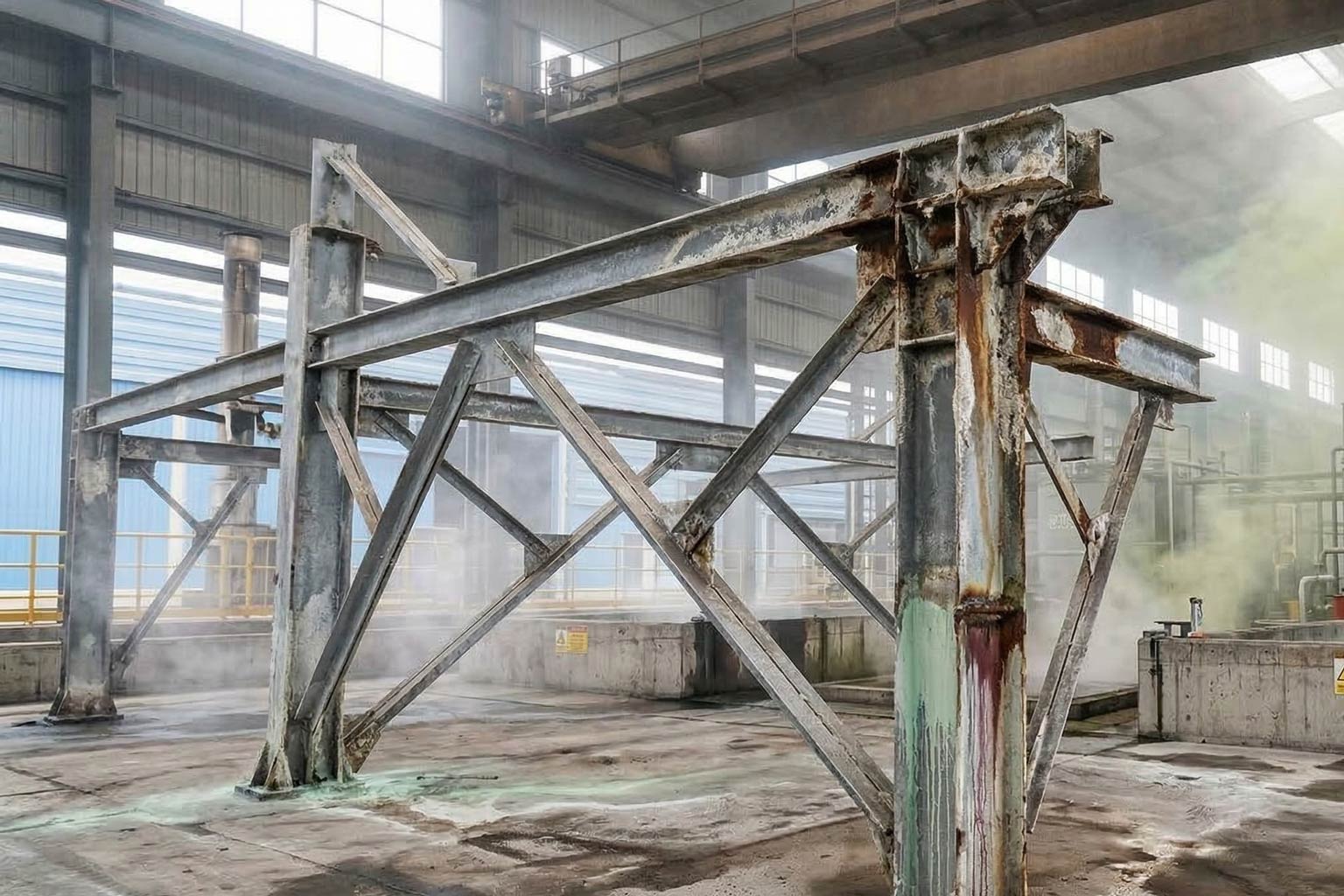
Hot dip galvanized steel performs exceptionally well in many atmospheric environments, but exposure to corrosive chemicals requires a more detailed compatibility assessment. Chemical environments can differ significantly from natural atmospheric exposure, and zinc corrosion behavior changes depending on pH, chemical concentration, temperature, and exposure duration.
The Galvanize It article on corrosive chemicals and galvanizing provides foundational guidance on this subject. Building on that framework, this article examines how zinc reacts with acidic and alkaline solutions, the limitations of galvanizing in chemical immersion environments, and how engineers can evaluate suitability for industrial applications.
How Zinc Reacts in Chemical Environments
Zinc corrosion behavior depends strongly on pH.
In neutral environments, zinc forms stable corrosion products such as zinc carbonate, which slow further corrosion and create a protective patina.
However, in strongly acidic or strongly alkaline environments, corrosion rates can increase significantly.
The general performance profile of zinc relative to pH can be summarized as:
- Good performance in near neutral pH environments
- Increasing corrosion rates in strong acids
- Increased corrosion in high alkalinity solutions
Zinc is amphoteric, meaning it can corrode in both acidic and highly alkaline conditions.
Understanding this behavior is critical when specifying galvanized steel in chemical processing environments.
Acidic Environments
Zinc reacts readily with many acids.
In dilute acidic environments:
- Corrosion may occur at an accelerated but predictable rate
- Thickness loss depends on acid concentration and temperature
In strong acid immersion:
- Rapid zinc dissolution may occur
- Galvanizing may not be suitable without additional protection
Applications involving sulfuric acid, hydrochloric acid, nitric acid, or other strong mineral acids require careful evaluation.
Atmospheric exposure to mild acidic vapors is often less aggressive than full immersion.
Alkaline Environments
Zinc also reacts with strong alkaline solutions.
Highly alkaline environments, such as those containing sodium hydroxide or concrete pore solutions, may increase corrosion rates.
In concrete applications, zinc typically performs well because the reaction products form a protective barrier once initial reactions stabilize.
However, continuous immersion in concentrated alkaline solutions may exceed zinc’s performance limits.
Engineering evaluation should consider both concentration and exposure duration.
Chemical Immersion Versus Atmospheric Exposure
It is essential to distinguish between:
- Splash exposure
- Intermittent wetting
- Continuous immersion
Hot dip galvanizing is most effective in atmospheric and intermittent exposure conditions.
Continuous immersion in aggressive chemical solutions may result in accelerated zinc consumption.
Temperature also plays a critical role. Corrosion rates typically increase as temperature rises.
Designers should evaluate:
- Chemical composition
- Concentration
- Temperature
- Duration of exposure
- Maintenance accessibility
Performance modeling should be based on actual operating conditions.
Industrial Applications
Galvanized steel is commonly used in:
- Wastewater treatment facilities
- Agricultural operations
- Chemical plants
- Pulp and paper facilities
- Industrial processing environments
In many cases, zinc performs well in mildly corrosive atmospheres even when industrial chemicals are present.
Localized chemical splash zones may require additional protection such as duplex systems.
Material selection should align with exposure severity rather than generalized assumptions.
Evaluating Compatibility
When assessing galvanized steel for chemical exposure, engineers should:
- Identify the specific chemical and concentration
- Determine expected exposure type
- Review pH range
- Consider temperature effects
- Evaluate maintenance intervals
Where uncertainty exists, conservative assumptions are recommended.
In some cases, alternative materials or supplemental coatings may be required.
Zinc provides predictable corrosion behavior, but performance must be matched to environment.
Duplex Systems in Chemical Environments
In aggressive chemical atmospheres, a duplex system combining galvanizing and paint may extend service life.
The zinc layer provides sacrificial protection, while the paint layer reduces chemical contact.
This layered protection approach may be appropriate where splash exposure or intermittent chemical contact occurs.
Selection should be based on exposure classification and lifecycle goals.
Hot dip galvanizing performs reliably in many atmospheric and mildly industrial environments. However, exposure to strong acids, concentrated alkaline solutions, or continuous chemical immersion may exceed zinc’s protective capacity. Proper evaluation of pH, concentration, temperature, and exposure duration is essential when specifying galvanized steel in chemical environments. A performance based assessment ensures that corrosion protection aligns with operating conditions.
If you would like to discuss a specific chemical exposure scenario or evaluate whether hot dip galvanizing is appropriate for your project, please reach out through our contact page.
Frequently Asked Questions About Corrosive Chemicals and Galvanizing
Can galvanized steel be used in chemical plants?
Yes, in many atmospheric or mildly corrosive industrial environments. However, compatibility depends on the specific chemicals, their concentration, temperature, and exposure duration. Continuous immersion in aggressive chemicals may require additional protection.
How does pH affect zinc corrosion?
Zinc performs best in near neutral environments. Corrosion rates increase in strongly acidic or strongly alkaline conditions. Because zinc is amphoteric, it can corrode in both extremes of the pH spectrum.
Is galvanizing suitable for acid immersion?
In dilute or intermittent acid exposure, galvanizing may provide reasonable protection depending on concentration and temperature. In strong acid immersion environments, rapid zinc dissolution may occur, making alternative materials necessary.
Does temperature affect zinc corrosion in chemicals?
Yes. Corrosion rates typically increase as temperature rises. Elevated temperatures combined with aggressive chemical exposure can significantly reduce service life.
Can a duplex system improve performance in chemical environments?
Yes. A paint topcoat over galvanizing can reduce direct chemical contact and extend overall service life in aggressive atmospheres.
How should engineers evaluate chemical compatibility?
Engineers should identify the specific chemical, concentration, exposure type, and temperature. Corrosion data and conservative modeling help determine whether galvanizing is appropriate.
Does galvanizing resist alkaline concrete environments?
Zinc generally performs well in concrete because initial reactions form protective corrosion products. However, continuous immersion in highly concentrated alkaline solutions may increase corrosion rates.
Is zinc resistant to all chemicals?
No. Zinc is resistant to many environments but can corrode rapidly in strong acids or highly alkaline solutions. Each application should be evaluated individually.
