

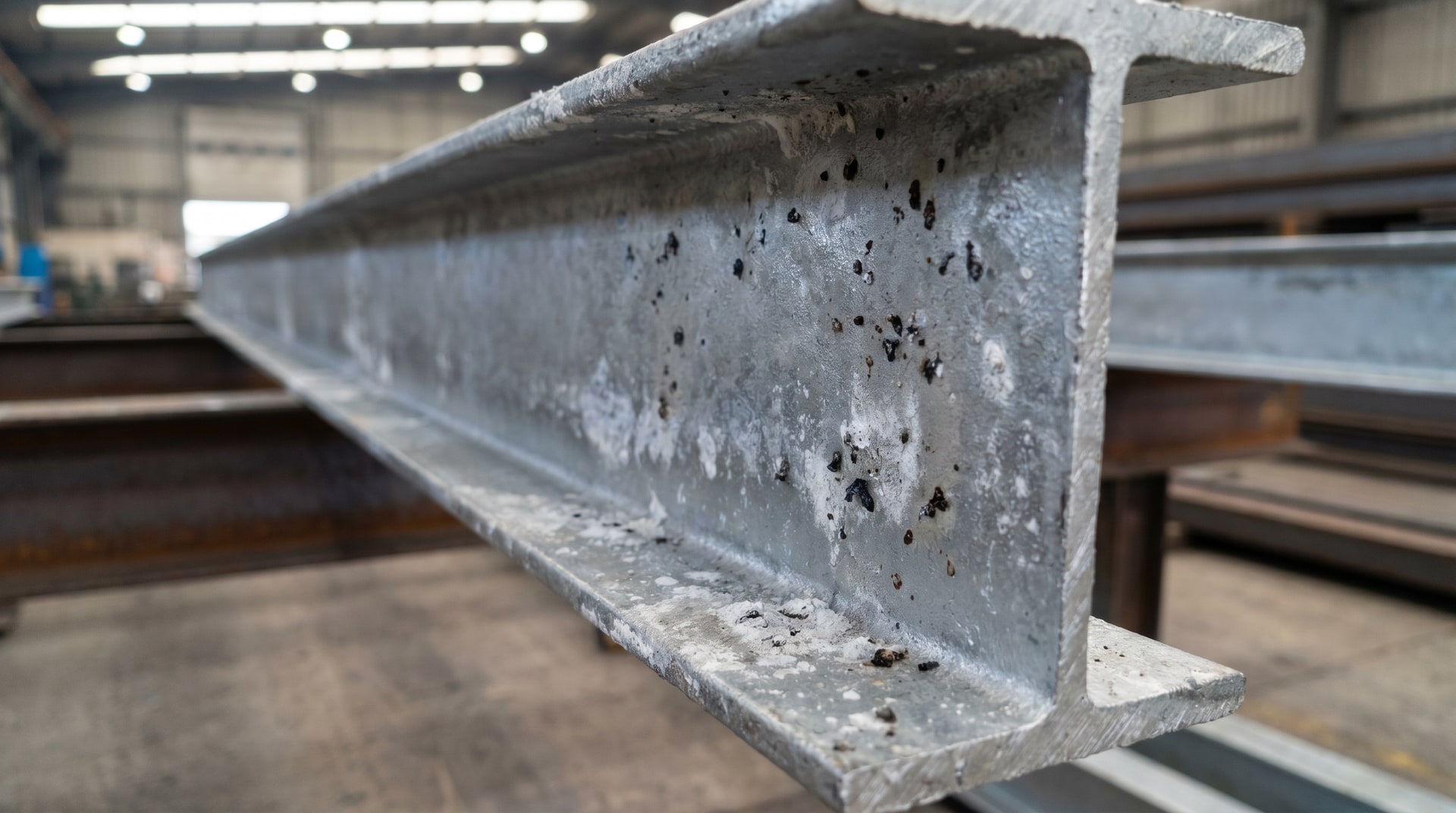
When galvanized steel comes out of the kettle, it does not always emerge with a perfectly uniform, mirror-bright surface. In practice, two specific coating variations show up regularly on finished galvanized work: zinc skimmings and flux inclusions. Both appear as dark or gray deposits on the zinc surface, and both are commonly misidentified as the same thing. They are not. One is a cosmetic nuisance that poses no structural or corrosion risk. The other is a genuine defect that exposes bare steel and, if left in place, creates conditions for accelerated corrosion. Knowing which is which, and what your options are under the governing standard, matters every time you receive or inspect a galvanized order.
Fabricators, architects, and project engineers encounter these surface conditions and often face uncertainty about whether to accept, reject, or simply touch up the affected areas. The distinction is not just visual. It is a material and performance distinction that determines whether a component leaves the galvanizing facility fully protected or with an active corrosion liability built into its surface.
The American Galvanizers Association addresses this directly in their article on inclusions on the galvanized coating. At V&S Galvanizing, we expand on that foundation to explain what is actually happening at the material level, how each type of inclusion influences long-term coating performance, and why the two are so often confused in the field.
How Zinc Skimmings Form During Normal Galvanizing Operations
The galvanizing kettle operates as an open bath of molten zinc held at roughly 830 to 850 degrees Fahrenheit. That exposed zinc surface is in constant contact with air, and the reaction is predictable: zinc oxide particles begin forming almost immediately on the bath surface. This is not a sign of a poorly run operation. It is a normal consequence of the chemistry involved, and every galvanizing line deals with it continuously.
Line personnel manage this by skimming the zinc oxide layer off the bath surface before steel is lowered in. The goal is to allow clean, unobstructed molten zinc to contact the steel. Even with careful skimming, some oxide particles remain. Once steel enters the kettle, the exposed bath surface begins forming another oxide layer around the submerged piece. Some zinc chloride also accumulates in this layer as flux residue evaporates off the steel during immersion. Before the steel is withdrawn, personnel skim the surface again to remove as much of this accumulated material as possible.
The problem arises during withdrawal. As the steel is lifted out through the zinc surface, any skimmings floating on the bath, or trapped beneath flat sections or inside hollow members, can adhere to the freshly formed coating. The result is a deposit of zinc oxide and zinc chloride particles sitting on top of an otherwise intact galvanized surface. These deposits appear black or gray and are often mistaken for bare spots or coating failures.
What the Micrograph Actually Shows About Zinc Skimmings
This is where the metallographic evidence becomes important. When you examine a cross-section of galvanized steel with zinc skimmings under a microscope, you see something that directly addresses the corrosion concern: the intermetallic layers, specifically the gamma, delta, and zeta layers that form through the iron-zinc reaction, are fully intact beneath the skimming deposit. The skimmings sit on top of the free-zinc eta layer, not between the coating and the steel.
What this means in practice is that the galvanized coating formed correctly and completely before the skimmings attached. The steel is not bare. There is no gap in the metallurgical bond. The skimmings are surface contamination on top of a functioning coating system, not evidence of a galvanizing failure. This is a critical distinction that changes the entire conversation about acceptance and rejection.
Because the underlying coating is intact, zinc skimmings do not affect the time to first maintenance of the galvanized article. Weathering will gradually change the surface appearance over time, and visual differences between skimmed and unskimmed areas tend to even out as the coating develops its natural patina. There is no corrosion clock running under the skimming deposit the way there is under a flux inclusion.
The Mechanics of Flux Inclusions and Why They Are Fundamentally Different
Flux inclusions originate at an entirely different point in the galvanizing sequence. Before steel enters the zinc kettle, it passes through a flux bath, typically a zinc ammonium chloride solution. The purpose of fluxing is to prevent oxide formation on the cleaned steel surface during the brief interval between the pre-treatment tanks and the molten zinc. If oxides form on the steel at this stage, they interfere with the iron-zinc metallurgical reaction and produce uncoated spots.
Under normal conditions, flux releases from the steel surface as soon as it contacts the molten zinc, leaving the steel free to react and form the characteristic intermetallic layers. The failure mode occurs when flux does not release. If a patch of flux remains bonded to the steel surface as it enters the kettle, that area is essentially masked. Molten zinc cannot reach the steel, the metallurgical reaction does not occur in that spot, and the result is either no coating or a severely deficient coating directly beneath the flux deposit.
Flux inclusions are composed primarily of zinc chloride, derived from the zinc ammonium chloride flux bath mixture. They also appear black or gray, which is exactly why they are so often confused with zinc skimmings on a casual visual inspection. The similarity in appearance is the core reason this topic requires careful engineering attention. Treating a flux inclusion as if it were a harmless zinc skimming is not a conservative error. It leaves corrosion risk unaddressed.
The Corrosion Risk That Makes Flux Inclusions a Rejectable Defect
Flux inclusions create corrosion vulnerability through two separate mechanisms, and both are active simultaneously once the steel is in service.
The first and most direct problem is the absence of galvanized coating beneath the inclusion. When a flux inclusion is removed, bare steel is exposed. Unlike a zinc skimming, which sits on top of a complete coating, a flux inclusion sits where the coating should have formed but did not. The steel at that location has no zinc protection and no cathodic protection from the surrounding coating beyond a very limited range.
The second mechanism involves the chemistry of the flux material itself. Zinc chloride is hygroscopic, meaning it readily absorbs moisture from the surrounding environment. When flux crystals on the surface absorb atmospheric moisture, rainwater, or condensation, they can produce hydrochloric acid. That acid then attacks both the surrounding galvanized coating and the bare steel beneath the inclusion. The result is localized corrosion that spreads outward from the inclusion site, undermining coating integrity in a radius well beyond the original deposit.
These two mechanisms together mean that a flux inclusion is not a passive blemish. It is an active corrosion site that will deteriorate over time and potentially compromise adjacent coating areas that were otherwise properly formed.
What ASTM A123/A123M Requires When These Conditions Are Found
ASTM A123/A123M is the governing standard for hot-dip galvanized coatings on iron and steel products, and it addresses both conditions explicitly. The language is worth understanding precisely because it determines what a fabricator or specifier can accept, require for repair, or reject outright.
The standard states that upon shipment from the galvanizing facility, galvanized articles shall be free from uncoated areas, blisters, flux deposits, and gross dross inclusions. Zinc skimmings that do not interfere with the intended use of the product are specifically permitted under this framework. Because the steel underneath is protected, acceptance is appropriate and rejection is not required. The standard acknowledges that skimmings are a normal byproduct of the process and do not compromise the coating system's performance.
Flux inclusions fall under a different category entirely. The standard identifies flux deposits as a prohibited condition. Any flux inclusion must be removed from the galvanized coating and repaired in accordance with ASTM A780, the standard governing repair of damaged and uncoated areas of hot-dip galvanized coatings.
Repair is permitted, but within defined limits. Each area subject to renovation must be one inch or less in its narrowest dimension. The total area subject to renovation on any single article cannot exceed one-half of one percent of the accessible surface area to be coated on that article, or 362 square inches per short ton of piece weight, whichever is the lesser value. These limits exist to ensure that repair is genuinely supplemental rather than a substitute for a properly galvanized surface.
When Repair Is Not an Option: Inaccessible Interior Surfaces
The repair provision under ASTM A123/A123M has a hard boundary: the affected area must be accessible. For tubular members, pipe, and similar hollow sections, flux inclusions can form on interior surfaces that simply cannot be reached for repair work. The standard is direct about this scenario. Flux inclusions on the interior of a hollow part that cannot be accessed for repairs must result in rejection of that part.
Rejected parts are not necessarily wasted. Parts rejected for flux deposits may be stripped of their zinc coating entirely and then re-galvanized. Stripping removes the existing coating, cleaning the steel surface back to a condition where the full galvanizing process can be repeated correctly. This is a meaningful distinction from scrapping the material, particularly for fabricated assemblies with significant labor content.
For specifiers and fabricators, this provision has practical implications during design. Hollow sections with restricted interior access carry inherent flux inclusion risk that cannot be remediated short of full re-galvanizing. This is worth considering during fabrication planning, particularly for structural tubular assemblies in aggressive corrosion environments where the full interior protection of the galvanized system is part of the corrosion control strategy.
Process Controls That Reduce Both Types of Inclusions
Neither zinc skimmings nor flux inclusions are entirely preventable, but both can be meaningfully reduced through attentive process management. Understanding the control points helps fabricators and specifiers evaluate the quality systems at a galvanizing operation and have informed conversations about process performance.
Zinc skimmings on finished steel are reduced by limiting splashing during the skimming process itself. Aggressive clearing of the bath surface can redistribute skimmings rather than removing them, and turbulence during withdrawal increases the chance of surface deposits adhering to the steel. Frequent, careful skimming throughout the production cycle keeps the bath surface cleaner and reduces the volume of material available to deposit on outgoing steel.
Flux inclusions are managed at two control points. First, consistent monitoring and maintenance of the flux bath chemistry is essential. A flux bath that has degraded or become contaminated is less effective at releasing cleanly from the steel surface in the molten zinc. Second, aluminum levels in the galvanizing kettle play a role. Aluminum is added to galvanizing baths to improve surface finish and reduce dross formation, but excessive aluminum can interfere with flux release. Monitoring aluminum concentration is therefore part of the flux inclusion prevention picture.
At V&S Galvanizing, process control is not incidental to quality. Our hot-dip galvanizing operations are managed with attention to bath chemistry, skimming protocols, and flux system maintenance because surface quality problems are significantly easier to prevent than to remediate after the fact.
Practical Inspection Guidance for Field Personnel
For anyone receiving and inspecting galvanized steel, the visual similarity between zinc skimmings and flux inclusions creates a real inspection challenge. Both appear as dark gray or black deposits on the zinc surface. Both can be found on flat plate, structural shapes, and tubular sections. The surface appearance alone is not sufficient to differentiate them reliably.
The distinguishing test is mechanical removal. When a zinc skimming deposit is scraped or brushed away, the surface beneath reveals an intact galvanized coating. The zinc surface is present and continuous. When a flux inclusion is removed, bare steel is exposed at that location. The steel may show discoloration, but there is no zinc coating underneath. This simple test, careful mechanical removal and examination of what lies beneath, is the definitive field differentiation method.
Inspection should also take note of location. Flat horizontal sections and the interior surfaces of closed sections are higher-risk locations for both types of inclusions. Flux inclusions on accessible exterior surfaces fall under the ASTM A123/A123M repair provisions. Those on inaccessible interior surfaces trigger rejection. Knowing which surfaces can be reached for repair informs the inspection decision immediately.
Work With a Team That Understands the Material, Not Just the Process
The difference between zinc skimmings and flux inclusions is not a technicality. It is a material distinction that determines whether a galvanized component is performing as designed or carrying a hidden corrosion liability into service. Engineers and fabricators who understand the distinction are better equipped to make sound acceptance decisions, specify appropriate inspection criteria, and hold galvanizing operations to the right standard without over-rejecting acceptable material or under-rejecting genuinely deficient work.
ASTM A123/A123M provides the framework, and it is a reasonable one. Skimmings that do not interfere with intended use are acceptable because the corrosion protection is intact beneath them. Flux inclusions are not acceptable because they represent gaps in that protection, gaps that become active corrosion sites once the steel enters service. The standard's repair and rejection provisions reflect exactly this logic.
Our team at V&S Galvanizing works directly with fabricators, engineers, and project teams to navigate these questions before, during, and after production. If you are dealing with a coating inspection question, have concerns about surface conditions on a galvanized order, or want to discuss how process controls affect surface quality on your specific project, reach out through our contact page and we will get you the right answers.
